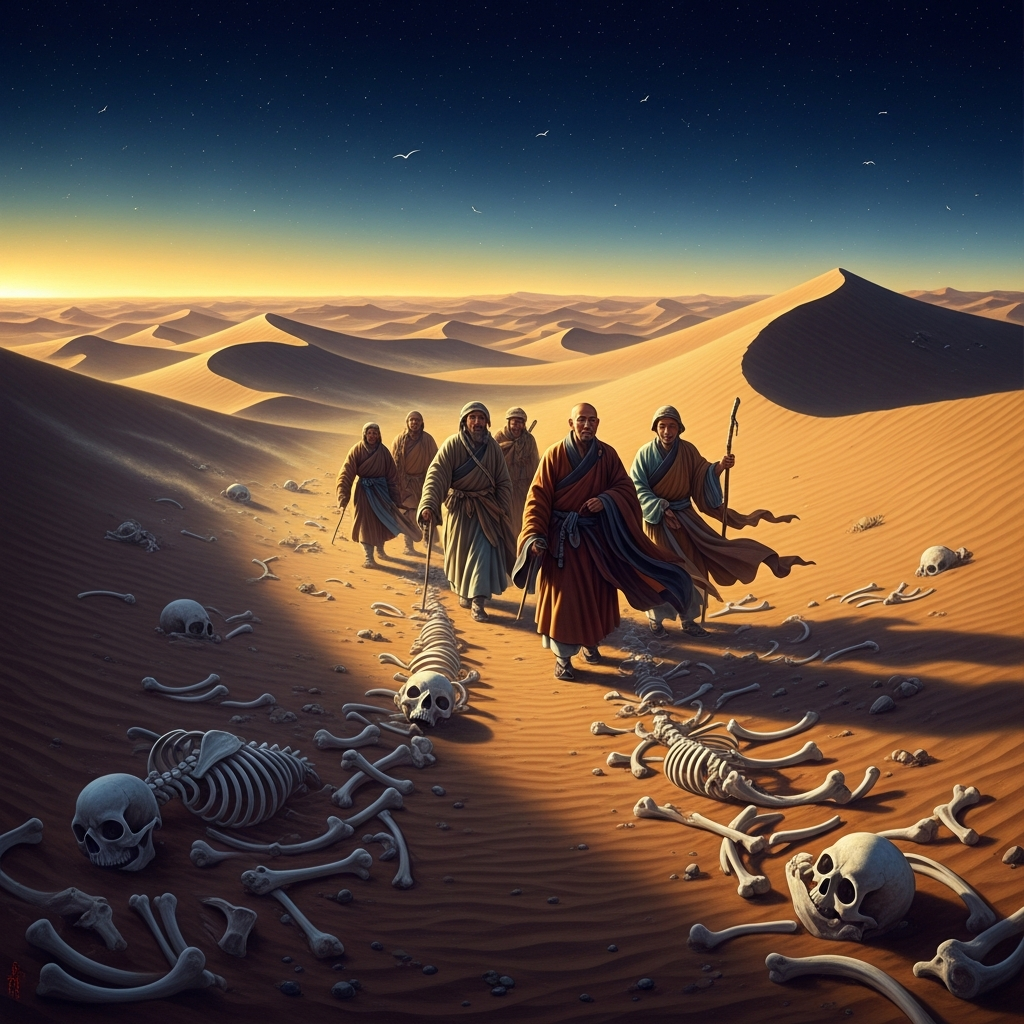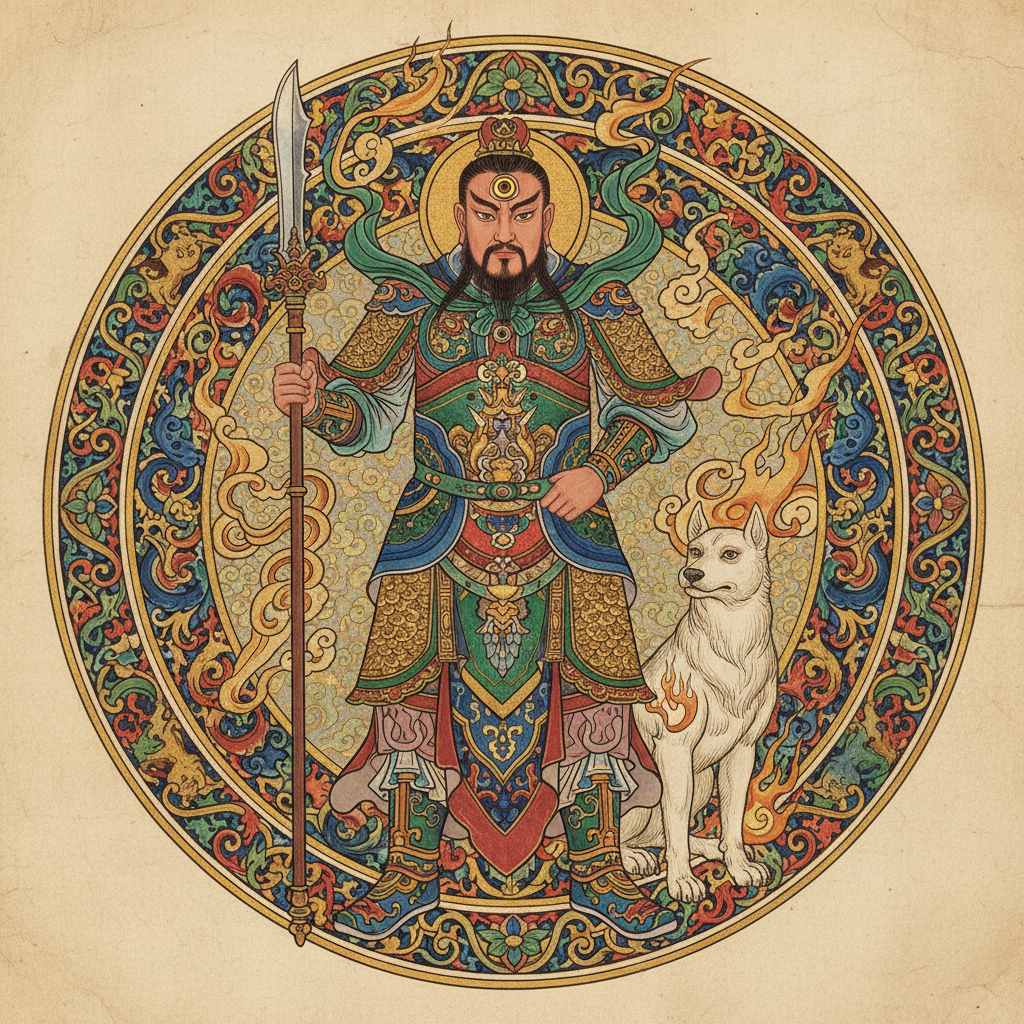
The Monkey King Demands Heaven's Acknowledgment
Mythic time; Journey to the West compiled by Wu Cheng'en, c. 1592 CE · Flower-Fruit Mountain; the Jade Emperor's Celestial Court; Five Elements Mountain
Contents
Sun Wukong, having already achieved immortality, mastered the seventy-two transformations, and erased his name from Death's ledger, decides he deserves the title Great Sage Equal to Heaven. Heaven disagrees. He wages war against the celestial army. Laozi's furnace gives him eyes of gold. It takes the Buddha himself to stop him — trapping him under a mountain with an open palm for five hundred years, from which the only release is agreeing to protect a monk walking west.
- When
- Mythic time; Journey to the West compiled by Wu Cheng'en, c. 1592 CE
- Where
- Flower-Fruit Mountain; the Jade Emperor's Celestial Court; Five Elements Mountain
The stone opens and he is already standing.
This is the first thing the novel tells you about Sun Wukong: he does not emerge from the cosmic egg in the ordinary way, does not crawl out blinking and helpless the way birth usually works. He was inside a stone on the summit of Flower-Fruit Mountain for as long as the stone needed to crack, absorbing the light of the sun and moon and stars, and when the stone cracks he stands up in the gap and announces himself with a howl. His eyes, at this moment, emit beams of light that reach the Palace of the Jade Emperor.
The Jade Emperor’s first response to this is to look out the window and note it and return to his administrative duties.
This is a mistake he will spend the next several chapters paying for.
The Monkey King earns his immortality. He does not inherit it or receive it as a gift. He locates an immortal, the Taoist master Subodhi, and he learns: the thirty-six minor transformations, then the seventy-two major transformations — every form a living thing has worn, from gnat to thundercloud, his to inhabit as easily as a change of posture. He learns the cloud-somersault, a single leap covering one hundred and eight thousand li, which the text provides specific math for and which equals approximately fifty-four thousand kilometers, which is roughly the circumference of the earth, which means a single somersault covers the distance from any point on the earth to that point again. He learns not to die.
Then he asks one question in the wrong social context — he is in class, he shows off for the other students — and Subodhi sends him home. But home now is different. He knows things that no one on Flower-Fruit Mountain knows. He has the kind of knowledge that produces a specific problem: what do you do with it?
He goes to the Dragon King of the Eastern Sea and relieves him of the Ruyi Jingu Bang — the As-You-Will Golden-Banded Staff, thirteen thousand five hundred jin of black iron with gold bands at each end, the measuring rod used to calibrate the depths of the primal ocean, which resizes to whatever he needs it to be and can be kept behind his ear as a needle. He also takes armor from three more dragon kings. He walks into the underworld and erases his name from the Book of Death. He is now, in any practical sense, unkillable, unageable, and definitionally outside the Jade Emperor’s jurisdiction.
The Jade Emperor’s response to this second set of reports is to offer him a job.
Bi Ma Wen. Keeper of the Heavenly Horses.
The novel delivers this with the specific timing of a punchline delivered by someone who knows how this ends. The celestial bureaucracy has decided the best way to manage this impossible monkey is to absorb him into the hierarchy. This is how the celestial hierarchy has managed every disruptive force since its foundation: give it a title, put it in an office, keep it busy with paperwork. The monkey, who has mastered immortality and erased himself from death’s ledger, is assigned to muck out the Jade Emperor’s stables.
He discovers the job’s actual rank two weeks into the posting. The Jade Emperor’s classification system for divine positions runs from nine grades downward, each grade with two sub-grades, and then below that, the unranked positions that are too minor for a grade number. Bi Ma Wen is unranked.
He leaves without giving notice. He returns to Flower-Fruit Mountain. He manufactures a title.
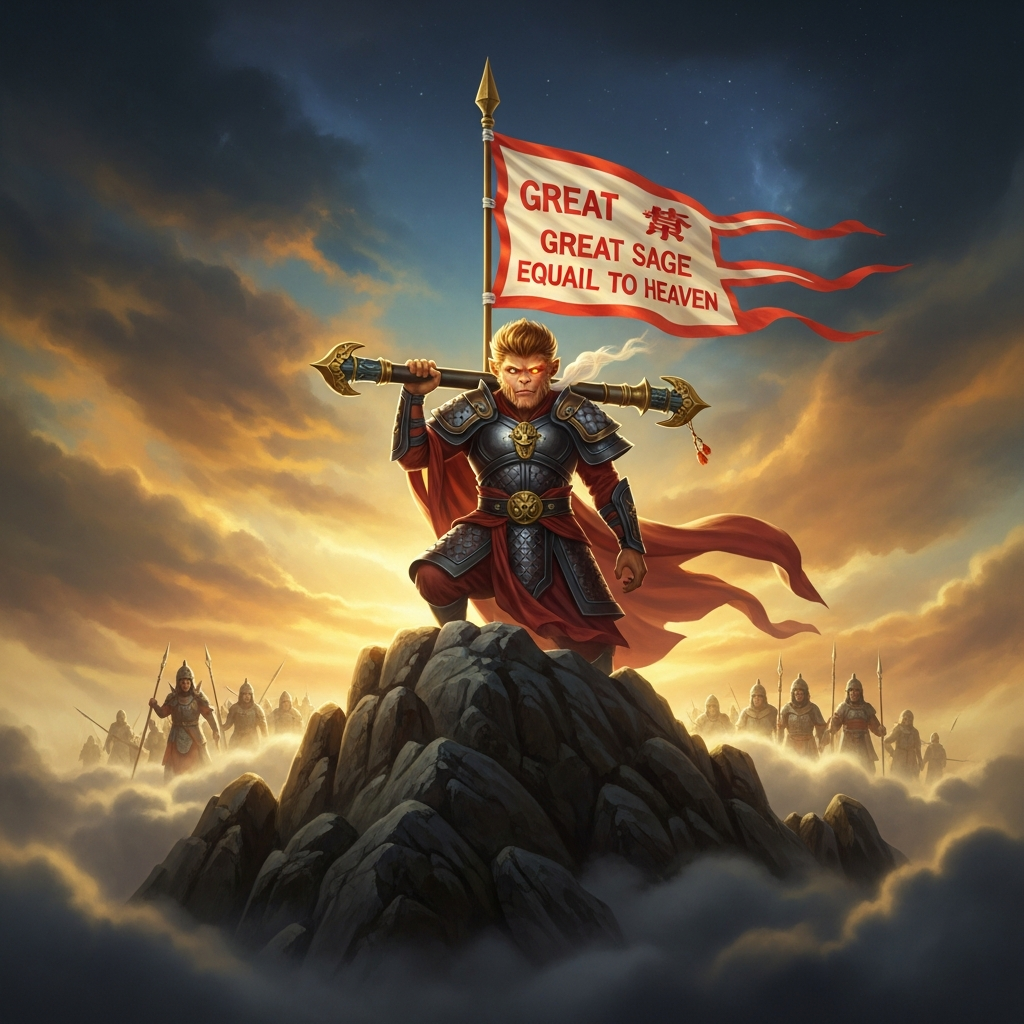
GREAT SAGE EQUAL TO HEAVEN. He has a flag made. He plants it on the summit. He tells every demon and monkey in his territory that this is now what he is.
The Jade Emperor sends an army.
The army is commanded by the Heavenly King Li Jing and his son Nezha — the lotus-born warrior, a formidable fighter who has never lost a significant engagement. Nezha fights Sun Wukong for three days. The celestial army numbers one hundred thousand. Sun Wukong fights them all. The army cannot subdue him.
The Jade Emperor’s next minister meeting produces the decision that defines the novel’s moral structure: give the monkey the title. Not the real thing — not actual governance, not actual equality, not a seat at any meeting where anything is decided. Give him the title and a building and a salary and no responsibilities. He wants acknowledgment. Give him the word without the substance.
It works. For a while, it works.
He receives the Great Sage Equal to Heaven designation, a pavilion, and an invitation to circulate in celestial society. He makes friends with the gods of the five directions. He plays chess. He drinks.
Then he is not invited to the Peach Banquet.
Xi Wang Mu — the Queen Mother of the West, keeper of the Peach Garden where the immortality peaches ripen every three thousand years — holds the great celestial feast. Every significant god in the hierarchy is invited. The celestial guest list is a political document as much as a social one: who is invited to the Peach Banquet is who matters in heaven.
The Great Sage Equal to Heaven is not on the list.
He goes to the garden himself. He eats the peaches — the ripest ones, the ones that take nine thousand years to mature. He eats so many that the garden is stripped. He wanders into Laozi’s Tushita Palace and drinks the five gourds of immortality elixir that Laozi has been aging for private divine use. He wanders into the feast itself and eats what remains.
He is now immortal in so many different ways and from so many different sources that the celestial pharmacopeia has no category for what has happened to him. He is also, in any reasonable accounting, the most impulsive and dangerous being in the cosmos.
The Jade Emperor’s court barricades the inner halls and sends for the best warrior in heaven. Erlang Shen — the third-eye warrior, the divine general who has never lost — arrives and fights Sun Wukong in a shape-shifting battle that makes the weather impossible for days: each combatant transforms into birds, fish, insects, architectural features, landscapes, each form countering the previous one in a chain of metamorphoses that reads as two very clever beings arguing in the grammar of living things. It ends, essentially, in a draw close enough for Laozi to knock Wukong unconscious from above with his diamond bracelet.
They cannot kill him. They have tried everything available.
Laozi suggests the furnace.
The Bagua Furnace — eight chambers corresponding to the eight trigrams of the I Ching, each burning at a different divine temperature, the device Laozi uses to refine his immortality elixir over years of careful tending. The proposal is to use it differently: seal the monkey inside and run the furnace for forty-nine days at maximum temperature. He has consumed the elixir; the furnace should be able to reduce the consumed elixir back to its component elements. This should, in theory, destroy what could not be killed by sword or lightning.
They seal him in. Forty-nine days pass. The celestial court waits.
What they have not accounted for is the wind chamber.
The Bagua Furnace’s structure includes a xun position — the fourth trigram, corresponding to wind — which produces a gap in the fire pattern. Sun Wukong, sealed inside a furnace hot enough to refine divine elixir, locates the gap in the fire and shelters in it. The fire cannot reach him in the wind corner. What it can reach is his eyes.
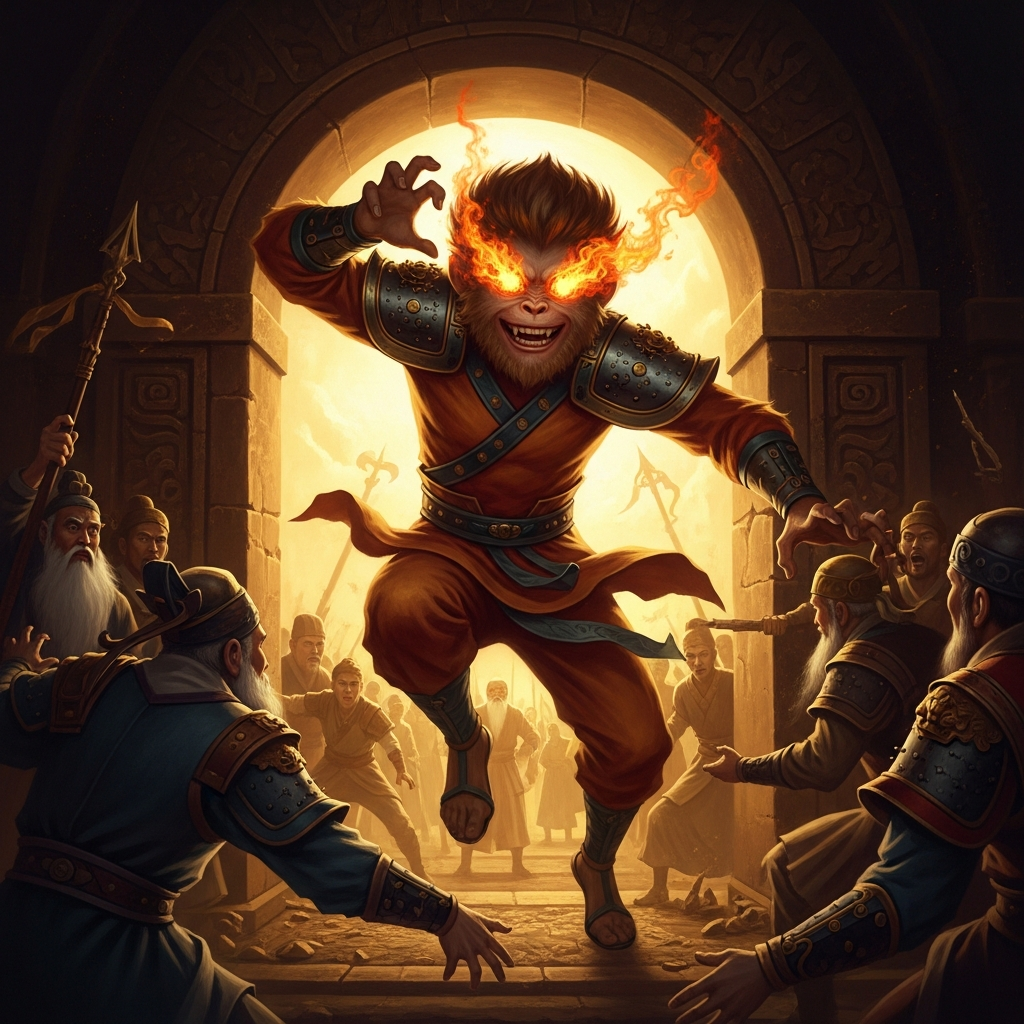
For forty-nine days, divine smoke and divine flame work on what they can reach. When Laozi opens the lid on the forty-ninth day, Sun Wukong leaps out with eyes transformed: huoyan jinjing, eyes of fire and gold, the Fiery Golden Eyes that will see through every illusion, every disguise, every demon in human form, for the rest of his existence. The furnace designed to destroy him has instead given him a power he did not have before.
He hits Laozi. He fights the entire celestial court. The court routes.
The Jade Emperor and his court are hiding in the innermost chambers of heaven. They send a message to the Western Paradise.
The Buddha arrives without an army.
He arrives as someone who has already solved the arithmetic of the situation and found it insufficient. He listens to the Jade Emperor’s accounting of events — the stable, the flag, the title, the peaches, the elixir, the routing of heaven — with the attention of a being who is not learning anything new about the problem, because the problem is one the Buddha has been thinking about for a long time.
He goes to find the monkey.
The negotiation is brief. Sun Wukong makes his case: he has done everything that the Jade Emperor has done and several things the Jade Emperor has not, specifically including surviving Laozi’s furnace, and the criterion for heavenly sovereignty has never been explicitly stated as anything other than power, and by the criterion of power he is the superior candidate. He would like heaven.
The Buddha makes a bet. If Sun Wukong can somersault out of his open palm, heaven is his.
Sun Wukong looks at the palm. The palm is the size of a hand. He agrees.
He leaps. He travels. He travels past clouds and star-fields and the dark between the stars and the dark past the dark. He finds five great pillars of pink-red stone at what he takes to be the edge of existence. He has gone far enough. He writes his name — Great Sage Equal to Heaven was here — on the largest pillar in characters readable across a room. For bureaucratic completeness, he adds a yellow mark at the pillar’s base.
He somersaults back. He lands in the Buddha’s palm and reports.
The Buddha raises his hand.
On the middle finger, in Sun Wukong’s own handwriting, is the inscription. The yellow mark is at the base of the finger. The five pillars of the universe’s edge were the Buddha’s five fingers.
He never left the palm.
The hand closes. The fingers become five mountains — Metal, Wood, Water, Fire, Earth, the Five Elements Mountain — and the mountains press down. Sun Wukong is pinned beneath them, his head and hands exposed, the weight of five mountains on his shoulders and back. The seal placed on the summit reads: Om Mani Padme Hum.
He cannot move. He cannot die. He can shout.
He waits.
He waits for five hundred years, which in the logic of the novel is the exact amount of time required for a monk named Xuanzang to be born in the Tang dynasty, to be commissioned by the Emperor Taizong, to accept a divine mission to retrieve Buddhist scriptures from the Western Paradise, and to walk west out of Chang’an into the wilderness with no weapon and no power and no plan for the vast and dangerous journey ahead.
The monk arrives at the mountain. He reads the seal. He does the thing that releases Sun Wukong from the mountain. He accepts the monkey’s company and his protection.
The Monkey King descends from the mountain, shakes off five centuries of stone dust, and picks up the Ruyi Jingu Bang from behind his ear where he has been keeping it since the celestial court last saw it. He is the same. He is exactly the same. The five hundred years did not change him.
He is now, for reasons involving a gold headband the monk places on his head and a spell attached to it, committed to the journey west. He will fight demons across fourteen years and ten thousand miles. He will protect the monk who freed him with all the power he developed on Flower-Fruit Mountain and everything the Bagua Furnace added to it.
He will still be the most powerful being in any room he enters. He will still be unable to let a wrongness go unchallenged. He will still be certain, bone-deep, that he was right about the stable.
He was right about the stable. He was right about the peaches. He was right that Equal to Heaven means something.
He was wrong only about one palm, measured against the universe. That is enough, the Buddha suggests, to teach a stone monkey the one thing immortality and the seventy-two transformations cannot teach: that there are spaces too large for the fastest leap, and they do not look like the sky.
They look like an open hand, extended in what appears to be generosity.
The mountain held him for five hundred years. The mantra sang over his head like a lullaby he could not unhear. And when he came out — when he finally agreed to the terms of the release — he went west, and he was still himself, and the story the novel is actually interested in was just beginning.
Scenes
Sun Wukong on Flower-Fruit Mountain, his flag planted in the summit stone: GREAT SAGE EQUAL TO HEAVEN in red characters
 Generating art…
 The Bagua Furnace of Laozi opened after forty-nine days — and Sun Wukong leaping out from the wind chamber, his eyes transformed into burning gold by weeks of divine smoke, the fiery golden eyes that will see through every illusion for the rest of his existence
 Generating art…
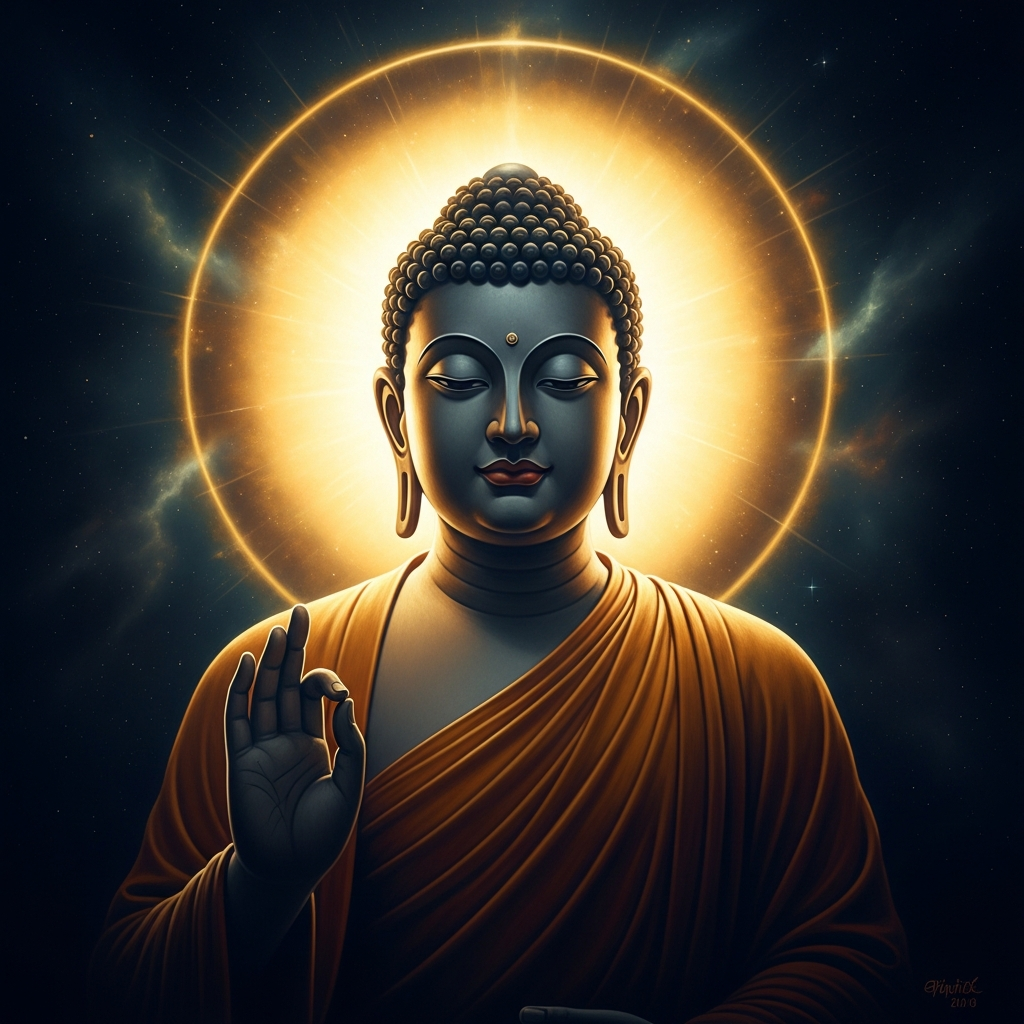
 The Buddha's open palm becoming Five Elements Mountain — the five fingers solidifying into five stone peaks, pinning Sun Wukong beneath them with his head exposed, the seal OM MANI PADME HUM pressed into the summit stone in golden characters
 Generating art…
 Echoes Across Traditions
Entities
- Sun Wukong
- Jade Emperor
- Laozi
- Erlang Shen
- The Buddha
- Tang Sanzang

Sources
- Wu Cheng'en, *Journey to the West* (Anthony C. Yu trans., University of Chicago Press, 4 vols., 1977-1983)
- Arthur Waley (trans.), *Monkey: Folk Novel of China* (George Allen and Unwin, 1942)
- Whalen Lai, 'From Protean Ape to Handsome Saint: The Monkey King,' *Asian Folklore Studies* 53.1 (1994)
- Anne Birrell, *Chinese Mythology: An Introduction* (Johns Hopkins University Press, 1993)
- Timothy Richard (trans.), *A Mission to Heaven: A Great Chinese Epic and Allegory* (Christian Literature Society, 1913)