The Yellow Emperor Defeats Chi You
Mythic Time · Yellow Emperor reign traditionally dated ~2697–2597 BCE · The Plain of Zhuolu · modern Hebei Province
Contents
At the primordial Battle of Zhuolu, the Yellow Emperor Huangdi faces Chi You — iron-headed, stone-stomached, eighty-one brothers of bronze and blood — in the fog that erases all direction. He invents the compass to navigate it. He summons the Drought Goddess to burn it away. Chi You falls, and from his blood grows a red lacquer forest. This is the battle that creates the Han people.
- When
- Mythic Time · Yellow Emperor reign traditionally dated ~2697–2597 BCE
- Where
- The Plain of Zhuolu · modern Hebei Province
The fog is not weather.
Weather is indifferent. It does not choose targets. It does not discriminate between armies. This fog comes from Chi You’s mouth — he and his eighty-one brothers breathe it out in shifts, iron lungs compressing stone air into a mist so dense that Huangdi’s soldiers cannot see the soldiers next to them, cannot see the ground beneath them, cannot see the sun, cannot find north, cannot find south, cannot find the direction of the enemy or the direction of home.
Chi You has used this before. It is his most reliable tactic. An army that cannot orient itself cannot fight; an army that cannot fight defeats itself. He has eighty-one brothers with iron heads and stone stomachs who eat metal ore and gravel and who do not need to see to kill. They know where they are. He gave them the fog and they navigate it by smell and vibration and the iron-sense that comes from having iron in your body rather than mere flesh.
Huangdi’s army on the plain of Zhuolu is forty thousand people who have stopped being able to move.
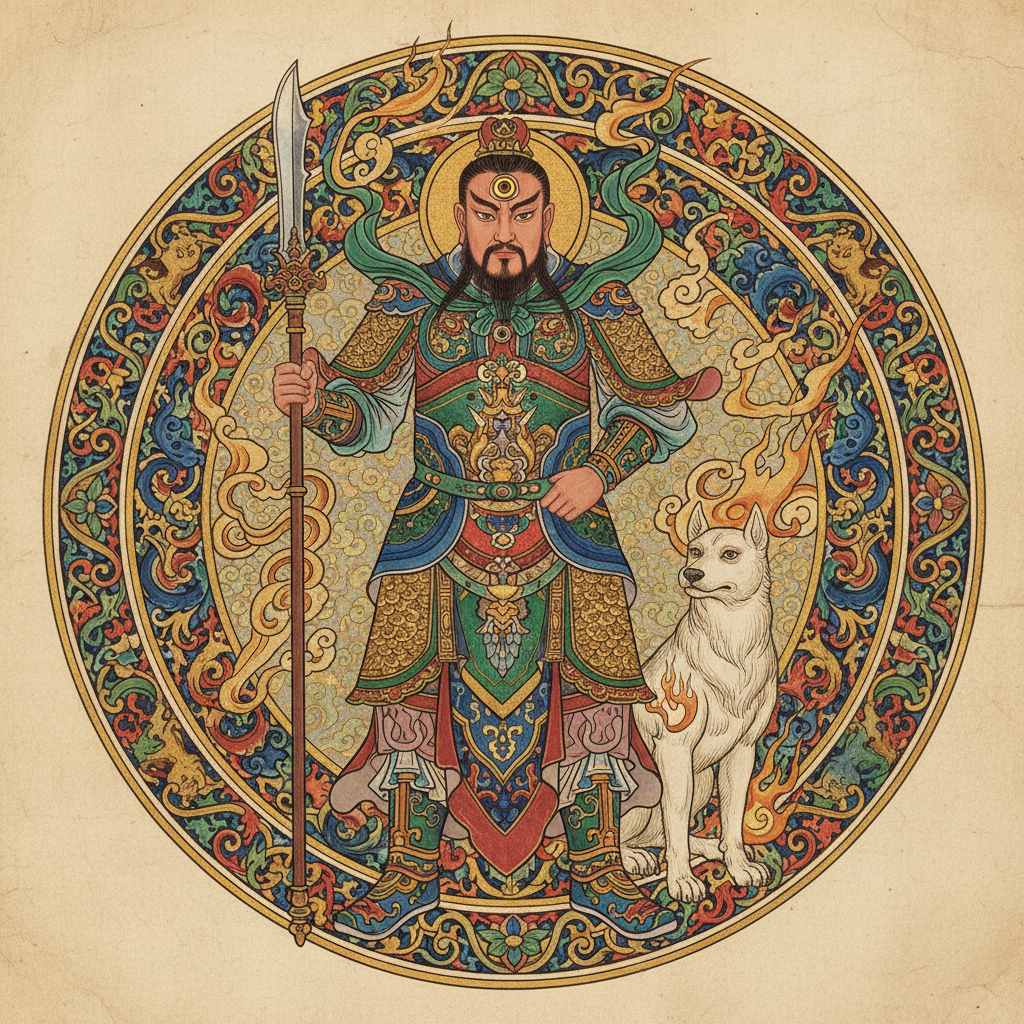
Huangdi is not, in the mythological accounting, a god before the battle. He is something harder to name: the most excellent of the clan leaders, the man who has united the Yandi tribes of the Yellow River valley, who has organized the farmers and the jade-workers and the silk cultivators and the healers into something that functions like a state before states have a word. His wife Leizu discovered silk when a cocoon fell into her tea. He himself invented or sponsored the invention of the wheel, of writing, of the calendar, of music’s mathematical relationship to the physical world, of medicine’s relationship to the body’s meridians. He is the Yellow Emperor because he is yellow — the color of the central earth, the color of the loess plateau, the color of the soil that his people farm — and he is already more than a man in the sense that he carries the civilization in his person, the way a seed carries a forest.
He has not, until this moment on the plain of Zhuolu, encountered anything that cannot be defeated by administration.
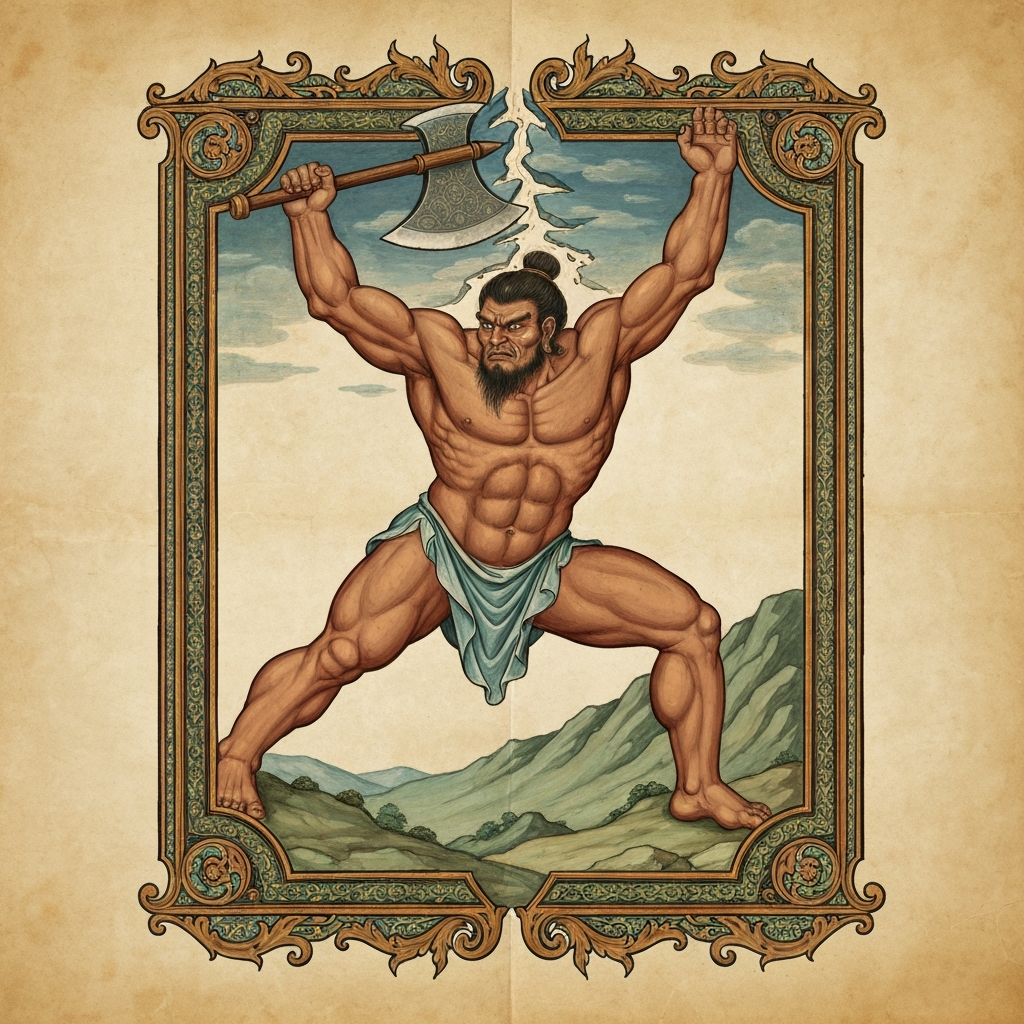
Chi You cannot be administered. Chi You is from a different time and a different metal. He is the war-leader of the Li and Miao peoples of the south and east, and his eighty-one brothers are either warriors or the number of varieties of warfare he commands — the sources are not always clear, and this ambiguity is itself informative. He has the head of a man and the horns of a bull. He has the body of a man and the hooves of a beast. He forges weapons from bronze and iron in his own furnaces and his soldiers carry things that Huangdi’s farmers have never seen and do not know how to answer.
And he can make fog.
Huangdi sits in his chariot in the fog and does what he always does when a problem cannot be solved with existing tools: he invents the missing tool.
The south-pointing chariot — zhi nan che — is the first compass in any civilization’s history, and Huangdi does not have time to give a proper account of its mechanism to his generals because the fog is closing and the army is dissolving into directionlessness. The chariot carries a bronze figure on a pole — a figure with an arm extended, and the arm always points south, regardless of which direction the chariot turns. The mechanism the ancient texts describe is a differential gear system, which the Yellow Emperor either invents in a morning of brilliant necessity or receives from a deity who arrives for exactly this purpose, depending on which source you prefer.
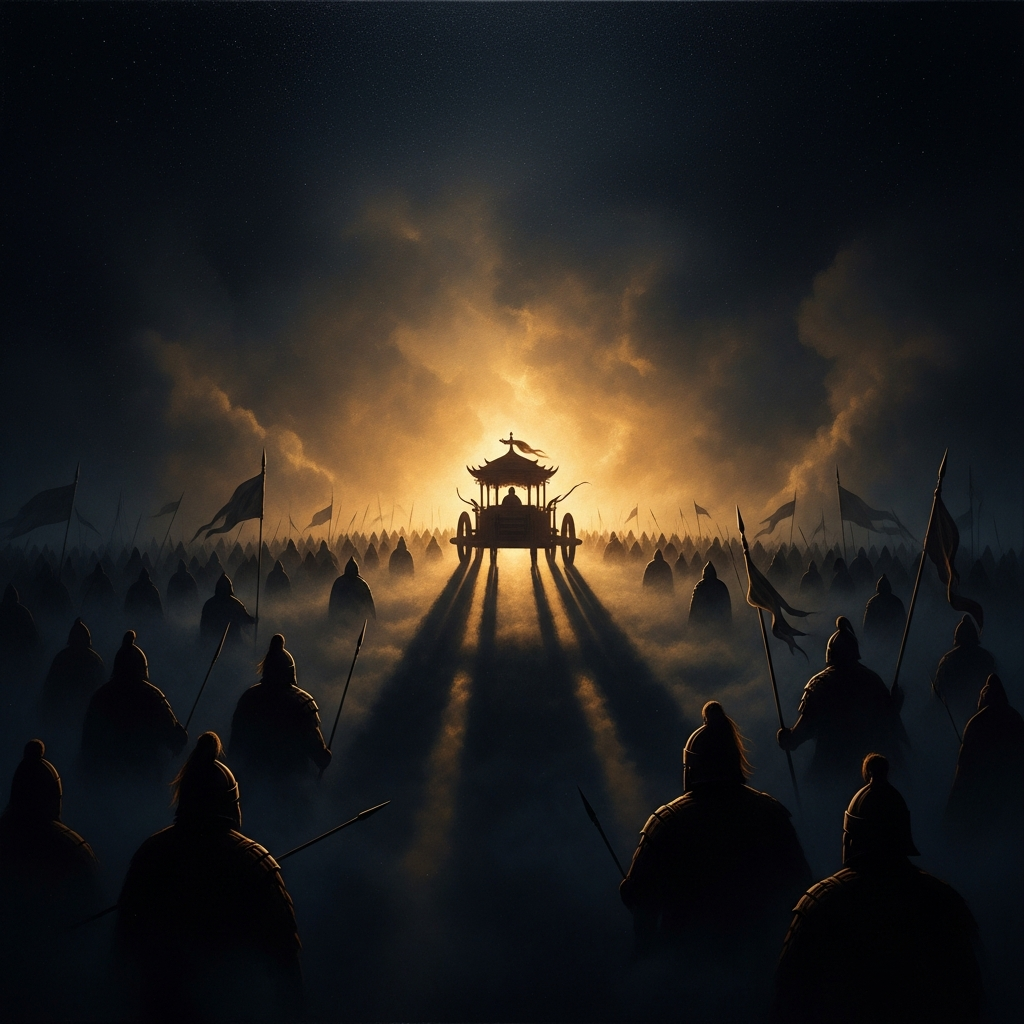
The army forms up around the south-pointing chariot. The figure’s arm points south. North is behind them. East is left. West is right. They are lost in a fog they cannot see through and they have just become unlosable.
This is the moment that the tradition remembers as the pivot. Not the killing of Chi You, not the final victory, but the chariot in the fog: the human mind creating orientation out of disorientation, refusing to accept the chaos-conditions as permanent, building a tool that makes the fog irrelevant.
Chi You, watching from somewhere in the fog with his iron senses, understands that the battle has changed. He does not retreat. He is not the retreating type. He increases the fog.
Huangdi calls for Ba.
Ba is his daughter — or the daughter of heaven, or both, depending on the source — and she is the Goddess of Drought. She lives in the north, where the air is so dry it cracks skin and kills grass and turns soil to powder. She does not travel willingly. She knows what happens when she travels: the land beneath her feet loses its moisture, the clouds flee her presence, the water recedes from wherever she stands. She is not malicious. She is simply what she is, and what she is is incompatible with rain, with rivers, with mist.
With fog.
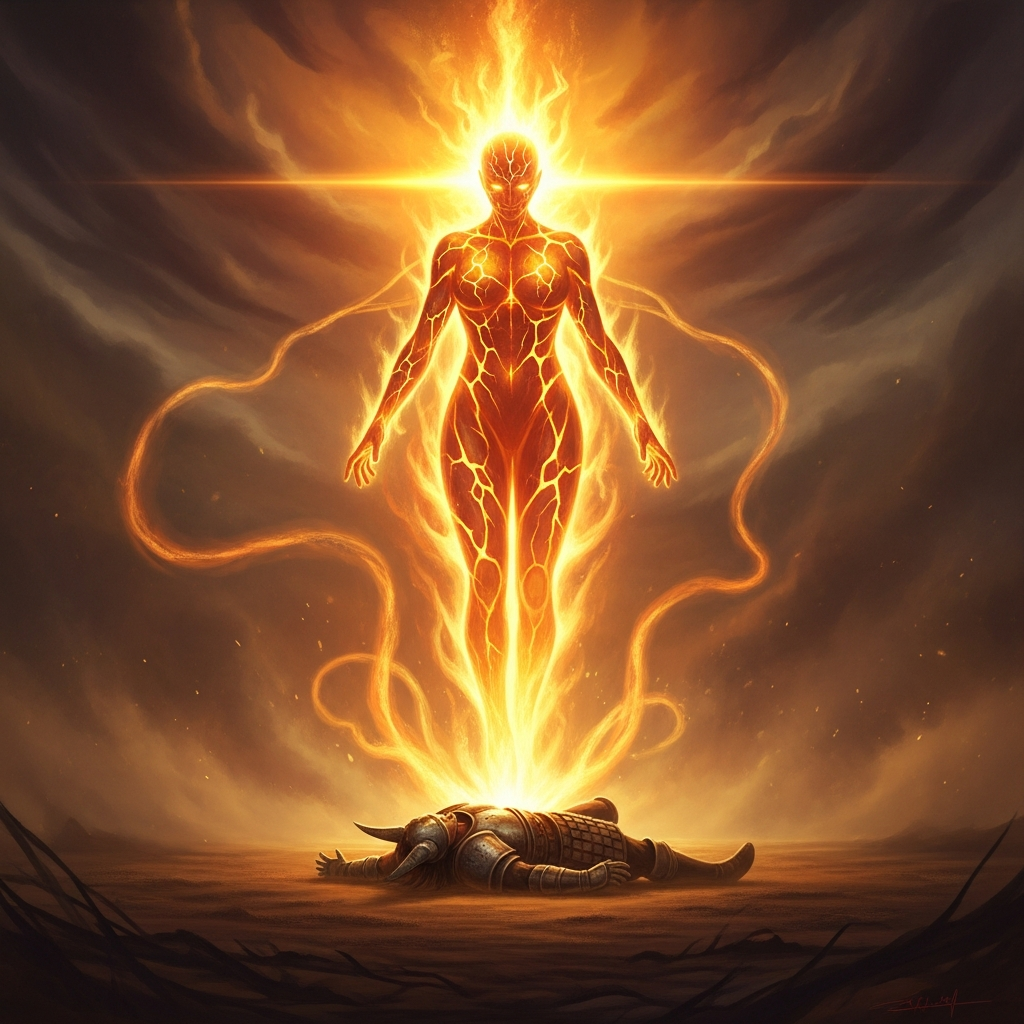
She descends to the plain of Zhuolu like a sun that has decided to land.
The fog burns. Not in the way fire burns — there is no flame, no smell of smoke, no scorched aftermath. The moisture simply leaves. The particles that Chi You and his brothers have breathed into the air find themselves in the presence of something that unmakes wet, and they dissolve into dry, and the plain emerges from the mist like a painting emerging from a grey wash when the background is removed.
Chi You is suddenly visible.
He is enormous. His iron head catches the light of the recovered sun like a beacon. His brothers — however many of them there are, the eighty-one arranged in their battle formations — are equally visible, equally iron, equally no longer concealed. They are formidable. They are, in the clear air, genuinely terrifying. But they are no longer hidden, and an army that cannot hide has already lost its best argument.
The battle that follows is loud enough to be heard in several surviving texts from the Zhou dynasty, each describing it differently. The details they agree on:
Chi You’s iron head cannot be cut. His stone stomach cannot be pierced. The weapons that worked against the Yandi tribes are insufficient. Huangdi’s dragons — he has trained dragons, which is one of the advantages of being the Yellow Emperor — tear at Chi You’s brothers, and the drums of war sound across the plain, and the battle goes on through a day and a night.
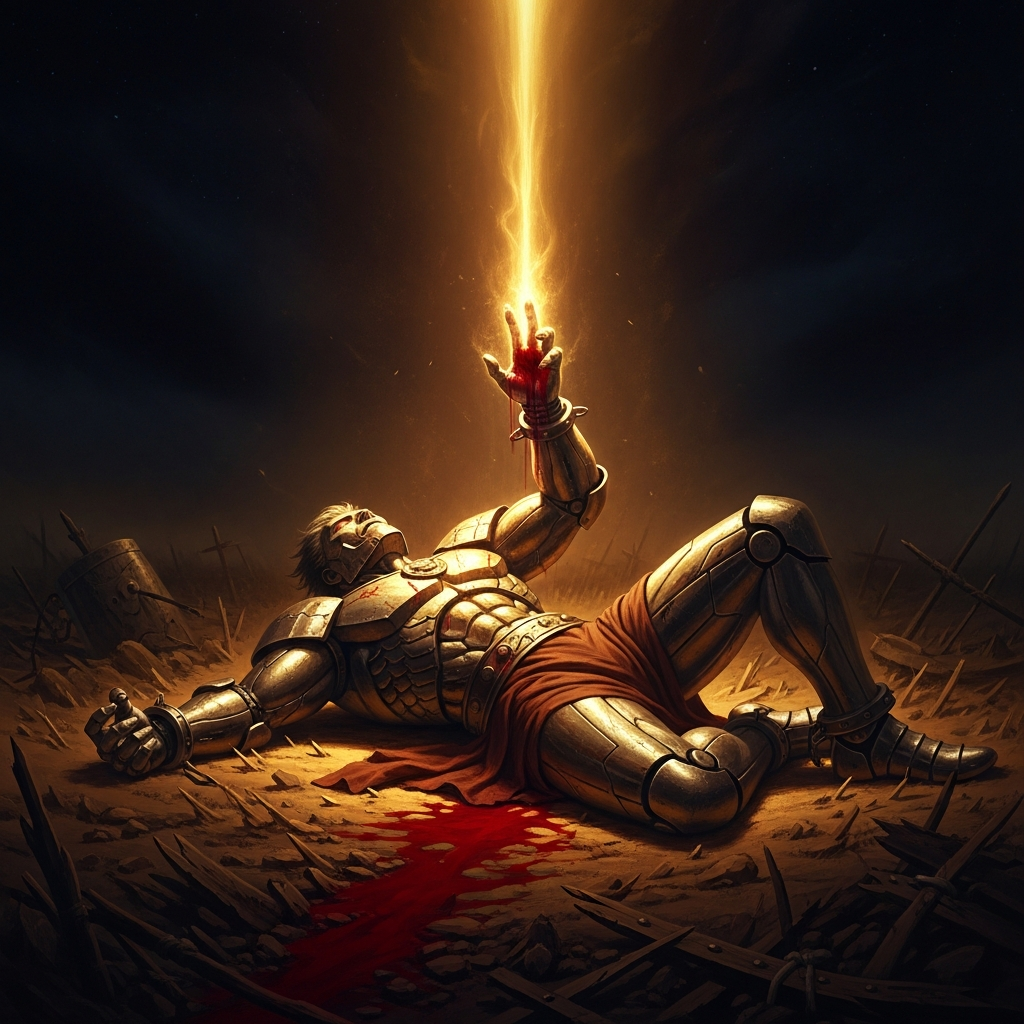
Chi You is captured, not killed. He is bound with restraints specifically made for him — because ordinary rope cannot hold iron — and he is brought before Huangdi. He does not beg. He does not argue. He accepts his end with the dignity of a being who has always known that the fog was his one advantage and that advantage has been solved.
He is executed on the plain.
His blood goes into the earth immediately — red, brighter red than ordinary blood, the red of ore, the red of forge-heat — and where it pools and spreads across the trampled ground, something grows within a generation. A forest of lacquer trees, their sap the same red as Chi You’s blood, their bark scarlet in autumn, their wood the color of the battlefield at the moment the fog cleared and the iron head caught the sun.
The Chi You Forest. It is there, the sources say, so that the earth does not forget.
Ba cannot go home.
This is the cost that the myth records without apology: after the battle, Ba’s drought-power is spent in Zhuolu, and she cannot return to the north where she belongs. She stays in the middle of the world and wherever she walks, the rain will not follow. She is the Yellow Emperor’s victory condition and his war crime simultaneously — a goddess displaced, a landscape permanently changed, the drought that followed Chi You’s defeat spreading out from the plain like a debt that has not been repaid.
Huangdi returns to his civilization, which is now the civilization. He will reign for a hundred years, in the tradition’s accounting, and teach the people medicine and music and the thirty-six stratagems and the calendar of heaven. He will ascend in a dragon eventually, spiraling up from a yellow mountain with seventy courtiers beside him. His reign will become the Year Zero from which all Chinese calendars are counted.
But Ba walks the middle of the world, dry-footed, unable to go home, her presence felt in every drought that empties the Yellow River, every summer that fails to bring rain, every harvest that comes in thin. The people pray to her, sometimes, in their prayers for rain — not asking her to stop but asking the sky to overpower her, to send enough water that even the drought goddess cannot drink it all.
She is the price of the compass. The price of civilization. The price of winning.
The Battle of Zhuolu is remembered because it is the moment when intelligence defeats power — when the ability to see clearly in fog proves more decisive than iron skulls and stone stomachs. Chi You is not evil in the cosmology; he is simply of the older world, the world before orientation, and the older world yields to the one that can point south.
But the myth does not let the Yellow Emperor win cleanly. Ba’s displacement is recorded because the tradition insists on accounting for the full cost of what was built. The compass that ended the fog also ended the goddess’s freedom to be where she belonged. Civilization’s first invention stranded someone.
In the red lacquer trees that grow from Chi You’s blood, the tradition preserves its ambivalence in the most literal form it knows: the forest that grows from the defeated enemy is also the most beautiful wood in the civilization, the wood of the finest lacquerware, the red that decorates the imperial palaces that the Yellow Emperor’s descendants will build on the plain where the fog once swallowed an army whole. Chi You is in the furniture. He always will be.
Scenes
Huangdi's army stands lost in Chi You's iron fog at Zhuolu, the south-pointing chariot at their center the only fixed point in a world that has erased all direction
 Generating art…
 Ba, the Drought Goddess, descends into the fog like a sun that has decided to land — her heat burning the iron mist from the plain of Zhuolu and laying Chi You bare
 Generating art…
 Chi You lies captured on the field, his iron body bright with the Drought Goddess's heat, his blood already pooling red in the trampled earth where the lacquer trees will grow
 Generating art…
 Echoes Across Traditions
Entities
- Huangdi
- Chi You
- Ba
- Nüwa
- Leizu
Sources
- Birrell, Anne, *Chinese Mythology: An Introduction* (Johns Hopkins University Press, 1993)
- Yuan Ke, *Dragons and Dynasties: An Introduction to Chinese Mythology* (Penguin, 1993)
- Edward T.C. Werner, *Myths and Legends of China* (Harrap, 1922)
- Michael Loewe and Edward Shaughnessy, eds., *The Cambridge History of Ancient China* (Cambridge University Press, 1999)