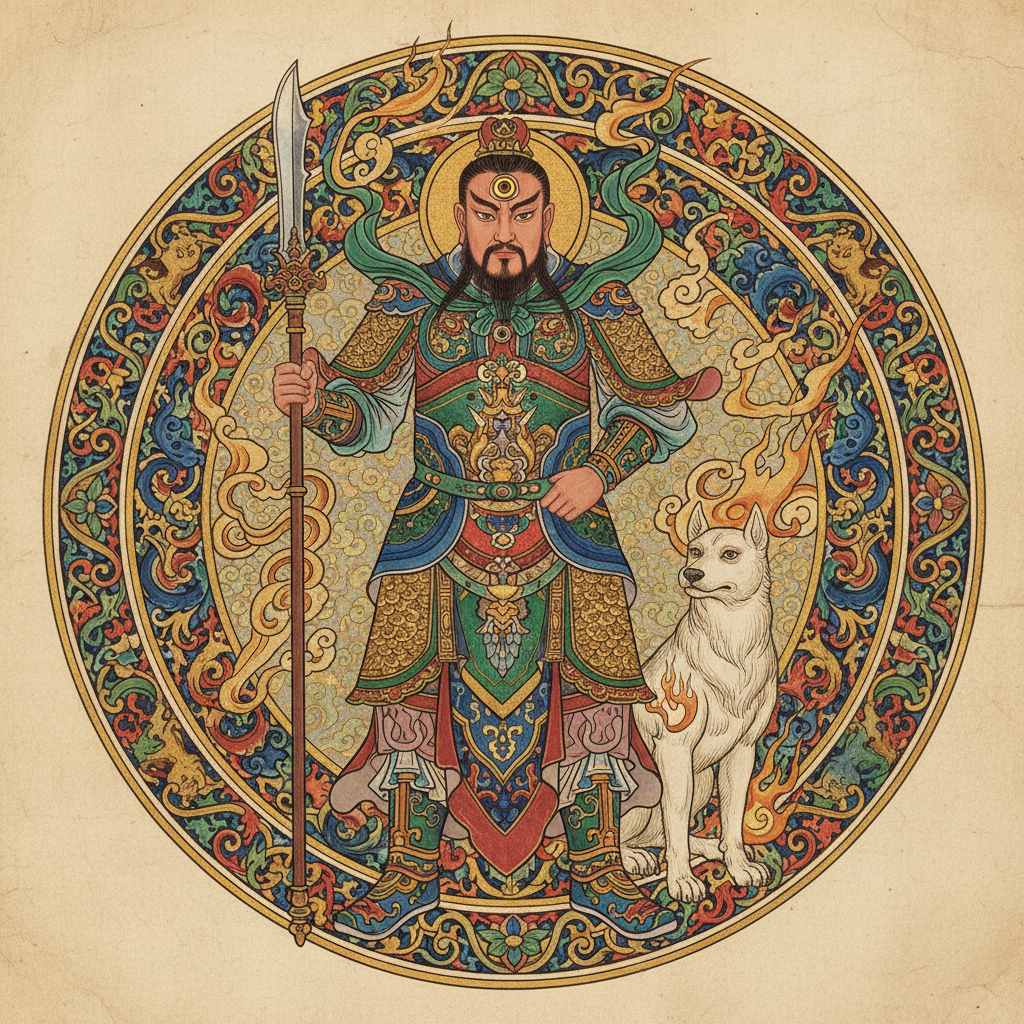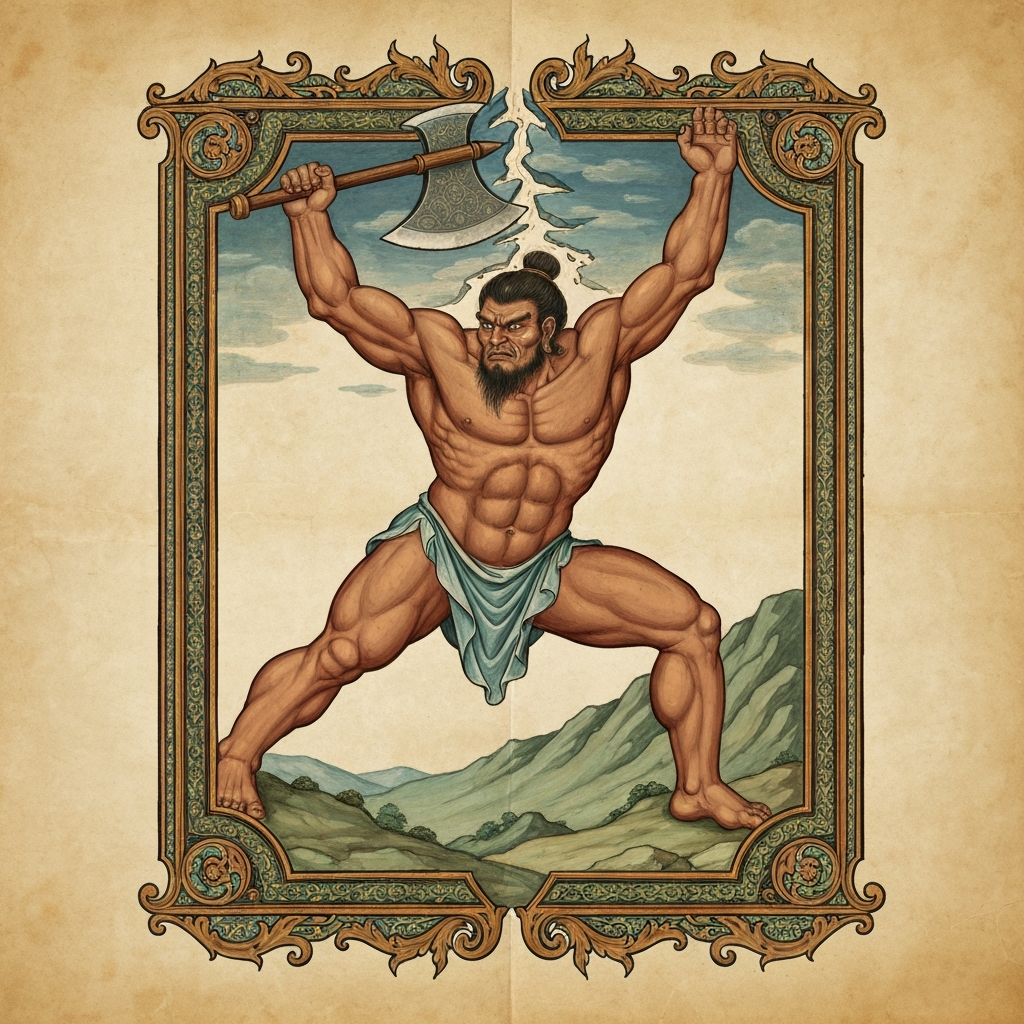
Pangu Holds Up the Sky
Before the beginning of time; earliest written sources from the Three Kingdoms period, 220-280 CE · The cosmic egg; then the world
Contents
Pangu sleeps inside the cosmic egg for eighteen thousand years. When he wakes, he pushes the shell apart with his hands and feet. He stands between earth and sky, growing ten feet taller each day to keep them from collapsing back together. After eighteen thousand more years, he dies. His breath becomes the wind; his voice, thunder; his left eye, the sun; his right eye, the moon; his body, the mountains and rivers and seas.
- When
- Before the beginning of time; earliest written sources from the Three Kingdoms period, 220-280 CE
- Where
- The cosmic egg; then the world
Before the beginning, there is an egg.
It floats in nothing. It has no location because location requires a container, and the egg is the container. It has no duration because duration requires a before and after, and there is nothing before the egg and nothing outside it. The egg is everything that will be anything. Inside it, darkness and light are mixed together, undifferentiated, the potential of every thing coiled in the warmth of its shell.
Pangu sleeps inside it.
He sleeps for eighteen thousand years, which is the number the tradition assigns to the gestation of the cosmos, the time required for the primordial potential to develop into something that can push the shell apart. He sleeps the way a seed sleeps — not dormant but accumulating, growing toward the event that will break its container open and allow it to become what it is.
When he wakes, it is the moment the world begins.
He pushes.
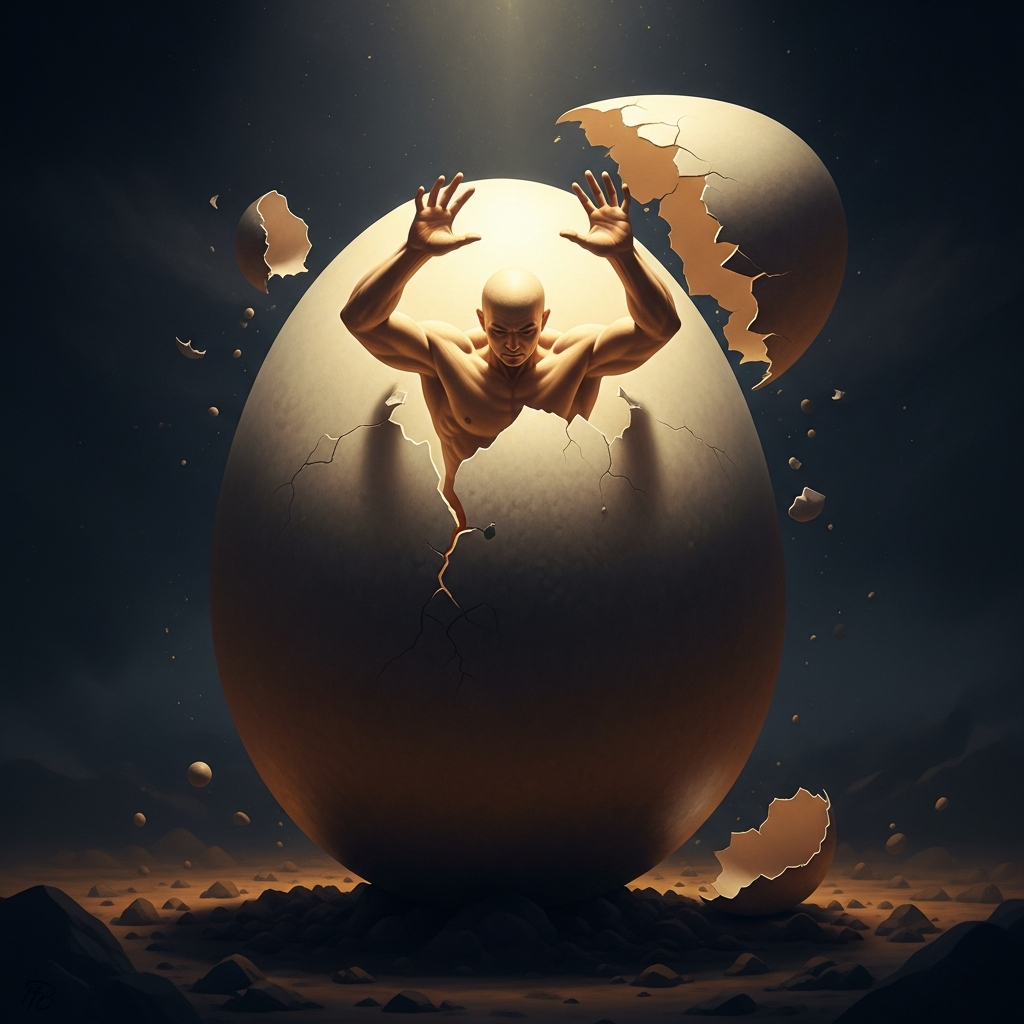
His hands go up. His feet go down. This is the first act of creation in the Chinese cosmological imagination, and it is not a word or a thought or a divine decree. It is a body applying force. He separates the heavy from the light — the yin from the yang, the dark dense matter that will become earth from the bright clear matter that will become sky — with the specific method of a body wedging itself between two things that do not want to be separated.
The shell cracks. Light enters. Darkness falls. The earth and sky separate by ten feet on the first day.
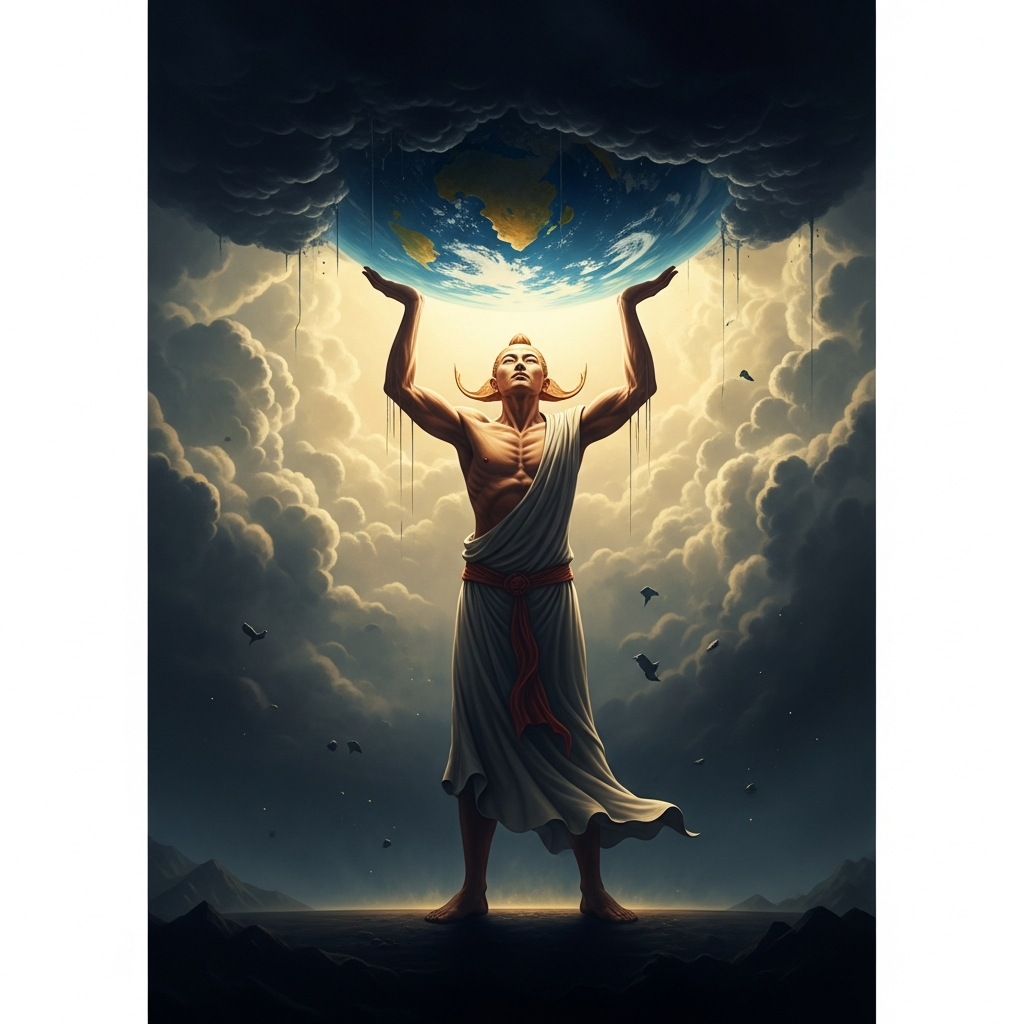
The problem is that they want to come back together. The earth and sky, freshly separated from their primordial unity, have no mechanism for maintaining their separation except Pangu. He stands between them, arms raised, feet planted, bearing the weight of the sky on his palms and the weight of the earth against his soles. If he steps aside, the world collapses back into the egg.
He does not step aside.
He grows ten feet every day.
This is the specific number the tradition gives, and it is important because it establishes the scale of what he is doing. Ten feet per day for eighteen thousand years is a calculation that produces a number too large to be meaningfully visualized, which is the point. He becomes so tall that the space between earth and sky is the space his body occupies. The sky is as high as it is because that is how tall Pangu grew. The distance between the ground and the firmament is his height.
He is holding the world open with his body.
He is doing this alone. There is no one else. He has not made anything yet — has not made the ten thousand things, has not made the animals or the spirits or the people. He has made only the condition of possibility: a sky and an earth with space between them. Everything that will ever live will live in the space he is holding open.
He holds it for eighteen thousand years.
His body changes as he grows.
The traditions that expand the Pangu story beyond its earliest written sources describe him as covered in hair, with horns on his head — more dragon than man, more primordial force than divine person. In some versions, he wears a bearskin. In others, he is simply enormous and naked, a body that is nothing except body, no divine attributes except the specific divine attribute of being large enough and strong enough to hold the sky up for eighteen thousand years.
He has a chisel and a mallet, in some versions, with which he does secondary work — carving out the valleys, shaping the mountains, refining the landforms while he holds the sky with the rest of himself. This detail shows the tradition’s attempt to reconcile the creation-by-dissolution that is central to the myth with the creation-by-craft that is the other dominant cosmological mode. He is both the dying god whose body becomes the world and the divine artisan who shapes the world before he dies.
He does not eat. He does not rest. He simply holds.
When he dies, the world is made.
The accounts of his death are the most artistically rich part of the tradition, because his death is the multiplication of creation — not the ending of one thing but the beginning of many things simultaneously. The sources list the transformations carefully:
His breath becomes the wind and clouds. His voice becomes the thunder. His left eye becomes the sun. His right eye becomes the moon. His four limbs and five extremities become the four cardinal directions and the five sacred mountains. His blood becomes the rivers. His veins become the roads. His flesh becomes the soil. His hair and beard become the stars. His skin and its hair become the plants and trees. His teeth and bones become the metals and stones. His marrow becomes pearls and jade. His sweat becomes the rain. And the parasites on his body — the insects, the creatures that lived on the great skin of him — become the people.
This is the creation account: people are the parasites on a dead god’s body.
The tradition does not mean this as an insult. It is a statement about relationship. People are not made separately, from superior materials, in a specially dignified act of divine attention. They are made from Pangu’s body along with everything else, from what was living on the body that became the world. They are part of the body. They are as world as the mountains.
The Pangu myth appears first in written sources from the Three Kingdoms period — Xu Zheng’s San wu li ji, the Record of Cycles of Three and Five, dated to approximately 230 CE. It appears again in the Shu yi ji of Ren Fang, Liang dynasty, approximately 500 CE. Its written history is significantly later than the written history of other Chinese cosmological traditions, which suggests either that it was transmitted orally for a long time before being written down, or that it was synthesized from other traditions during the Three Kingdoms period, or some combination of both.
The myth’s structure has close parallels in the Zhuang people’s traditions of southern China, and scholars of comparative mythology have noted its similarities to the Vedic Purusha Sukta. The question of whether these similarities reflect shared origin or parallel development is one of the open questions of Chinese mythology scholarship. The traditions do not themselves raise this question. They simply tell the story.
What the myth says about the world is this: the world is a body.
Not a machine. Not an artifact. Not a creation produced according to a plan and handed over to the creatures who inhabit it. A body that was a person, that experienced something and became the world in the process of experiencing it. The mountains are his grief-muscles from holding the sky for eighteen thousand years. The rivers are his blood, which means the rivers are what was flowing through him when he was alive. The rain is his sweat.
When a Chinese farmer plants in the soil, he is planting in Pangu’s flesh. When a river floods, Pangu’s blood is moving. When the wind comes down from the mountains, Pangu’s last breath is still in it.
This is a cosmology without a god who continues. Pangu is not governing the world from somewhere else. He is the world. His divine personality has become geography.
The question the myth poses is not theological in the usual sense — it does not ask where God is or why God permits suffering or whether God can be known. It asks something prior to those questions: what is the world made of? And it answers: a sacrifice. An enormous body that held the sky open for eighteen thousand years and then dissolved itself into the world so the world could have a sky.
The sky is still sky because he held it. Every day of the sky is one of his days.
Scenes
Pangu waking inside the cosmic egg — the massive figure just becoming visible as the shell begins to crack, light entering for the first time, his hands pushing up and his feet pushing down, the first gesture of creation being an act of raw physical force rather than divine speech
 Generating art…
 Pangu standing between the earth and sky, arms raised, bearing the weight of the firmament on his palms
 Generating art…
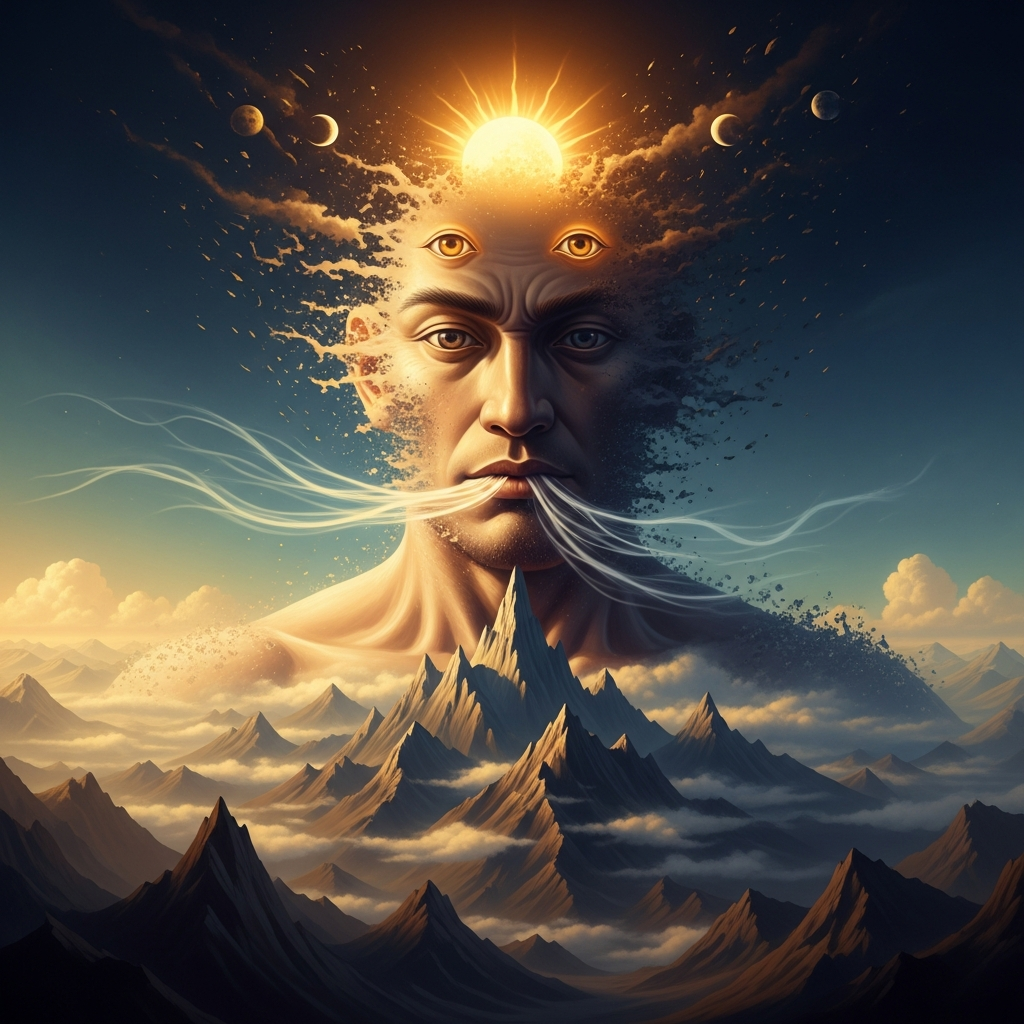
 Pangu dying — the great figure dissolving, his breath becoming visible as wind sweeping across the new landscape, his eyes rising separately as sun and moon, his body becoming the mountains that form on the horizon
 Generating art…
 Echoes Across Traditions
Entities

Sources
- Anne Birrell, *Chinese Mythology: An Introduction* (Johns Hopkins University Press, 1993)
- Derk Bodde, 'Myths of Ancient China,' in *Mythologies of the Ancient World*, ed. Samuel Noah Kramer (Anchor, 1961)
- Yang Lihui and Deming An, *Handbook of Chinese Mythology* (ABC-CLIO, 2005)
- Xu Zheng, *San wu li ji* (Record of Cycles of Three and Five), Three Kingdoms period, c. 220-280 CE
- Ren Fang, *Shu yi ji* (Records of Strange Things), Liang dynasty, c. 500 CE