Combat Profile
Primordial Separation
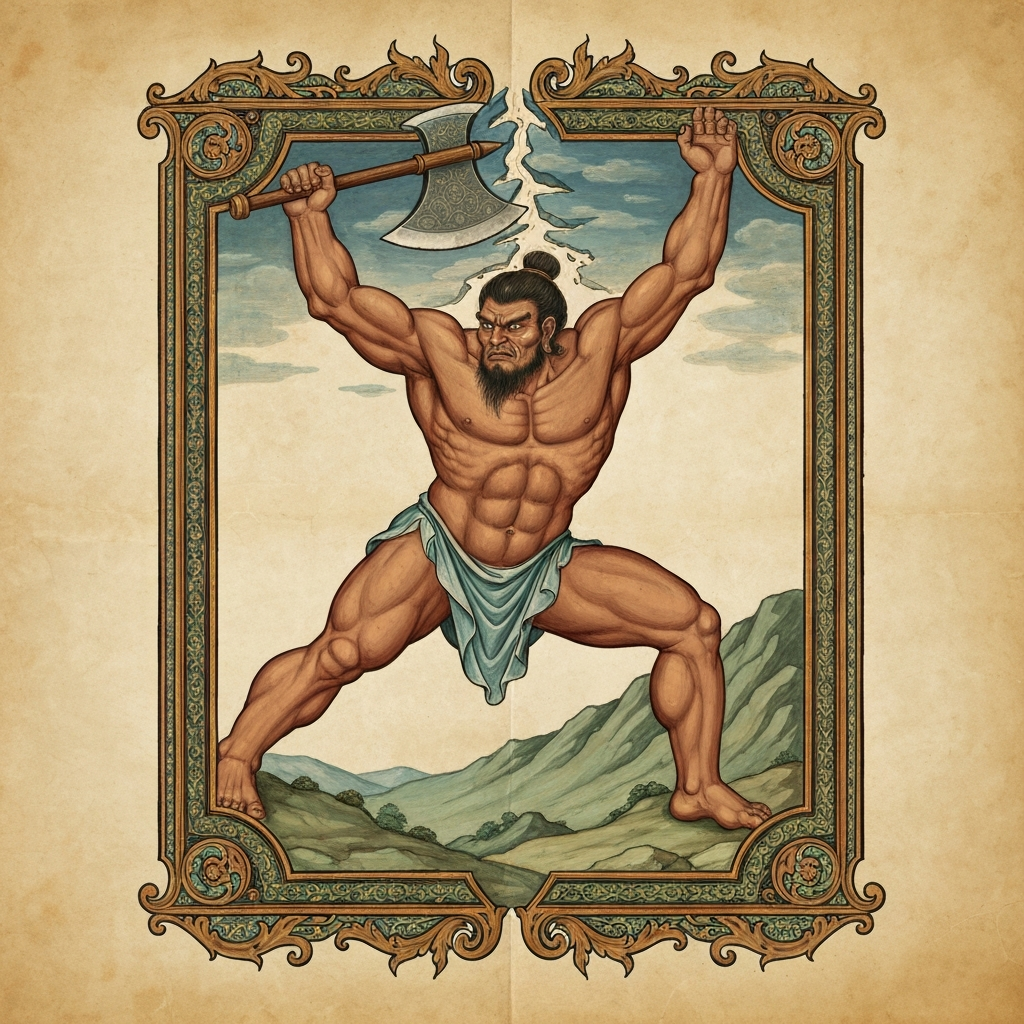
Pangu cleaves reality itself, permanently dividing domains and reshaping the fundamental structure of existence
Cosmic Body
Pangu's physical form continuously generates the material world; their death creates mountains, rivers, and celestial bodies from their decomposition
None in life. His death was the price of creation -- his body became the world, meaning creation required self-destruction
“He held heaven and earth apart with his own body. When his work was done, his body became the work.”
Lore: Pangu is the Chinese creation giant, and his myth is one of the great cosmogonic narratives of world mythology. Before Pangu, there was hun dun — primordial chaos, an undifferentiated cosmic egg containing all potential but no form. Pangu emerged within this egg and began to separate the light, clear yang (which rose to become heaven) from the heavy, dark yin (which sank to become earth). He stood between them, pushing them apart, growing ten feet taller each day. After 18,000 years, the separation was complete, and Pangu died. His death was not a tragedy but a transformation: every part of his body became a feature of the natural world. The myth appears relatively late in Chinese textual tradition (3rd century CE), leading some scholars to suggest Buddhist or Central Asian influence, but the cosmogonic pattern — a primordial being whose body becomes the world — is so widespread that independent development is entirely plausible.
Parallel: Pangu belongs to the “body-of-the-giant-becomes-the-world” mythological pattern that appears across cultures: Ymir in Norse mythology (whose flesh became earth, blood became seas, skull became sky), Tiamat in Babylonian mythology (whose split body became heaven and earth in the Enuma Elish), and Purusha in Vedic mythology (Rig Veda 10.90, the cosmic man sacrificed by the gods, whose body parts became the world and the social castes). The consistent pattern across unrelated cultures suggests either deep transmission or a fundamental human intuition that the world is the body of something that died to create it — which resonates with the Christian eucharistic theology of consuming the body to receive life.
1 min read
None. Pangu exists before opposition. There are no enemies in the formless void
*Sanwu Liji* (Xu Zheng, 3rd century CE) -- earliest recorded version; *Wuyun Linian Ji* (5th century CE); *Classic of Mountains and Seas* (partial traditions)