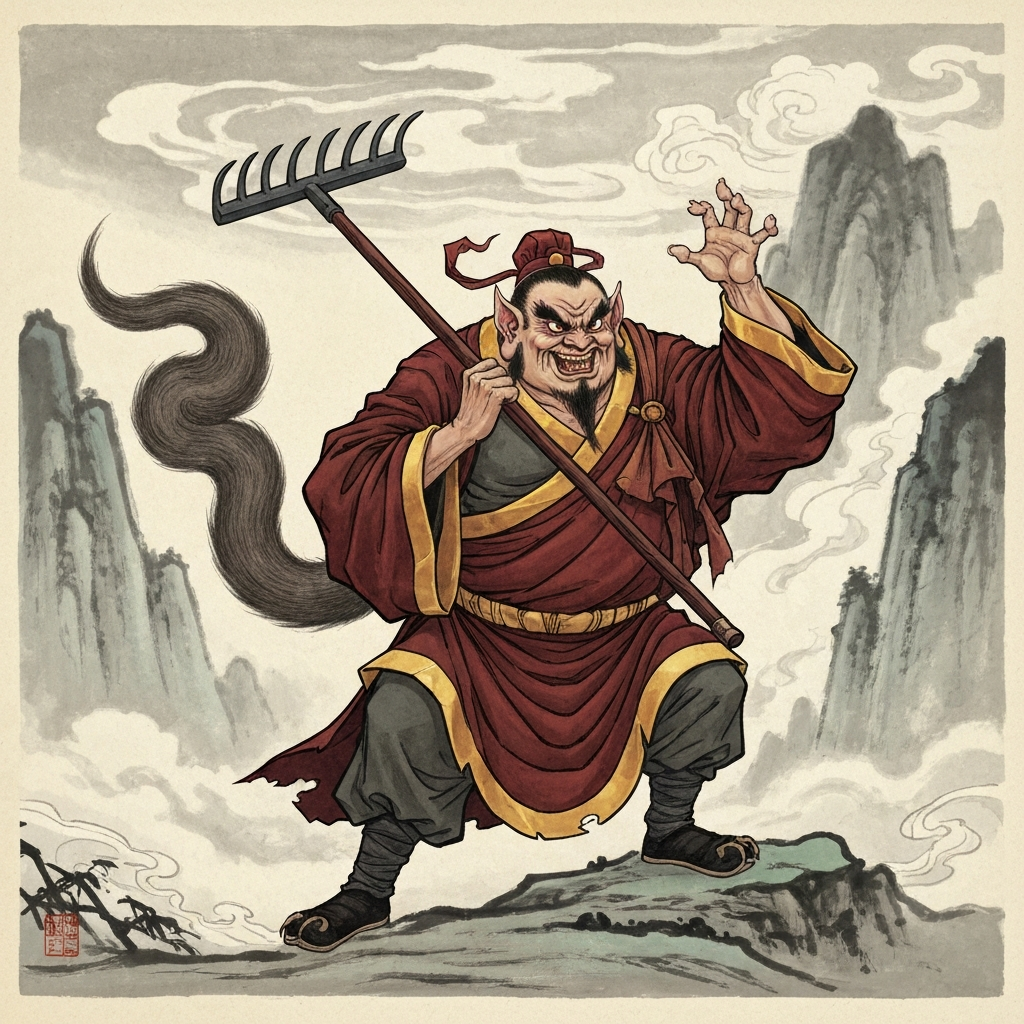
Combat Profile
Rake Rampage
Zhu Bajie channels his celestial strength through his nine-toothed rake to unleash a devastating combo attack that grows more powerful the hungrier he becomes.
Heavenly Glutton
Despite his demonic pig form, Zhu Bajie retains celestial heritage; he gains increased combat prowess after indulging in food, but suffers reduced wisdom when tempted by worldly desires.
Every physical temptation. Food, sleep, women, comfort. He constantly suggests abandoning the pilgrimage to go home. He is the part of us that wants to quit
“He wants to go home. He always wants to go home. But he never actually goes.”
Lore: Zhu Bajie is the comic heart of Journey to the West and one of the most psychologically honest characters in world literature. He was once a powerful heavenly marshal, but his appetites — for wine, for women, for ease — brought him low. His reincarnation as a pig-man is not merely punishment but revelation: he now looks on the outside the way he always was on the inside. On the pilgrimage, he is everything a spiritual seeker should not be: lazy, lecherous, greedy, cowardly, and perpetually suggesting that the group split up and go home. He hoards food. He flirts with every woman they meet. He complains about the walking, the weather, the demons, and especially about Sun Wukong’s leadership. And yet — he stays. When the fighting starts, he picks up his nine-toothed rake and fights. When Tang Sanzang is captured (again), Bajie helps rescue him (eventually). He is not the best version of himself. He is the real version of himself. And he makes it to the end.
Parallel: The comparison with the Apostle Peter is illuminating. Peter denied Christ three times but remained faithful. Peter was impulsive, often wrong, sometimes cowardly — and became the rock on which the church was built. Bajie fails constantly but persists. He represents the body in Chinese Buddhist allegory — the physical cravings that slow the spiritual journey but cannot be abandoned because you need your body to walk the road. In Western terms, he is the flesh that wars against the spirit (Romans 7:18-23) but remains part of the pilgrim. At the journey’s end, Bajie is not made a Buddha (his spiritual attainment is insufficient) but is given the post of “Cleanser of the Altars” — he gets to eat all the offerings. It is perfect. He is rewarded with exactly what he wanted all along, and the universe accommodates even his appetite.
2 min read
Sun Wukong (mocks and disciplines him); Tang Sanzang (moral authority); any beautiful woman (he loses all judgment)
*Journey to the West*; folk traditions of pig spirits in Chinese demonology