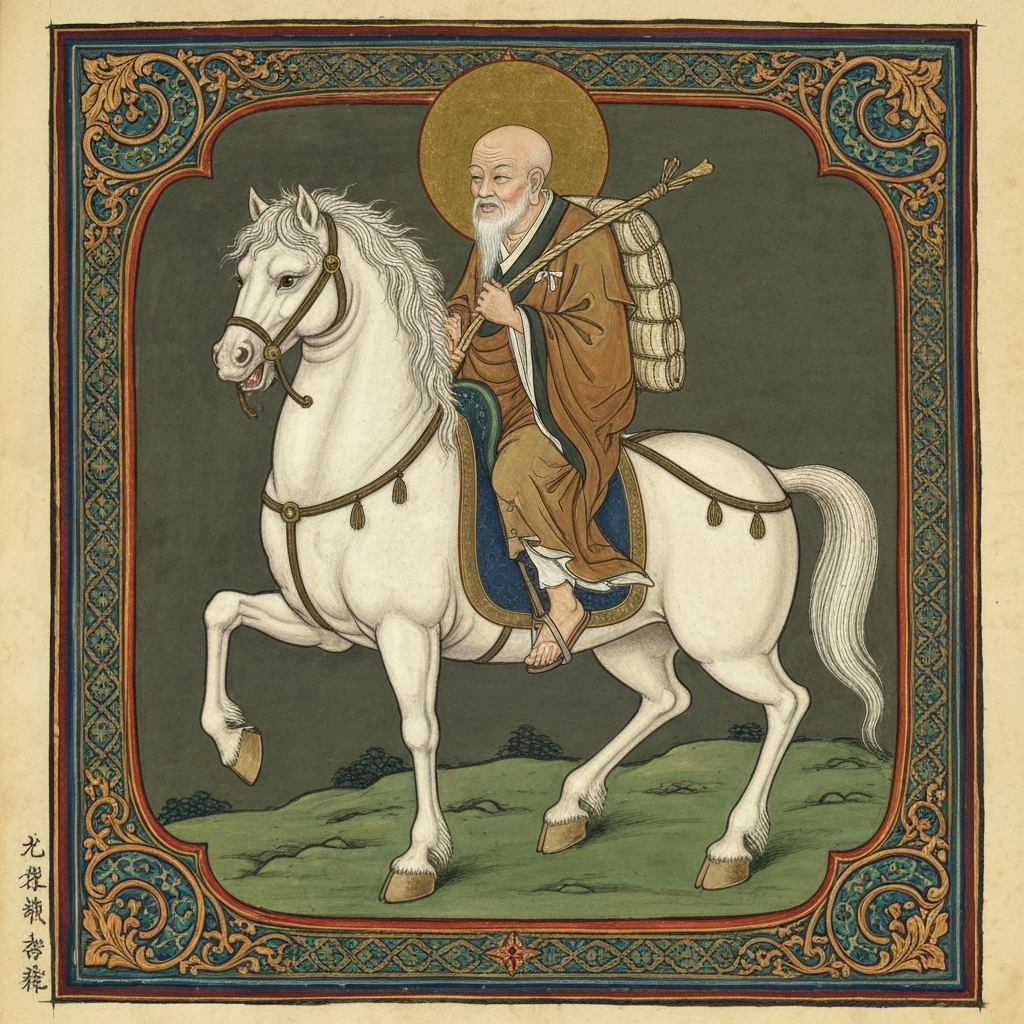
Combat Profile
Scripture Recitation
Chants Buddhist sutras to purify evil spirits and redirect hostile entities toward enlightenment rather than destruction.
Golden Cicada's Blessing
Immune to corruption and temptation; radiates an aura that weakens demonic influence and grants spiritual protection to allies.
Physically helpless. Constantly captured by demons. Gullible -- he trusts the wrong people repeatedly. His compassion makes him unable to recognize evil, and he often punishes Sun Wukong for killing demons who are trying to eat him
“He cannot fight. He cannot fly. He cannot transform. He walks every step of the way on his own two feet. And that is exactly the point.”
Lore: Tang Sanzang is based on the historical Xuanzang, one of the most remarkable figures in Chinese history — a Buddhist monk who defied the Tang emperor’s travel ban, crossed the Gobi Desert, traversed the Silk Road kingdoms, studied at the great Indian Buddhist university of Nalanda, and returned to China after seventeen years with 657 Sanskrit texts that he spent the rest of his life translating. The historical Xuanzang was brilliant, brave, and politically savvy. The fictional Tang Sanzang is deliberately different: he is weak, naive, constantly weeping, endlessly captured by demons, and frequently wrong (especially in his treatment of Sun Wukong, whom he punishes for violence even when that violence is justified). This apparent diminishment is the novel’s deepest joke and its deepest teaching. Tang Sanzang represents the pure mind seeking truth — and the pure mind, without the rest of the self (ego, body, will, sincerity), is helpless. He needs Sun Wukong (discipline), Zhu Bajie (the body), Sha Wujing (sincerity), and the White Dragon Horse (determination) to complete the journey. He is not weak because the author made a mistake. He is weak because the teaching requires it.
Parallel: Tang Sanzang is the archetypal holy fool — the figure whose very helplessness is the source of his spiritual power. Compare Percival in the Grail legend (the innocent who reaches the Grail precisely because he lacks the cunning of experienced knights), or the Gospel teaching that “the meek shall inherit the earth” (Matthew 5:5). His constant need for protection parallels the Christian concept of the soul that must be guarded by spiritual forces (guardian angels, the armor of God in Ephesians 6). His flesh granting immortality to demons who eat it is a dark mirror of the Eucharist — consuming the body of the holy one to gain eternal life.
2 min read
Almost everything. Any demon of moderate power can capture him. His only defenses are his disciples and his spiritual purity (his flesh grants immortality to any demon who eats it, making him the most hunted being on the road)
*Journey to the West*; based on the historical monk Xuanzang (602-664 CE), who really did travel to India (629-645 CE) and returned with 657 Buddhist texts; Xuanzang's own *Great Tang Records on the Western Regions*