Ogun and the City He Cannot Live In
Primordial time — before the Yoruba kingdoms · Ire, in Yorubaland (present-day Ekiti State, Nigeria)
Contents
Ogun, the Yoruba god of iron, war, and labor, attends a celebration and cannot stop the killing — the iron in his hands does what iron does. He withdraws into the forest and will not come back. Blacksmiths, soldiers, surgeons, and taxi drivers still call his name at the blade's edge.
- When
- Primordial time — before the Yoruba kingdoms
- Where
- Ire, in Yorubaland (present-day Ekiti State, Nigeria)
Before the first city, there is the forest, and in the forest Ogun works.
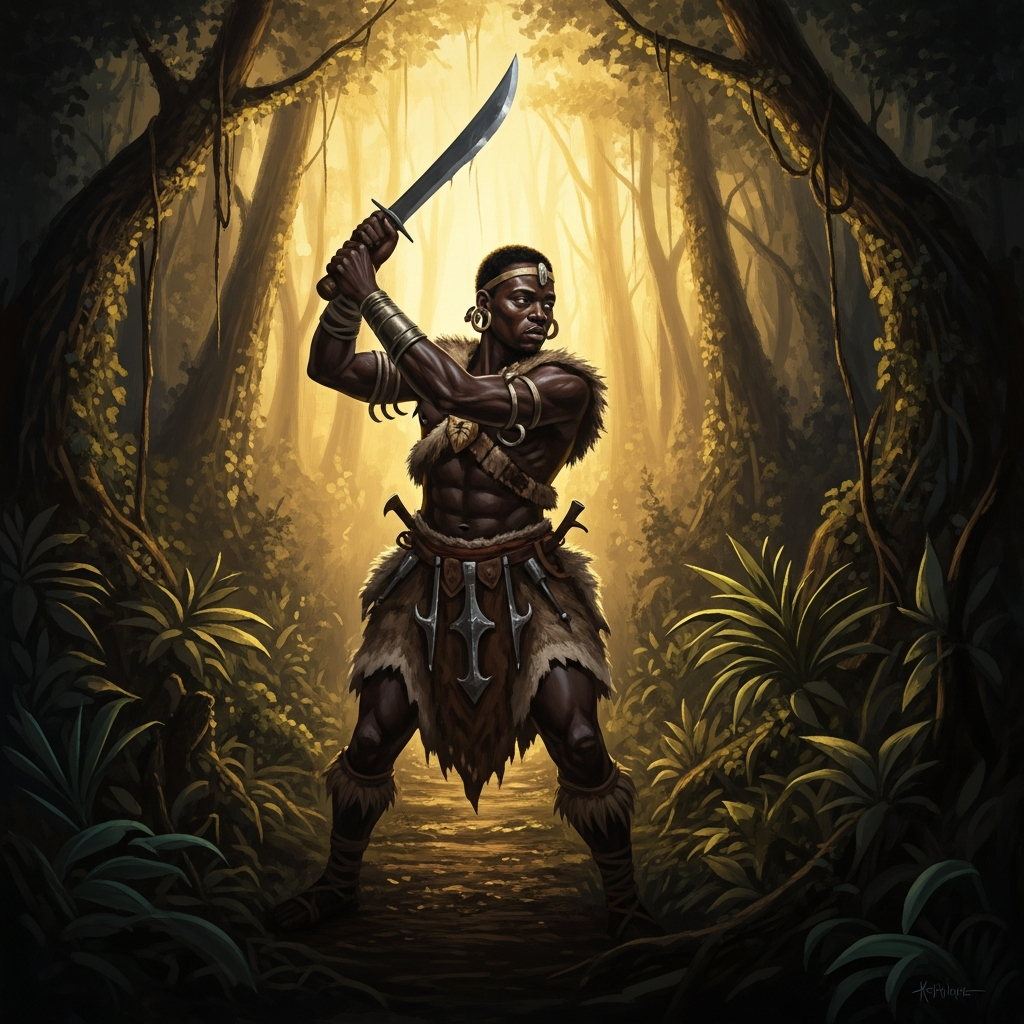
He is working when the other orishas find him — Obatala, Yemoja, Sango, the whole bright company of heaven — because Ogun is always working. He has cleared the path from the realm of the orishas to the realm of humanity by cutting it with his machete, which is the first iron tool, which he made himself from the ore he found in the earth’s body. The path exists because Ogun made it. The gate between heaven and earth swings on hinges he forged. The world that humans will live in has been opened, in the most literal sense, by his blade.
The other orishas ask him to come to the city. They say: the humans need you. They need iron for their farms, iron for their hunts, iron for the surgery that will pull the fever out of the body and the child out of the difficult birth. Without iron there is no civilization worth the name. Come and live among them and teach them what you know.
Ogun is a god of few words. He goes.
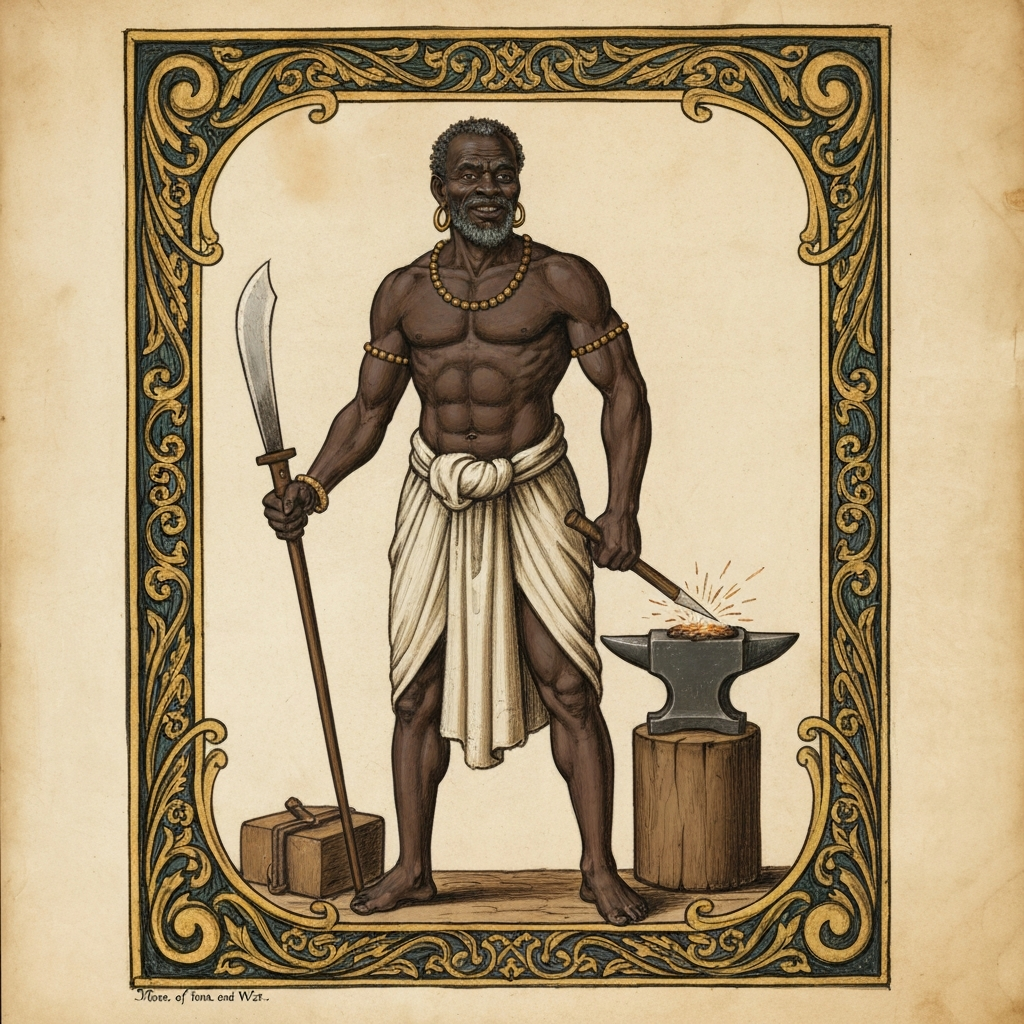
He is good at the work. This is not in question and has never been in question. The forge he sets up in Ire is a place of real learning — he teaches the smiths to hear the iron’s temperature in the ring of the hammer, to read the color of the metal in the fire, to feel the moment when the blade is ready to receive its edge. He teaches the farmers the angle of the hoe and the surgeon the depth of the cut. The tools he makes are tools that do not break, because he understands what breaking is and designs against it.
The city grows around his forge. This is the natural movement of civilization: toward the source of the thing that makes civilization possible. People want to be near Ogun because being near Ogun means access to iron and iron means food and shelter and security. He tolerates the city in the way a large animal tolerates a fence — aware of it, not persuaded by it.
What he cannot tolerate is the celebration.
There is a celebration at Ire, and someone brings palm wine, and Ogun drinks the palm wine, and this is where the accounts differ in their details but agree in their shape. He drinks. He is among the crowd. He is celebrated, praised, honored for all he has done — the roads he cleared, the blades he forged, the city he made possible. The drums are playing. People are pressing close to touch him.
And then the machete is moving.
Ogun is not angry. This is the point that every account of the event tries to make clear: he is not in a rage, not in a battle, not responding to any threat. He is in the crowd at a celebration with iron in his hand and the iron does what iron does. By the time he comes back to himself there are bodies on the ground — his own people, the people of Ire, the people who were celebrating him — and he is standing in their midst holding the machete and the celebration is over.
He stops. He looks at what has happened.
He goes into the forest and does not come out.
This is not a god who has been punished or defeated or overcome by a rival. He is not exiled by Orunmila or Obatala or any other orisha. He exiles himself, and the reason he gives — when he gives one, which is not always — is essentially this: I cannot promise you it will not happen again.
The machete does not know the difference between an enemy in battle and a friend at a feast. Iron cuts what is in front of it. This is what makes iron useful and this is what makes iron dangerous, and Ogun is the god of iron in both directions simultaneously. He is the patron of the surgeon and the patron of the soldier, and the surgeon and the soldier are not different in the most fundamental sense — they both make precise incisions into the body of a living thing, and the difference between healing and killing is very thin and sometimes not visible until afterward.
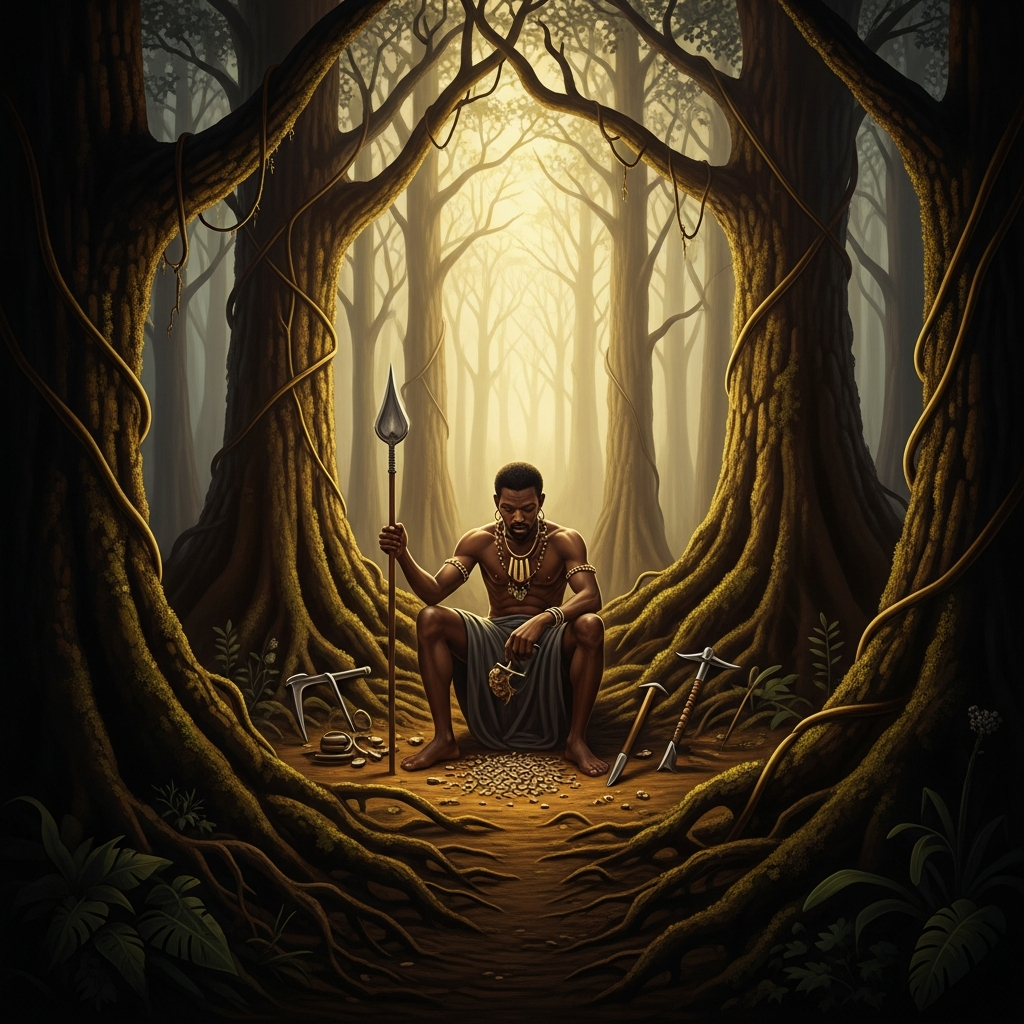
He sits in the forest among the roots of the old trees. He does not build a forge there. He simply sits.
The worship continues in his absence. This is the theology: Ogun does not need to be present for his domain to persist. Every blacksmith who starts the forge before dawn is starting it in Ogun’s name. Every soldier who takes an oath before battle — in Yorubaland, traditionally with one hand on iron, often a machete or an axe — is taking the oath by the god who first cleared the path between heaven and earth. Every taxi driver in Lagos and Ibadan who hangs an Ogun amulet from the rearview mirror before pulling onto the expressway is acknowledging that the vehicle they are driving is an iron thing and iron things are his.
The worship is not comfortable. You do not approach Ogun the way you approach Yemoja, who is the sea and who will receive a gentle offering. You approach Ogun with specificity and seriousness, because he is a god who has demonstrated what happens when the relationship is not maintained correctly. Palm wine, palm oil, dog, kola nut — and the acknowledgment that you are working with something dangerous, that the blade you carry or the steel you drive or the scalpel you hold is not neutral, is not innocent, is subject to the logic of iron, which cuts what is in front of it regardless of the operator’s intentions.
Surgeons in teaching hospitals in Ile-Ife and Ibadan, trained in Western medicine, will sometimes invoke Ogun before entering the operating theater. This is not superstition. This is an accurate theological statement: they are about to use iron to open a human body, and the god who governs that act is in the forest, and it is worth acknowledging him before you begin.
He is there. He has always been there, in the deep forest where the trees are old enough to have forgotten what sunlight looks like from ground level. He does not come out, because he cannot promise what will happen if he does.
But he hears the invocations.
The forest where Ogun lives is not a punishment. It is a boundary he drew for himself, the boundary between the force that makes civilization possible and the civilization that cannot safely contain that force. He is the god at the edge, and the edge is where he belongs.
This is why you call him before you begin and not after. After is too late. He knows this better than anyone.
He learned it in Ire, at the celebration, with the machete already moving and the crowd already falling and the palm wine and the drums and the bodies on the ground and the terrible clarity of iron doing exactly what iron does.
Scenes
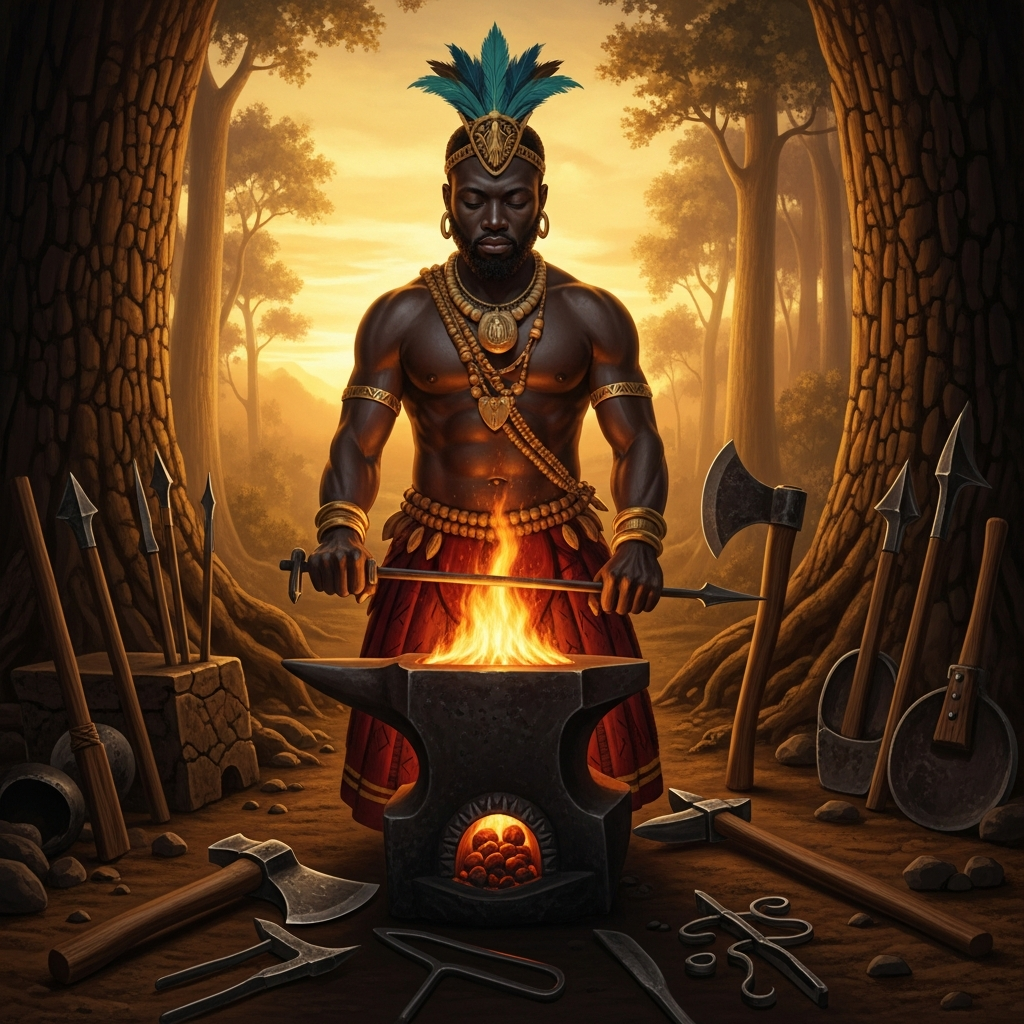
Ogun at his forge in the primal forest, surrounded by the first iron tools he made for the orishas — machetes, hoes, surgical blades, the first axe
 Generating art…
 The celebration at Ire — palm wine, drums, the crowd pressing in
 Generating art…
 Ogun alone in the deep forest, seated among roots and vines, his tools laid out beside him
 Generating art…
 Echoes Across Traditions
Entities
- Ogun
- Orunmila
- Sango
- palm wine

Sources
- Ulli Beier, *Yoruba Myths* (Cambridge University Press, 1980)
- Robert Farris Thompson, *Flash of the Spirit: African and Afro-American Art and Philosophy* (Random House, 1983)
- John Mbiti, *African Religions and Philosophy* (Heinemann, 1969)
- Sandra T. Barnes (ed.), *Africa's Ogun: Old World and New* (Indiana University Press, 1997)
- William Bascom, *The Yoruba of Southwestern Nigeria* (Holt, Rinehart and Winston, 1969)