Obatala Shapes Humanity
In the beginning · oral tradition recorded ~19th–20th century CE · Ile-Ife, the navel of the earth — primordial Yorubaland
Contents
The orisha of the white cloth descends an iron chain from heaven with a sack of soil and a rooster — and, drunk on palm wine, makes the first humans crooked.
- When
- In the beginning · oral tradition recorded ~19th–20th century CE
- Where
- Ile-Ife, the navel of the earth — primordial Yorubaland
There is only water.
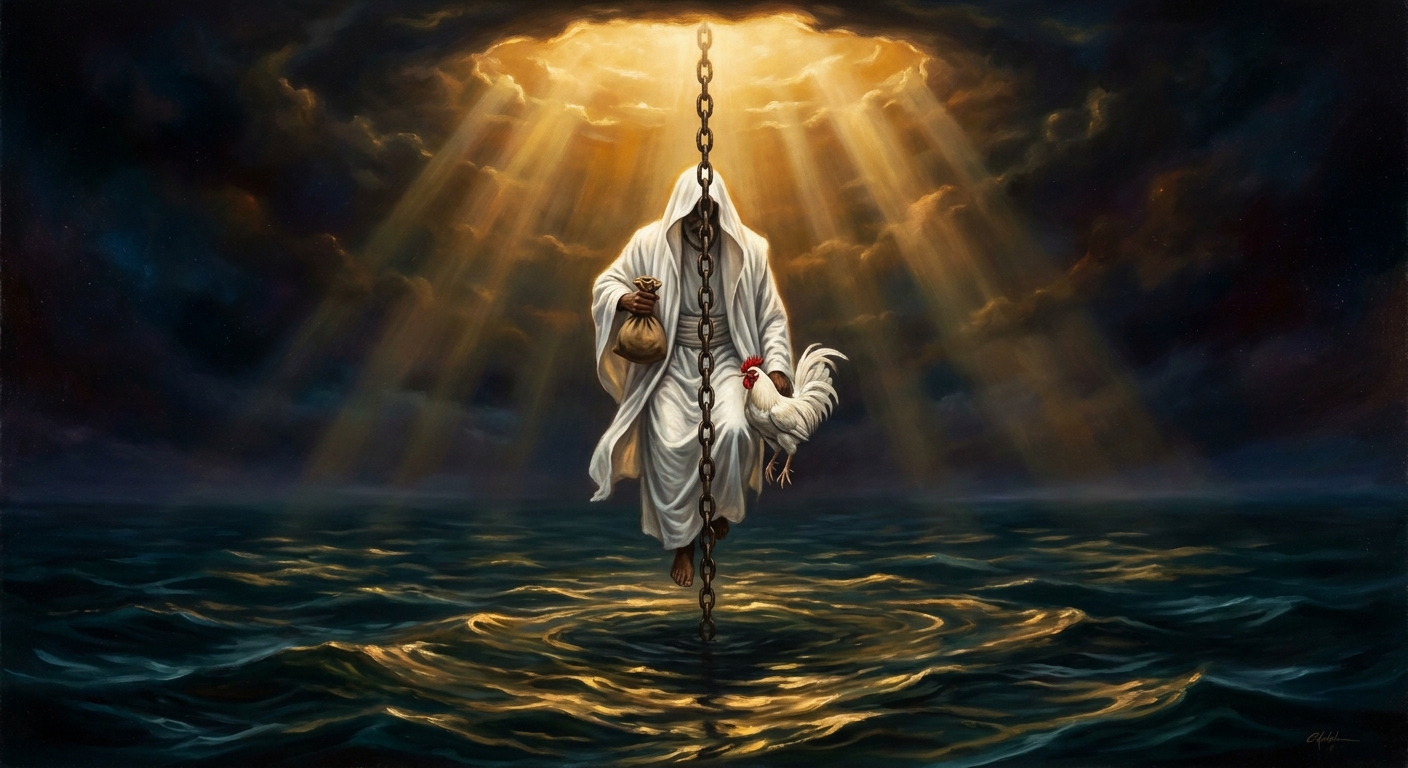
Above the water, Olodumare’s sky-house. Below the water, nothing — no fish, no floor, no edge. Olodumare, the owner of the sky, calls Obatala to the doorway and gives him three things: a sack of loose soil, a five-toed white rooster, and a length of iron chain long enough to reach down through the cloud-floor to the surface of the sea.
“Make a place,” Olodumare says. That is all the instruction.
Obatala wraps his white cloth twice around his waist. He takes the sack, the rooster, the chain. He climbs over the threshold of heaven and begins to descend.
The chain creaks above him for a long time. The water below makes no sound. Obatala lowers himself link by link, and the rooster under his arm does not struggle — roosters know when something larger than them is happening.
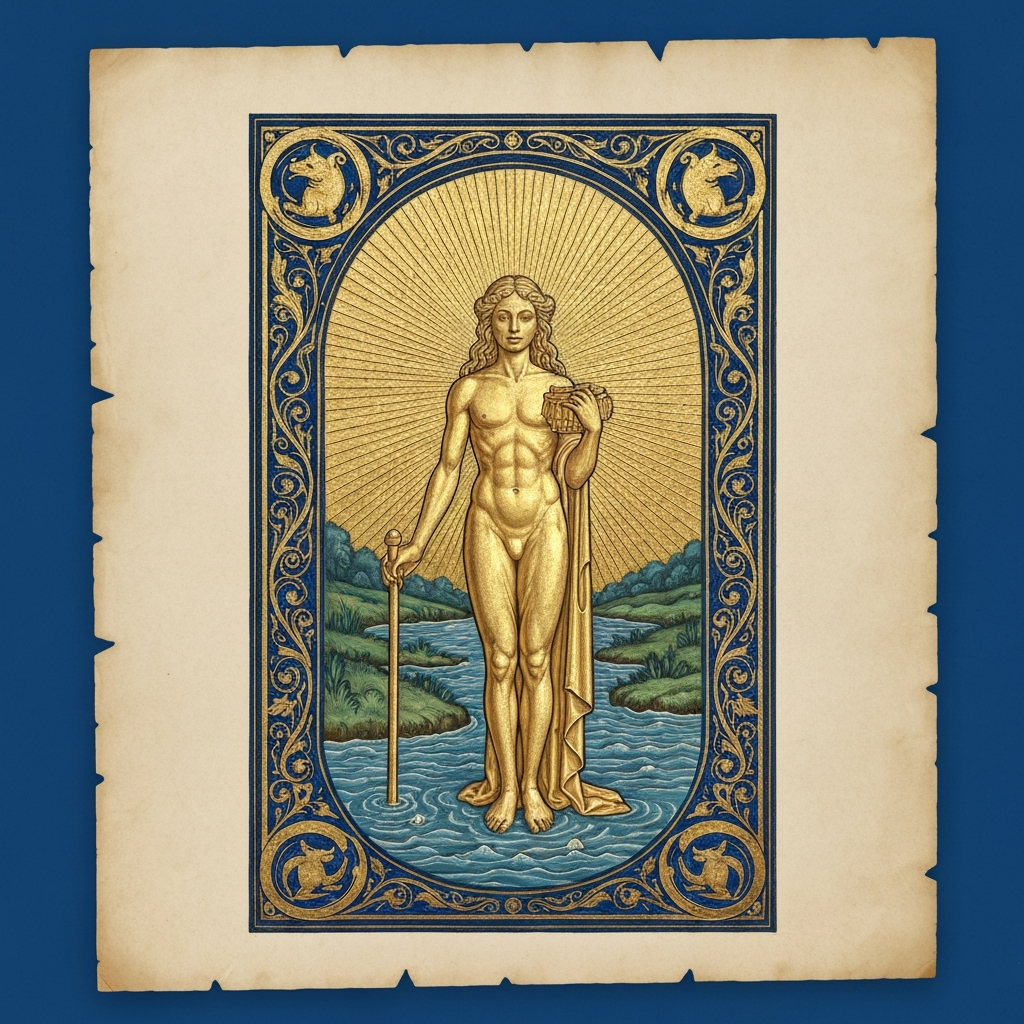
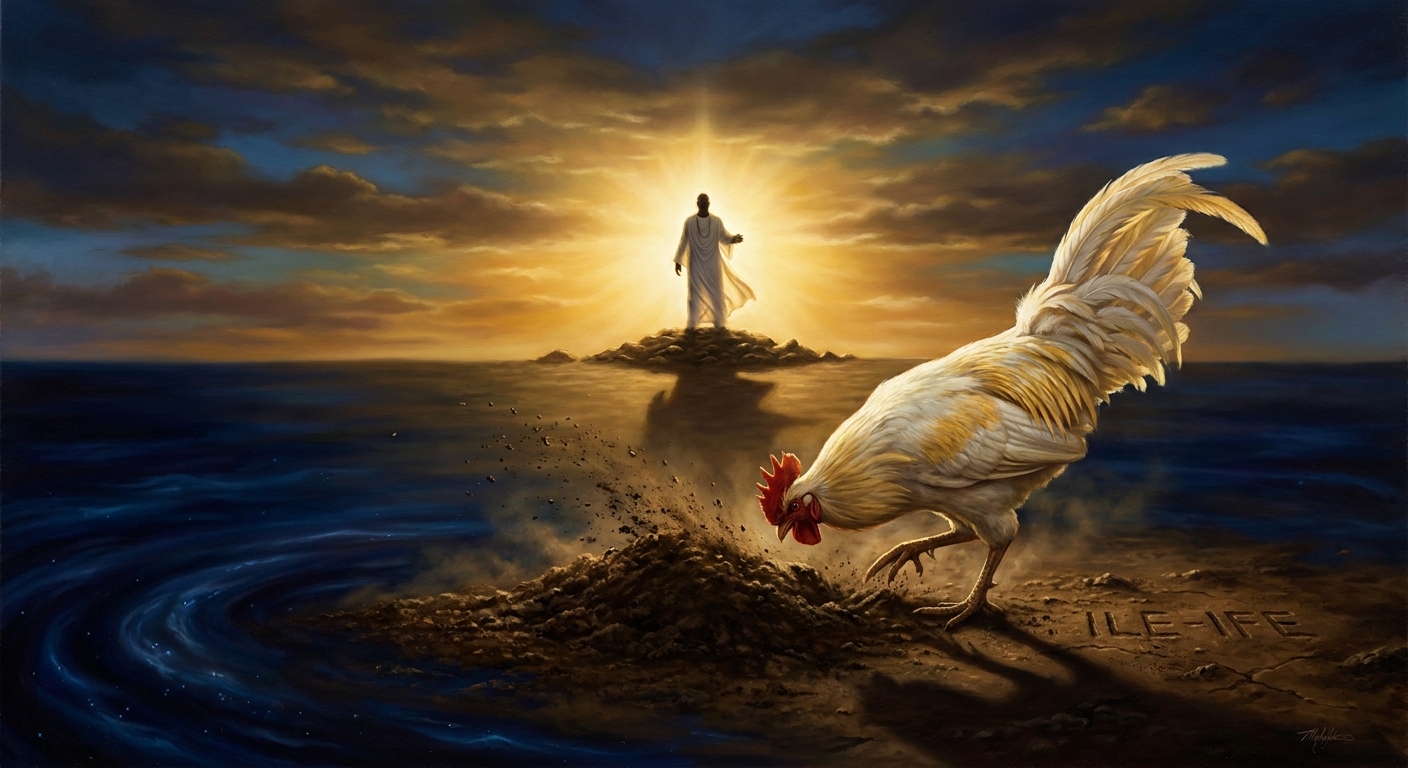
When he reaches the lowest link he stops. There is no land. There has never been land. He pours the soil from the sack into the water, and where it falls it does not sink — it heaps. A small dry hill, no bigger than a threshing floor.
He drops the rooster onto the hill.
The rooster does what roosters do. It scratches. It scrapes the soil outward in every direction, kicking, pecking, spreading the heap until the dry place runs to the horizon in all four directions. By the time the bird is finished, there is a world.
Obatala steps off the chain. He calls the place Ile-Ife — the house that spreads. The navel of the earth.
He works alone for a long age.
He plants the first palm tree. He raises the first hill. He watches what shapes please him and keeps them, watches what shapes do not and lets the rain take them back. The rooster wanders into legend. The sack, emptied, becomes the first cloud.
Then Olodumare gives him the second commission. “Now make people. Make them in the shape of the work.”
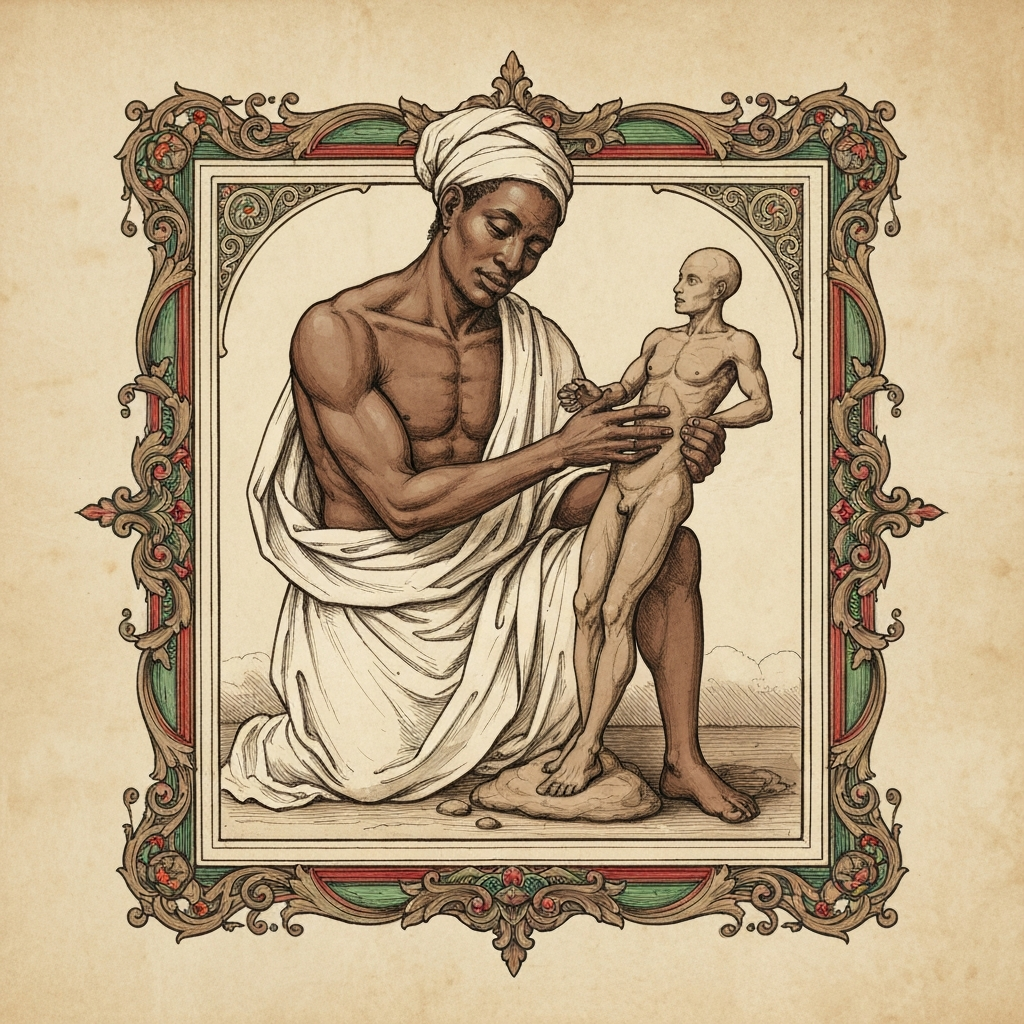
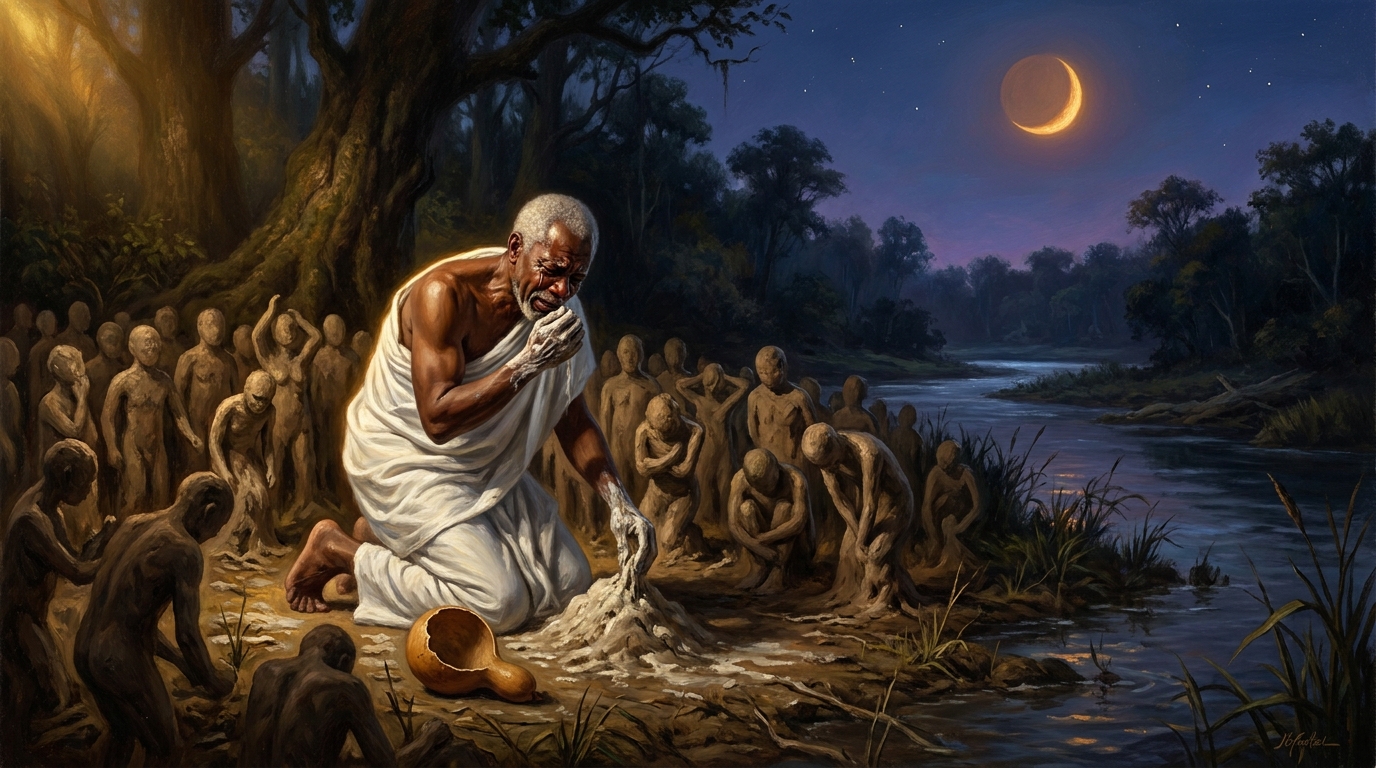
Obatala kneels at the riverbank where the clay is best — slow river, white clay, the kind that holds a fingerprint without cracking. He works the way a potter works, palm and thumb, palm and thumb. He shapes a head. He shapes shoulders. He shapes a man, and he leaves the man on the bank to dry, and Olodumare leans down out of the sky and breathes — and the man stands up.
The work is good. Obatala makes another. Then another. Then, because the day is long and the river is patient, he takes a clay pot of palm wine to the bank with him.
The wine is white, like his cloth. Like the foam at the river’s edge. He drinks a little to steady his hands. He drinks a little more because the sun is hot. By the third gourd, his thumbs have begun to argue with his palms.
He keeps shaping.
A leg comes out shorter than its partner. He shrugs and keeps going. A spine bends where it should be straight. He smooths it with his thumb and the smoothing makes it worse. An eye comes out blank, milk-white, the color of his own cloth — he stares at it for a long time and cannot decide whether he has made a mistake or a self-portrait. He sets the figure down with the others.
By dusk he has made a hundred. Some are straight. Some are not. He does not yet know which is which. Olodumare leans down and breathes, and a hundred people stand up on the riverbank, and only then does Obatala see, sober now, what his hands have done while the wine was holding the brush.
He weeps.
He weeps the rest of the night, and into the morning, and the river runs white past his knees with the tears and the wine and the leftover clay. Some of the people he has made walk away on uneven legs. Some cannot walk at all and crawl. One, with the milk-white eye, sits beside him and does not leave.
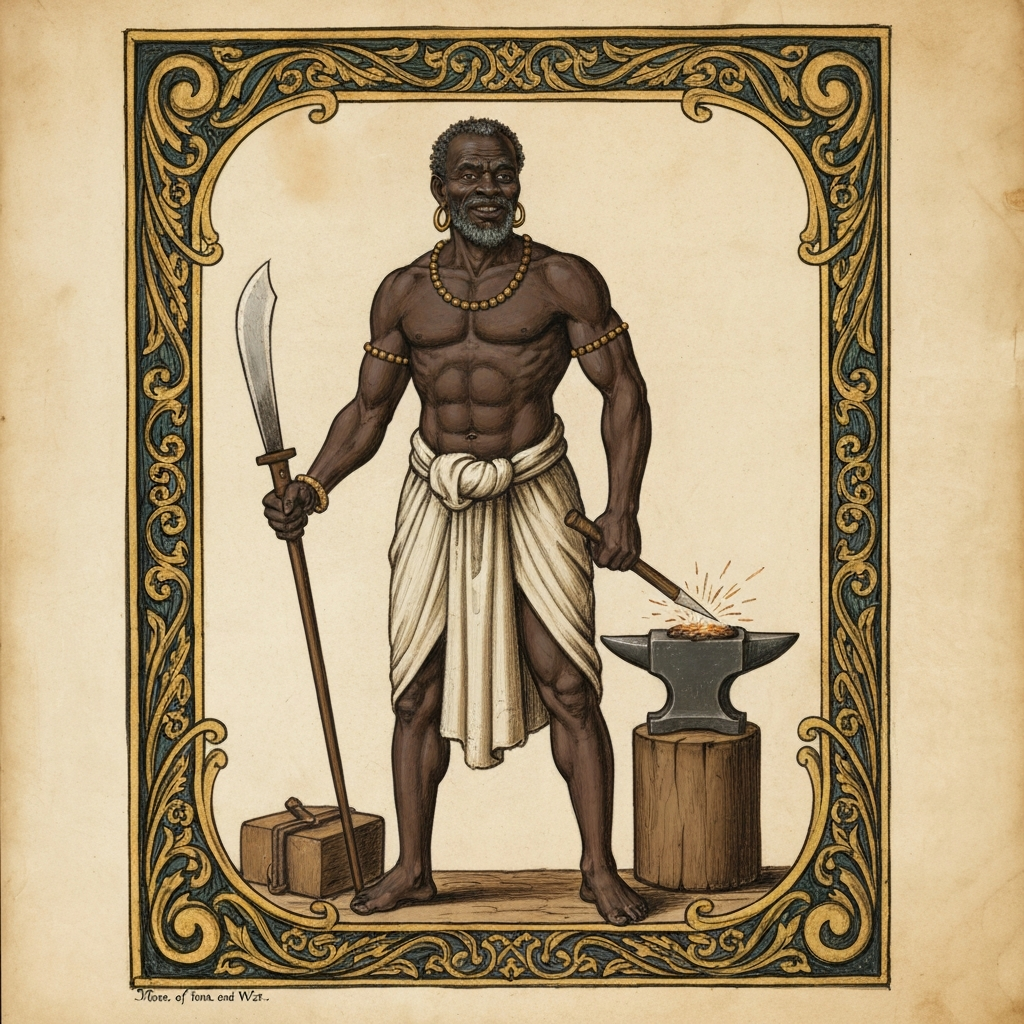
He swears, then, on his white cloth — the cloth that is the color of innocence and the color of the wine that ruined the work — that he will never drink palm wine again. (He keeps the oath. His priests keep it for him. To this day a worshipper of Obatala touches no palm wine, ever, on pain of being struck blind by the orisha’s own grief.)
And he swears a second oath, larger than the first: that the people he made crooked are not failures. They are Eni Orisa — people belonging to the orisha. Sacred. Under his protection forever. Anyone who mocks them mocks him. Anyone who shelters them shelters him.
The work continues.
Other orisha come down the chain. Oduduwa contests the kingship of Ile-Ife with him and, depending on which lineage tells the story, wins. Eshu watches from the crossroads and laughs, because Eshu always laughs. The world fills with kings and farmers and hunters and twins.
But the first carving is the carving that matters. Every Yoruba child learns it: the world was made by a god who got drunk while making it, and the proof of his work is walking among us — uneven, beloved, holy. The straight-limbed are not better than the crooked-limbed. They are only the figures Obatala happened to shape before the third gourd.
Most creation myths flatter the creator. The Yoruba one indicts him — and then, in the same breath, builds a permanent ethic of compassion out of the indictment. The disabled are not punished by Obatala. They are protected by him, because he knows whose hand slipped.
It is one of the few theologies in the world that admits its god was tired, was thirsty, was working too long, and made the kind of mistake any craftsman makes — and then refuses to throw the mistake away.
The white cloth Obatala wears is the cloth of that admission. It is also the cloth of the oath that followed. Both are the same color, because in Yoruba thought, repentance and innocence are made of the same thread.
Scenes
Obatala descends the iron chain from Olodumare's sky-house, sack of soil under one arm, the five-toed white rooster under the other
Generating art… The rooster scratches the heaped soil outward in every direction across the primal water
 Generating art…
 Riverbank at dusk
 Generating art…
 Echoes Across Traditions
Entities
- Obatala
- Olodumare
- Oduduwa
- Eshu

Sources
- William Bascom, *The Yoruba of Southwestern Nigeria* (1969)
- Wande Abimbola, *Ifá: An Exposition of Ifá Literary Corpus* (1976)
- E. Bolaji Idowu, *Olódùmarè: God in Yoruba Belief* (1962)
- Robert Farris Thompson, *Flash of the Spirit* (1983)