Bachué Walks Out of the Lake
Mythic time · Muisca origin tradition · recorded by Pedro Simon, 1623; Lucas Fernandez de Piedrahita, 1688 · Lake Iguaque, Boyacá Department, Colombia
Contents
From the cold depths of Lake Iguaque in the Colombian highlands, Bachué emerges carrying a small boy in her arms. She waits for him to grow, marries him, and together they fill the world with children. When the earth is populated, she leads her husband back to the lake, and both become great serpents and disappear. She is the mother of all the Muisca people — and she is still in the lake.
- When
- Mythic time · Muisca origin tradition · recorded by Pedro Simon, 1623; Lucas Fernandez de Piedrahita, 1688
- Where
- Lake Iguaque, Boyacá Department, Colombia
She stands in the water and watches the boy grow.
The years at Lake Iguaque have a quality unlike years anywhere else — the high-altitude lake in the Boyacá highlands of Colombia sits at more than 3,000 meters, ringed by cloud forest that catches the mist from both sides of the Andes, its water cold and dark and very clear. The clouds come low here. The air is wet and green. Bachué stands in the shallows at dawn and watches the boy she brought from the lake’s depth grow into a man, and she is patient the way that water is patient: not in the absence of force but in the understanding that force applied continuously, over time, shapes everything.
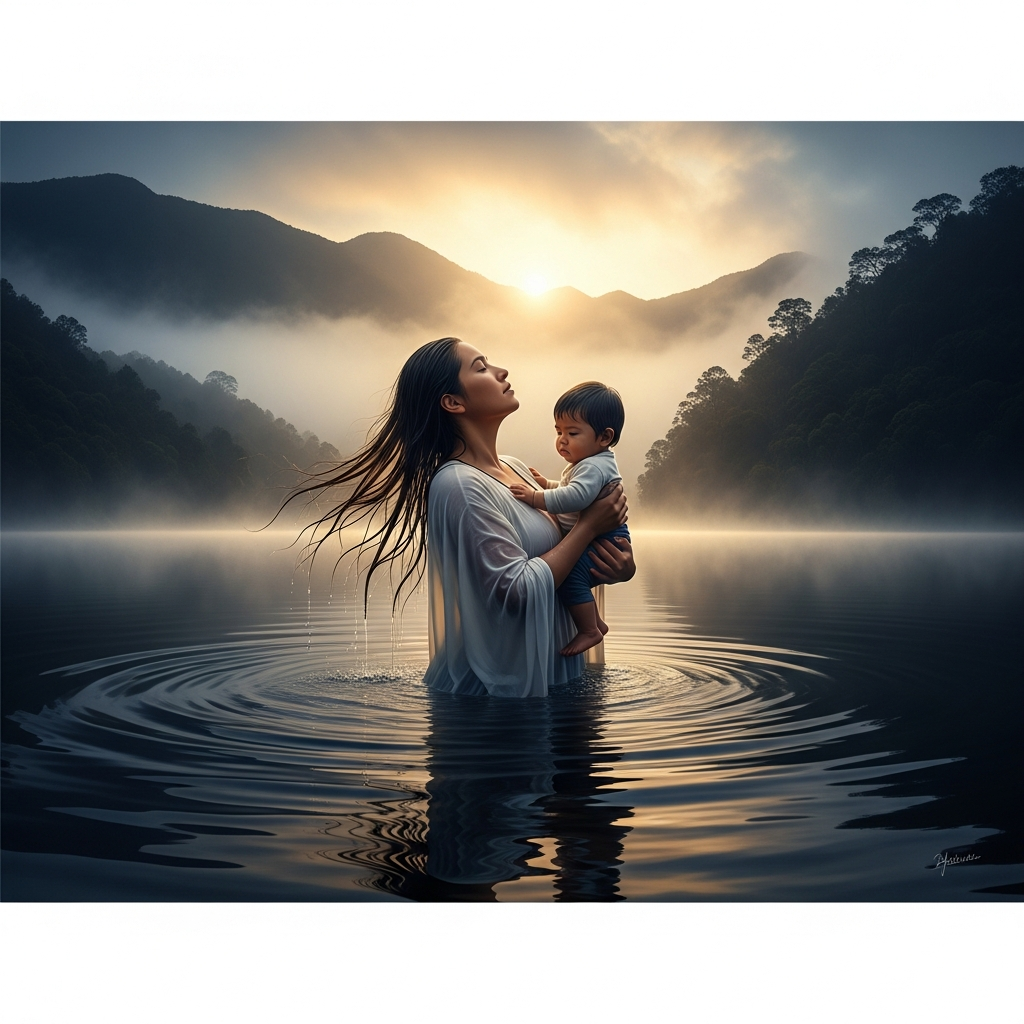
She carried him when she emerged. This is the image the Muisca sources preserve most vividly — the woman rising from the depths of the sacred lake, water streaming from her hair, and in her arms a small boy, awake and calm, looking at the cloud forest around the lake with the alert expression of someone who has been expecting exactly this. The boy’s name is not given in most versions of the myth; Pedro Simon, writing in 1623 from Muisca oral accounts, calls him only the child, the companion, the one who would become her husband.
The waiting is part of the story. She does not hurry it. She tends the boy, teaches him, watches him grow through childhood and adolescence into a young man, and when he is grown she marries him, and the marriage is the act of creation: every child they have together is a new Muisca person, and they have very many children.
The sources are specific about her productivity.
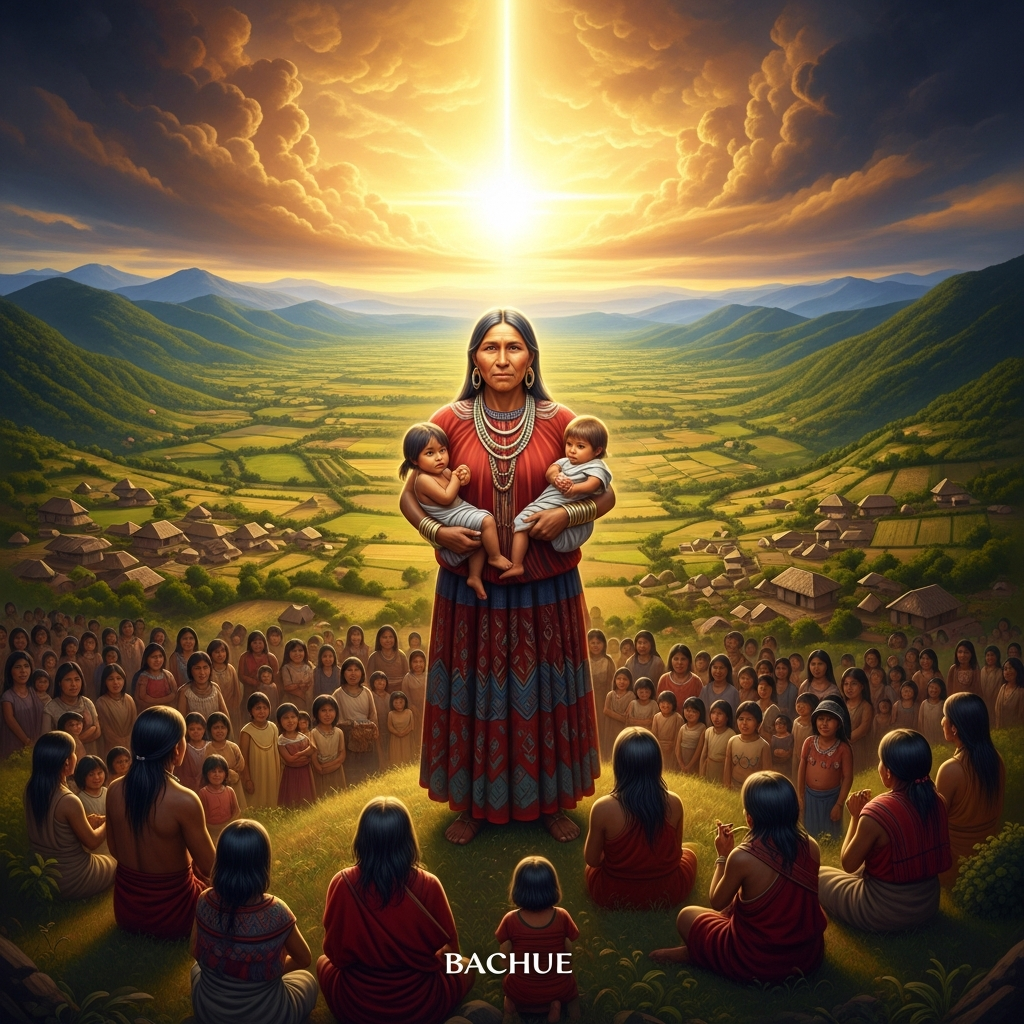
Pedro Simon’s account, drawing on testimonies from the Muisca communities of the Bogotá savannah in the early 17th century, records that Bachué and her husband produced between four and six children with every pregnancy, and that they traveled continuously — not staying at Lake Iguaque but moving through the highlands, settling each valley and plateau with the people they produced. The Muisca territory at its greatest extent covered most of what is now the Colombian Andean interior: the Bogotá savannah, the valleys of Boyacá and Cundinamarca, the highlands toward the Venezuelan border. This is not a small territory. The number of children required to populate it, over the span of Bachué’s life, is staggering.
The sources do not find this staggering. They find it appropriate. Bachué is not a woman who has many children — she is the mother whose nature is to be the source of humanity, and being the source of humanity is simply what she does, the way the lake is simply wet. The mythic logic is not quantitative. It is qualitative: she is the one from whom the Muisca come, and all the mathematics follow from that.
Furachogua — the name given to the boy-husband in some versions, meaning something like “good man” or “man of goodness” — is a gentle presence in the myth. He is not the creative force; she is. He is the partner, the collaborator, the human complement to the divine feminine power that Bachué embodies. Their marriage is not the subordination of one to the other but a working relationship between the divine source (Bachué, from the water) and the human recipient (Furachogua, raised in the world she created). Their children are the result of this collaboration.
She teaches the laws.
The Muisca sources — fragmentary as they are, filtered through the Spanish chroniclers who recorded them primarily to understand what they were supposed to suppress — indicate that Bachué’s role was not only generative but legislative. As she traveled through the highlands populating the territory, she also established the rules of the society that would inhabit it: the laws around marriage, around property, around the correct relationship with the sacred places. The Zipa and Zaque, the two major Muisca paramount chiefs whose courts the Spanish encountered, traced their legitimacy through genealogical lines that eventually ran back to Bachué.
She is, in other words, both the origin of life and the origin of law — the source not only of the Muisca people’s bodies but of the structure by which those bodies would organize themselves. The mother who populates the world is also the architect of the world she populates.
This dual role — creative and legislative — is typical of founding mother figures across many traditions, and it matters theologically because it means that the social order is not a human invention layered onto a natural world but a feature of the original design. The laws are not rules that Muisca society developed through trial and error. They are the instructions that Bachué gave when she gave the people themselves. To violate the laws is not merely social transgression. It is an act against the mother who made you.
When the world is full, she returns.
This is the movement of the myth that most distinguishes it from comparable origin stories: Bachué does not disappear because she dies, or because she is displaced by the gods she created, or because she withdraws in anger. She leaves because her work is complete. The world is populated. The laws are established. The genealogies that will structure Muisca society for the centuries to come are in place. There is nothing more to do.
She calls her husband. She leads him back to Lake Iguaque.
The Muisca community gathers at the shore — not because they knew she was coming, but because they felt it, the way communities feel the movements of the sacred even when they have no rational explanation for the feeling. They watch her walk to the water’s edge. They watch her husband follow. They watch Bachué turn and speak to them — the accounts do not agree on exactly what she says, but the substance is consistent: honor the sacred places, maintain the offerings, do not forget where you came from.
Then she walks into the water.
And at the water’s edge, the transformation begins.
The serpent form is not a punishment or a diminishment.
This needs to be said explicitly because the Christian cosmology through which the Spanish missionaries read the myth associated the serpent with the Fall — with Satan, with deception, with the enemy of the human. The Muisca serpent is not the enemy of the human. It is the form that divine beings take when they return to the water, the way that a river takes the form of a river when it reaches the sea. Bachué and Furachogua become serpents because serpents are the form of water-dwelling divine power, because the nage (water serpent) is the being of the sacred lake, because the great mother who came from the water returns to the water in the form appropriate to that domain.
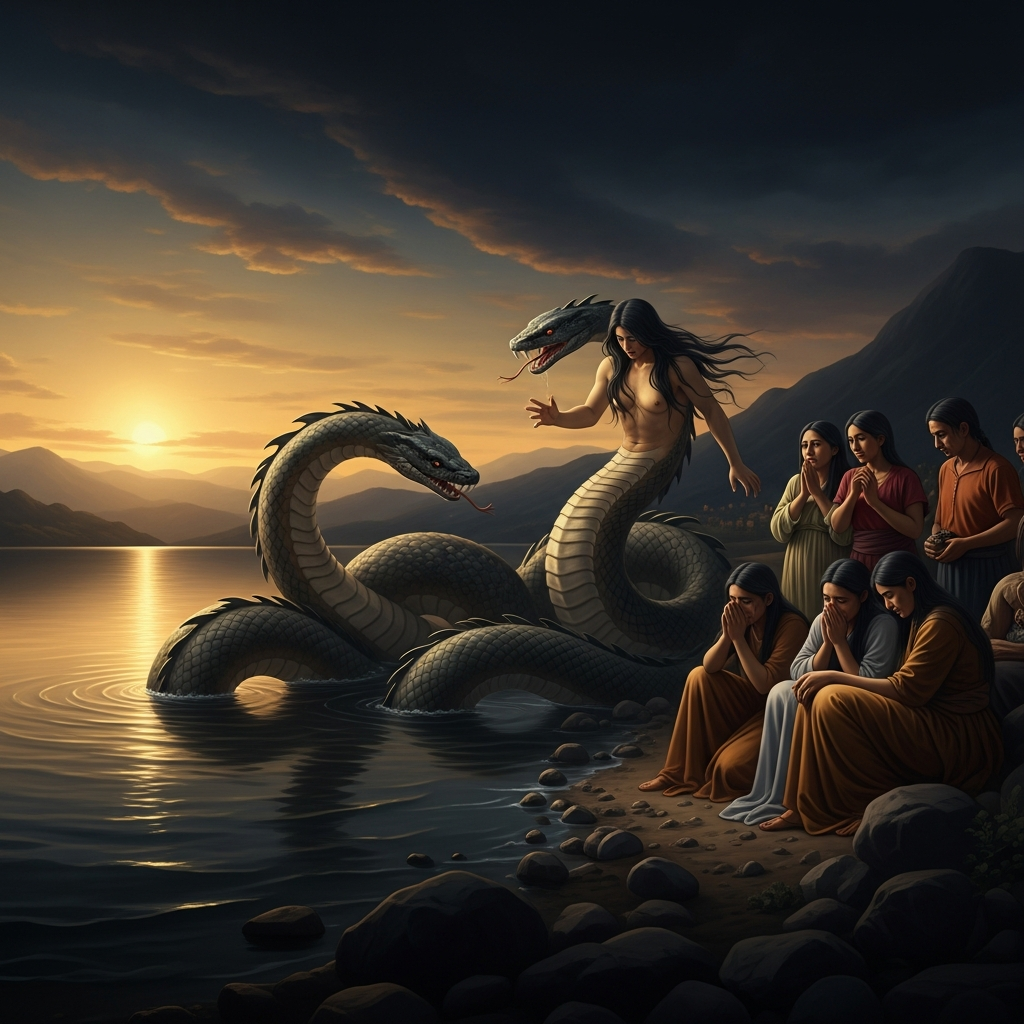
The community on the shore watches both figures transform — skin to scale, limbs to coil — and enter the lake, the dark water accepting them without disruption, without splash, with the quiet completeness of a thing returning to its proper place. The surface closes above them.
She is still there.
This is the theological position the Muisca maintained — and that Muisca descendants maintain — about Lake Iguaque: she did not leave. She transformed and entered, and the lake is her. When you make offerings at the shore of the sacred lake (the Muisca threw offerings of gold and other sacred materials into its waters), you are not sending gifts to a distant deity. You are giving directly to the presence that inhabits the lake, the mother who chose this body of water as her home.
Lake Iguaque today is a protected natural sanctuary and UNESCO biosphere reserve in the Boyacá Department of Colombia. The cloud forest surrounding it is largely intact. Muisca-descended communities, and people who claim Muisca heritage through centuries of mestizaje, still make pilgrimages to the lake. The road to it passes through the town of Villa de Leyva and climbs into high paramo grassland, and the lake itself is cold and quiet and the water is very dark.
The gold is related.
The Muisca are the people whose practice of offering gold to sacred lakes generated the legend of El Dorado. The Cacique Dorado — the golden chief — was an actual Muisca ritual: the zipa or his representative, covered in gold dust, would be floated on a raft to the center of Lake Guatavita (a different sacred lake, but of the same theological class as Lake Iguaque) and would pour the gold and other offerings into the water. The Europeans who heard of this practice understood it as the location of a golden city. The Muisca understood it as an offering to the divine presence in the water.
It was, theologically, the same gesture Bachué made when she returned to Lake Iguaque: the gold is given to the water because the water is where the divine power lives. The offering is the acknowledgment that wealth comes from the sacred source and returns to it — that the gold the Muisca extracted from the rivers and worked into the extraordinary tumbaga objects the Bogotá Gold Museum now holds was always ultimately the earth’s, and should be returned.
The Spanish drained Lake Guatavita searching for gold. They found some. They did not find enough, because the point of the offering was not to accumulate. The point was to give.
She is still in the lake.
The Muisca creation myth resists the template of divine withdrawal that many origin stories follow. The gods who make the world and then leave — who exist at a founding moment and then recede into myth — are a common feature of religious thought. Bachué is not this kind of god. She is in the lake. She has been in the lake since she walked into it, and the lake is in the Boyacá highlands, and the highlands are accessible by road, and the water is cold and dark and clear, and if you stand at the shore and look out at the surface you are looking at the body of water that is the home of the mother who made the Muisca people.
She left instructions. She established the laws. She said: honor the sacred places, maintain the offerings, do not forget where you came from.
The pilgrimages to the lake are not nostalgia. They are compliance.
Scenes
Bachué emerging from the cold dark water of Lake Iguaque at dawn — a beautiful woman rising from the lake surface carrying a small boy child, the high-altitude lake surrounded by cloud forest and morning mist, the Colombian Andes visible behind her, her wet hair flowing, the child awake and watching
 Generating art…
 Bachué surrounded by the growing families of the Muisca people she has borne — a lush highland valley filled with villages and cultivated fields, Bachué at center as a mature woman of dignity and power, children and grandchildren stretching to the horizon in every direction
 Generating art…
 Bachué and her husband Furachogua at the shore of Lake Iguaque at dusk — both transforming into great serpents, their bodies beginning to coil and scale, the Muisca community gathered on the shore weeping, the two serpent-forms sliding into the dark water and disappearing beneath the surface
 Generating art…
 Echoes Across Traditions
Entities
- Bachué
- Furachogua
Sources
- Pedro Simon, *Noticias Historiales de las Conquistas de Tierra Firme en las Indias Occidentales* (1623)
- Lucas Fernandez de Piedrahita, *Historia General de las Conquistas del Nuevo Reino de Granada* (1688)
- Libardo Trujillo Arbeláez, *Los Muiscas: Pasado y Presente* (Universidad Nacional de Colombia, 1986)
- Ana Maria Falchetti, *El territorio de los metales* (Banco de la Republica, Bogotá, 1995)
- Carl Henrik Langebaek, *Noticias de Caciques Muy Mayores* (Universidad de los Andes, 1987)