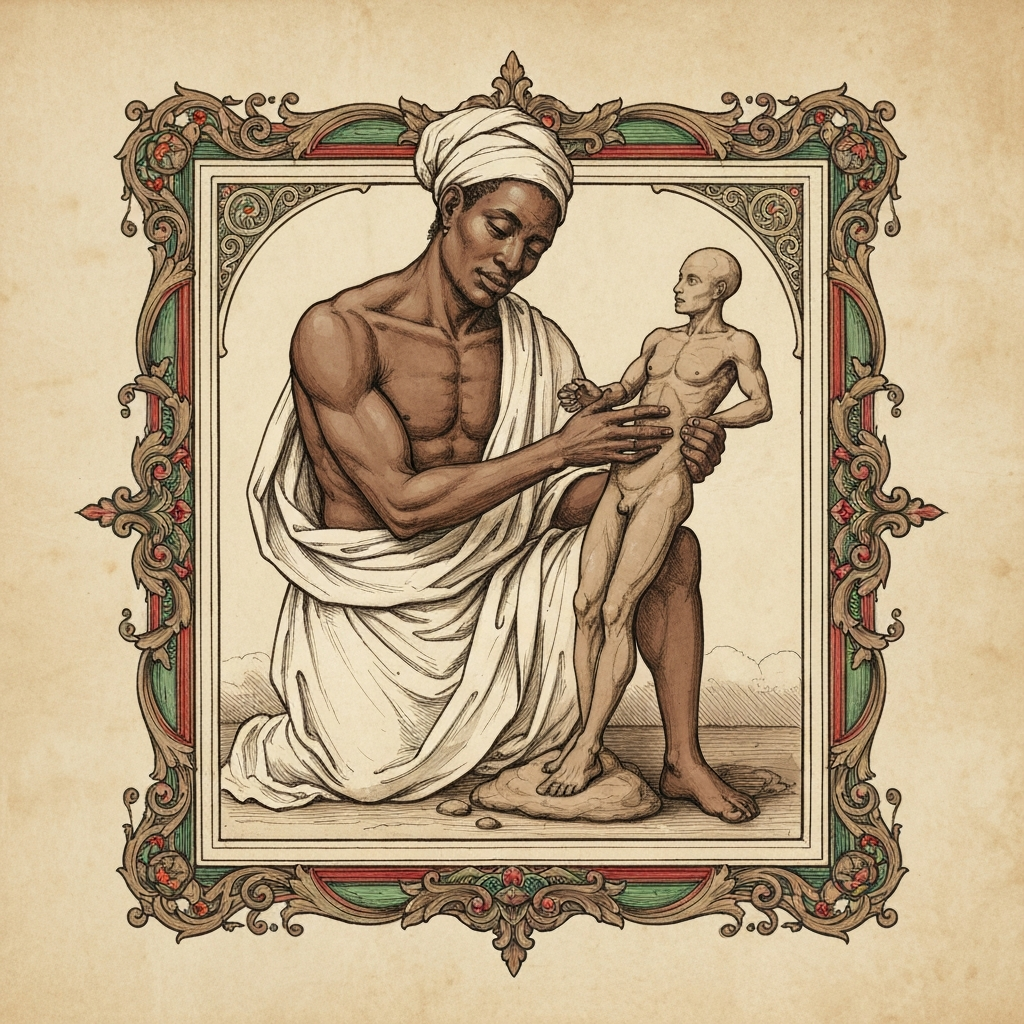
Oduduwa Descends the Iron Chain
In the beginning — Yoruba oral tradition, Southwest Nigeria · Ile-Ife, Osun State, Nigeria — the sacred city at the center of Yoruba cosmology
Contents
The world is water. Obatala is chosen to create the earth, given sand and a hen and a chain of iron. He drinks palm wine on the way down and arrives drunk. His younger sibling Oduduwa takes the chain and descends instead. The dispute over who made the earth has never been resolved.
- When
- In the beginning — Yoruba oral tradition, Southwest Nigeria
- Where
- Ile-Ife, Osun State, Nigeria — the sacred city at the center of Yoruba cosmology
In the beginning, everything is water.
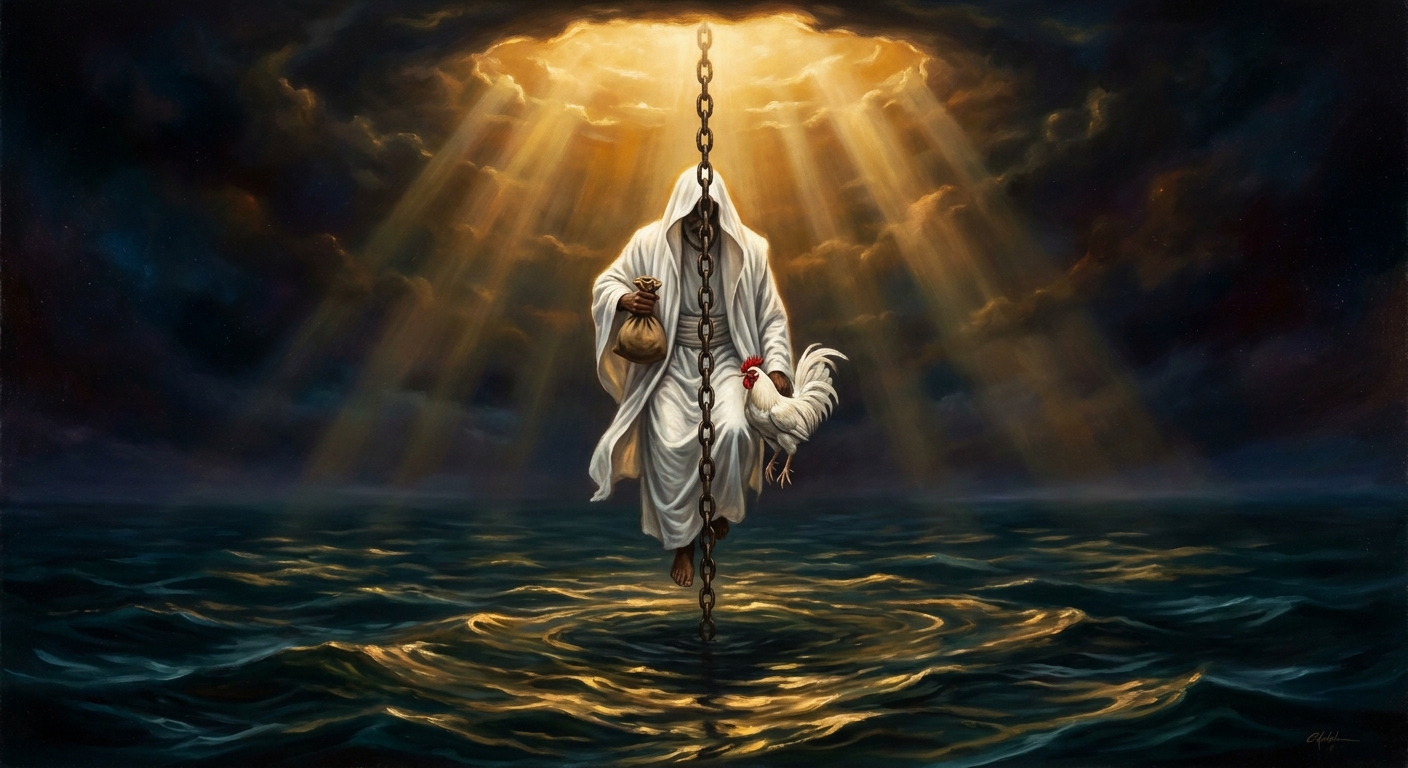
This is not metaphor. This is the condition. Look down from the sky — from the high place where Olodumare sits in the vast and absolute silence of the god who is too great to be named more specifically than this, the Owner of the Sky, the eternal one — and see water. Infinite, flat, gray-dark, without shore. Nothing grows in it. Nothing stands. The sky is bright and the water below is dark and between them is only distance and the iron chain that hangs from the sky’s edge, that no one has yet used.
Olodumare calls the orisa — the divine beings, the children of the sky who carry various portfolios of the holy — and he says: the earth must be made.
He chooses Obatala.
Obatala is the white god.
He is Orisa Nla, the great divinity, the orisa of creation and purity and the modeling of human forms. He is clothed in white. He drinks no palm wine. He eats no snails. He has no relationship with red things or dark things. He is the principle of uncorrupted form, the divine artist who shapes the human body from clay before Olodumare breathes life into it. There is no one better suited to the work of making the earth. He is precise, patient, clean.
Olodumare gives him the tools: a calabash gourd of sand — not much sand, a small amount, seemingly insufficient — and a five-toed hen to spread it. And an iron chain to descend on, because there is no other way down. The water is everywhere below and the sky is high and the chain is the only connection between them.
Orunmila the diviner reads the Ifa oracle for Obatala before he leaves. Orunmila reads the odu — the pattern of the divination, the configuration of the sixteen cowries — and the pattern says: sacrifice. The pattern says specifically: do not drink palm wine on the journey. Orunmila tells Obatala this. Obatala nods. He is the god of purity. He does not drink palm wine. This is not a difficult instruction.
He begins to descend.
The chain is long.
It goes down from the sky’s edge past the clouds, past the place where the air begins to thicken, past the level where the birds fly, down and down into the distance between the sky’s warmth and the gray water below. Obatala climbs down hand over hand, his white garments moving in the air of descent, the calabash with the sand at his side and the hen tucked under his arm.
On the way down, he passes the other orisa who are making offerings of palm wine along the chain. They are celebrating his mission. They offer him a cup. He takes it. He takes another. The descent is long. The palm wine is good. He is the god of purity — but he is also a god, and gods, it turns out, are not immune to the particular logic of a long journey and good company and a cup that keeps being refilled.
By the time he nears the water, Obatala’s head is heavy.
He is drunk.
He is not severely drunk — not incapacitated, not unable to hold the chain — but he is the god of precision and he is not precise. His eyes are not quite focused. The water below him shimmers and shifts and he cannot tell the exact distance. He hangs on the chain above the primordial water with the sand gourd and the hen and the entire project of creation in his hands, and he is not in a condition to execute it.
He hangs there.
Oduduwa has been watching.
Oduduwa is younger — or older, depending on which lineage is telling the story, and this ambiguity is part of the point. He is Obatala’s sibling, though the nature of that relationship is something the traditions negotiate with considerable tension. He has been watching the whole journey from above, and he can see what Obatala cannot: that the god of purity is drunk on the chain, hanging above the primordial water, unable to act.
He does not wait for permission.
He takes the calabash of sand. He takes the five-toed hen. He begins his own descent — moving past Obatala on the chain, passing him in the way that someone passes a person who has stopped moving in a corridor, carefully, without saying much. He descends to the point just above the water and he pours the sand.
It falls onto the water. It does not sink. It spreads.
Then he releases the hen.
The hen lands on the sand mound and begins to scratch, the way hens always scratch — with the particular focused intensity of a bird that is always excavating for something slightly beyond the horizon of what it can see. It scratches and the sand moves, and where the sand moves it spreads further, and where it spreads further it becomes more solid, and the mound grows outward in all directions, and what was a single point of sand on the surface of infinite water becomes a widening disk of earth.
This is how the world is made.
The first solid land is in the center. The Yoruba call the place Ile-Ife — the house of expansion, the source-place, the center from which all else radiates. Everything that exists, every society, every lineage, every city, every forest and river and road traces its origin point back to that mound of sand, scratched wide by a five-toed hen, in the hands of a god who was not the one who was supposed to be there.
Obatala sobers.
He descends the rest of the chain. He steps onto the new earth. He sees what Oduduwa has done and he does not speak for a long time. The earth is beautiful — the hen has made it wide, and the sand has settled into soil, and things are already beginning to grow where the soil has depth. He did not make it. He was supposed to make it. He was given the tools and the mission and the instruction and he drank palm wine when the oracle told him not to and he hung above the primordial water drunk while his sibling took the chain from his hands.
He does not deny any of this. Obatala is the god of honesty as much as the god of purity.
But he was chosen. Olodumare chose him. The calabash of sand was given to him. The hen was given to him. The authority — the divine commission to make the earth — was his, and authority does not automatically transfer to the person who acts in its place. Oduduwa made the earth. But Obatala was the one who was supposed to make it. What does it mean that the making and the authority were separated by the length of time it takes a god to drink too much palm wine on a long chain?
This question does not resolve.
The Yoruba live in the aftermath of the unresolved question.
Obatala is worshipped as the creator of human forms — he molds the body from clay before Olodumare breathes life into it, and this is a creative act that belongs to him by both commission and practice. He is the patron of people born with disabilities, because on the days when he has drunk palm wine he makes their bodies wrong, and he knows it, and he carries the knowledge of that error with the particular grief of a god who understands his own flaw.
Oduduwa is worshipped as the creator of the earth — the one who poured the sand, released the hen, generated Ile-Ife. He is the ancestor of all the Yoruba kings. Every ruling lineage in Yorubaland traces its descent from Oduduwa. The land itself, the solid ground under every foot — this is his legacy, this is the evidence of his act, and no subsequent argument about authority changes the fact that he was the one who did it.
Both traditions are true. Both are honored. The priests of Obatala and the priests of Oduduwa negotiate their relationship the way the traditions always have — with ceremony, with precedence, with the careful maintenance of boundaries that acknowledge that both gods made something, and that what each made is essential, and that the story of their making is not one that permits a clean resolution.
The earth is solid. The question of who made it is not.
The chain still hangs from the sky’s edge. No one has taken it down. On certain nights, when the clouds are low and the sky seems very close, the Yoruba know the chain is still there — the iron link between the sky and the earth, the thread along which Obatala hung drunk and along which Oduduwa descended to do what needed to be done.
Somewhere above the clouds, Olodumare still sits in his silence.
He does not adjudicate. He watches. He is too great to be named more specifically than the Owner of the Sky, and the Owner of the Sky has seen everything that happens below it, including the entire dispute, and has not settled it.
Some things the high god allows to remain open.
In Ile-Ife today, at the sacred groves and the bronze-casting precincts and the palace shrines, the priests still carry both traditions simultaneously. Obatala was chosen. Oduduwa acted. The earth exists because someone did the work, and it is complicated because the wrong someone did it, and it is holy because in the end the work was done. This is the Yoruba understanding of how things get made: imperfectly, with disputed credit, and permanently.
Scenes
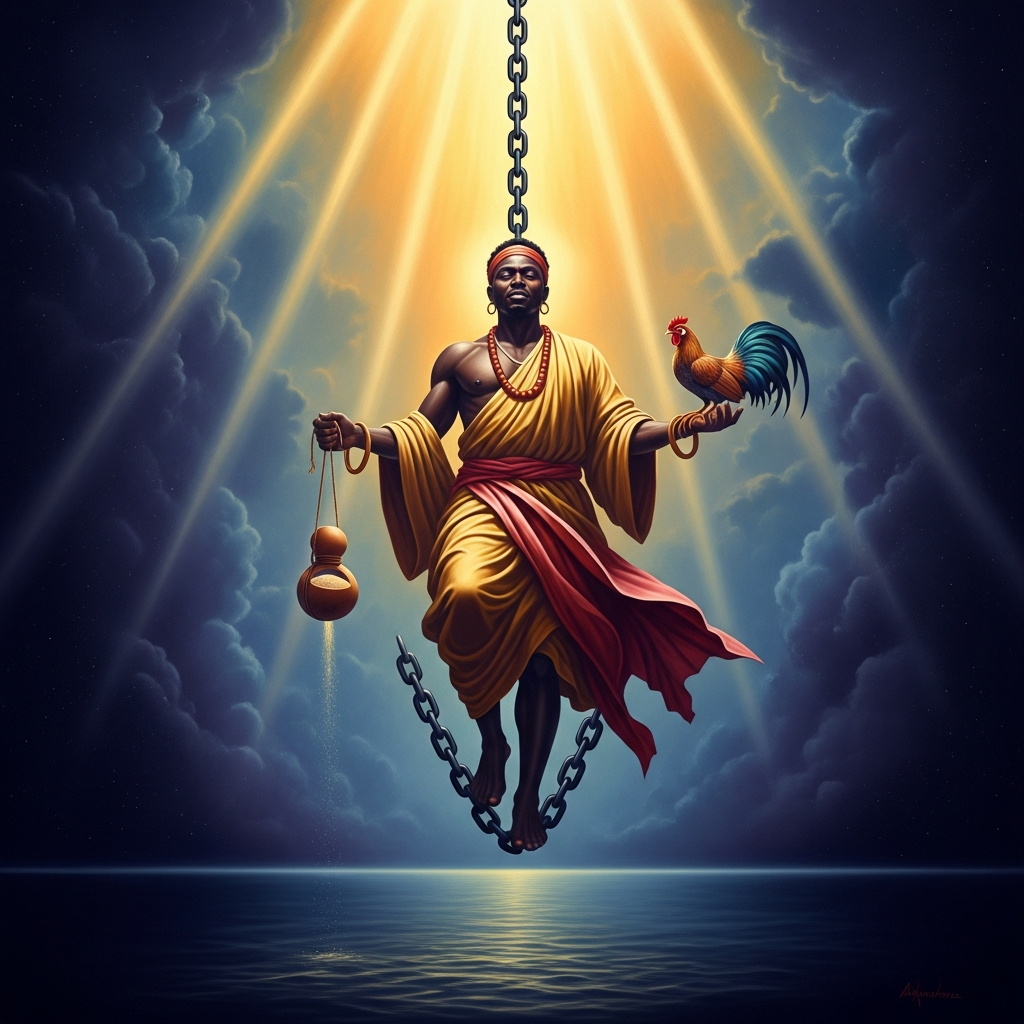
Oduduwa descends the iron chain from the sky — a figure of immense composure, the gourd of sand at one side and the five-toed hen at the other, the primordial waters stretching infinite below
 Generating art…
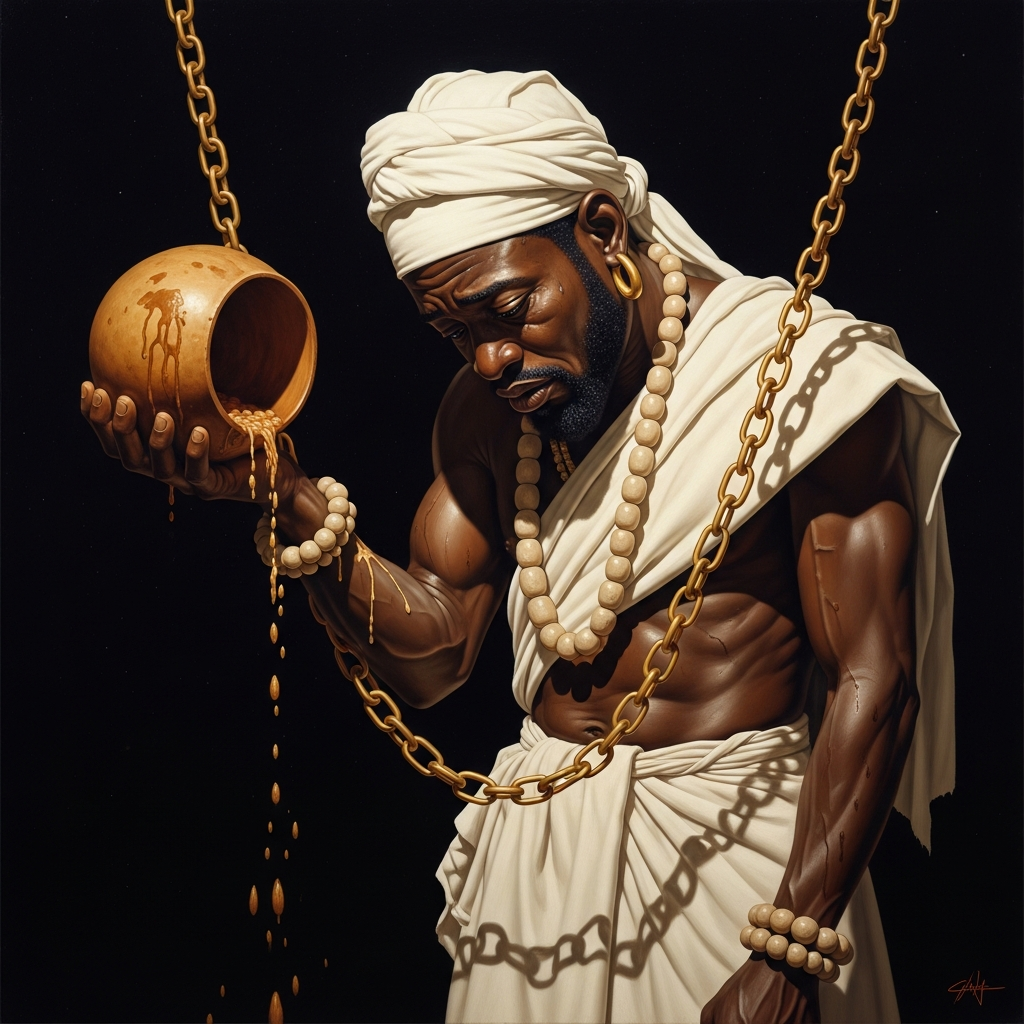
 Obatala on the chain, head heavy, the calabash of palm wine tilted — the white god who was given the first task and could not wait until the work was done to drink
 Generating art…
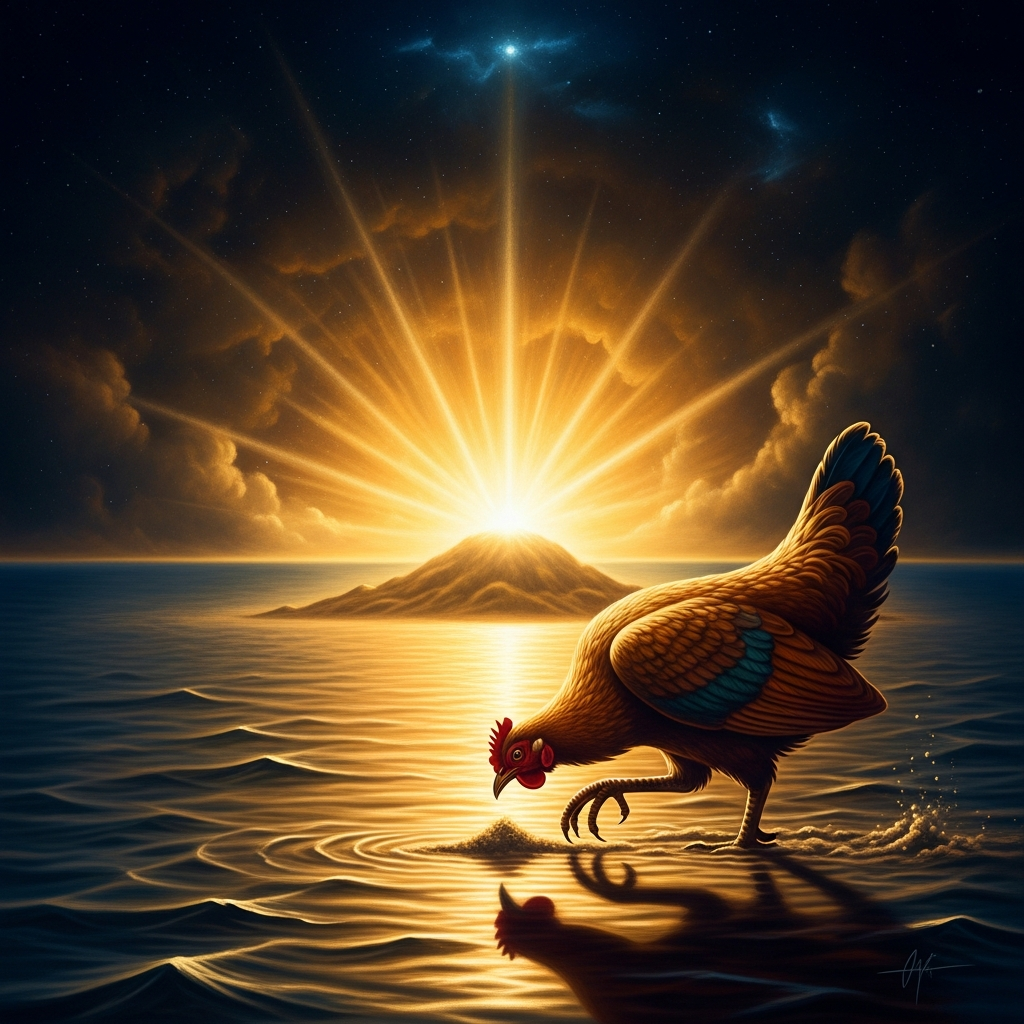
 The five-toed hen scratches the sand across the surface of the waters, and earth spreads outward from a single mound at the center — the place the Yoruba call Ile-Ife, the source of existence
 Generating art…
 Echoes Across Traditions
Entities


Sources
- Samuel Johnson, *The History of the Yorubas* (CMS Bookshops, 1921)
- E. Bolaji Idowu, *Olodumare: God in Yoruba Belief* (Longmans, 1962)
- Wande Abimbola, *Ifa Will Mend Our Broken World* (Aim Books, 1997)
- Jacob K. Olupona, *City of 201 Gods: Ile-Ife in Time, Space, and the Imagination* (University of California Press, 2011)
- Toyin Falola and Ann Genova, eds., *Orisa: Yoruba Gods and Spiritual Identity in Africa and the Diaspora* (Africa World Press, 2005)