Mansur al-Hallaj and the Gallows
Abbasid Caliphate, Baghdad - 26 March 922 CE · Baghdad — the prison below the Tigris watermark, the court of the Abbasid vizier, the gallows ground at Bab al-Taq
Contents
Baghdad, 922 CE. The wool-carder who cried Ana al-Haqq — I am the Truth — goes to his execution calm as a man attending a wedding. The theologians call it heresy. The mystics call it the logical endpoint of fana. Both are right, and neither is.
- When
- Abbasid Caliphate, Baghdad - 26 March 922 CE
- Where
- Baghdad — the prison below the Tigris watermark, the court of the Abbasid vizier, the gallows ground at Bab al-Taq
The question is simple, and nobody in Baghdad can answer it.
It is not a question of law. The lawyers have already answered it. It is not a question of theology. The theologians answered it years ago, when al-Hallaj first walked into the marketplaces and said the sentence aloud. The question is something else, the kind of question that sits behind the verdict and refuses to dissolve when the execution is over.
The question is: what happens when a man annihilates himself in God so completely that the only voice left is God’s?
Junayd of Baghdad — the most careful Sufi alive, a man who has built an entire career on saying the dangerous thing in the safe way — was asked this when al-Hallaj was still free. He must be killed, Junayd said. But according to the outer law, not the inner one. Even Junayd will not say al-Hallaj is wrong. He says al-Hallaj has said out loud what the inner law requires to be kept silent.
This is the distinction that condemns a man to death.
Al-Hallaj has been saying it for twenty years.
Ana al-Haqq. I am the Truth. Al-Haqq — the Truth — is one of the ninety-nine names of God. In Arabic grammar the sentence is unambiguous: the speaker identifies himself with the divine name. The lawyers hear this as the worst form of shirk, the association of the created with the Creator. The sentence is blasphemy. The sentence is, in the Maliki reading, a capital offense.
But the mystics hear something else. They have been circling the doctrine of fana for a century — the annihilation of the self in God that the earliest Sufis described as the goal of all prayer and all contemplation. Bayazid of Bistam cried subhani — glory be to me — in the ecstasy and was excused because he was clearly in a state the law could not reach. Al-Hallaj is not in ecstasy when he says it. He says it in the marketplace. He says it in the courtroom. He says it standing still, eyes clear, voice level, as if reporting an observable fact.
This is the part that cannot be forgiven.
He has been in prison for nine years when they bring him out.
The cell is below the Tigris flood mark. In high water the floor is wet. He has converted three of his guards. He has written, on paper smuggled in by the guards he has converted, the Kitab al-Tawasin — short chapters that will not be fully understood for centuries. In one of them, Iblis — the Satan — becomes a tragic monotheist. Iblis refused to prostrate before Adam when God commanded it. The lawyers read this as the ultimate sin. Al-Hallaj reads it as the ultimate devotion: Iblis loved God too purely to bow to anyone else. He is wrong, al-Hallaj concedes, but he is wrong out of love, and love wrong is closer to the truth than obedience correct.
The theologians who read this understand at once why he must die. Not because he defends Iblis. Because the logic of fana, taken to its endpoint, makes every human act either love or its absence, and the law cannot survive in a world where love is the only criterion.
The warrant is signed. The caliph al-Muqtadir is eighteen. He signs without reading.
They bring him out before dawn.
The crowd on the Tigris bank is in the thousands. Boats stop in the current. He is wearing a loincloth and a cloth wrap. His hair is white. He sees the gibbet and his face changes — not to fear, the chroniclers agree, but to something they struggle to name. The closest word is recognition.
He turns to the crowd. He says — loudly enough for the scribes to catch: For the one who knows the Truth, death is the gateway. The lover does not fear the door.
They take his hands. Right, then left. Each is a single stroke. When the blood comes, he lifts what remains of his wrists and rubs the blood across his face. Ablution, he says. The lover prays in the blood of the Beloved.
A scribe writes this down. The scribes are there because someone in the court knows that whatever al-Hallaj says at the gallows will be copied for a thousand years. They are correct.
Before they take his tongue, they offer him the last chance.
Hamid the vizier has come himself. The chief qadi is present. Recant, they say. Not the doctrine — the public utterance. Say a jinn spoke through you. Say you were in ecstasy and the law could not reach you. Say anything that leaves you on this side of the sentence.
He looks at them for a long time.
To affirm Oneness, he says, is to make Him One in oneself.
He pauses.
It is enough for the lover that he should make the One single.
The qadi writes the final verdict in the margin of his copy of the warrant. The vizier turns away. Ibn Ata, his oldest disciple, is in the crowd and has been weeping since the hands. At this sentence Ibn Ata begins to make a sound the chroniclers describe as not weeping — lower, more continuous, like a man whose chest has cracked and cannot close.
Within a year, Ibn Ata will be beaten to death for refusing to disavow his teacher. The price of love compounds in the Abbasid court.
They burn the body and scatter the ashes from the top of a minaret into the Tigris. No shrine. No relics. The administrative logic is sound: a body can become a pilgrimage site, and a pilgrimage site becomes a problem. Ash in a river becomes nothing.
But the question does not scatter.
Within a generation his sayings are being copied in Khorasan and Cairo and Cordoba. Within two centuries Rumi writes that al-Hallaj said only what every saint says, but he said it in the marketplace on a Wednesday, in plain Arabic, without the protection of metaphor. Within four centuries every major Sufi order has found a way to teach his doctrine while declining to quote it directly.
The wine-poems of Hafiz. The gazelle-poems of Ibn al-Farid. The sixty thousand couplets of the Masnavi. All of them are the sentence al-Hallaj said without a veil, now wearing veils — because the veil is what survives, and the unveiled thing is what the poets are pointing at.
The theology of fana says: when the self is fully annihilated in God, what remains is not nothing. What remains is God. Al-Hallaj arrived at this not as a doctrine but as a fact he reported from inside the experience. The report cost him everything.
The question the lawyers answered in 922 CE — was he guilty? — is not the question that has traveled. The question that traveled is the other one, the one Junayd would not answer directly:
Was he right?
Louis Massignon — a French Catholic Arabist — spent forty years on this question. He read every Arabic chronicle, every Sufi hagiography, every hostile refutation, every defense. He visited the prison site. He visited the gibbet ground. He converted to a deeper form of his own Christianity, he said, because al-Hallaj showed him what total self-offering looked like when it was not metaphor.
Massignon’s conclusion was not that al-Hallaj was a Muslim saint or a Christian proto-martyr. His conclusion was that the question itself — what is left when the self is gone? — is the question all mysticism is trying to answer, and that al-Hallaj answered it with his body on a Wednesday morning in 922, and that the answer is still in the water.
The ashes drifted to the sea. Some of them, the chronicles say, formed letters on the Tigris surface — Allah, Allah, Allah — before the current took them. Every chronicler who reports this also doubts it. Every chronicler reports it anyway.
That is the final form of the sentence: written in water, argued about forever, impossible to take back.
Scenes
On the gibbet above the Tigris crowd, al-Hallaj turns his severed wrists toward the dawn sky and performs ablution in his own blood, calling the act the only prayer the lover can offer
 Generating art…
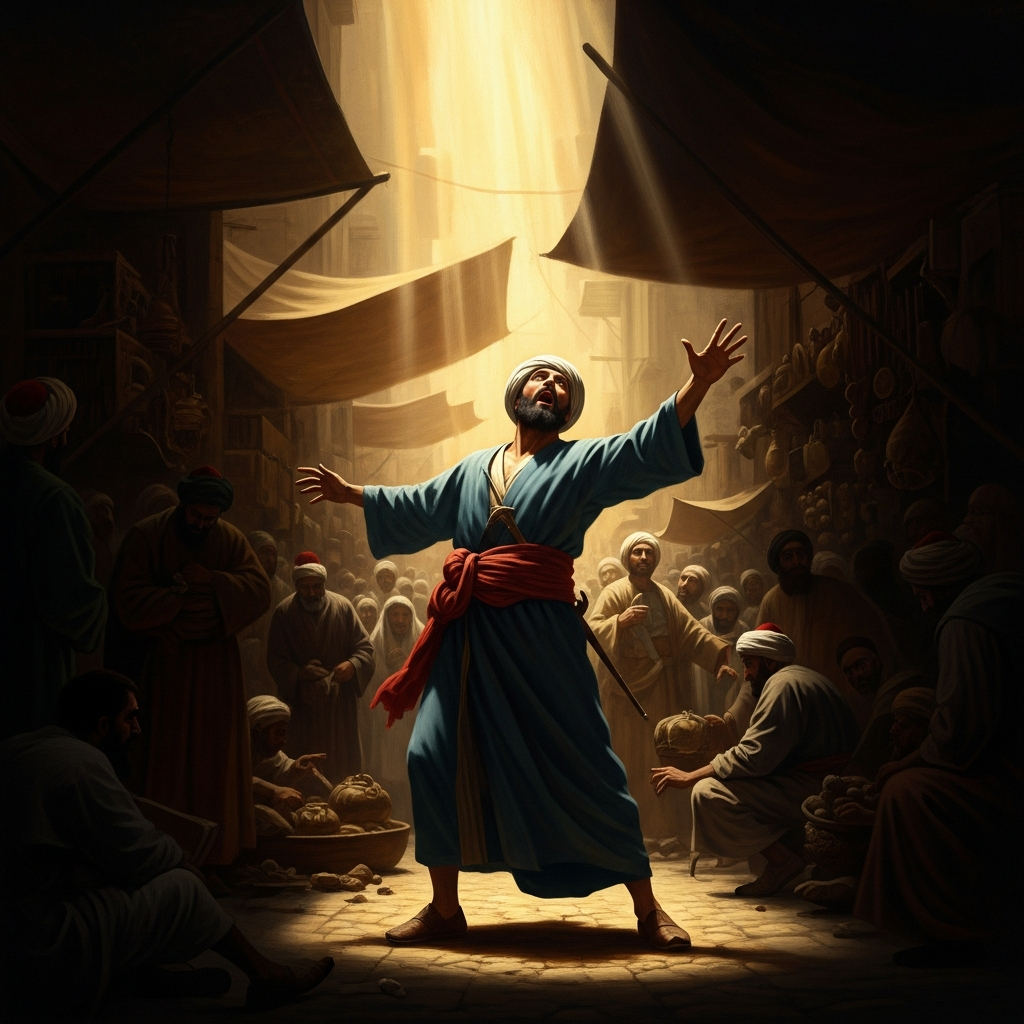
 In the Baghdad marketplace he stops mid-step and cries out Ana al-Haqq to no one and everyone, eyes wide with the shock of what is speaking through him
 Generating art…
 By lamplight in his flooded cell, al-Hallaj writes the Kitab al-Tawasin on smuggled paper — the chapters in which Iblis becomes a tragic monotheist who loved God too purely to bow to Adam
 Generating art…
 Echoes Across Traditions
Entities
- Mansur al-Hallaj
- Junayd of Baghdad
- Caliph al-Muqtadir
- Ibn Ata
- fana
Sources
- Louis Massignon, The Passion of al-Hallaj: Mystic and Martyr of Islam, trans. Herbert Mason (Princeton University Press, 1982) — 4 volumes, the foundational study
- Annemarie Schimmel, Mystical Dimensions of Islam (University of North Carolina Press, 1975), ch. 2
- Carl Ernst, Words of Ecstasy in Sufism (SUNY Press, 1985)
- Farid al-Din Attar, Tadhkirat al-Awliya (Memorial of the Saints), c. 1220, the Manaqib al-Hallaj chapter
- Al-Hallaj, Kitab al-Tawasin, trans. Aisha Abd al-Rahman Bewley (Diwan Press, 1974)