Ana al-Haqq: I Am the Truth
Abbasid Caliphate, Baghdad · 26 March 922 CE · Baghdad — the marketplaces, the Abbasid prison below the Tigris watermark, the gallows at Bab al-Taq
Contents
Al-Hallaj walks through the streets of Baghdad crying Ana al-Haqq — I am the Truth — which is one of the names of God. The lawyers call it blasphemy. The mystics call it the logical endpoint of union. After eleven years in prison, he is publicly flogged, mutilated, crucified, and his ashes scattered in the Tigris. He prays for his executioners. The question of whether he was right has not been settled.
- When
- Abbasid Caliphate, Baghdad · 26 March 922 CE
- Where
- Baghdad — the marketplaces, the Abbasid prison below the Tigris watermark, the gallows at Bab al-Taq
The question nobody in Baghdad can answer is not the one they are arguing about.
The question they are arguing about — is it legal to execute a man for saying Ana al-Haqq? — was answered years ago. The Maliki lawyers answered it. The Hanbali lawyers answered it. The Shafi’i lawyers are more cautious but they answer it too: the sentence Ana al-Haqq asserts that the created shares the nature of the Creator. This is shirk. Under the law of the Abbasid caliphate in the year 922, the answer is yes.
The question nobody can answer is the other one. The one Junayd of Baghdad — the most careful Sufi alive, a man who has built an entire career on saying the dangerous thing in safe language — was asked when al-Hallaj was still preaching in the streets. Junayd said: He must be killed. But according to the outer law, not the inner one. He would not say al-Hallaj was wrong. He said al-Hallaj had spoken out loud what the inner law requires to be kept silent.
That distinction — between the thing and the public saying of the thing — is the knife that divides all of Sufi history before this moment from all of it after.
His full name is Abu al-Mughith al-Husayn ibn Mansur al-Hallaj, but the name that follows him is simply al-Hallaj — the wool-carder — from his father’s trade in the city of Wasit. He is from Fars, Persian, provincial, not born into the Baghdad scholarly class that will eventually condemn him. He is apprenticed to several of the greatest Sufis of his generation: Sahl al-Tustari, who teaches him the inner dimensions of the Qur’an; Amr al-Makki, who eventually disowns him; and Junayd of Baghdad himself, whose school al-Hallaj attends and from whose orbit he is eventually expelled.
He makes the pilgrimage three times. He spends a year in Mecca standing barefoot in the heat for days at a time, speaking to no one. He travels to India, to Khorasan, to Transoxiana — the outer edges of the Islamic world at that moment. Everywhere he preaches. Everywhere he performs what the chronicles call miracles: healing, feeding, prophesying. Everywhere he makes enemies among the established scholars and converts among the common people.
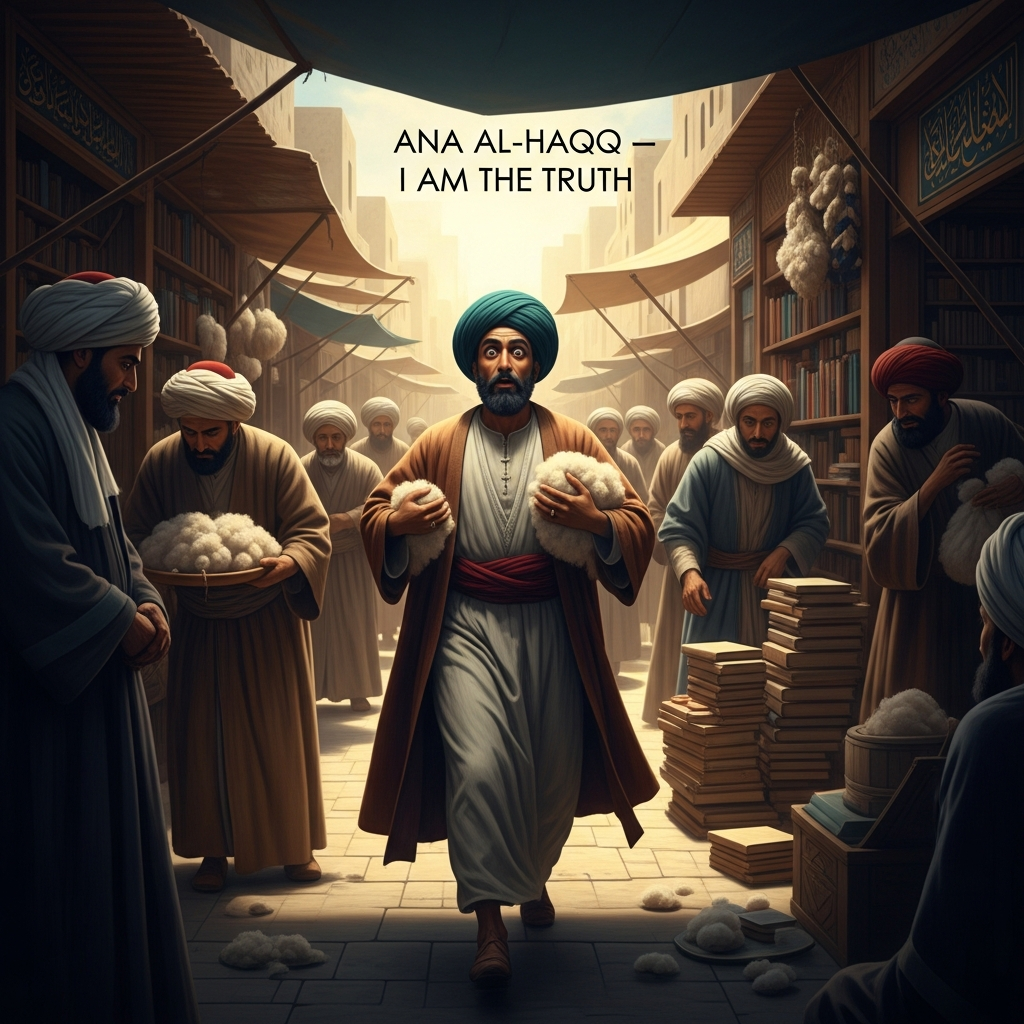
And everywhere he says it: Ana al-Haqq.
Al-Haqq — the Truth — is one of the ninety-nine names of God. In Arabic grammar the sentence Ana al-Haqq is unambiguous: the speaker identifies himself with the divine name. Not with a quality of God, not with a reflection of God, not with a metaphor for God’s presence. With the name itself.
Bayazid Bistami had said something like it a generation before: Subhani ma a’zama sha’ni — Glory be to me, how great is my majesty! He said it in ecstasy and was excused, because the law had a category for ecstatic utterance — shath, the overflow of mystical experience that should not be taken literally. Al-Hallaj does not say it in ecstasy. He says it in the marketplace, in the courtroom, standing still, eyes clear, voice level, as if reporting an observable fact about the nature of reality.
This is what cannot be forgiven. Not the content — the form. The form refuses the defense that would save him.
The doctrine he is working inside is called fana — annihilation. A century of Sufi practice had developed the idea that the goal of mystical discipline was the progressive dying of the ego: first the death of desire, then the death of will, then the death of the self’s claim to independent existence. At the far end of fana, the tradition said, what remains is God, because the self was always only a veil over the divine presence, and when the veil burns away, what is left is what was always there.
Al-Hallaj had arrived at the far end.
The dispute is not about whether fana is real. The dispute is about what you say when you get there. The established answer — Junayd’s answer — is that you say nothing, or that you say it in poetry, in metaphor, in the language of wine and drunkenness and the beloved that everyone understands to be speaking about something else. The metaphor is not dishonesty. The metaphor is protection — protection for the doctrine, protection for the community, protection for the man who has seen the thing.
Al-Hallaj had no patience for the metaphor. He believed that the protection the metaphor offered was also an evasion. That to speak Ana al-Haqq in private, at night, in the protected circle of the initiated, and to refuse to speak it in the marketplace, was itself a form of duplicity — a double life that contradicted the unity it was claiming to express.
Oneness, he would say, must be made one in oneself. You cannot hold fana in one room and the world in another.
The first arrest comes around 912. He is released. The second arrest follows the discovery of letters he has written — or is said to have written — that the authorities interpret as sedition. He is flogged. He is displayed in the marketplace in the stocks for three days, for public humiliation. He is returned to prison.
He is in prison for nine years.
The cell is below the Tigris flood mark. When the river runs high, the floor is wet. He is permitted visitors, at first, and then not. He converts three of his guards. He writes on paper they smuggle in. He writes the Kitab al-Tawasin — short chapters of compressed, radiant prose that will not be fully understood for centuries.
In one chapter, Iblis becomes a tragic monotheist. God commanded the angels to prostrate before Adam. Every angel obeyed. Iblis refused. The orthodox reading: ultimate disobedience, ultimate pride. Al-Hallaj’s reading: ultimate fidelity to monotheism. Iblis loved God too purely to bow to anything else. He saw Adam as a creature and refused to worship a creature. He was wrong — the command was from God, and the act of bowing would have been an act of obedience, not idolatry — but he was wrong out of love, and love wrong is closer to the truth than obedience without understanding.
The theologians who read this passage understand immediately why al-Hallaj must be executed. Not because he defends Iblis — but because the logic, extended, makes love the only criterion of any act. And the law cannot survive in a world where love is the only criterion.
The warrant is signed by the caliph al-Muqtadir, who is eighteen years old. He signs without reading. The political logic is the vizier’s: al-Hallaj has popular support in Baghdad’s poorer quarters, and popular support for a mystic who speaks of divine union is always a step away from popular support for a political alternative to the caliphate. The theological charge is genuine but the political anxiety is genuine too. Both are reasons enough.
Junayd has already given his legal opinion. Ibn Ata, al-Hallaj’s closest disciple, will refuse to disavow his teacher. Within a year of the execution, Ibn Ata will be beaten to death for this refusal. The price of loyalty compounds in the Abbasid court.
They bring him out before dawn on the 26th of March, 922.
He walks from the prison to the Bab al-Taq gate. The crowd on the Tigris bank is in the thousands. Boats stop in the current. He is in a loincloth and a wrap, white-haired, sixty years old. He sees the gibbet.
His face changes. The chroniclers struggle to name what they see. Not fear, they all agree. Something closer to recognition.
He turns and addresses the crowd. The scribes are positioned to catch every word, because someone in the court has understood that whatever al-Hallaj says today will be copied and disputed for a thousand years. He says: For the one who knows the Truth, death is the gateway. The lover does not fear the door.
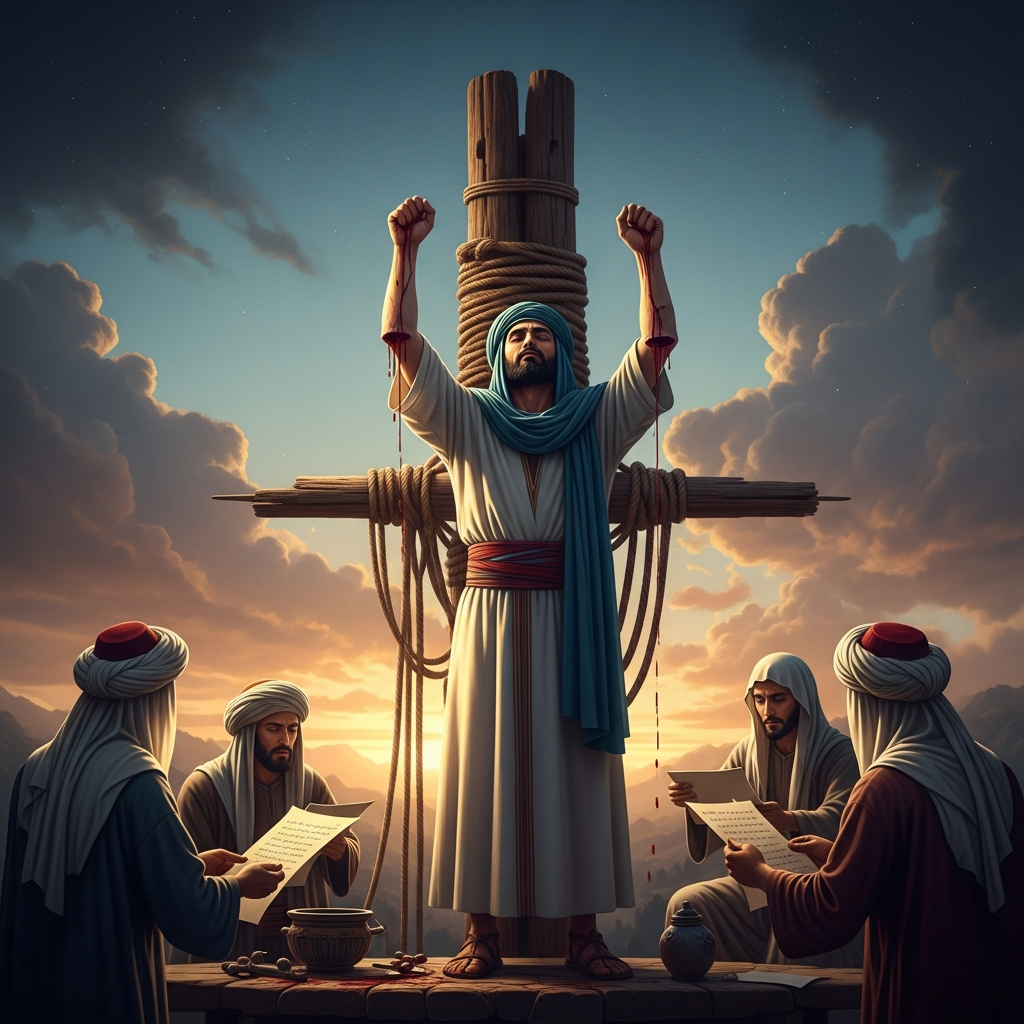
They take his right hand. A single stroke. Then his left. He lifts the stumps and rubs the blood across his face. Ablution, he says. The lover has no ritual purity except in the blood of the Beloved. A scribe writes this down, hand shaking.
They cut his feet. They beat him. Before the final blow, the vizier’s representative comes forward with the formal offer: recant the public utterance. Not the doctrine. Not even the experience. Just say a jinn spoke through you, or that you were in a state the law cannot reach. Say anything that keeps you on this side of the sentence.
Al-Hallaj looks at him.
To affirm Oneness, he says, is to make Him One in oneself. He pauses. It is enough for the lover that he should make the One single.
The qadi records the final verdict.
What he says in prayer, before the end, is what the chroniclers most argue over. The version in Attar’s Memorial of the Saints — written two centuries later but drawing on early sources — has him pray for his executioners. Not as a gesture of forgiveness, but as a statement of theology: These are your servants, gathered in your name, acting in your name. They see no path except the path you have placed before them. Lord, if you had shown them what you have shown me, they would not have done this. If you hide from them what you have hidden from me, I forgive them.
The prayer, if he said it, is the final form of the doctrine. Not I forgive them despite what they have done. I forgive them because they are exactly as trapped by your will as I am, and the difference between us is only what you have chosen to reveal.
They hang the body. They burn it. They scatter the ashes from the top of a minaret into the Tigris, so there will be no shrine, no relics, no pilgrimage site. The administrative logic is correct: a body becomes a problem. Ashes in a river become nothing.
But the question does not scatter.
Within a generation, his sayings are being copied in Khorasan and Cairo and Cordoba. Within two centuries, Rumi writes that al-Hallaj said only what every saint says, but said it in the marketplace without the veil. Within four centuries, every major Sufi order has found a way to teach his doctrine while declining to quote it directly.
The wine-poems of Hafiz. The sixty thousand couplets of the Masnavi. The gazelle-poems of Ibn al-Farid. All of them are Ana al-Haqq wearing veils, because the veil is what survives, and the unveiled thing is what the poets are pointing at through the veil.
Louis Massignon — the French Catholic Arabist who devoted forty years to al-Hallaj, who visited the prison site, who stood on the bank of the Tigris where the ashes fell — concluded not that al-Hallaj was a Muslim saint or a Christian proto-martyr. He concluded that al-Hallaj answered, with his body, the question that all mysticism is trying to answer: what is left when the self is completely gone? And that the answer, written in blood and scattered in water, is still moving through every tradition that has ever asked it.
Some chronicles say the ashes formed letters on the Tigris surface — Allah, Allah, Allah — before the current took them. Every chronicler who reports this also doubts it. Every chronicler reports it anyway.
Ana al-Haqq is the sentence that fana produces when it is taken seriously. The sentence says: I have died the death the tradition was describing, and what is left is not me, and what is not me says that it is the Truth, and the Truth is the name of God.
Every mystical tradition has a version of this claim. The Vedanta calls it Aham Brahmasmi. The Christian mystics call it union with Christ. The Jewish Kabbalists call it devekut taken to its limit. The Zen Buddhists call it the moment when there is no one left to answer the koan. All of them arrive at the threshold al-Hallaj stepped over.
The difference is that al-Hallaj said it in the street, in plain Arabic, on a weekday morning, to people who were not prepared to hear it.
Whether he was right is the question the lawyers settled in 922 and the mystics have been reopening ever since. The ashes are still in the river. The question is still in the ashes.
Scenes
In the Baghdad marketplace, al-Hallaj stops mid-step and speaks Ana al-Haqq — I am the Truth — to no one and everyone, eyes wide with the shock of what is speaking through him
 Generating art…
 Nine years below the Tigris flood mark, writing the Kitab al-Tawasin on paper smuggled in by the guards he has converted
 Generating art…
 On the gibbet at Bab al-Taq, al-Hallaj raises what remains of his severed wrists toward the dawn sky and performs ablution in his own blood
 Generating art…
 Echoes Across Traditions
Entities
- Mansur al-Hallaj
- Junayd of Baghdad
- Caliph al-Muqtadir
- fana
- Ana al-Haqq
Sources
- Louis Massignon, *The Passion of al-Hallaj: Mystic and Martyr of Islam*, trans. Herbert Mason (Princeton University Press, 1982)
- Annemarie Schimmel, *Mystical Dimensions of Islam* (University of North Carolina Press, 1975)
- Carl Ernst, *Words of Ecstasy in Sufism* (SUNY Press, 1985)
- Farid al-Din Attar, *Tadhkirat al-Awliya* (Memorial of the Saints), c. 1220
- Al-Hallaj, *Kitab al-Tawasin*, trans. Aisha Abd al-Rahman Bewley (Diwan Press, 1974)