The Brotherhood of Silent Breath
Timurid Central Asia, Bukhara - c. 1430 CE · Bukhara in the Timurid Mawarannahr — crossroads of the Silk Road, center of Islamic scholarship, heartland of the Naqshbandi order
Contents
Bukhara, 15th century. A Naqshbandi master teaches his student the practice of dhikr khafi — silent remembrance, the repetition of God's name in the heart rather than the tongue. The difference between the prayer that stops when you stop praying and the prayer that continues while you sleep.
- When
- Timurid Central Asia, Bukhara - c. 1430 CE
- Where
- Bukhara in the Timurid Mawarannahr — crossroads of the Silk Road, center of Islamic scholarship, heartland of the Naqshbandi order
The teacher asks the student a question before the lesson begins.
When you finish the evening prayer, he says, where does the prayer go?
The student considers. He has been studying for three years. He knows enough to be careful. It goes to God, he says. The words ascend.
And when you stop saying the words?
The prayer is finished.
Then you have not yet learned to pray, the master says, and the lesson begins.
His name, in the chronicles, is given as Yusuf — a student in the circle of Khwaja Ahrar in fifteenth-century Bukhara, one of several young men studying under the most influential Naqshbandi teacher of the Timurid age. Ahrar owns more land than the sultan and wields more influence than any minister, which puts him in the paradoxical position of the Naqshbandi masters generally: a brotherhood committed to the inward over the outward, which nonetheless becomes the hidden governor of empires.
But the student Yusuf does not know this yet. He knows that he has been assigned, for the last three months, to the practice of vocal dhikr — la ilaha illa Allah, there is no god but God, repeated with each breath, aloud, as the Qadiri and Chishti masters teach it, filling a room with sound, filling the hours before dawn with the sound, until the sound fills the practitioner and what remains of ordinary thought grows thin.
He is good at this. He has the capacity for sustained attention that the practice requires. He sleeps four hours. He eats one meal. His lips move constantly in the bazaar and the lecture hall, below the level of hearing.
Today the master takes it away.
Stop, Ahrar says. Just that. Stop saying it.
Yusuf stops. The silence is strange — not empty but suddenly audible, as if the room has its own sound that the dhikr was covering.
Now, the master says, say it again. But this time, say it only in the heart. The tongue does not move. The lips do not move. The breath is the only thing that moves.
This is dhikr khafi. Hidden remembrance. Silent remembrance. The Naqshbandi distinction that separates the order from every other major Sufi brotherhood: where the Qadiris chant aloud, where the Chishtis sing, where the Mevlevis spin and cry — the Naqshbandis are silent. In a room of practicing Naqshbandis, you would hear nothing. You would see men and women sitting still, eyes sometimes open, breathing. Nothing more.
The practice looks like nothing. This is the first difficulty.
The second difficulty is the breath.
Ahrar teaches Yusuf the Naqshbandi system: the inhalation carries the word la ilaha — there is no god, the negation, the stripping away of every false object of worship. The pause at the top of the breath is the moment of emptiness, the cleared space. The exhalation carries illa Allah — except God, the affirmation that fills the cleared space with the only thing that was ever there.
So each breath is a complete theology, Yusuf says.
Each breath is a complete act of worship, Ahrar says. You have been performing an act of worship ten thousand times a day since birth, without knowing it. The practice is not to add something new. It is to realize what the breath has always been doing.
Yusuf tries this for the rest of the afternoon and into the evening. It is harder than the vocal dhikr in one way and easier in another. Harder because there is no sound to hold on to, no rhythm to follow with the body, no community of voices to be carried by. Easier because it does not require a special time or place. You can do it in the bazaar. You can do it while talking, the tongue shaping words about grain prices while the heart underneath shapes the divine name.
You can do it while sleeping, Ahrar says, and Yusuf does not understand this yet.
The question that divides the masters is not whether silent dhikr is valid. The question is what it is for.
The older understanding, which the Naqshbandis inherit from Baha ud-Din Naqshband himself — the fourteenth-century Bukharan master whose name the order bears — is that dhikr khafi is the most complete form of remembrance because it requires no external condition. You can be in jail. You can be in a noisy marketplace. You can be in the presence of an enemy who would harm you for practicing. The prayer is invisible. It cannot be taken. It continues when everything else is stripped away.
But Ahrar teaches a deeper version. The dhikr khafi that must be consciously maintained is still, in his understanding, a technique. A discipline. A practice. The goal is not the practice. The goal is what the practice points toward: the state in which remembrance is no longer something you do but something you are.
There is a prayer that stops when you stop, he tells Yusuf. And there is a prayer that continues while you sleep. The first kind is called a practice. The second kind is called a station.
How do you arrive at the station?
You practice until the practice falls away. You repeat the name until the repetition ceases to be repetition — until the name is not something said but something lived.
Three weeks later, Ahrar comes to Yusuf’s room in the middle of the night.
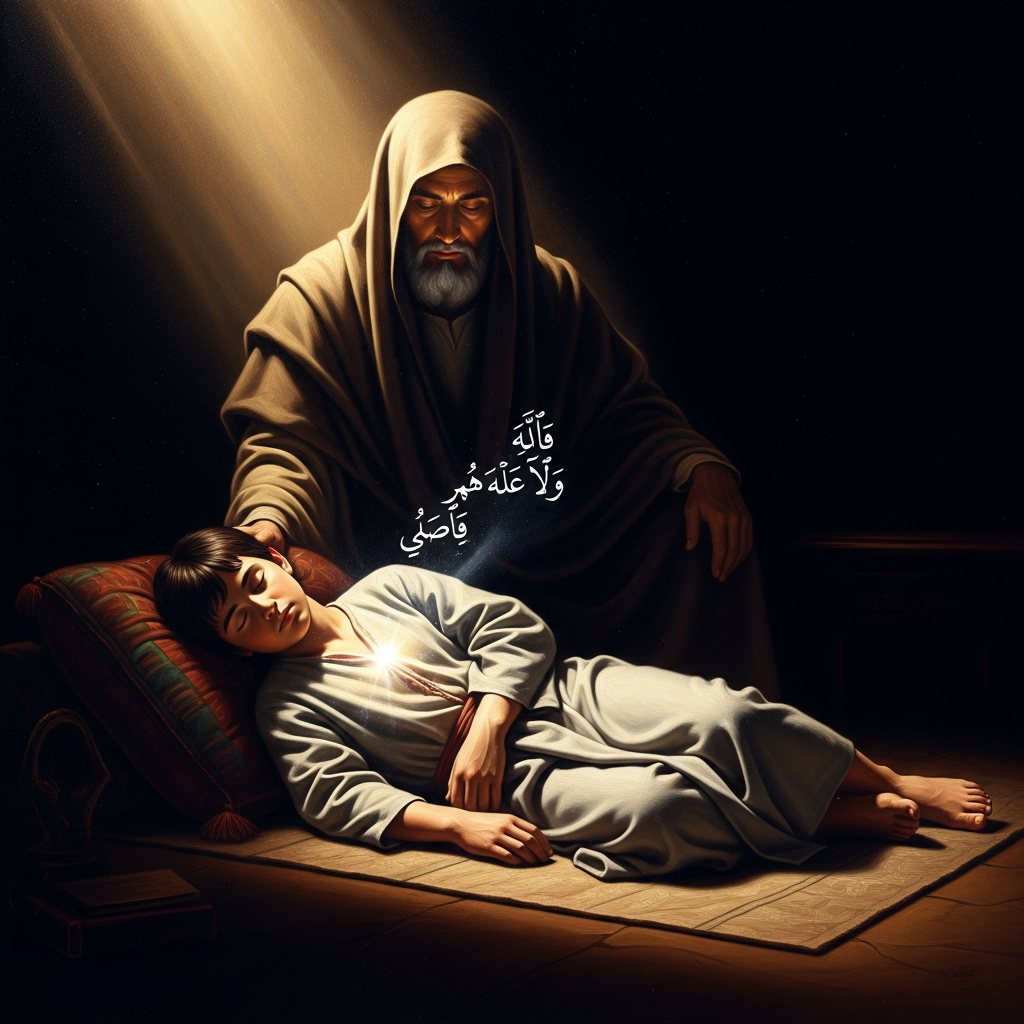
The student is asleep. Ahrar stands in the doorway and watches him breathe. He does not wake him.
In the morning, when Yusuf rises and comes for the lesson, Ahrar asks: What were you doing last night?
Yusuf lists the ordinary things of sleep. He was not aware of anything.
Your breath was not ordinary, the master says. Your breath was saying the name. While you slept.
Yusuf is quiet. He does not know how to receive this.
You did not do anything, Ahrar says. This is the important part. You were not practicing. You were asleep. The practice had settled deep enough that the body continued it without you. This is the beginning of what we mean by the station.
He pauses.
The prayer that stops when you stop is yours. The prayer that continues while you sleep belongs to God. At some point in the practice, the prayer transfers ownership. You stop praying and the prayer continues praying, and the distinction between you and the prayer begins to become unclear.
This is the Naqshbandi theology of the ordinary.
Where al-Hallaj shouted the divine name in the marketplace and was executed for the volume of it, where Rumi spun in the courtyard and wept for the absent beloved, where Ibn Arabi constructed metaphysical systems in fourteen volumes — the Naqshbandis are quiet. They are shopkeepers and farmers and government ministers. They live in the world. They are not visibly distinguishable from ordinary men and women.
The invisibility is the practice.
The Naqshbandi master Baha ud-Din said: the outward is with the creation, the inward is with the Truth. The order does not withdraw from the world. It teaches the student to carry the world and the inward at the same time, until the distinction between the sacred time of prayer and the ordinary time of work and sleep begins to dissolve.
Yusuf learns to eat with the name. He learns to walk with the name. He learns to sit in the lecture hall listening to a discussion of grain law while the heart underneath is occupied with something that is not grain law. Eventually he learns to sleep.
He does not know when it happens. This is also part of the teaching: the transition from practice to station is not an experience you can report. If you are aware of it happening, it has not yet happened. The prayer that has truly transferred ownership continues below the level of awareness.
The Naqshbandi order spreads from Bukhara throughout the Islamic world in the fifteenth and sixteenth centuries. It becomes the dominant Sufi brotherhood in the Ottoman Empire, in Mughal India, in Central Asia, in China’s Muslim communities, and eventually in West Africa and Southeast Asia. It produces political figures — Khwaja Ahrar himself negotiates between Timurid princes — and scholars and saints and, in the twentieth century, leaders of anti-colonial resistance.
What they have in common is not mystical fireworks. What they have in common is the breath.
In a Naqshbandi gathering in any city in any century, you would see a group of people sitting quietly together, doing something that looks like nothing. The air in the room would feel different. The silence would be different from ordinary silence. But you would need to be trained to notice even this.
Yusuf, late in his life, tries to teach the same lesson Ahrar taught him. He brings a new student and asks the question.
When you finish the evening prayer, where does the prayer go?
The student thinks. He is careful. He knows enough to suspect the question.
I am not sure, he says finally.
Good, Yusuf says. That is the beginning.
The dhikr khafi controversy — whether silent remembrance is superior to, inferior to, or simply different from vocal dhikr — was never fully resolved. The Qadiris and Chishtis maintained that the vocal practice builds community, carries emotion, and produces the ecstatic states that are the markers of genuine spiritual progress. The Naqshbandis maintained that the ecstatic state is a stage, not a goal, and that a practice depending on sound and emotion is a practice that cannot be maintained in silence, in prison, in the ordinary hours.
Both sides were correct, for different students, at different stages.
But the Naqshbandi argument has a particular edge: if your prayer requires favorable conditions, then the conditions are doing part of the work. The prayer that continues while you sleep requires nothing from you at all. You are not doing it. It is doing you.
This is the prayer the master was pointing at. The prayer that does not stop because you have stopped being the one who prays.
Scenes
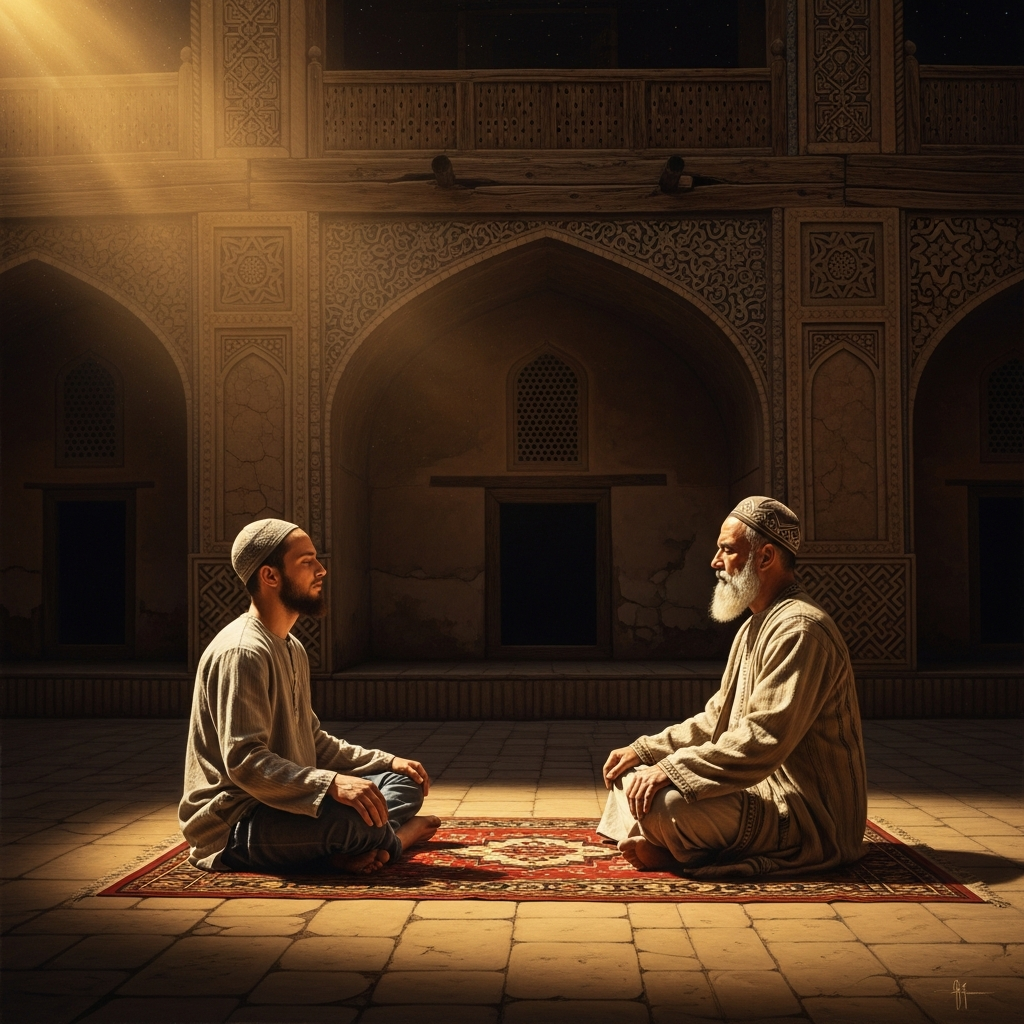
In a Bukhara courtyard at dusk, master and student sit facing each other, eyes open, breathing — the room so quiet that the only sound is two men doing the thing that has no sound
 Generating art…
 On a teaching cloth spread in the madrasa, the master traces the path of the breath through the body — the inhalation as negation, the exhalation as affirmation, the pause between as the moment of presence
 Generating art…
 The student sleeps on his mat
 Generating art…
 Echoes Across Traditions
Entities
- Khwaja Ahrar (Ubaidullah Ahrar)
- the Naqshbandi order
- dhikr khafi
- Baha ud-Din Naqshband
- Yusuf Naqshbandi
Sources
- Annemarie Schimmel, Mystical Dimensions of Islam (University of North Carolina Press, 1975), ch. 12 on the orders
- Hamid Algar, The Naqshbandi Order: A Preliminary Survey of Its History and Significance (Studia Islamica, 44, 1976)
- Baha ud-Din Naqshband, Anis al-Talibin wa Uddat al-Salikin (Companion of the Seekers), collected sayings, c. 14th c.
- Arthur Buehler, Sufi Heirs of the Prophet: The Indian Naqshbandiyya and the Rise of the Mediating Shaykh (University of South Carolina Press, 1998)
- Dina Le Gall, A Culture of Sufism: Naqshbandis in the Ottoman World, 1450-1700 (SUNY Press, 2005)