The Last Emperor Walks into the Battle
May 29, 1453 CE · Constantinople — the Theodosian Walls, the Gate of Saint Romanos (Topkapı), the Golden Horn, the Hagia Sophia
Contents
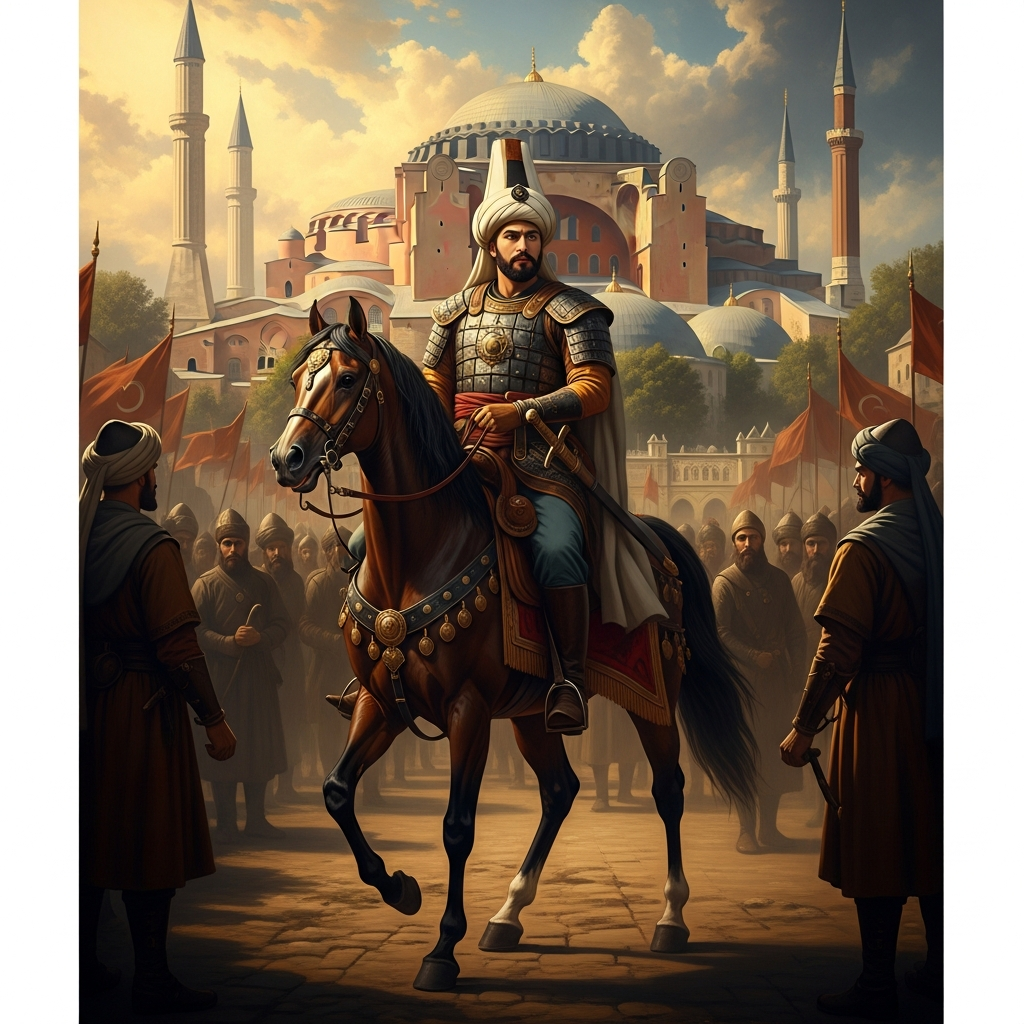
May 29, 1453. Twenty-one-year-old Sultan Mehmed II has besieged Constantinople for fifty-three days. The city that has not fallen in a thousand years is held by eight thousand against eighty thousand. At dawn the artillery breaches the Theodosian Wall. Constantine XI tears off his imperial insignia and charges into the breach on foot. No one finds his body. Mehmed enters at noon, rides to the Hagia Sophia, dismounts, pours a handful of earth over his turban — and orders the church converted to a mosque.
- When
- May 29, 1453 CE
- Where
- Constantinople — the Theodosian Walls, the Gate of Saint Romanos (Topkapı), the Golden Horn, the Hagia Sophia
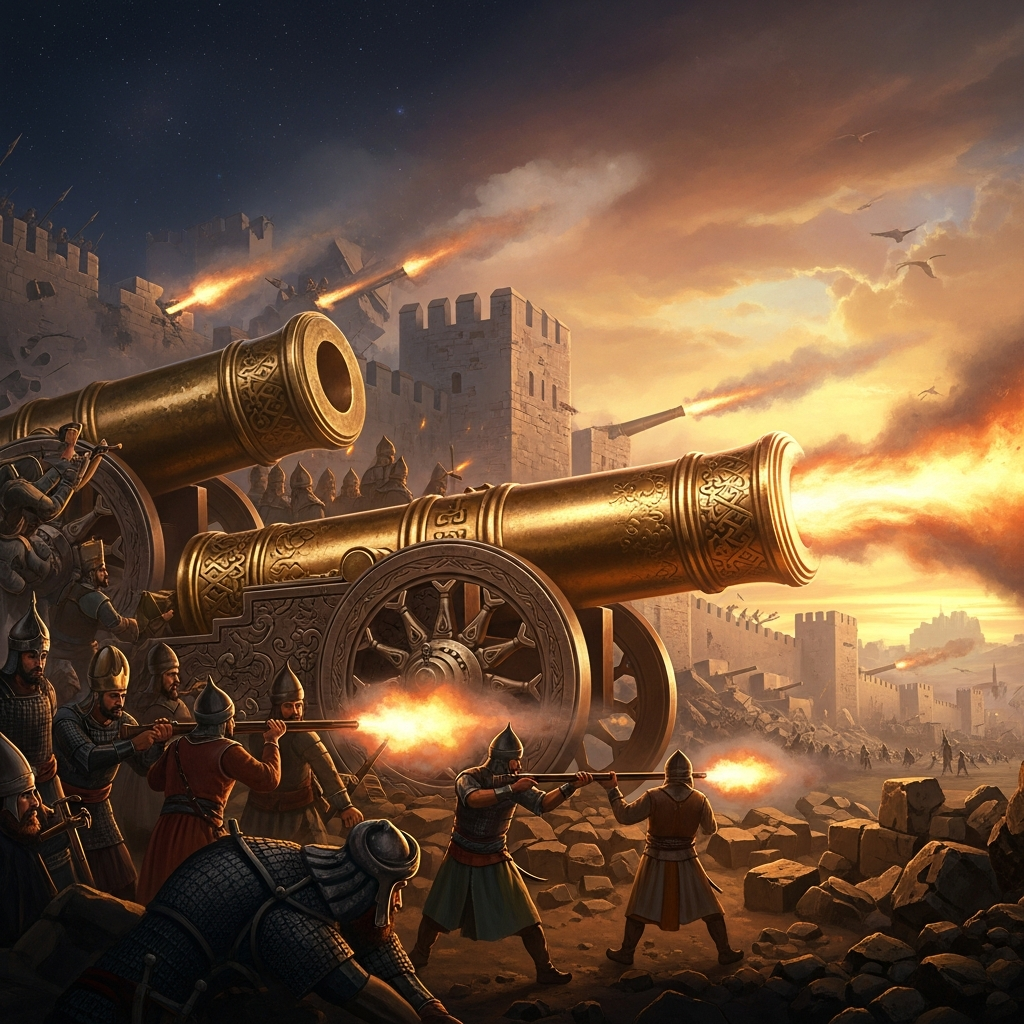
The bombard fires for the first time on the twelfth of April, 1453, and the sound reaches villages forty miles away.
It is the largest cannon ever built. Its maker is a Hungarian named Orban who, six months earlier, offered his services to the Byzantine Emperor Constantine XI for a salary the imperial treasury could not pay. He was dismissed politely. He went to Edirne and offered the same services to Sultan Mehmed II, who paid him four times what he had asked, and gave him whatever materials he required.
The cannon is twenty-seven feet long. Its barrel will accept a stone ball weighing fifteen hundred pounds. It is so heavy it requires sixty oxen and four hundred men to drag it from Edirne to the walls of Constantinople, a journey of one hundred and forty miles that takes two months. The road has to be paved as the cannon advances. Bridges have to be reinforced. Two hundred men work ahead of the gun-train smoothing the route.
The Theodosian Walls of Constantinople have stood for a thousand and twenty-five years. They have stopped the first Arab siege in 674. They have stopped the second Arab siege in 717. They have stopped the Avars, the Bulgars, the Rus, the Pechenegs, and twenty other armies that have come and gone and left no mark on the mortar.
The walls were not designed to stop Orban’s cannon. They were designed to stop battering rams.
By the eighteenth of April there is a forty-foot breach near the Gate of Saint Romanos. The defenders fill it overnight with earth, broken stones, fascines, and barrels packed with dirt — the kind of patchwork the medieval world used to plug what gunpowder had begun to make obsolete. The next morning Orban’s gun fires again, and the patch holds. The wall is dying slowly, but it is dying.
Inside the city are about fifty thousand people, of whom perhaps eight thousand can fight.
Half of them are Genoese mercenaries under the command of a forty-five-year-old soldier named Giovanni Giustiniani Longo, who has been hired specifically because he is the most respected siege defender in Christendom. He is paid in promises of land. He has come anyway, because his honor will not let him stay in Genoa while the city falls.
Half of the rest are Constantine XI’s own troops, an imperial guard hollowed out by sixty years of fiscal collapse. The remainder are Venetian sailors, a few hundred Cretans, the city’s bakers and tanners with weapons in their hands, and a handful of monks.
Constantine has spent the winter sending embassies. He has begged the Pope. He has begged Venice. He has begged Genoa, Florence, Aragon, France, Hungary, and Trebizond. The Pope sent Cardinal Isidore of Kiev with two hundred archers and a demand that the Byzantine Church accept the Union of Florence — the formal submission of the Eastern Church to Rome — as the price of further help. The Cardinal arrived. The Union was proclaimed in Hagia Sophia in December 1452. The Greek population rioted. A senior official, the Megaduke Loukas Notaras, was heard to say: Better the Sultan’s turban than the Cardinal’s hat.
He will get what he asked for.
Outside the walls Mehmed has eighty thousand soldiers, including twelve thousand Janissaries — the slave-elite infantry, raised from Christian children, converted to Islam, trained from childhood, the most disciplined troops in the world.
He has Orban’s cannon and seventy other guns of varying size. He has a fleet of one hundred and thirty ships in the Sea of Marmara. He has spent the last decade preparing for this single siege.
He is twenty-one years old.
His father Murad II had besieged the city in 1422 and failed. Mehmed himself attempted to take the throne at twelve, was deposed by his father’s recall from retirement, and waited five more years before Murad died and he ascended for real at nineteen. He is, in 1453, half a child still — described by chroniclers as silent for hours, brilliant in conversation when he chooses to speak, fluent in Turkish, Arabic, Persian, Greek, Latin, and Hebrew, a reader of Caesar and Alexander, a builder, a commissioner of portraits by Italian masters, a poet, a strangler.
He has been preparing this siege since he was ten years old. The hadith of the Prophet hangs over him like a vocation: Verily you shall conquer Constantinople. What a wonderful leader will her conqueror be. Mehmed intends to be that leader. He intends to be the fatih, the conqueror, and he intends to do it before he turns twenty-two.
The decisive innovation is the portage.
The Byzantine harbor — the Golden Horn — is closed by an iron chain stretched between Galata and the city. The Ottoman fleet cannot enter. Without the harbor, Mehmed cannot attack the seaward walls. Without pressure on the seaward walls, all his forces concentrate on the land walls, and Giustiniani’s defense holds.
On the night of April 22 Mehmed orders his ships moved overland. He has had the engineers build a road of greased logs from the Bosphorus, up the steep hill behind Galata, and down into the Golden Horn — a road two miles long. Seventy ships are dragged up the slope on rollers, with sailors aboard rowing in the air to keep them stable, and lowered down the other side. They are launched into the harbor by dawn.
When the defenders look down from the seaward walls in the morning they see seventy Ottoman ships in waters that have been Byzantine since the city was founded. The chain is irrelevant. The seaward walls now require defense, which means thinning the land defense, which means Giustiniani has fewer men at Saint Romanos.
The Genoese on Galata, observing all of this, do not intervene. Their treaty of neutrality is technically intact. Mehmed will remember.
The bombardment continues for six weeks. The defenders patch the breaches. The Ottoman miners dig tunnels under the walls; the Byzantine miners — many of them German engineers in Byzantine pay — countermine and intercept. By late May the underground war has been won by the defenders, but the wall above is in ruins.
Mehmed orders the final assault for the night of May 28-29. He has consulted the ulema, the Islamic scholars in his camp, and they have determined that the conditions of just war have been met: the city has been offered surrender three times, has refused, and may now be taken by storm under the laws of conquest, with three days of plunder permitted to the troops.
The first wave is the irregulars — the bashi-bazouks, the unpaid auxiliaries from across the empire who fight for loot. They attack at one in the morning and are slaughtered. The defenders kill them by the thousand. This is what they are intended for; their function is to wear down the defense.
The second wave is the Anatolian regulars. They press for two hours and are repulsed. Giustiniani has organized the defense brilliantly. The breaches at Saint Romanos are walled with earth and barrels and fire-pots. The defenders shoot from the inner wall while the breach swallows attackers in the killing ground between.
The third wave is the Janissaries. They advance in silence. They reach the wall. They climb. And at the moment the assault is at its peak, two things happen.
A small postern gate called the Kerkoporta — the Circus Gate, almost forgotten in the planning — has been left unbarred after a sortie earlier in the night. A handful of Janissaries find it open and rush through. They climb to the top of the inner wall and raise an Ottoman banner.
At the same moment Giovanni Giustiniani is shot in the chest at close range — the chronicles disagree about whether by an arrow or a small culverin ball. His armor is pierced. He bleeds heavily. He commands his men to take him out of the line for treatment. Constantine XI begs him to stay. Lord, the Emperor says, your wound is light. Stay. The fate of the city depends upon you.
Giustiniani leaves. His Genoese, seeing their commander carried away and the Ottoman banner on the inner wall behind them, panic. The line breaks.
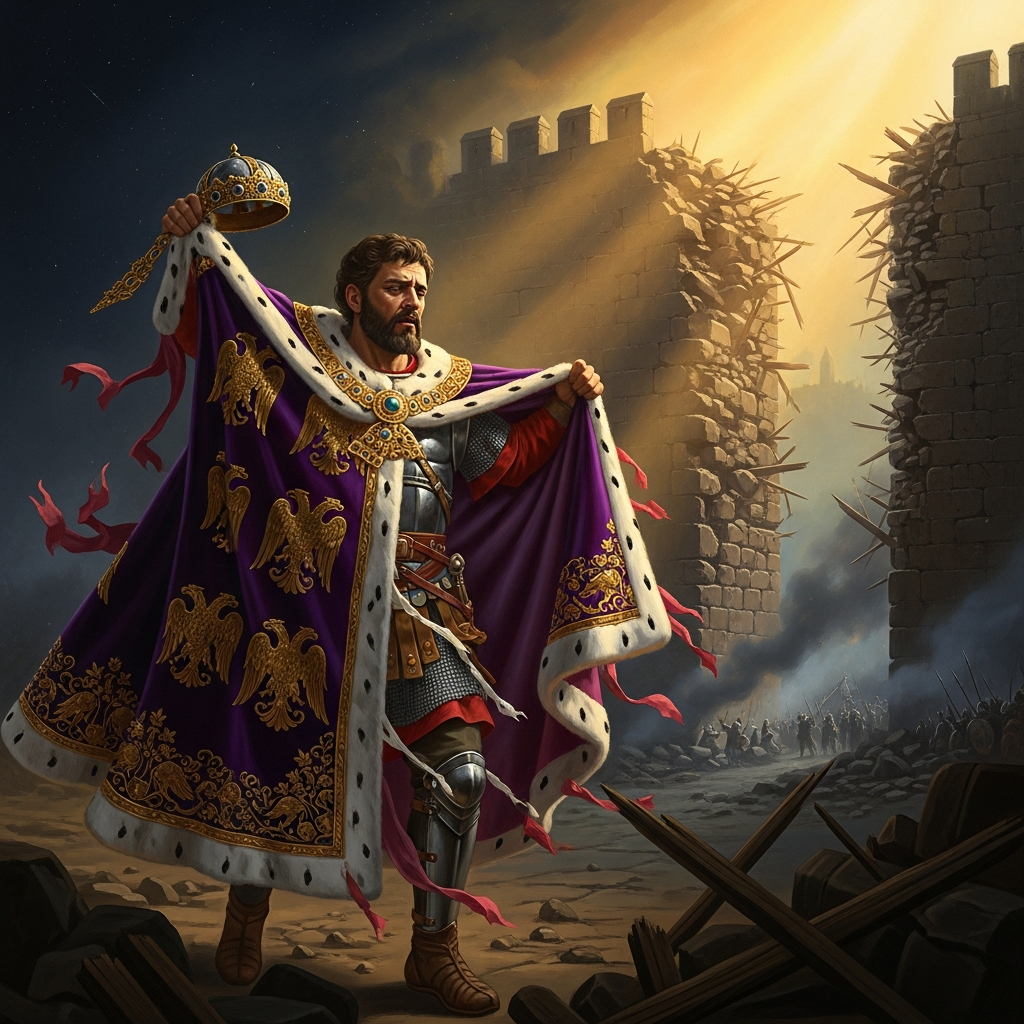
When the line breaks, Constantine XI Palaiologos — the last of the Roman Emperors, the eighty-eighth man to wear the diadem of Constantine the Great in unbroken descent across eleven centuries — does what every chronicler who survives that day records.
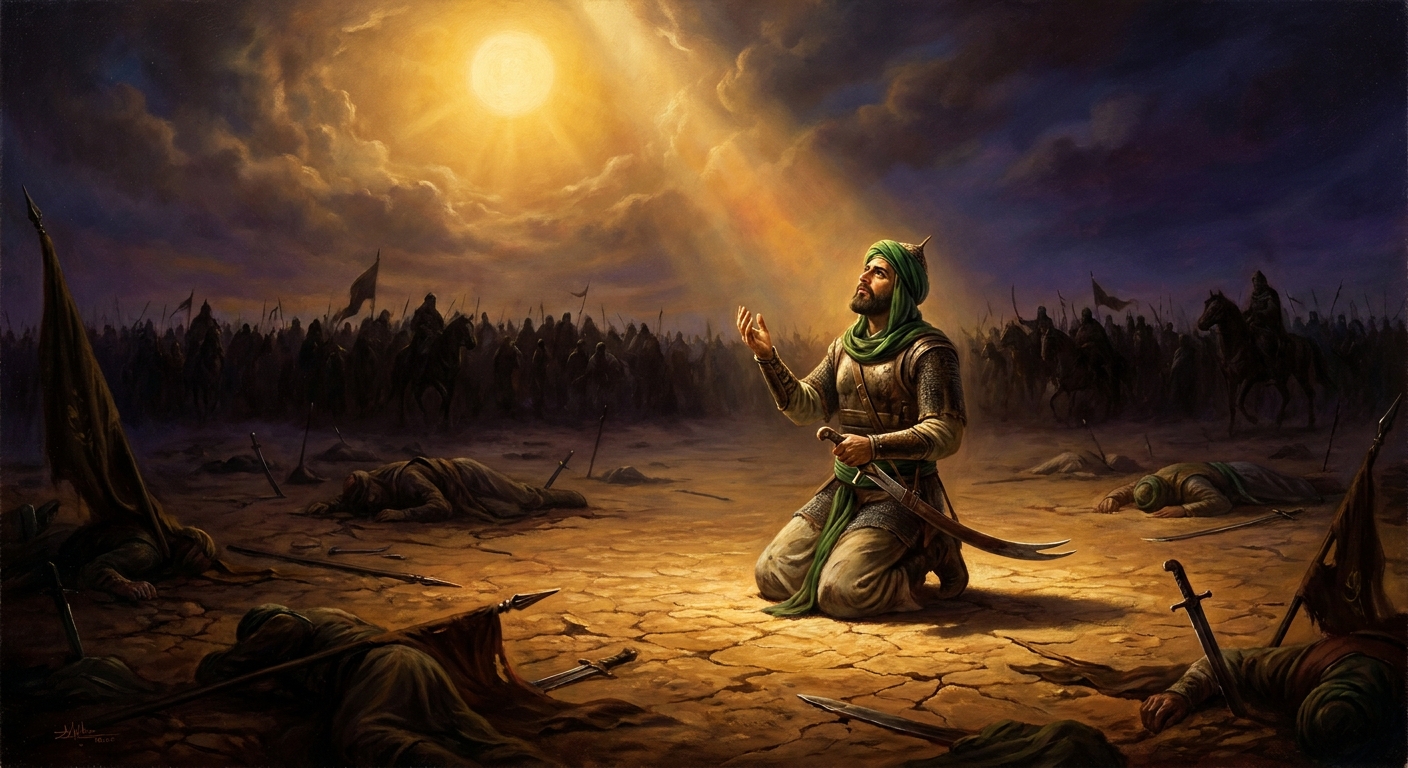
He pulls off his purple cloak. He pulls off the imperial buskins, the boots embroidered with eagles that mark the wearer as basileus. He throws aside the insignia. He says to the men around him — to George Sphrantzes, to his cousin Theophilus Palaiologos, to the Castilian Don Francisco of Toledo, to John Dalmata — Is there no Christian here who will take my head from me?
No one answers. He charges into the breach.
He is forty-nine years old. He has reigned for four years. He has fathered no son. The dynasty ends at his sword arm.
No one ever finds his body. There are stories — that he was buried by the Turks with imperial honors, that his head was salted and sent on tour, that he was buried in a small church near the Vefa Mosque whose location was forgotten — but no body, ever, is identified.
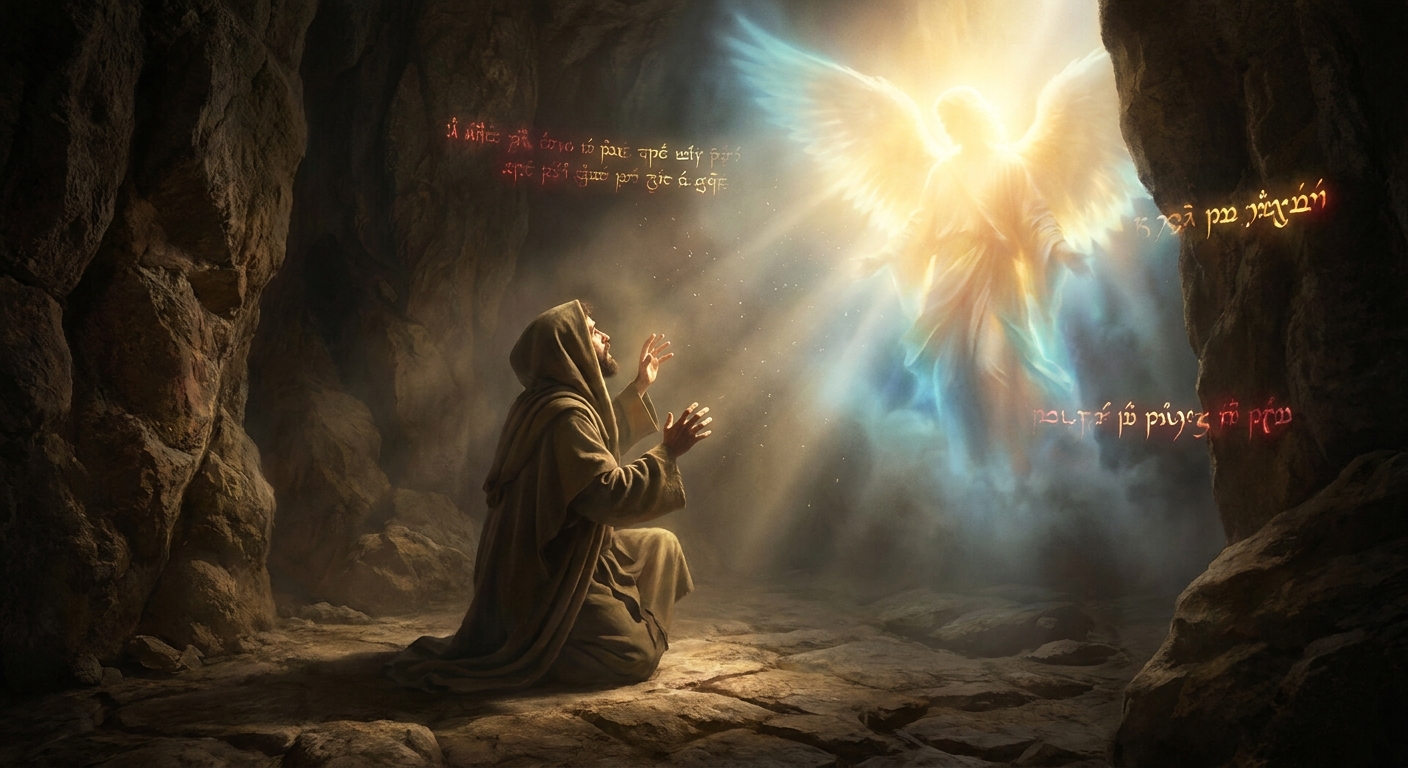
The Greek folk tradition will say: he is not dead. He is the Marble Emperor, o marmaromenos basileus, hidden in a cave by an angel, sleeping with sword in hand, and one day the angel will wake him and he will return and the city will be Christian again and the Hagia Sophia, whose Liturgy was interrupted at the precise moment the Ottoman troops broke into the nave, will resume the eucharist on the unfinished phrase.
The Liturgy was indeed interrupted. The unfinished phrase has been recorded by the chroniclers: it was the axion estin, the prayer at the consecration. The priests, the tradition says, did not flee. They walked into the wall — into the wall itself — and the wall closed behind them, and they wait.
Mehmed enters the city at noon on the twenty-ninth of May.
The army has been plundering for six hours by the time the Sultan rides through the Gate of Charisius on a white horse. The streets are choked. The Hagia Sophia is full of refugees who have shut themselves inside the great church believing the old prophecy that an angel would descend to defend it. The doors have been broken. The refugees have been bound and led away as slaves.
Mehmed rides directly to the church. He dismounts. He scoops a handful of earth from the ground and pours it over his turban — the gesture of a Muslim acknowledging that all victory is from God and that pride before the Almighty is the conqueror’s true risk. He enters the Hagia Sophia.
He finds an Ottoman soldier hacking at the marble floor with a pickaxe in search of treasure. Mehmed strikes the man with the flat of his sword. The plunder is yours by my law, he says, but the building is mine. He orders the church cleared of bodies, of debris, of the broken images. He orders the muezzin to climb the southwest minaret — there is no minaret yet; the muezzin climbs a wooden gallery — and to call the adhan. The dome that has heard the Christian liturgy continuously since Justinian rebuilt it in 537 hears the call to Muslim prayer for the first time. Mehmed prays.
When he steps outside he stands for a long moment in the courtyard. He looks at the dome. A poet of his court writes down what the Sultan recited under his breath, in Persian, a couplet by the eleventh-century Persian Sa’di:
The spider weaves the curtains in the palace of the Caesars; The owl calls the watches in the towers of Afrasiab.
It is the standard meditation, in classical Islamic literature, on the transience of empire. He is twenty-one years old. He is the Caesar now. The empire that survived a thousand years has been transferred to him, and he is preparing to rebuild it under a new theology.
Three days later — three days of plunder being the army’s right under Islamic law of conquest — Mehmed orders the looting stopped. The chroniclers say he stops it on the morning of the second day, not the third, because the city has lost too much of what he wanted to inherit. He pays the army to compensate them for the day they did not get. He buys back churches the troops have already converted. He summons the Greek Orthodox monks from their hiding places and orders the Patriarchate restored. He selects the scholar Gennadios — who has been sold as a slave during the sack — buys him back from his owner, and elevates him to Ecumenical Patriarch under Ottoman sovereignty in January 1454.
He guarantees the Orthodox Church its property, its hierarchy, its courts, its tax exemptions. He establishes the millet system — separate legal jurisdictions for Christians and Jews under their own clergy — that will define the Ottoman state for the next four hundred and fifty years.
He invites the Jews who were expelled from Spain to settle in his city; some forty thousand will come over the next forty years. He invites Italian humanists; some come, some don’t. He commissions Gentile Bellini to paint his portrait — the famous portrait now in the National Gallery in London — and sits for it in 1480, near the end of his life, in the same way Augustus sat for Greek sculptors.
He is calling himself Kayser-i Rum — Caesar of Rome — by 1454. The Russian Orthodox Church will respond by declaring Moscow the Third Rome. The Hapsburgs will revive the Holy Roman Empire’s claim with new urgency. Three rival inheritances of the fallen city will compete for the next four centuries.
Constantinople is now Istanbul, though the formal name change does not happen for another five hundred years. The Hagia Sophia is now Ayasofya. The Great Palace where Justinian sat is gradually buried under Mehmed’s new palace at Topkapı. The Roman Empire ends at noon on May 29, 1453.
It had lasted, in some form, since the founding of the Republic in 509 BCE: nineteen hundred and sixty-two years. It is the longest-lived political entity in human history, and a twenty-one-year-old ended it in fifty-three days.
He had been preparing all his life.
Scenes
April 1453
 Generating art…
 Dawn, May 29, 1453
 Generating art…
 Noon
Generating art… Echoes Across Traditions
Entities
- Mehmed II (Sultan, age 21)
- Constantine XI Palaiologos (last Byzantine Emperor)
- Cardinal Isidore of Kiev (the papal legate)
- Giovanni Giustiniani Longo (the Genoese commander)
- Loukas Notaras (the Megaduke)
- Orban (the Hungarian cannon-maker who switched sides)
Sources
- Steven Runciman, *The Fall of Constantinople 1453* (Cambridge University Press, 1965) — still the standard narrative in English
- Roger Crowley, *1453: The Holy War for Constantinople and the Clash of Islam and the West* (Hyperion, 2005)
- Doukas, *Decline and Fall of Byzantium to the Ottoman Turks* — eyewitness Byzantine historian, translated by Harry Magoulias (Wayne State University Press, 1975)
- George Sphrantzes, *The Fall of the Byzantine Empire: A Chronicle by George Sphrantzes 1401-1477* — the imperial secretary's diary, translated by Marios Philippides (University of Massachusetts Press, 1980)
- Kritovoulos of Imbros, *History of Mehmed the Conqueror* — the Greek historian who served the Ottoman court, translated by Charles T. Riggs (Princeton, 1954)
- Franz Babinger, *Mehmed the Conqueror and His Time* (Princeton, 1953/1978)
- Marios Philippides and Walter K. Hanak, *The Siege and the Fall of Constantinople in 1453* (Ashgate, 2011)