Kabir: Neither Hindu Nor Muslim
c. 1440-1518 CE · Varanasi (Banaras) — the weavers' quarter, the bathing ghats, the banks of the Ganges
Contents
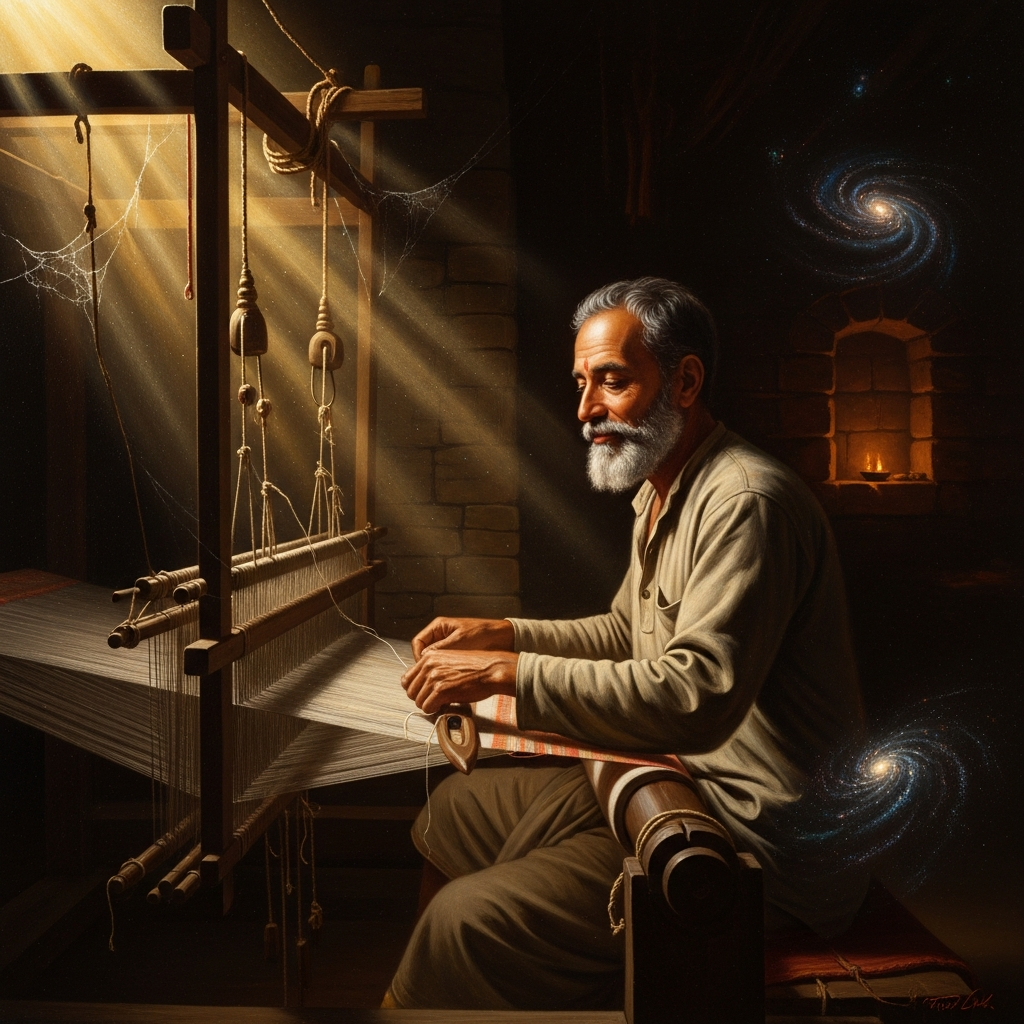
He is a Muslim weaver in Varanasi — low-caste, practicing a lowly trade, living in the city most sacred to Hindus. He is also a poet of such devastating clarity that both Hindu and Muslim traditions claim him after his death and neither one fully owns him during his life. His couplets attack idol worship, caste hierarchy, the Quran recited without understanding, the Vedas memorized without comprehension, the pilgrimage performed as a substitute for practice, the pandits, the mullahs, the renunciants who have left their families to look for what they could have found at the simple loom. He says that Ram and Allah are the same name for the same truth. He says that neither temple nor mosque contains what he has found. He is the most quoted vernacular poet in north Indian religious culture and no tradition fully owns him.
- When
- c. 1440-1518 CE
- Where
- Varanasi (Banaras) — the weavers' quarter, the bathing ghats, the banks of the Ganges
He is born in a basket on a pond.
The legend, recorded in dozens of variants by the Kabir Panth and the local Varanasi tradition, says he is found by a Muslim weaver named Niru and his wife Nima at the lotus pond at Lahartara, on the outskirts of Varanasi. They take the infant home. They raise him. The poet himself, in dozens of his couplets, claims this origin: Kabir was born without parents. Kabir is the child of nobody. The historians cannot verify any of it. What they can verify is that a Muslim weaver named Kabir was active in Varanasi in the second half of the fifteenth century, composing poetry in a north Indian vernacular that local audiences memorized faster than scribes could write down.
The biographical erasure is part of the project. Kabir does not want a lineage. He is going to spend his entire poetic life refusing categories, and he will start by refusing the category of son. Whatever he is, he is not because his parents were what they were. The weaver’s house is incidental. The lotus pond is the stage prop.
He grows up on the edge of Varanasi.
The city is, in 1450, what it has been for a thousand years and what it still is — the holy city of Shiva, the cremation ground of the Hindu world, the place every devout Hindu hopes to die so that the path to liberation is shortened. The bathing ghats run for miles along the Ganges. The temples rotate the priests in shifts. The cremation ground at Manikarnika never goes out. Pandits debate philosophy in the lanes. Sufi fakirs beg at the corners. Muslim weavers, mostly recent converts from low-caste Hindu families, work the looms in the quarter assigned to them.
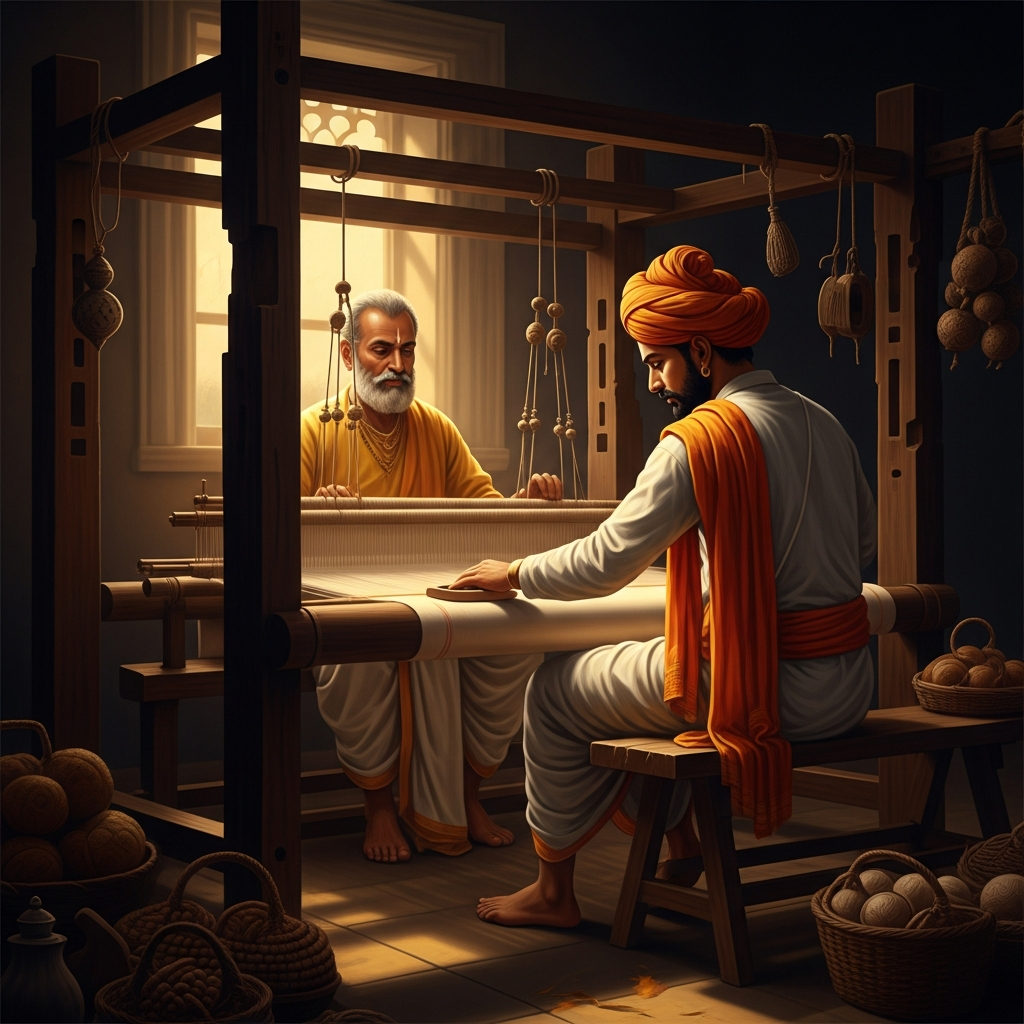
Kabir works one of the looms.
He has a teacher. The texts disagree about which one.
The dominant biographical tradition gives him Ramananda, a Vaishnava Brahmin teacher in Varanasi who had broken with caste-orthodox practice and accepted disciples regardless of birth. The legend says Kabir wanted Ramananda as guru, knew Ramananda would refuse a Muslim disciple, and arranged to be lying on the steps of the Panchganga Ghat in the dark before dawn when Ramananda came down to bathe. Ramananda stepped on him. The shock made Ramananda exclaim Ram. Kabir leapt up and announced that he had received the mantra — Ram — from the master’s own mouth, and that Ramananda was now obliged by the rules of his own discipline to accept him as a disciple.
Ramananda, the legend says, accepted.
The historians treat this as legendary. The actual relation, if there was one, may have been less dramatic and more institutional. Ramananda’s lineage was demonstrably influential on Kabir. Kabir uses Ram as the primary name of God, the way Ramananda did. But Kabir’s Ram is not the Ram of the Ramayana — not the prince of Ayodhya, not Sita’s husband, not Hanuman’s master. Kabir’s Ram is Ram-without-attributes, the formless name itself, the syllable.
He says so explicitly. My Ram is not the one born in Ayodhya. My Ram is not the one with two arms or four arms. My Ram is the name itself, naked, before any image was attached to it.
The Muslim teachers in Varanasi want him too. The Sufis recognize the apophatic move — the negation of attributes, the insistence that the divine is beyond every form — as the move Ibn Arabi had been making in Andalusia three centuries earlier and that the Chishti Sufis were making in north India in Kabir’s own period. They claim him as one of their own. Kabir refuses this also. He makes fun of the Sufis as readily as he makes fun of the Brahmins.
He refuses both schools by the same instrument. The instrument is the doha — the rhymed couplet, native to north Indian oral tradition, two lines, twenty-four syllables, devastating.
He attacks every institution.
He attacks the Vedas. The pandit reads the Veda. The Veda becomes water in his mouth. He swallows it and pisses it out. The water is the same water it was when it went in.
He attacks the Quran. The mullah reads the Quran. The Quran becomes a noise his throat is making. The noise rises to the rooftop and dies in the air.
He attacks pilgrimage. Going to Kashi will not save you. Going to Mecca will not save you. The God you have not found at home is not waiting for you in Mecca.
He attacks idol worship. The stone is a stone. You painted it. Now you are kneeling to your own paintbrush.
He attacks the azan — the Muslim call to prayer. Why are you shouting? Has your God grown deaf?
He attacks the renunciants. You shaved your head. You wear orange. You walk away from your wife. The God you could not find with her is not in the road.
He attacks the householders. You sit in your house and count your rupees. You think your business is your business. The auditor is closer than your shadow.
He attacks death. You think death is coming. Death is here. You are inside death. You have always been inside death. The question is whether you can be alive while you are inside it.
He attacks himself. Kabir says: I am a fool. I am a fool. The fool is closer to the truth than the man who knows.
The instrument that does all of this is the doha.
The doha is two lines. The first line sets up the situation. The second line collapses it. The collapse is calibrated — the verse does not collapse into a different position. It collapses into the absence of position. The reader is left holding nothing. That is the desired result.
Pothi padh padh jag mua, pandit bhaya na koy. Dhai akhar prem ka, padhe so pandit hoy.
Reading book after book the world dies, but no one becomes wise. Two and a half letters of love — read those, and you become wise.
The two and a half letters are prem — p-r-e-m — written in Devanagari with two and a half characters. The arithmetic is the joke. The joke is the teaching.
The political authorities take notice.
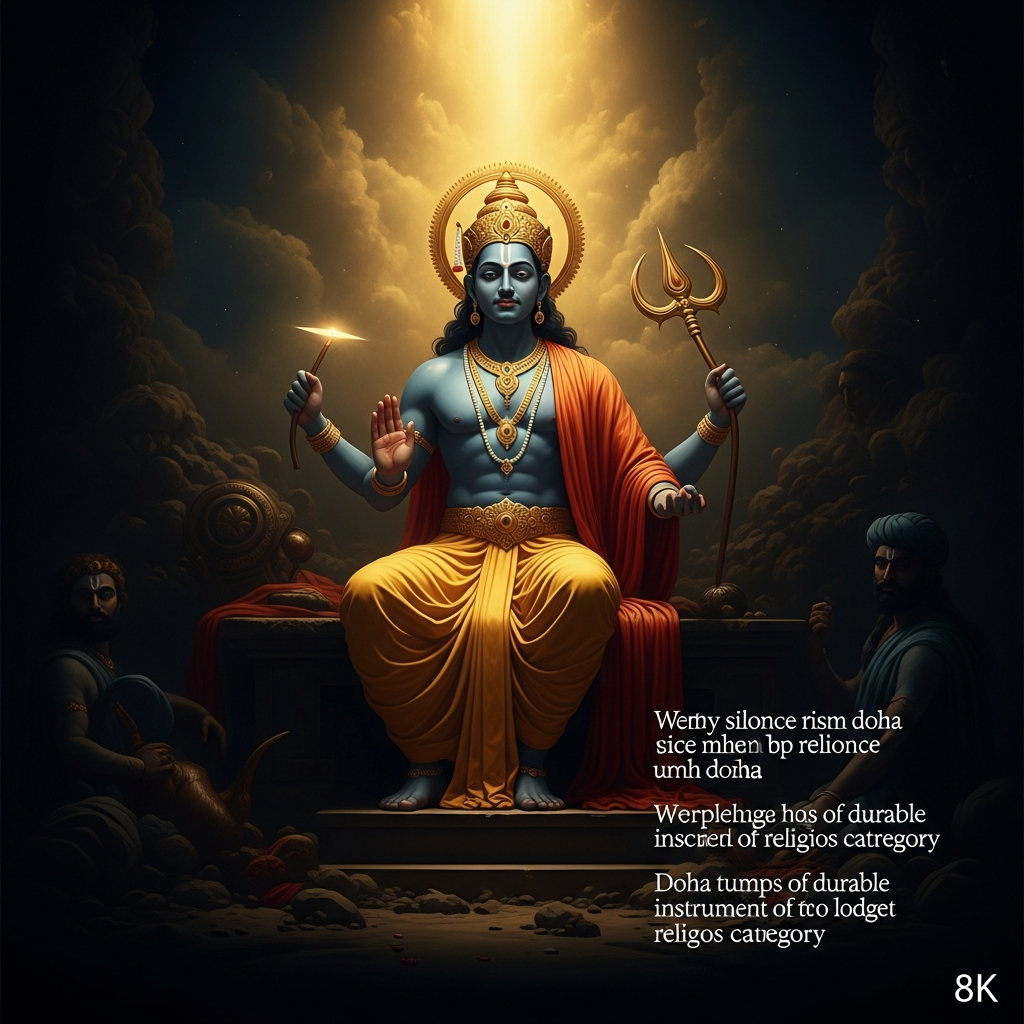
The Sultan of Delhi in the relevant period — possibly Sikander Lodi, who ruled 1489 to 1517 — receives complaints from the Brahmin pandits and the Muslim qazis of Varanasi simultaneously. The pandits say that this Muslim weaver is teaching false doctrine in the city of Shiva. The qazis say that this Muslim weaver is mocking the Quran. The two sides cannot agree on what religion he belongs to but they agree that he must be silenced.
Sikander Lodi summons him to Delhi. The legend records the ordeal: Kabir is bound and thrown into the Yamuna with a stone, and floats. Kabir is bound and thrown into a fire, and the fire goes out. Kabir is set before a charging elephant, and the elephant kneels. The Sultan, having exhausted the standard means of execution, releases him.
The historians treat the ordeal narrative as legendary. The political fact behind it is verifiable: Kabir was harassed by both religious establishments and by the Sultanate, was probably driven out of Varanasi at least temporarily, and ended his life in Maghar — a town considered religiously inferior to Varanasi, a town where dying was supposed to send the soul to a lower destination than dying in Varanasi would.
He went to Maghar deliberately. He said: if Kashi is what saves you, then Maghar is what damns you. I will die in Maghar. The God I have known does not need Kashi to save anyone.
He died in Maghar in 1518.
The death scene is the most repeated story in the Kabir biographical tradition.
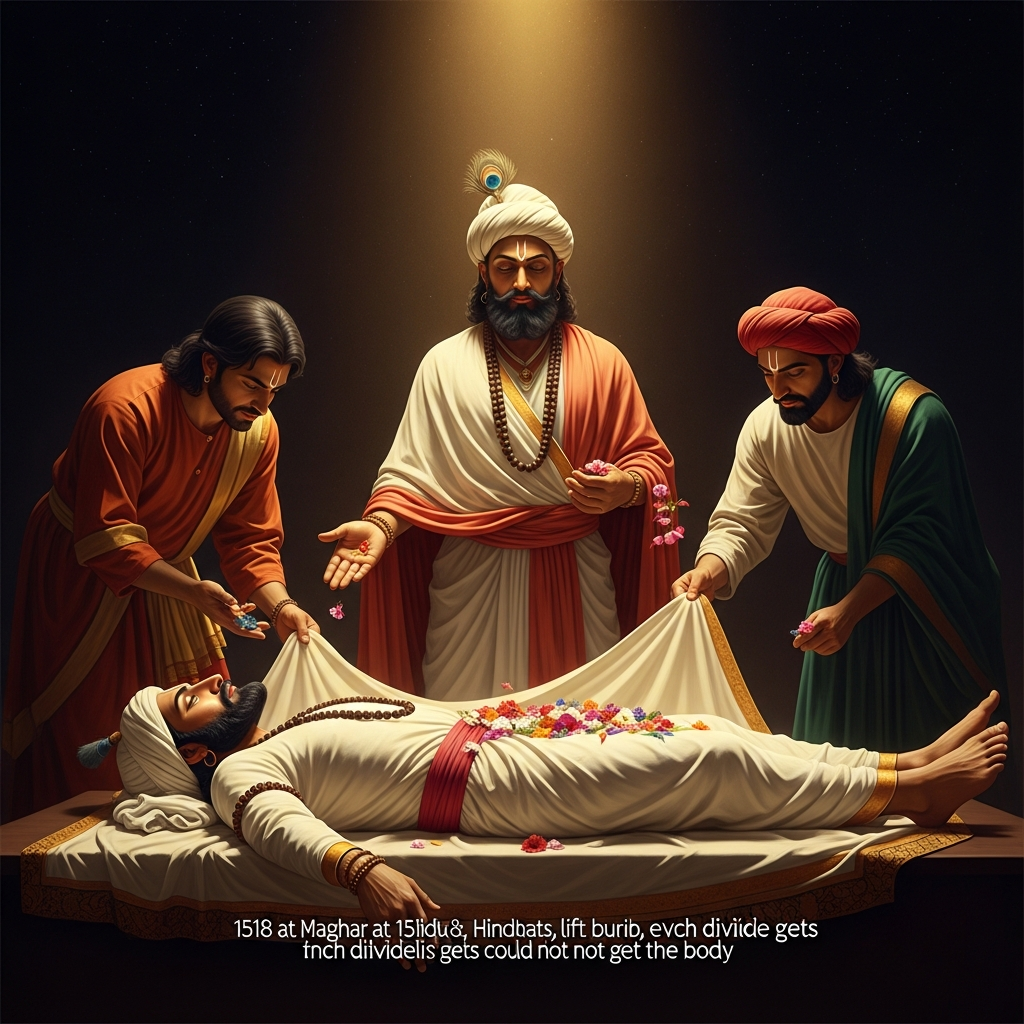
The body is laid out in Maghar. The Hindu disciples want to cremate it according to Hindu rites. The Muslim disciples want to bury it according to Muslim rites. The argument escalates. The two sides nearly come to violence over the corpse of the man who had spent his life telling them they were the same.
Someone — the texts disagree about who — suggests that the cloth covering the body be lifted to determine the matter.
The cloth is lifted.
There is no body underneath. There are only flowers — fresh flowers, in the place where the body had been. The two sides each take half. The Hindus take their share to Varanasi and cremate it. The Muslims bury their share at Maghar. Each tradition gets its relic. The man himself has slipped out between the categories one final time.
The historians cannot verify the flowers either. What they can verify is the political solution: there is a Hindu shrine to Kabir at Varanasi and a Muslim shrine at Maghar, both functioning continuously since the sixteenth century, both claiming his body, neither possessing it. The biographical legend matches the institutional fact. The man is divided after his death the way he refused to be divided in life.
The poetry survives.
It survives in three main collections that disagree with each other. The Bijak — the seedling — is the version preserved by the Kabir Panth, the Hindu sect that took him as founder. The Adi Granth — the Sikh scripture compiled by Guru Arjan in 1604 — preserves 541 of his compositions. The Panchvani of the Dadu Panth in Rajasthan preserves another large body. The three collections share many poems but differ on which ones, and the textual scholars have been arguing for a century about which version is closer to whatever Kabir actually said.
The argument is, in a sense, Kabir’s last joke. He spent his life refusing the institutional category. The institutions that came after him to claim him produced three different versions of his work, none of which is reliable, all of which carry his name. The poet is everywhere and nowhere — exactly as he had insisted he was during his life.
The dohas are still spoken aloud across north India. They are quoted by farmers, by students, by Bollywood lyricists, by film directors making mainstream movies, by spiritual teachers running retreats in Rishikesh, by Hindi-pop singers covering Kabir verses in folk-rock arrangements. The poems are five hundred years old and they are still moving in the bloodstream of the language.
The most quoted single doha may be this one:
Maati kahe kumhar se, tu kya rondhe mohi. Ek din aisa aayega, main rondhungi tohi.
The clay says to the potter: why are you kneading me? A day will come when I will knead you.
The doha is preserved without commentary in every collection. It does not need commentary. The potter takes the clay and shapes it. The potter dies. The potter’s body returns to the earth. The earth — the same clay — receives the potter and begins, in its own slow way, to shape him into something else.
The clay outlasts the potter. The clay also outlasts the institutions that have collected the clay’s sayings. The clay, in Kabir’s poetry, is what every reader is. The potter, also, is what every reader is. The kneading goes both directions. The categories — Hindu and Muslim, priest and worshipper, God and devotee — are scaffolding the clay can shrug off.
That is the argument the poem makes in two lines.
That is the argument the man made for seventy years on the outskirts of Varanasi while weaving cloth that nobody now owns and singing songs that the entire north Indian subcontinent still has by heart.
He was a Muslim weaver. He was a Hindu mystic. He was neither. He was both. He was none of these. The flowers under the cloth at Maghar are still being divided every time a child in a Hindi-medium school memorizes a doha for the school assembly without knowing — without needing to know — which religion the doha belongs to.
The doha belongs to the language. The language belongs to whoever speaks it. The man who wrote it in 1490 had already worked this out and walked away.
Scenes
He weaves at the loom in the morning
 Generating art…
 The Brahmin pandits and the Muslim mullahs both come to silence him
 Generating art…
 He dies at Maghar in 1518
 Generating art…
 Echoes Across Traditions
Entities
- Kabir Das
- Ramananda
- Sikander Lodi
- The Kabir Panth
- The Doha Tradition
Sources
- Kabir, *The Bijak of Kabir* (trans. Linda Hess and Shukdev Singh, 1983)
- Kabir, *One Hundred Poems of Kabir* (trans. Rabindranath Tagore, 1915)
- Charlotte Vaudeville, *A Weaver Named Kabir: Selected Verses with a Detailed Biographical and Historical Introduction* (1993)
- John Stratton Hawley, *A Storm of Songs: India and the Idea of the Bhakti Movement* (2015)
- Linda Hess, *Bodies of Song: Kabir Oral Traditions and Performative Worlds in North India* (2015)
- David Lorenzen, *Kabir Legends and Ananta-Das's Kabir Parachai* (1991)
- Hazari Prasad Dwivedi, *Kabir* (1942, in Hindi)