The Dedication of the Templo Mayor
1487 CE · Ahuitzotl's reign · Tenochtitlan, the Templo Mayor
Contents
1487 CE. Ahuitzotl's priests open twenty thousand chests on the pyramid summit over four days, feeding the sun god Huitzilopochtli so the Fifth Sun does not fail. The blood runs down channels into Tenochtitlan. The Spanish arrive thirty-two years later.
- When
- 1487 CE · Ahuitzotl's reign
- Where
- Tenochtitlan, the Templo Mayor
The lines form before dawn.
Twenty thousand men from the Flower Wars — from Tlaxcala, Huexotzingo, Cholula, Tlahuica — have been held in the city for weeks, fed, housed, treated with the ceremony due to the sacred. They are not slaves. They are ixiptla, god-vessels, the living food of the sun. They know what this week is. Most of them have worshipped the same gods. The metaphysics are not in dispute.
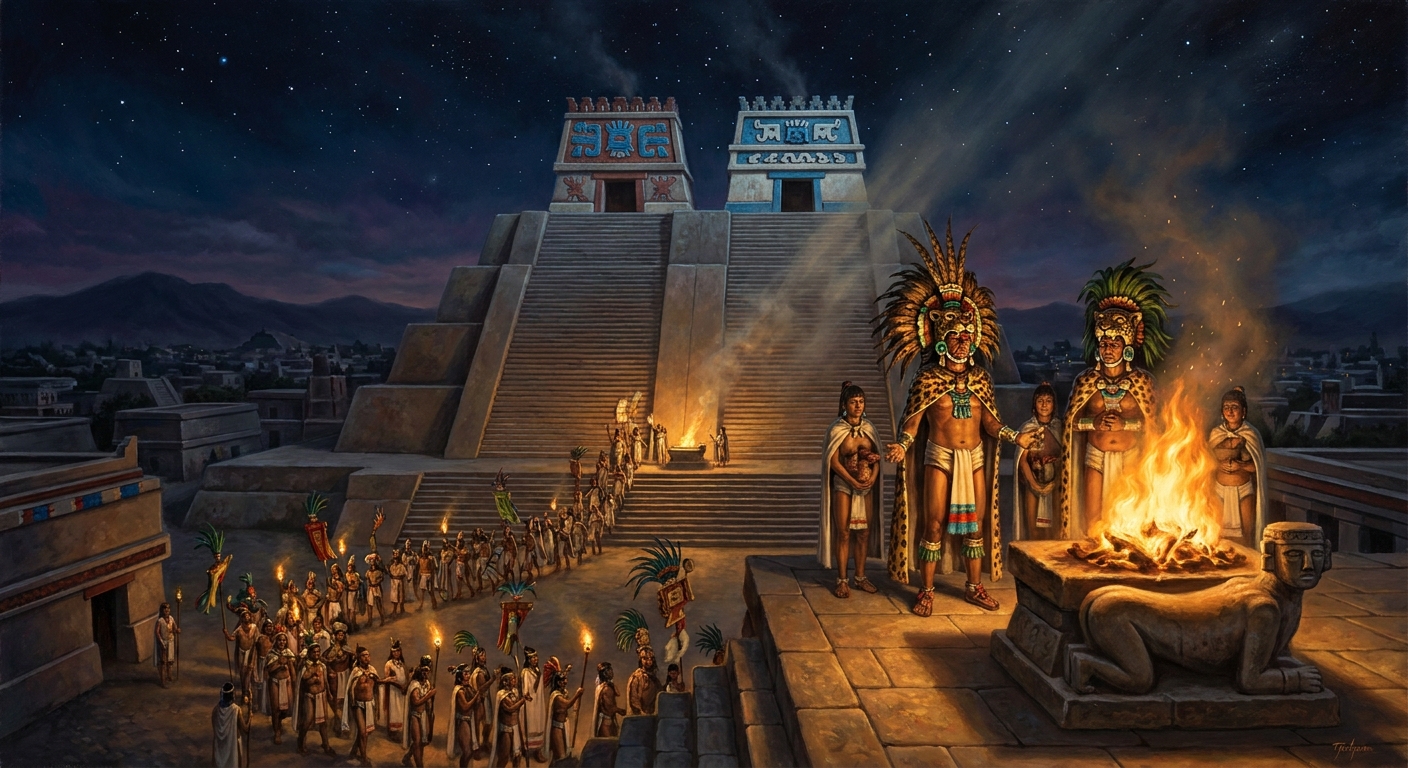
Tlacaelel — cihuacoatl, the woman-snake, second voice of the empire — has organized this. He is past ninety, old enough to have counseled three emperors, architect of everything the Mexica have become. The empire, the Flower Wars themselves, the theology of blood as cosmic debt — these are his work as much as any god’s. He watches from the summit where the twin shrines of Huitzilopochtli and Tlaloc look out over the lake city, over the causeways streaming with people, over the basin mountains, over the world the Mexica have decided they are responsible for keeping alive.
Ahuitzotl, huey tlatoani, the great speaker, oversees from the pyramid’s upper platform. He has expanded the Templo Mayor to its seventh and largest form. The dedication requires scale. The sun does not accept small gestures.
The priests work in rotation.
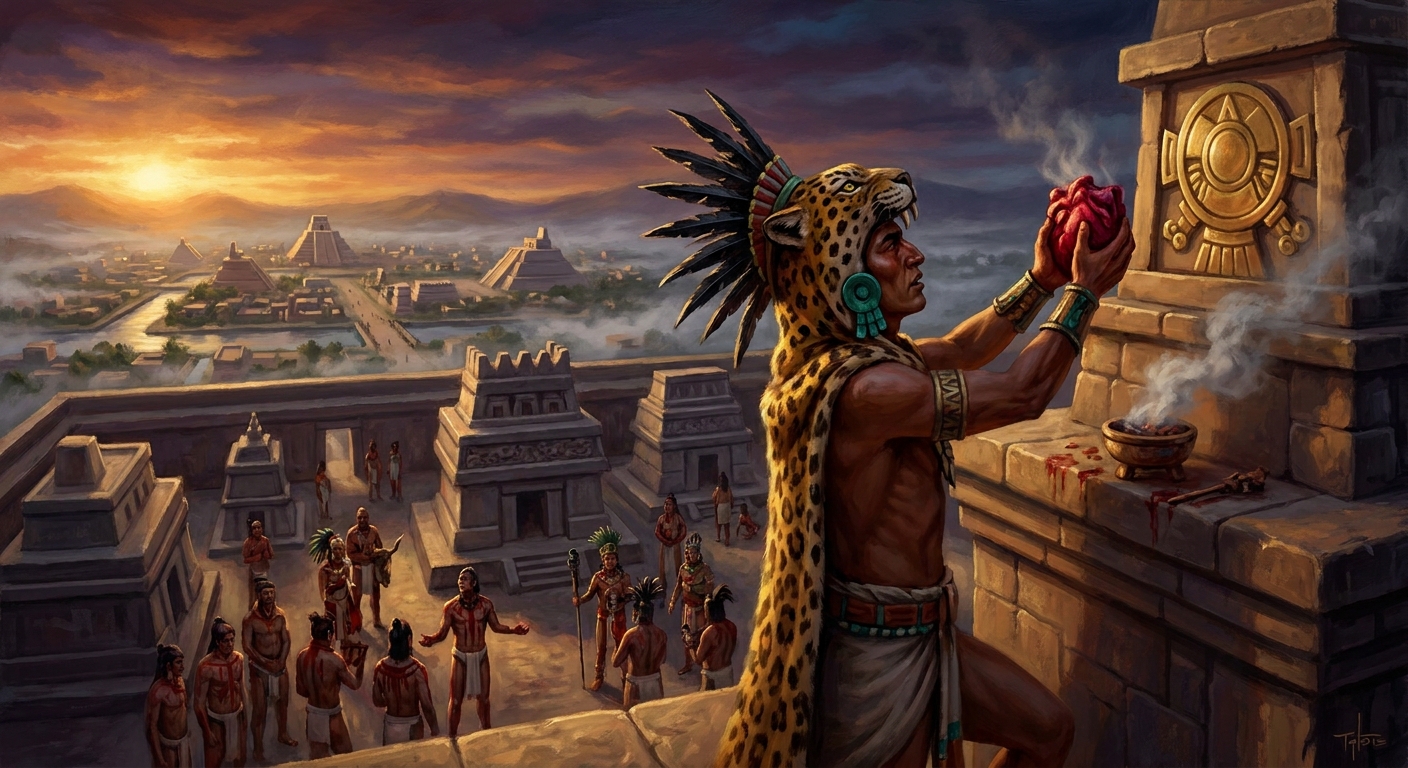
Four of them per victim: two to hold the arms, one for the legs, one for the head arched back across the stone. The obsidian blade — tecpatl — opens the chest in a single practiced motion. The hand goes in. The heart comes out. The word for it is teyolia, the animating force that lives in the heart, the part of the human soul that the sun requires to fight. The priest raises it toward the shrine. The name shouted is Huitzilopochtli’s. The body goes over the edge.
The bodies go over the edge.
Down the steep stairways of the Templo Mayor, four days and four nights, the blood runs in channels cut for this purpose. It pools at the base of the pyramid. It runs into the streets. The priests who are not working at the stone stand waist-deep in it by the second day. The smell of the city changes. The lake around the island is dark at the edges.
Here is the theology, stated plainly.
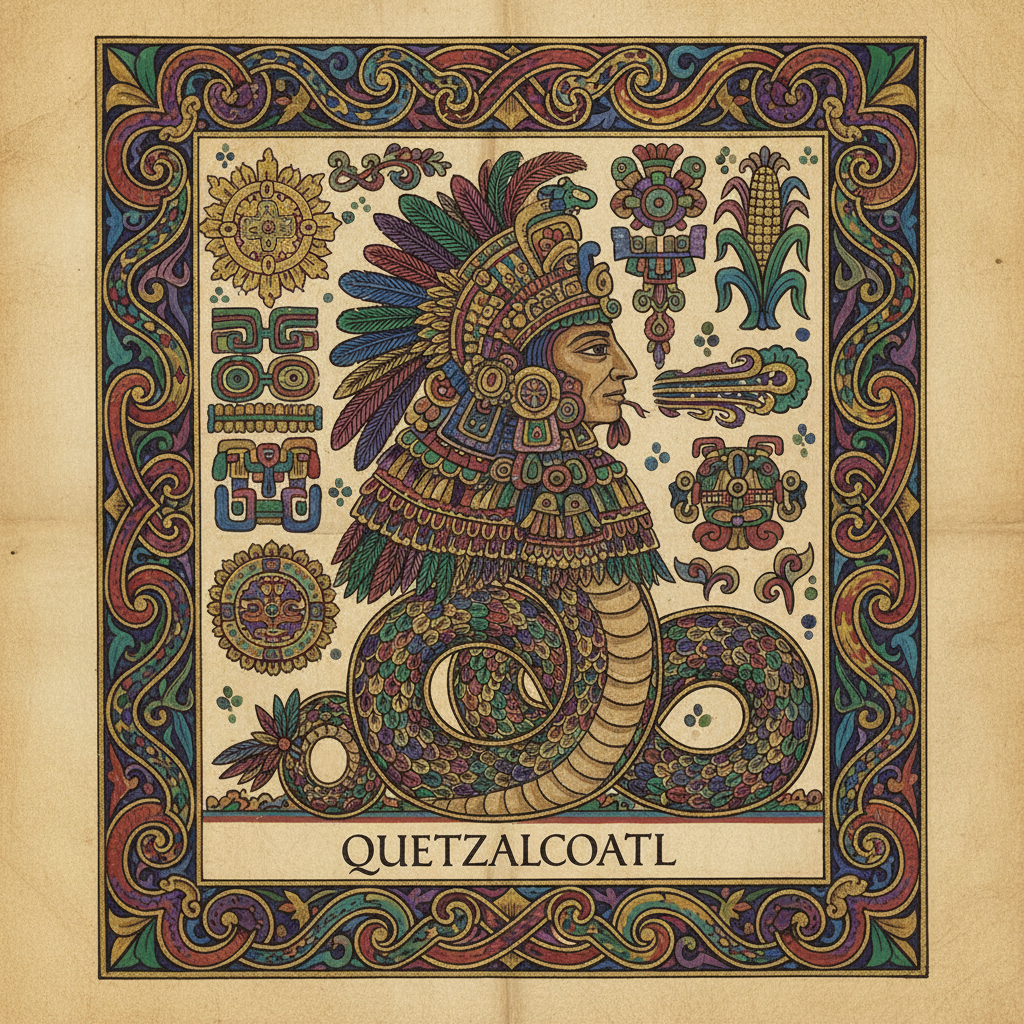
Before this world — the Fifth Sun — there were four others. Each was destroyed. This one was created at Teotihuacan, where the gods gathered in the dark and two of them threw themselves into fire to become the sun and moon. But the new sun would not move. It hung in the sky, massive and still, refusing to rise. The other gods realized what was required: they had to bleed. They had to give themselves. Quetzalcoatl took a blade to each god’s body and drew the chalchihuatl, the precious water. When enough had been given, the sun began to move.
The sun has been moving ever since, but it moves because it is fed. Every dawn is a battle — Huitzilopochtli the hummingbird sun fighting the moon and the four hundred stars of night — and every battle costs. The blood of warriors who die in battle accompanies the sun for four years, traveling the eastern sky, feeding the fire. The blood of sacrifice is the same currency. To stop giving it is to withdraw the fuel from a sun that has not yet gone out but will.
This is not superstition. This is a coherent cosmological debt-structure with a maintenance schedule. The gods bled for humanity. Humanity bleeds for the gods. The cosmos is a loan that must be serviced or it forecloses.
Tenochtitlan is not a city in which this is strange.
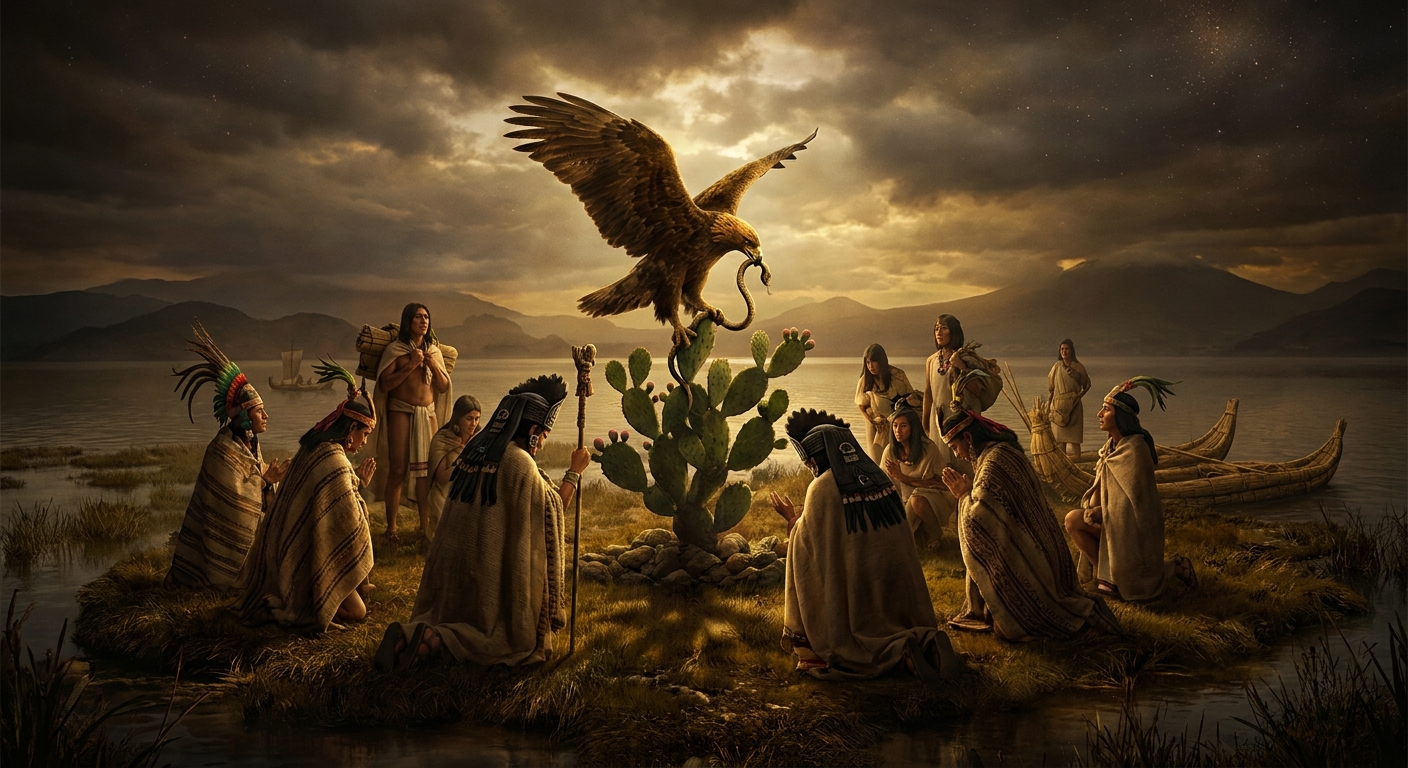
The Mexica built it on nothing — a swampy island in a lake, on the instruction of a vision. Eagle. Cactus. Serpent. Their god told them here, and here they built the largest city in the Western Hemisphere: 200,000 people, floating gardens called chinampas, causeways, aqueducts, a market at Tlatelolco larger than anything in contemporary Europe. They were outsiders who arrived late, mercenaries before they were emperors. They made themselves indispensable by being willing to do what others would not. The Flower Wars are an institution they invented: ritualized conflict with neighboring cities, specifically to generate a sustainable supply of captives for sacrifice. Their neighbors understood the arrangement. They participated in it. They also hated it.
That hatred will matter, thirty-two years from now.
The fourth day ends at dusk.
The count is disputed in every source. The Codex Telleriano-Remensis suggests 20,000. Other sources reach higher. Historians pull the number down toward what is logistically possible, though “possible” here is not the same as “small.” Four days. Four priests per altar, multiple altars working simultaneously, rotating shifts. The arithmetic of the temple summit, the channels, the disposal of the bodies — all of this had been engineered. The Mexica were not improvising.
Tlacaelel lives another two years before dying of age, never having been deposed, never having been conquered, having outlasted every rival and reshaped the religion of an empire. He is the closest thing the Aztec tradition has to a theologian-statesman — the man who looked at the existing religion and decided it needed to be larger, more systematic, more demanding. He did not invent human sacrifice. He scaled it.
Ahuitzotl rules another fifteen years, expanding the empire to its greatest extent, then dies in a flood.
The Templo Mayor stands, seventh iteration, dedicated and fed.
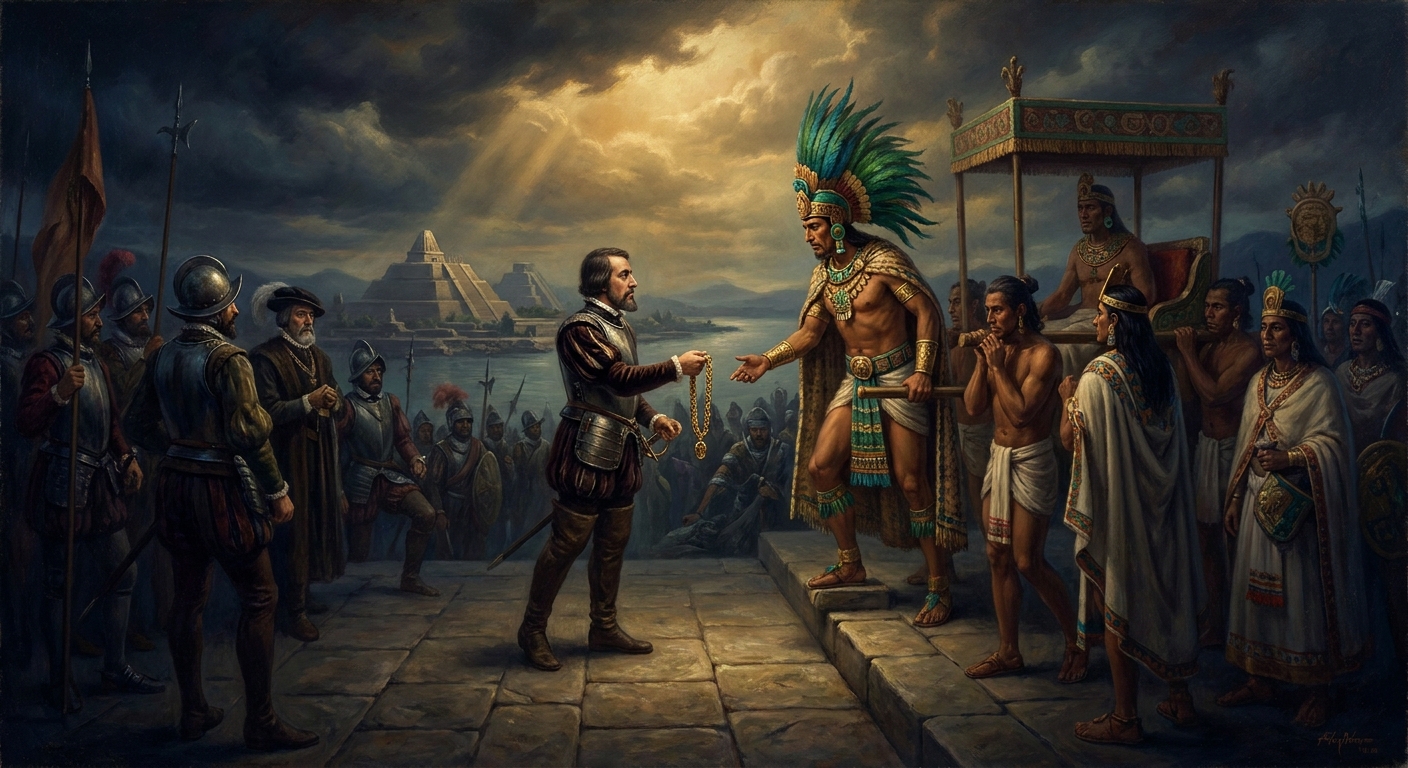
In 1519, a man named Hernán Cortés lands on the Gulf Coast with five hundred soldiers, sixteen horses, and artillery. He is not Quetzalcoatl. He is a minor hidalgo with a gift for reading situations. He finds, immediately, that the Tlaxcalans — neighbors of Tenochtitlan, veterans of the Flower Wars, people who have spent generations supplying captives to the Templo Mayor — will fight with him. They do not need much persuading.
Two years later the city is rubble. The Templo Mayor is pulled apart stone by stone. A cathedral is built above it — consecrated on the feast day of Saint Hippolytus, which is now also the feast day of the conquest. The stone goes into the new church’s foundations. The channels where the blood ran are filled.
Under the cathedral, the pyramid waits. Archaeologists begin excavating in 1978 and are still excavating now.
The question Westerners always ask is: how could they? The question the Mexica would ask back: how could you let the sun die? Both questions assume the other party’s metaphysics are merely wrong rather than differently structured. The Aztec system was internally consistent — a universe on a maintenance schedule, a theology of reciprocal debt, a religion that took the sun’s effort seriously enough to pay for it. The arithmetic of suffering remains hard to look at directly. So does the idea that the universe might owe us nothing and we might owe it everything.
The Spanish found it thirty-two years later. They were horrified by the sacrifice and unbothered by the smallpox. These things are not unrelated.
Scenes
Four priests hold the captive arched across the sacrificial stone at the pyramid's summit
Generating art… The priest lifts the still-beating heart — *chalchihuatl*, precious water — toward Huitzilopochtli's shrine
 Generating art…
 The founding vision: an eagle perched on a nopal cactus, a serpent in its beak, on a marshy island no one else wanted
 Generating art…
 Echoes Across Traditions
Entities
- Tlacaelel
- Ahuitzotl
- Huitzilopochtli
- Tlaloc


Sources
- *Florentine Codex*, Book 2 — Bernardino de Sahagún
- *Codex Telleriano-Remensis*
- Inga Clendinnen, *Aztecs: An Interpretation* (1991)
- Davíd Carrasco, *City of Sacrifice: The Aztec Empire and the Role of Violence in Civilization* (1999)