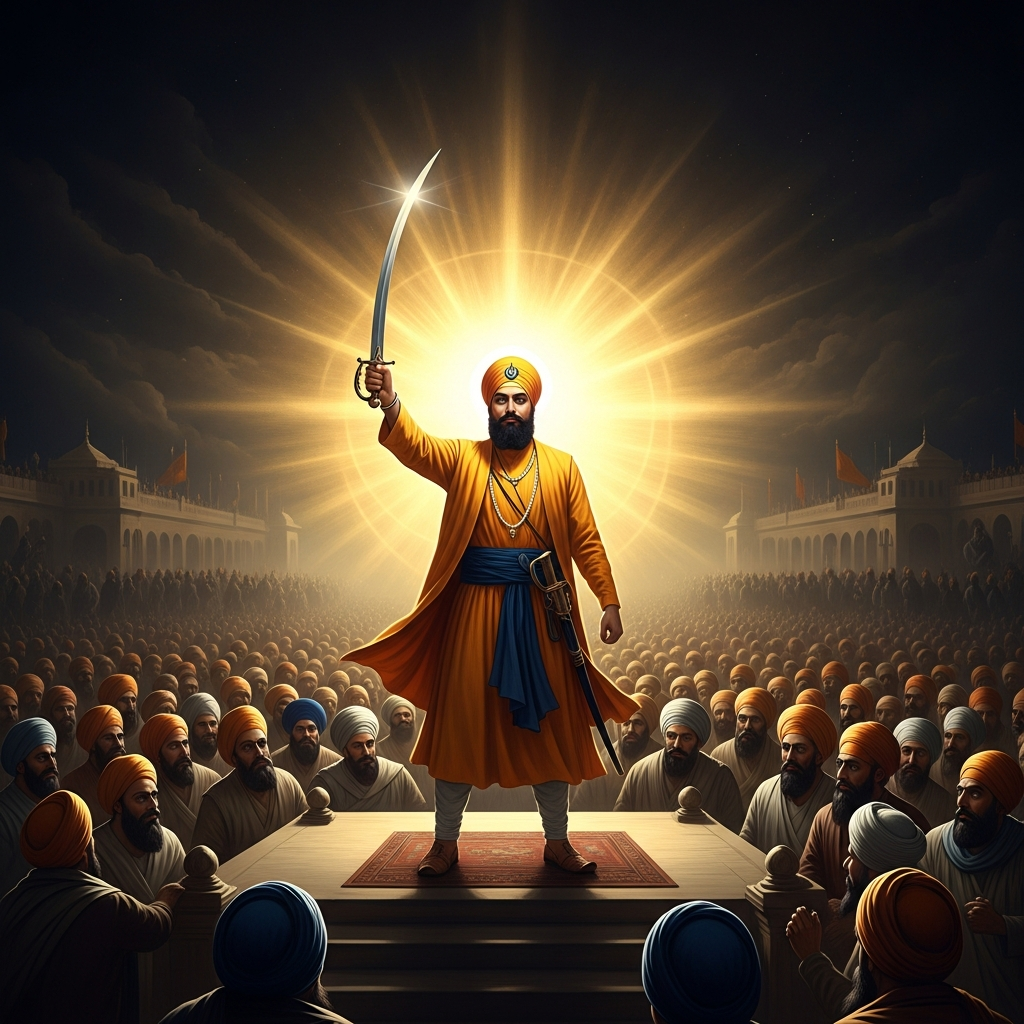
The Accountant Who Did Not Return
c. 1499 CE · Sultanpur Lodhi, Punjab · the ghat of the Kali Bein, a tributary of the Beas, in Sultanpur under the Lodi Sultanate
Contents
Nanak, thirty years old and employed as a grain accountant for the Sultan of Sultanpur, walks to the Bein river at dawn for his morning bath and vanishes. Three days later he climbs out of the water and speaks a sentence that neither the Mughal Empire nor the Hindu priesthood has a category for.
- When
- c. 1499 CE · Sultanpur Lodhi, Punjab
- Where
- the ghat of the Kali Bein, a tributary of the Beas, in Sultanpur under the Lodi Sultanate
He weighs millet for the Sultan.
Every morning he takes the brass key from his belt, opens the grain stores of Daulat Khan Lodhi’s modi-khana, and balances the accounts with a care that has never turned up short. He gives the poor an extra measure when no one watches. At night, by lamp-oil he pays for himself, he writes hymns. He has a wife, two sons, and the reputation of a man who is honest in two languages simultaneously. He is thirty years old and has been trying, for most of those thirty years, to name the thing he feels pressing against the inside of his ribs whenever he sings.
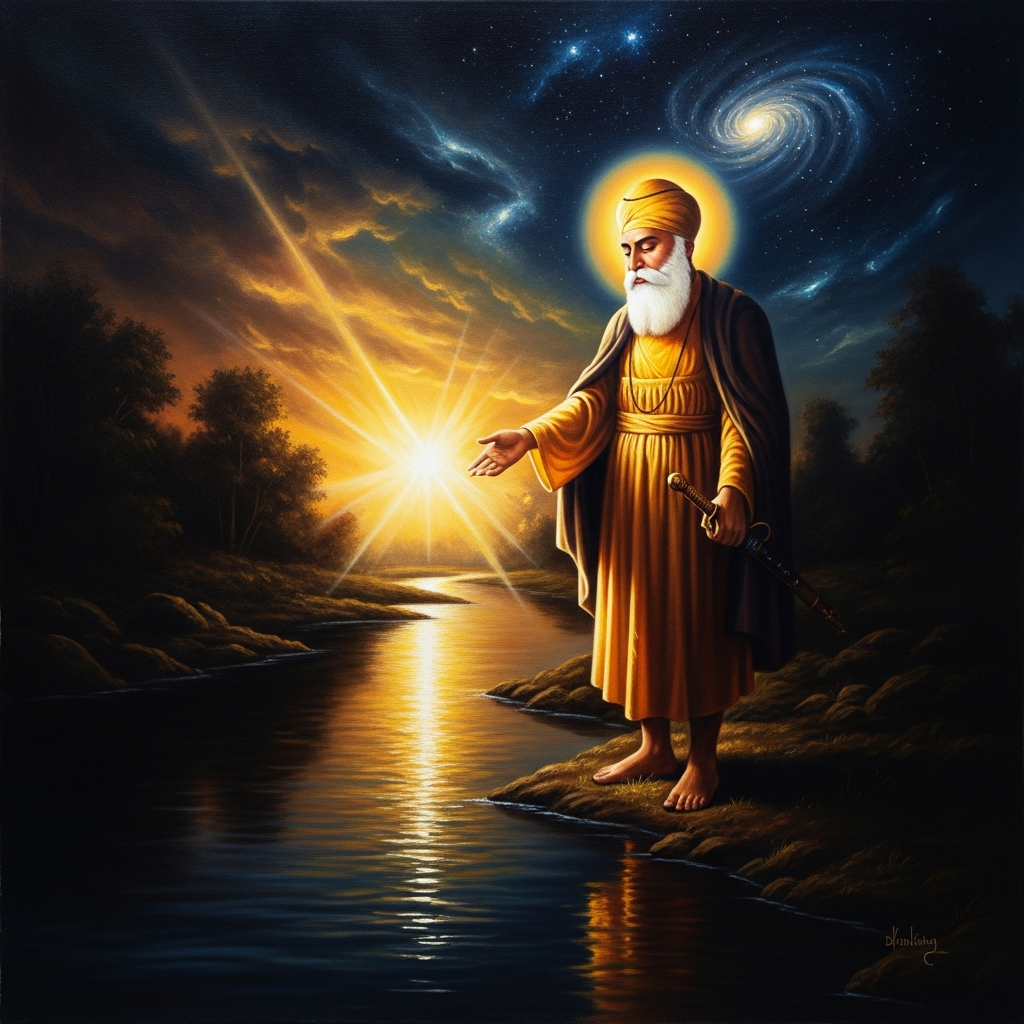
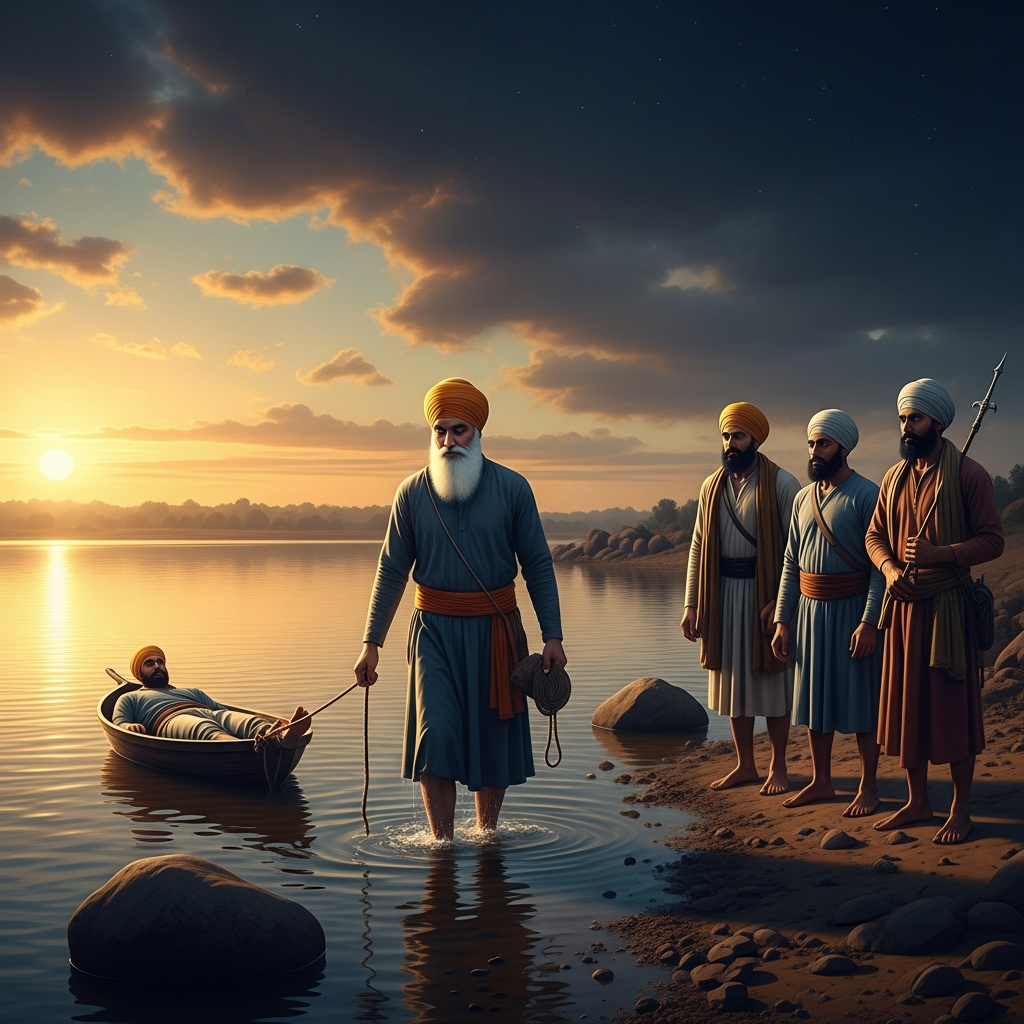
On a morning in 1499 he takes his brass lota from his belt and walks down the path to the Bein, the way he has walked every morning since he came to Sultanpur. Bhai Mardana walks behind him, the rebab wrapped across his back. The river is small and brown and slow at this hour, with egrets on the shallows and the sound of the city not yet started behind them. Nanak hands Mardana his outer cloak. He steps into the water. It comes to his knees, then his waist, then he takes another step. Mardana waits for him to turn back, the way a man turning in a bath turns back. Nanak does not turn back. The Bein closes over his turban.
He does not come out.
Mardana wades in to his chest and finds nothing.
He runs back to the city. By midmorning a hundred men are dragging the Bein with nets, poling the channel downstream, searching every reed and eddy. The Sultan sends his retainers. Nanak’s brother-in-law Jai Ram walks the bank calling his name until his voice gives out. The second day, Mardana sits at the water’s edge and plays the rebab into the current. The notes go under and do not come back. The city begins to mourn. His family washes his clothes in preparation for a funeral without a body.
The third day, the searching stops.
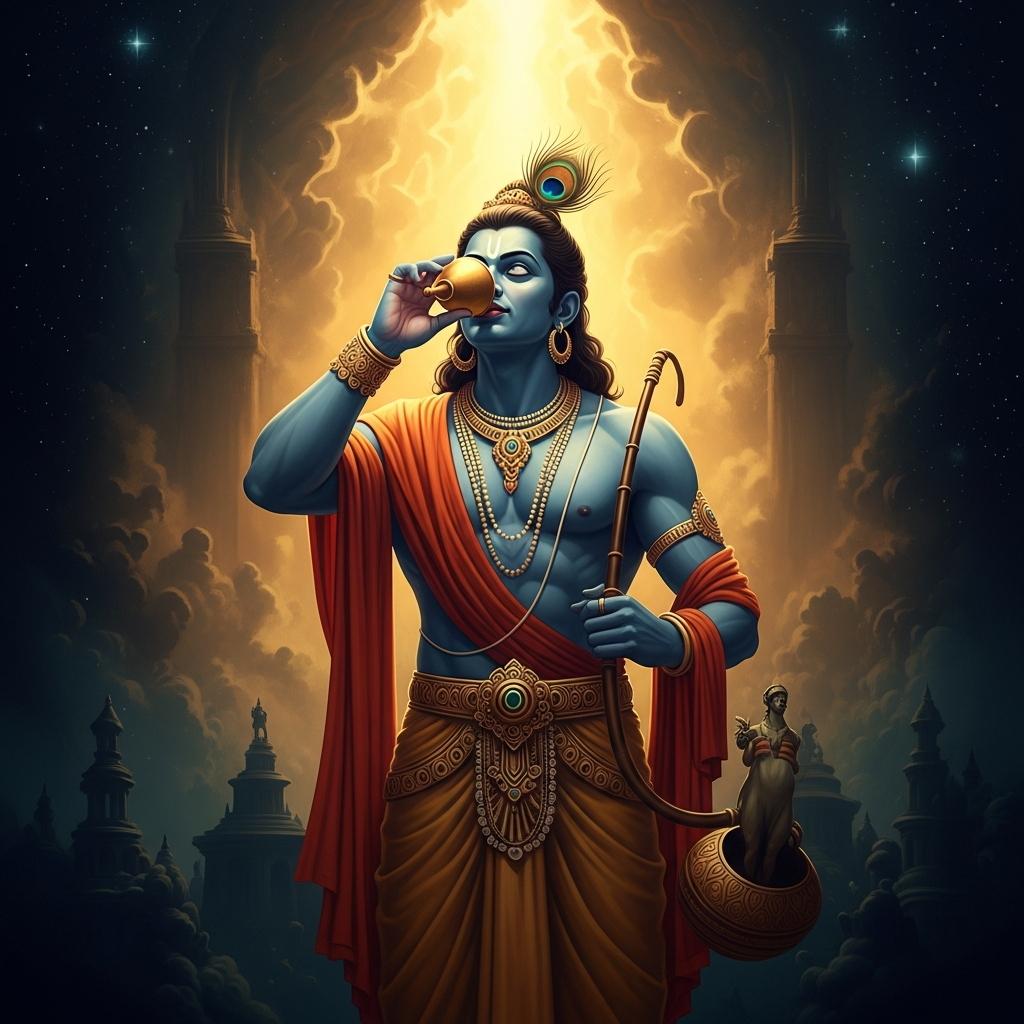
Beneath the surface — the janamsakhis hold back the geography and the theology both — Nanak stands in a court that has no walls.
The light here is not the light of Punjab mornings. It has no source and no shadow. A figure he will spend the rest of his life finding words for — Akal Purakh, the Timeless One — hands him a cup and he drinks. The sweetness in the cup is not a metaphor; it burns through him the way a lamp’s heat presses through closed eyes. The voice that follows is quiet and total and says what it says without ceremony: Nanak, I am with you. My Name shall be magnified through you. Go into the world. Repeat my Name. Cause others to repeat it.
He is handed a robe. He is handed a single line of verse. He is pointed back toward the surface.
On the morning of the third day, he walks out of the Bein.
He is soaked. He is barefoot. He walks past Mardana without speaking, past the boatmen, past the priests who wrote the obituary, past the retainers who do not know whether to bow or arrest him. He walks into the bazaar and sits down in the dust and does not speak. He sits the entire day in silence. People bring food; he does not eat it. The Qazi comes to ask what is the meaning of this; he does not answer. The Brahmins come with the same question in different vocabulary; he does not answer. His wife sends word; he does not answer.
On the morning of the fourth day he opens his mouth.
He says: Na koi Hindu, na koi Musalman. There is no Hindu. There is no Muslim.
He resigns from the modi-khana by noon.
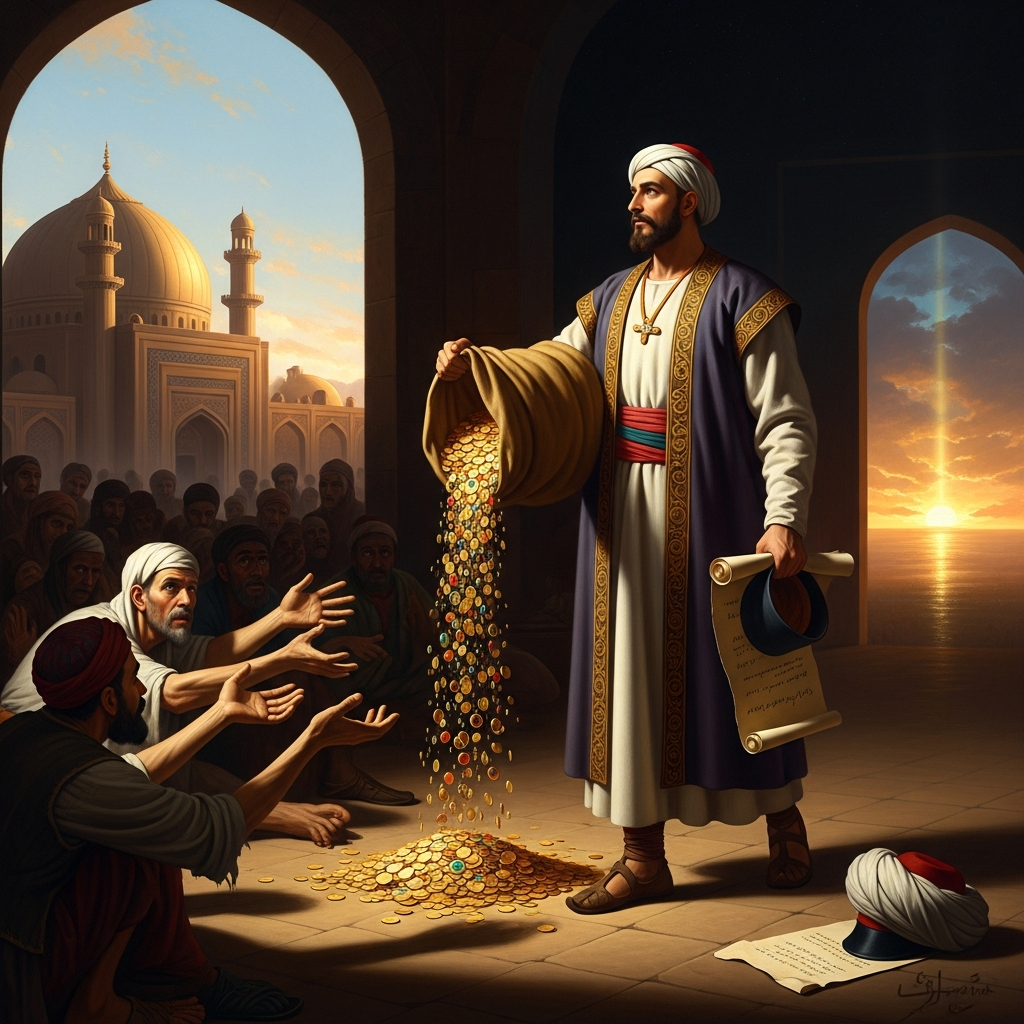
He empties his coin purse in the market square, the systematic way he balanced accounts — the poor in a line, each one given what he has until there is nothing left to give. He puts on the motley robe he was handed in the court with no walls, half the color of the Hindu sadhu and half the color of the Sufi faqir, deliberate about the confusion. He tells Mardana to bring the rebab. They walk east out of Sultanpur as the light comes off the Bein behind them, and the sentence he spoke in the bazaar — still scandalous, still spreading from stall to stall — blows ahead of them like smoke before a fire that has not yet appeared.
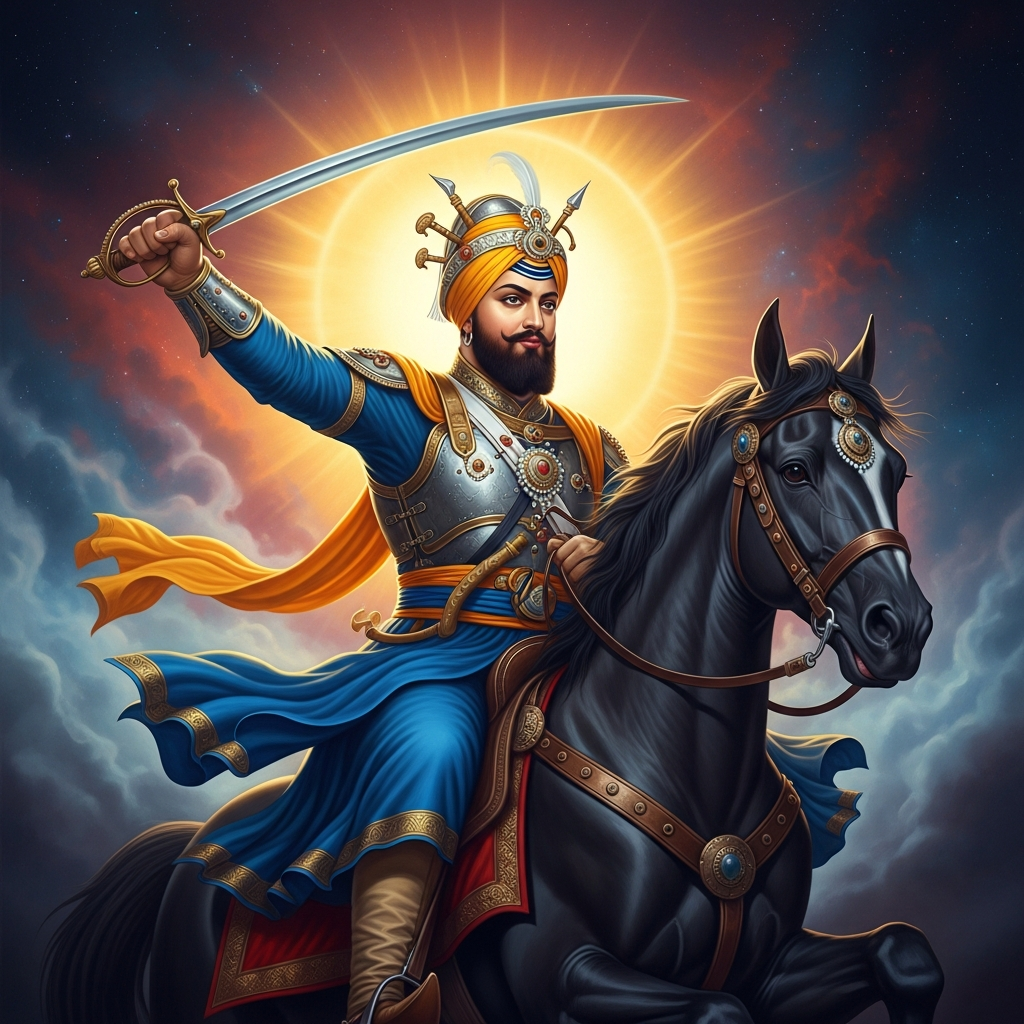
For the next twenty-eight years, across four great journeys, he does not stop walking. He goes to Mecca and Baghdad and Assam and Sri Lanka and the high Himalayan shrines and the island temples of the south. Everywhere he goes he sings the line he was given in the river. He sets it to music. He writes it at the top of every verse. He calls it Ik Onkar — One Reality — and it contains, in the two syllables before the vowel drops, the entire religion that has not yet been named.
The Ber Sahib gurdwara rises today at the ghat where he disappeared, and the Kali Bein still flows past it, narrow and brown and unhurried, carrying no outward sign of what it once swallowed and gave back.
Scenes
Third day, dawn
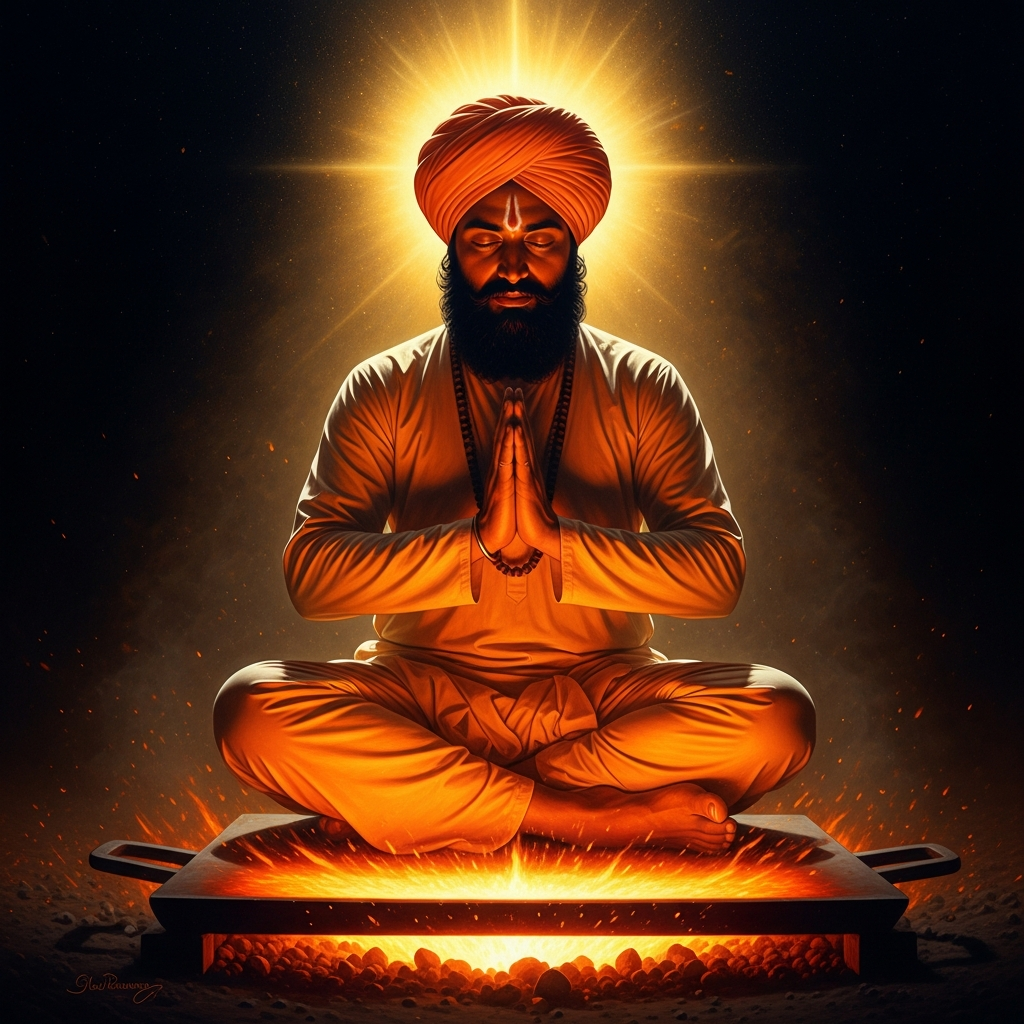
Generating art… Beneath — or beyond — the surface, he stands in a court without walls or ceiling, brighter than any Punjab noon, and drinks from a cup whose sweetness he will spend the rest of his life trying to describe in verse
 Generating art…
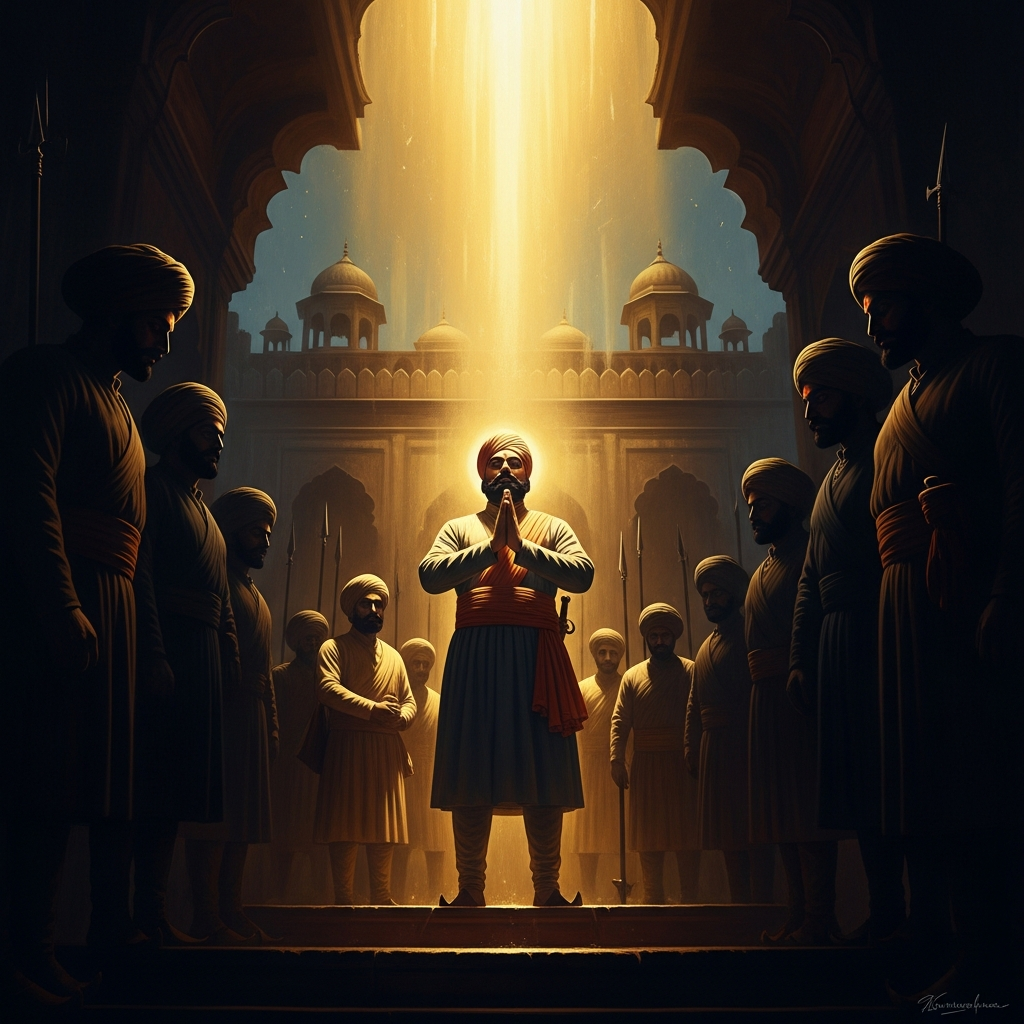
 He empties his savings into the hands of the poor, resigns from the Sultan's granary, and begins walking east — the first step of 28 years and thousands of miles
 Generating art…
 Echoes Across Traditions
Entities
- Guru Nanak Dev Ji
- Bhai Mardana
- Akal Purakh (the Timeless One)
- Daulat Khan Lodhi
- the Bein (Kali Vein) river


Sources
- *Sri Guru Granth Sahib* (compiled 1604, finalized 1708) — *Japji Sahib* opens with the *Mool Mantar* born from this vision
- *Janamsakhis* (Bālā, Mihrbān, and Puratan recensions, 16th-17th c.) — four independent narratives of the Bein immersion
- W. H. McLeod, *Guru Nanak and the Sikh Religion* (Oxford University Press, 1968)
- Khushwant Singh, *A History of the Sikhs, Vol. I: 1469-1839* (Princeton University Press, 1963)
- Pashaura Singh & Louis Fenech (eds.), *The Oxford Handbook of Sikh Studies* (Oxford University Press, 2014)