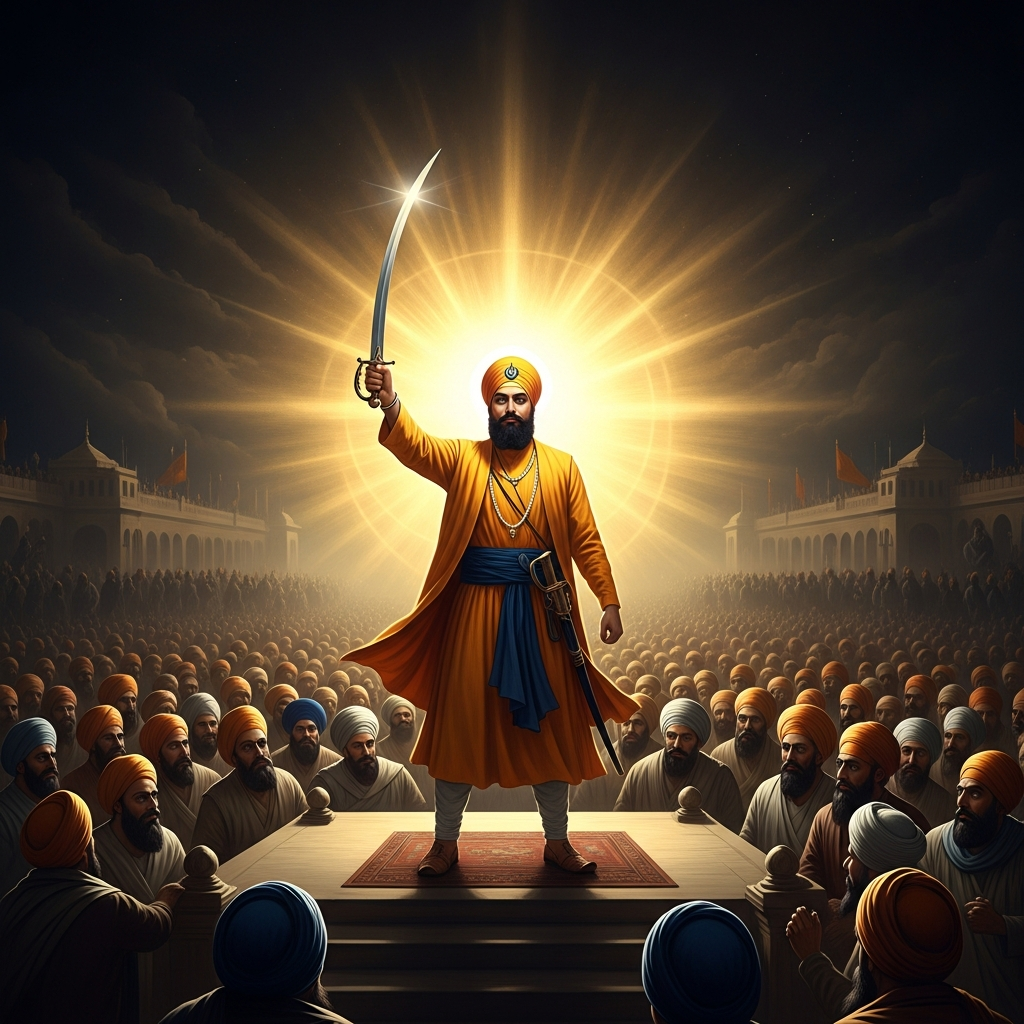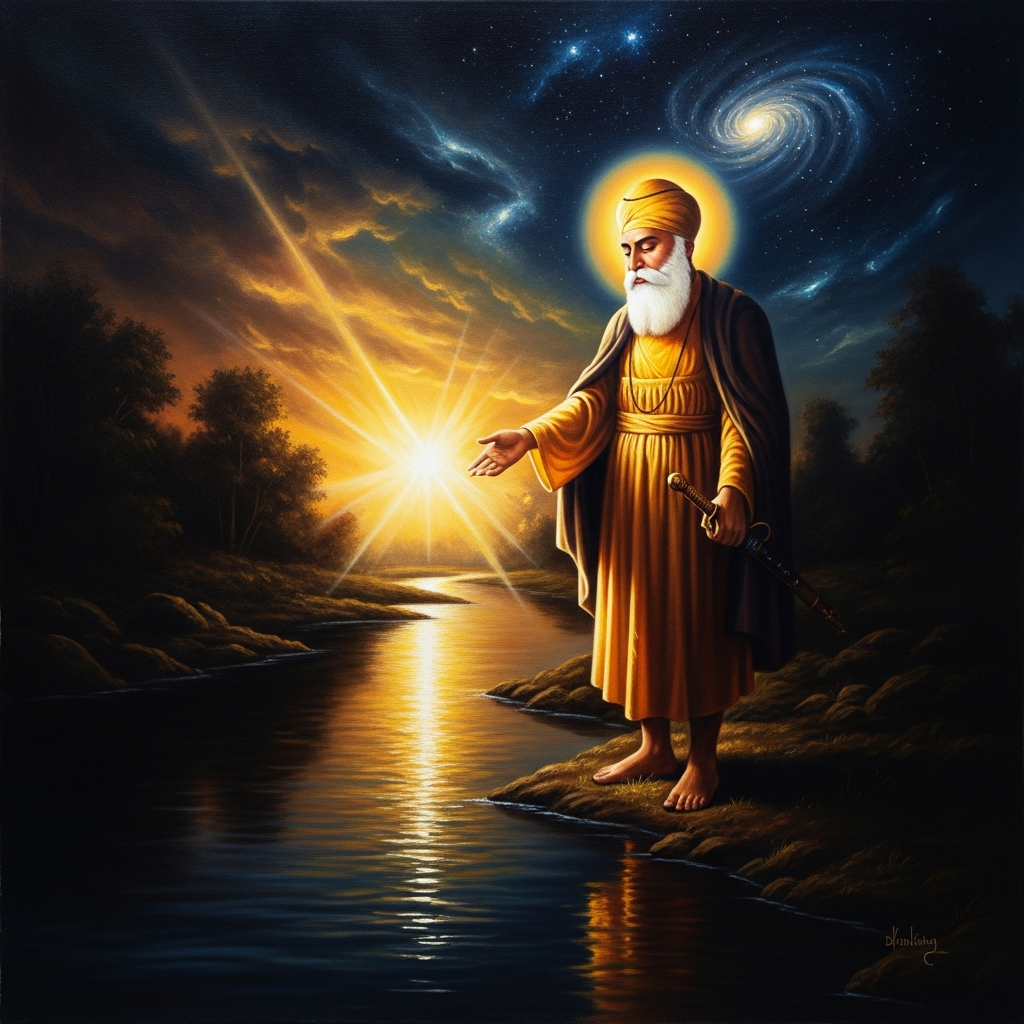
Three Days in the Bein
c. 1499 CE · Sultanpur Lodhi, Punjab · the banks of the Kali Bein, a tributary of the Beas, in Sultanpur Lodhi under the Lodi Sultanate
Contents
A thirty-year-old grain accountant walks into a Punjabi river at dawn for his morning bath and does not come out for three days. When he finally surfaces, he has stopped being a Hindu, stopped being a Muslim, and started being something the subcontinent has not seen before.
- When
- c. 1499 CE · Sultanpur Lodhi, Punjab
- Where
- the banks of the Kali Bein, a tributary of the Beas, in Sultanpur Lodhi under the Lodi Sultanate
He is thirty years old and tired of being right.
The grain accounts at Daulat Khan Lodhi’s modi-khana balance every day under his hand. He weighs millet for the Sultan’s stores, gives the poor an extra measure when no one is looking, and writes hymns at night by lamp-oil he buys with his own pay. He has a wife. He has two sons. He has the respect of Hindus and Muslims alike, which in Sultanpur in 1499 is its own kind of tightrope.
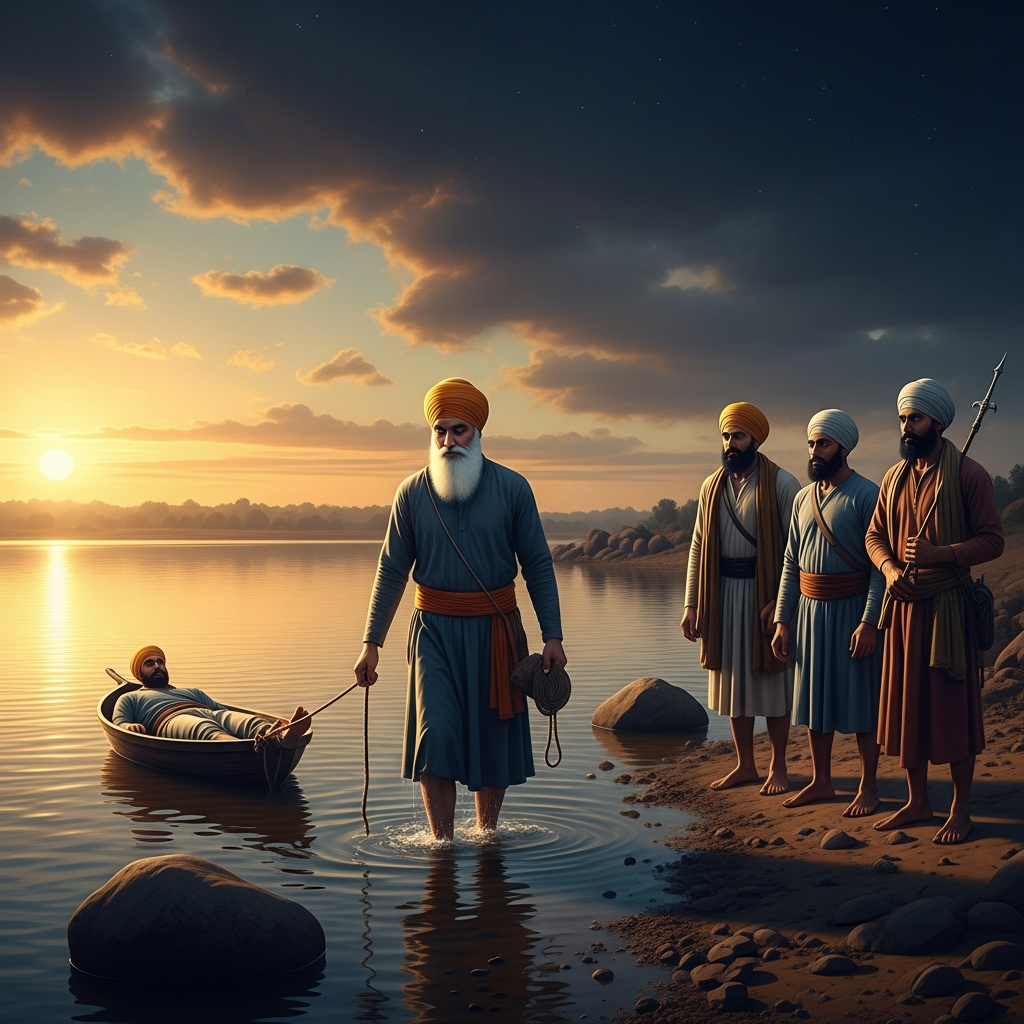
Before dawn each day he goes to the Bein to bathe. The river is small — a tributary, brown, slow — but it is the only thing in Sultanpur older than the Sultanate.
This morning he takes his brass lota and walks down the path he has walked a thousand times. Bhai Mardana, his Muslim friend with the rebab strapped to his back, walks behind him.
At the ghat, Nanak hands Mardana his cloak. He steps into the water.
He does not come out.
Mardana waits.
The sky lightens. The kingfishers begin to dive. A heron stands in the reeds without moving, the way herons do, the way Mardana cannot. After an hour he calls Nanak’s name. After two he wades in. The Bein is shallow here — thigh-deep at most — and there is no current that could take a grown man under. He searches the bank. He searches the reeds. He runs back to the town.
The news travels like a struck bell. The accountant has drowned. Nets are dragged through the river. Boatmen pole the channel for a mile downstream. The Sultan sends his own retainers. Nothing.
The second day, Mardana sits on the bank and plays the rebab into the water. The notes go down and do not come back.
The third day, the search ends. Nanak’s family begin to mourn.
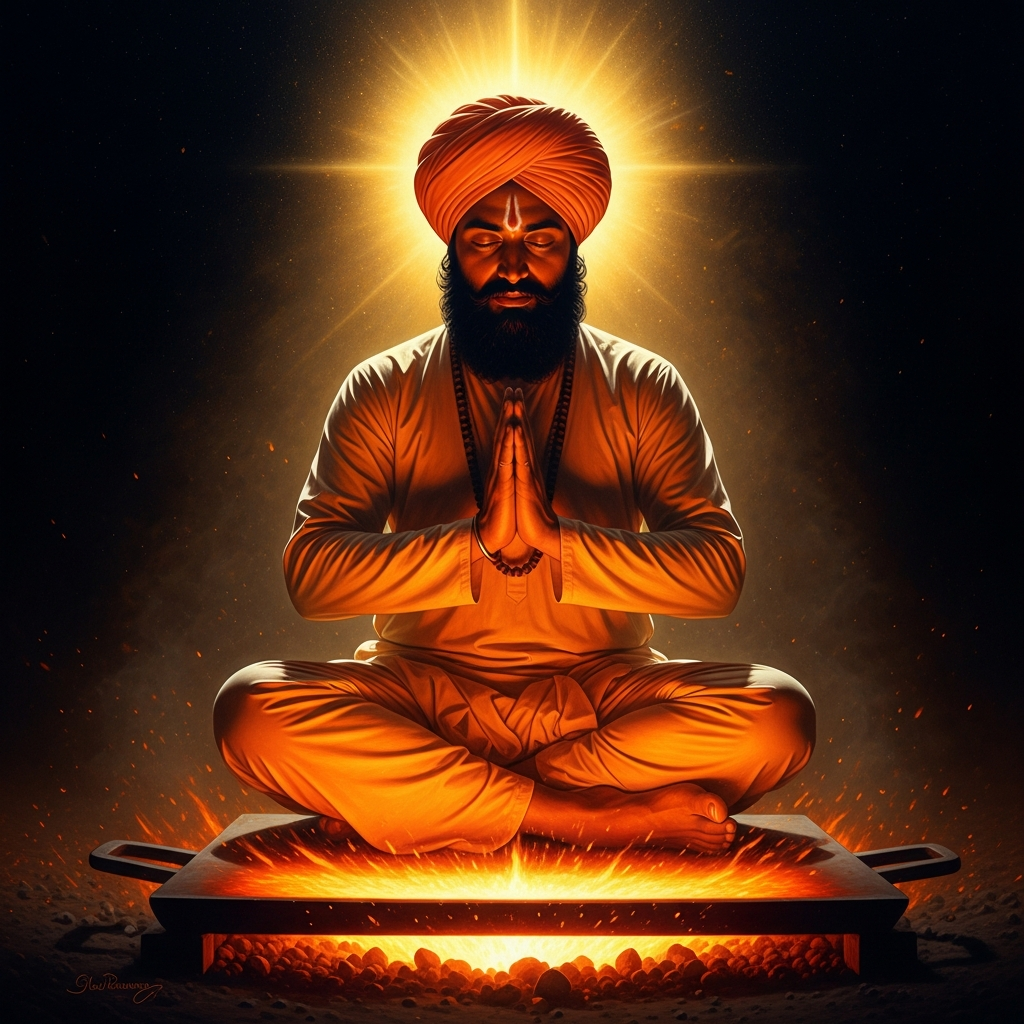
Beneath the surface — the janamsakhis are careful not to say where, exactly — he is standing in a court he has never seen.
It has no walls. It has no roof. It is brighter than the sun and quieter than the inside of a sleeping animal. A figure he will only ever describe as the Timeless One — Akal Purakh — hands him a cup of nectar, and he drinks. The cup is sweet beyond any sweetness Sultanpur trades in. The voice that follows is not loud. It says: Nanak, I am with thee. Through thee my Name shall be magnified. Go into the world. Repeat my Name. Cause others to repeat it.
He is given a robe of honor. He is given a single sentence to carry back: Ik Onkar — One Reality — which contains, the way a seed contains a tree, every line of the Mool Mantar he has not yet spoken.
Then the court folds away. The water comes back. He is climbing.
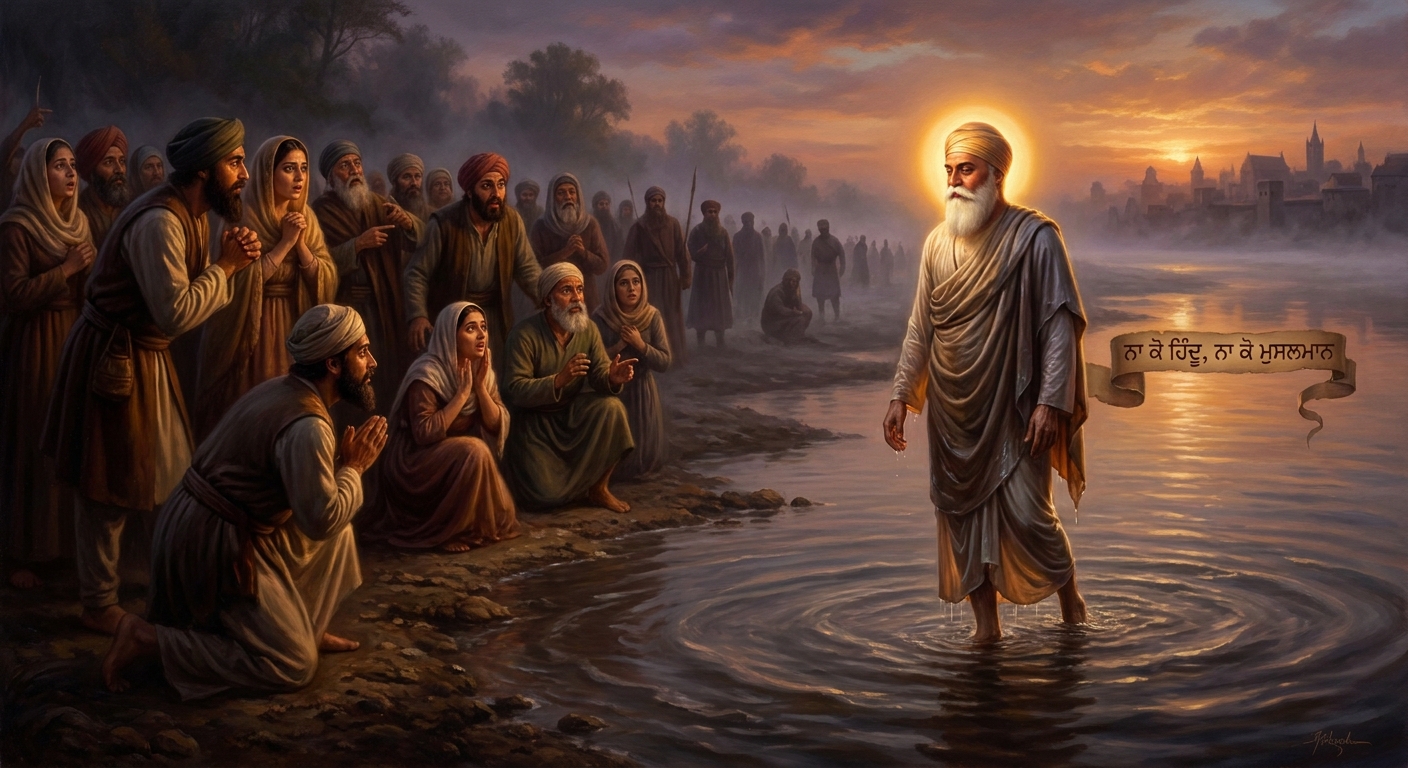
On the morning of the third day he walks out of the Bein.
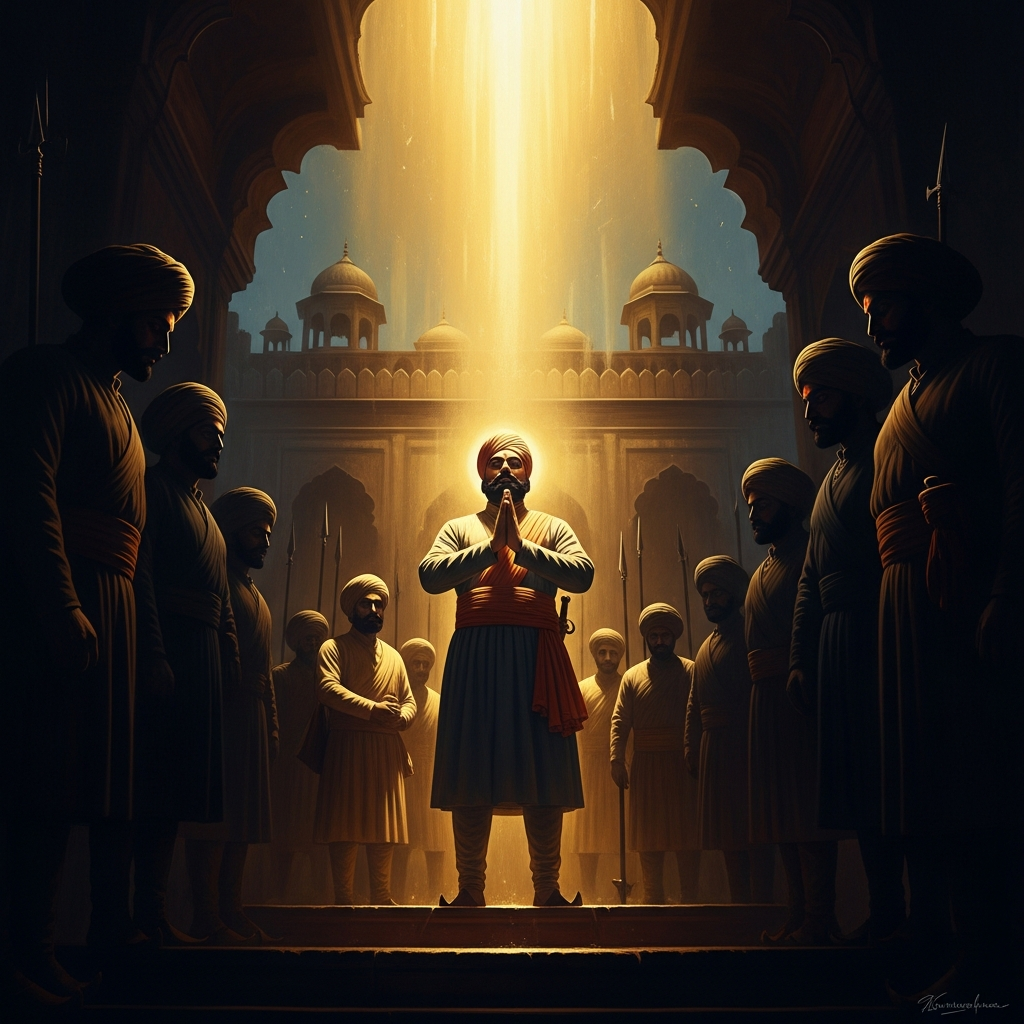
He is barefoot and soaked. He is silent. He walks past Mardana, past the boatmen who had given up dragging the river, past the priests who had begun to write his obituary, past Daulat Khan’s retainers who do not know whether to bow or arrest him. He walks into the bazaar and sits down in the dust.
He sits for a full day. He says nothing. People bring him food; he does not eat. People ask him questions; he does not answer. The Qazi of Sultanpur comes to demand what he means by this performance. The Brahmins come with the same demand in different vocabulary.
Finally, on the morning of the fourth day, he opens his mouth.
He says: Na koi Hindu, na koi Musalman. There is no Hindu. There is no Muslim.
The Qazi’s face hardens. The Brahmins step back.
It is, on its surface, a simple sentence. It refuses both certifications the subcontinent runs on. It says — out loud, in a city where saying it costs a man his livelihood and possibly his life — that the categories the empires use to sort their subjects are not the categories God uses. Beneath the turban and beneath the topknot, beneath the namaaz mat and beneath the puja thali, there is one Reality, and it does not check papers.
The Qazi orders him brought to the mosque to prove his orthodoxy by praying with the Sultan. He goes. During the prayer he stands silent. When asked why, he says the Qazi was thinking of his new mare in Kabul and the Sultan was thinking of accounts; whose prayer was I to join?
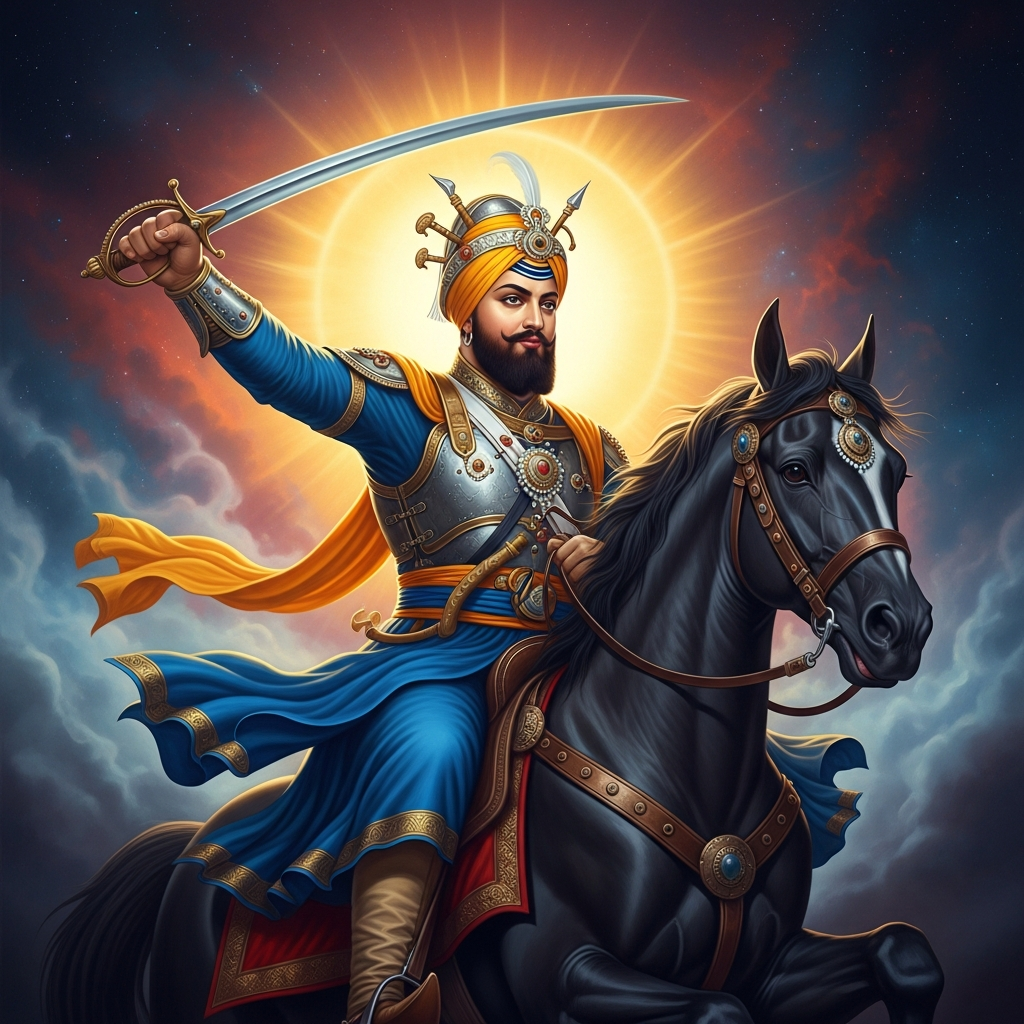
He resigns from the modi-khana the same day. He gives his savings to the poor. He puts on the strange motley robe of his commission — half Hindu sadhu, half Muslim faqir, neither — and he begins to walk.
He walks for the rest of his life.
Mardana walks with him, the rebab on his back, playing while Nanak sings. They go to Mecca. They go to Mount Sumeru. They go to Baghdad and to Assam and to Sri Lanka and to the temple at Jagannath Puri, where Nanak refuses to perform the aarti with lamps because the cosmos is already performing it — the sun and moon are the lamps, the wind is the censer, the stars are the offerings, Gagan mein thaal, the sky itself is the platter.
Everywhere he goes he repeats the sentence he was given in the river. Ik Onkar. One Reality. He sets it to music. He writes it out at the head of every hymn he composes. When he dies in 1539 in Kartarpur, the Hindus and Muslims at his bedside argue over whether to cremate or bury him, and — the janamsakhi says — when they lift the sheet there is nothing under it but flowers, half for each.
The flowers are a legend. The sentence is not.
The Bein still flows past Sultanpur. Pilgrims bathe at the ghat where he disappeared, in the gurdwara called Ber Sahib for the jujube tree under which he sat afterward.
The Sikh tradition refuses, throughout its scripture, the claim that Nanak invented anything. He says only that he was given a Name to repeat. The radicalism of that gesture is easy to underestimate from a distance of five centuries: in Mughal Punjab, where Hindu and Muslim were the two licensed identities and conversion the only permitted movement between them, declaring that neither category was ultimate was a third position the empire had no slot for.
There is no Hindu. There is no Muslim. There is, the Bein gave back, only the One.
Scenes
Before dawn, Sultanpur
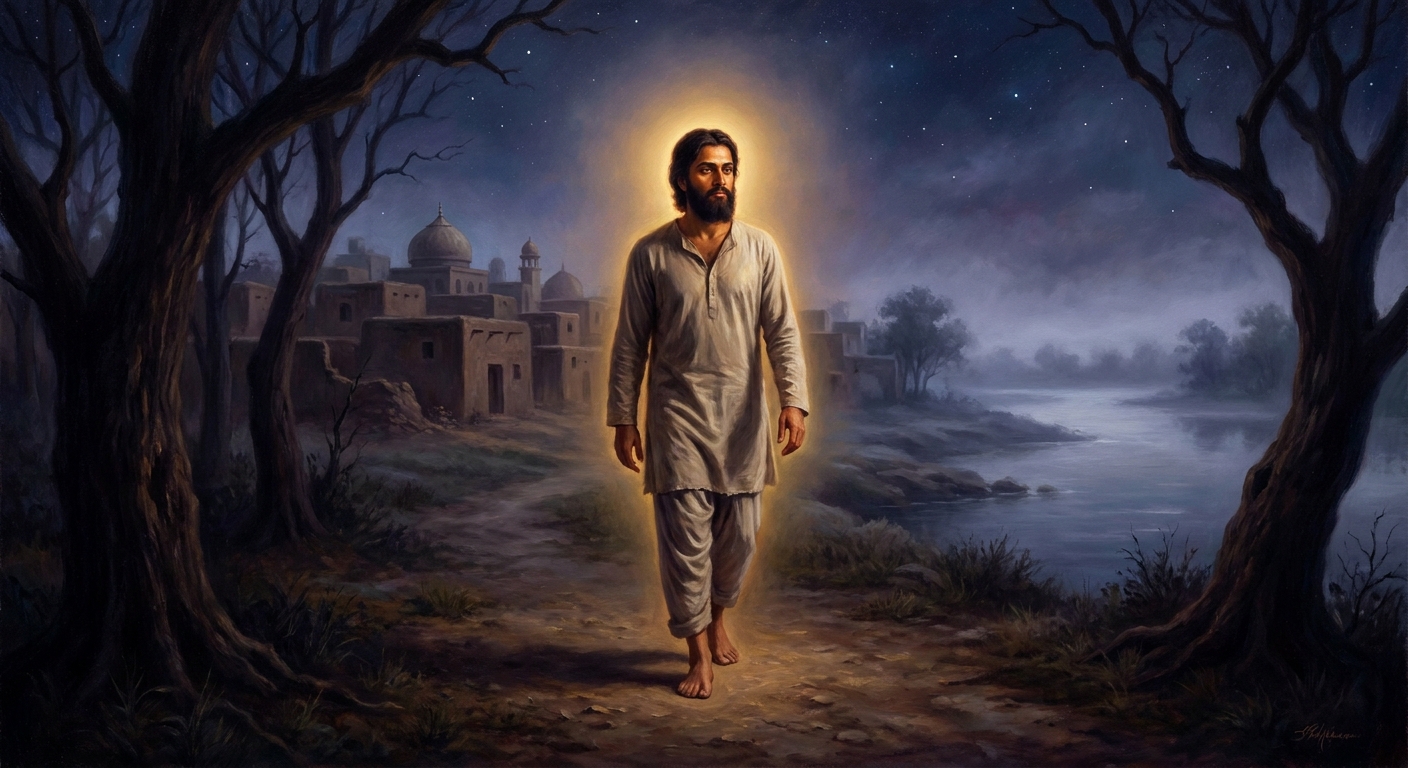 Generating art…
 Beneath the surface — or above it; the *janamsakhis* are unclear — he is brought into the court of *Akal Purakh*, handed a cup of nectar, and given the commission: *Go, repeat my Name
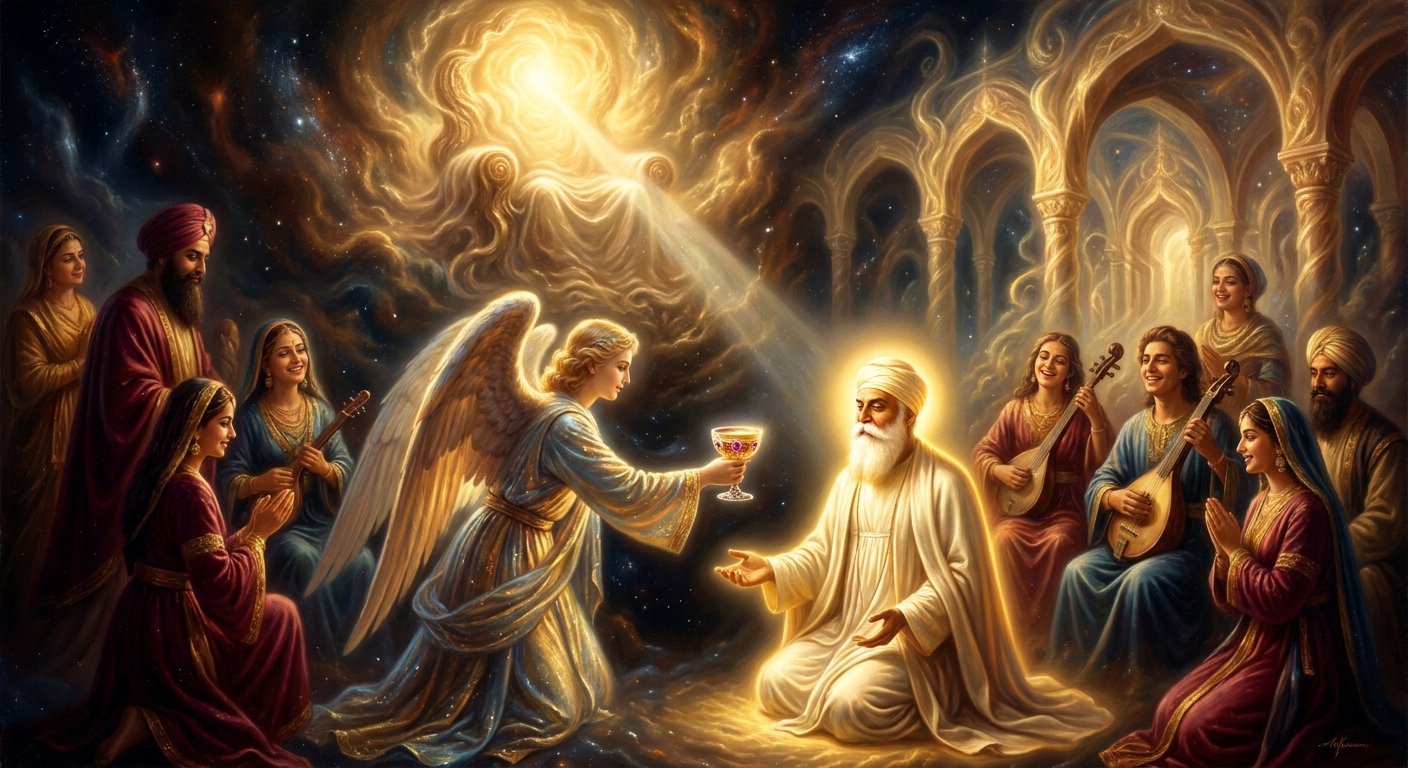 Generating art…
 On the third day he climbs the bank in soaked white cloth and speaks his first sentence as Guru: *Na koi Hindu, na koi Musalman
 Generating art…
 Echoes Across Traditions
Entities
- Guru Nanak Dev Ji
- Bhai Mardana
- the Bein (Vein) river
- Akal Purakh (the Timeless One)
- Daulat Khan Lodhi


Sources
- *Sri Guru Granth Sahib* (compiled 1604; finalized 1708) — *Japji Sahib* and the *Mool Mantar*
- *Janamsakhis* (Bālā, Mihrbān, and Puratan recensions, 16th-17th c.)
- W. H. McLeod, *Guru Nanak and the Sikh Religion* (Oxford, 1968)
- Trilochan Singh, *Guru Nanak: Founder of Sikhism* (Gurdwara Parbandhak Committee, 1969)
- Pashaura Singh & Louis Fenech (eds.), *The Oxford Handbook of Sikh Studies* (Oxford, 2014)
- Khushwant Singh, *A History of the Sikhs, Vol. I: 1469-1839* (Princeton, 1963)