Five Heads, One Sword, the Khalsa
Vaisakhi · April 13, 1699 CE · Keshgarh Sahib, Anandpur, in the Sivalik foothills of Punjab — under the Mughal emperor Aurangzeb
Contents
On the festival of Vaisakhi, with eighty thousand Sikhs assembled at Anandpur, the Tenth Guru draws his sword and asks for a head. Five men step forward. They walk into a tent one at a time and do not come out until the Guru himself does, with a steel bowl of sweetened water and a new kind of community on the other side of it.
- When
- Vaisakhi · April 13, 1699 CE
- Where
- Keshgarh Sahib, Anandpur, in the Sivalik foothills of Punjab — under the Mughal emperor Aurangzeb
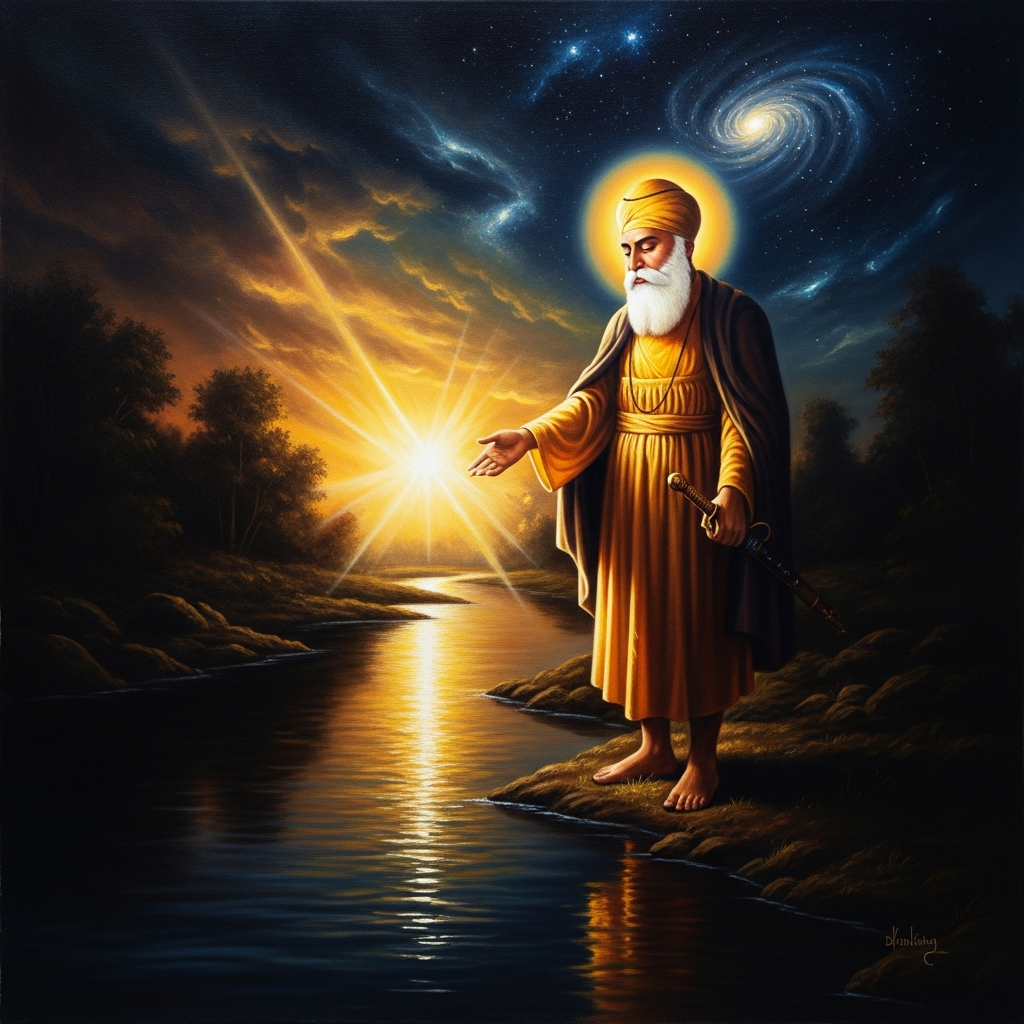
Vaisakhi morning. The first warm light of the Punjab spring.
Eighty thousand Sikhs have walked to Anandpur for the festival, the way their grandparents walked under the first Gurus. They come from Lahore and Kabul and Kashmir and the Deccan. They camp on the slopes below Keshgarh fort. They expect a sermon. They expect langar — the free meal that has fed Sikh gatherings for two centuries. They expect the Tenth Guru, age thirty-two, son of the beheaded Ninth, to bless them and send them home.
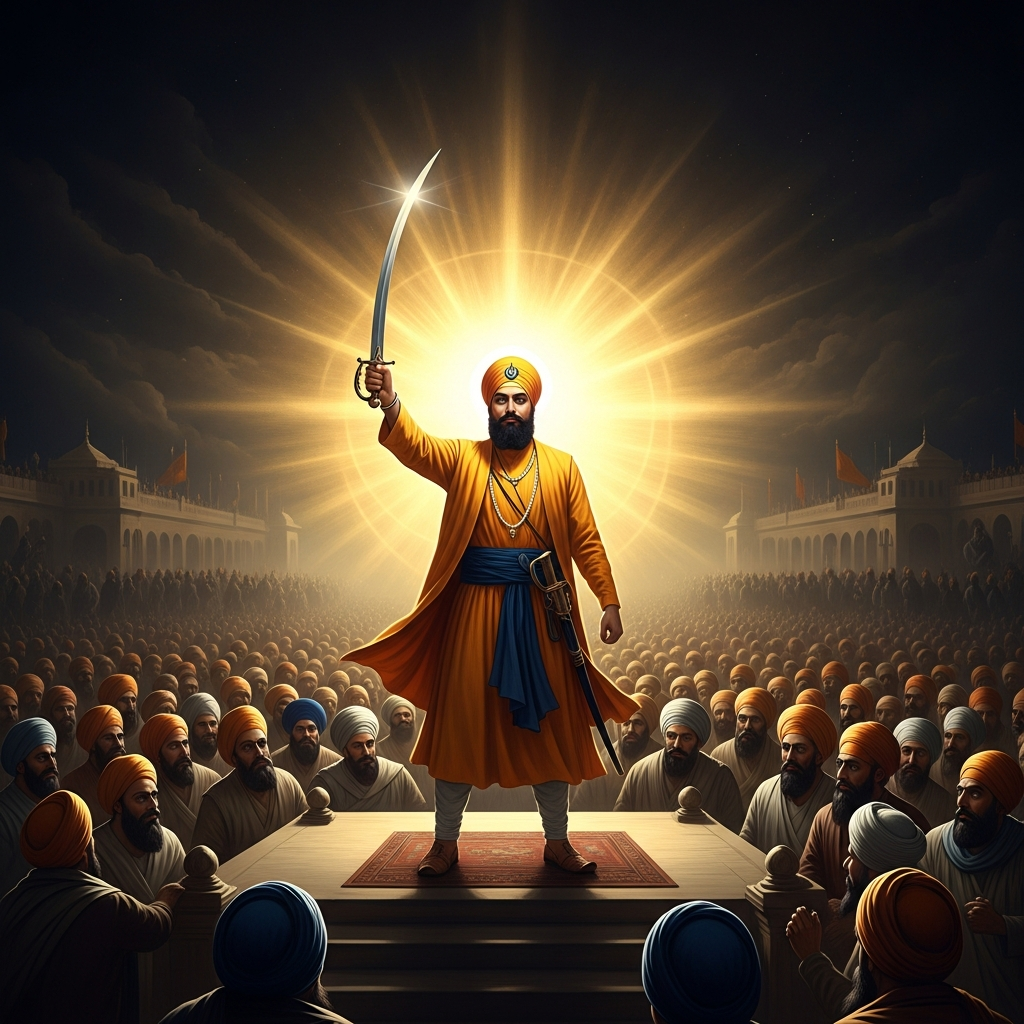
The Guru appears on the dais in saffron. A long sword is in his right hand. He has not put it down.
He waits for the crowd to fall silent. The silence takes a long time.
When he speaks, his voice carries to the back of the field. He says: Is there one among you ready to give me his head?
The crowd does not move.
The Guru repeats the question. Then again, a third time. Each repetition is a beat the field absorbs without answering. Mothers look at sons. Disciples look at the dais and away. Some begin to leave — quietly at first, then in larger groups, slipping toward the tents to find horses, suddenly remembering pressing business in their home villages.
After a long minute, a man stands up.
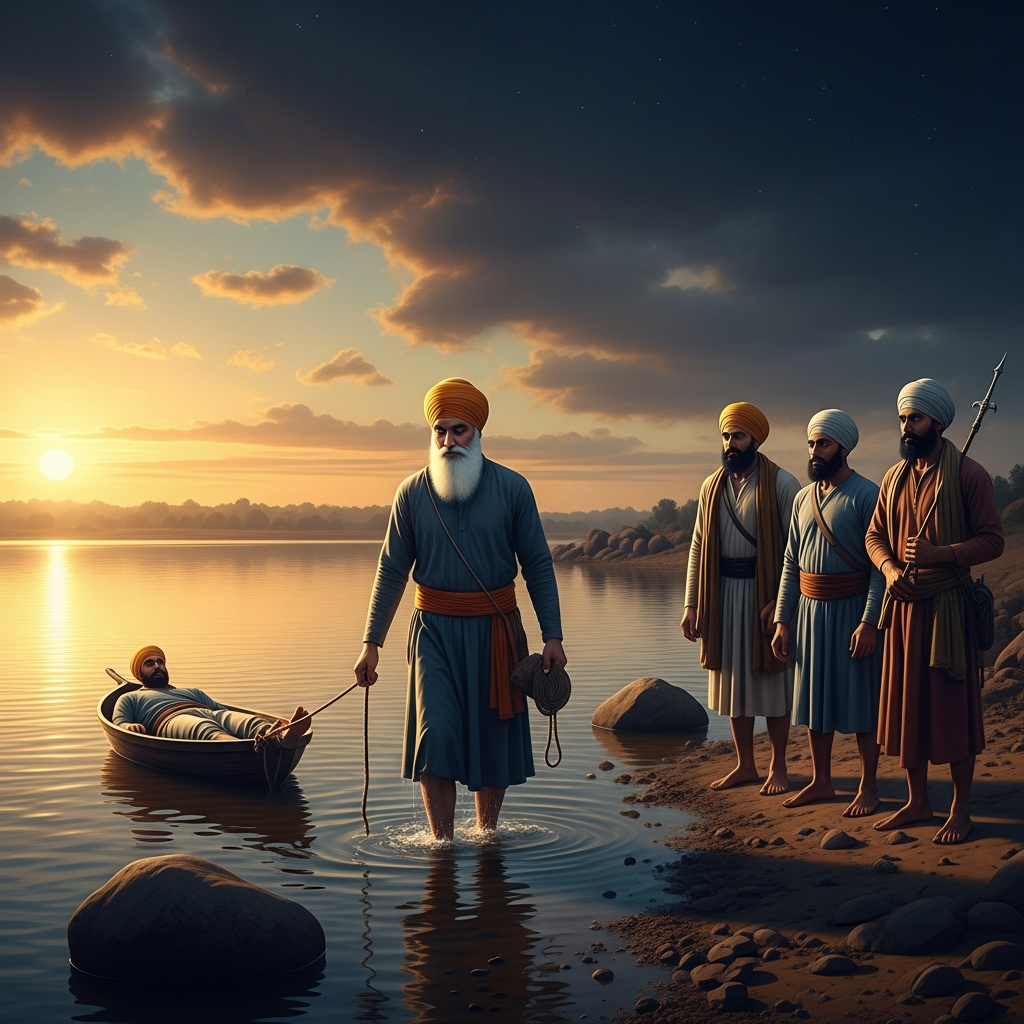
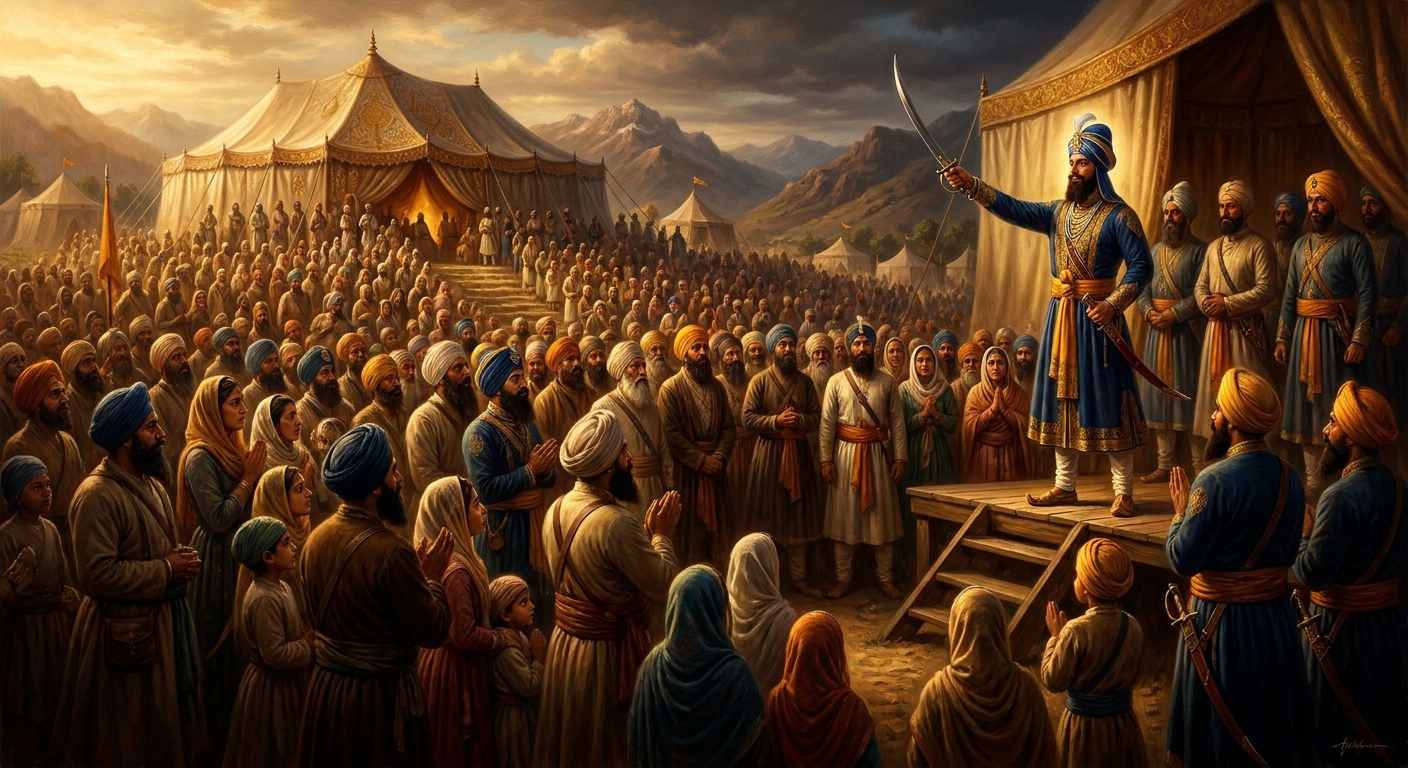
He is Daya Ram, a Khatri shopkeeper from Lahore. He says: Sir, my head is yours. He climbs the dais. The Guru takes him by the arm and leads him into a tent pitched behind the platform. The flap closes.
The crowd hears the sword fall. They hear it cut something that is not air.
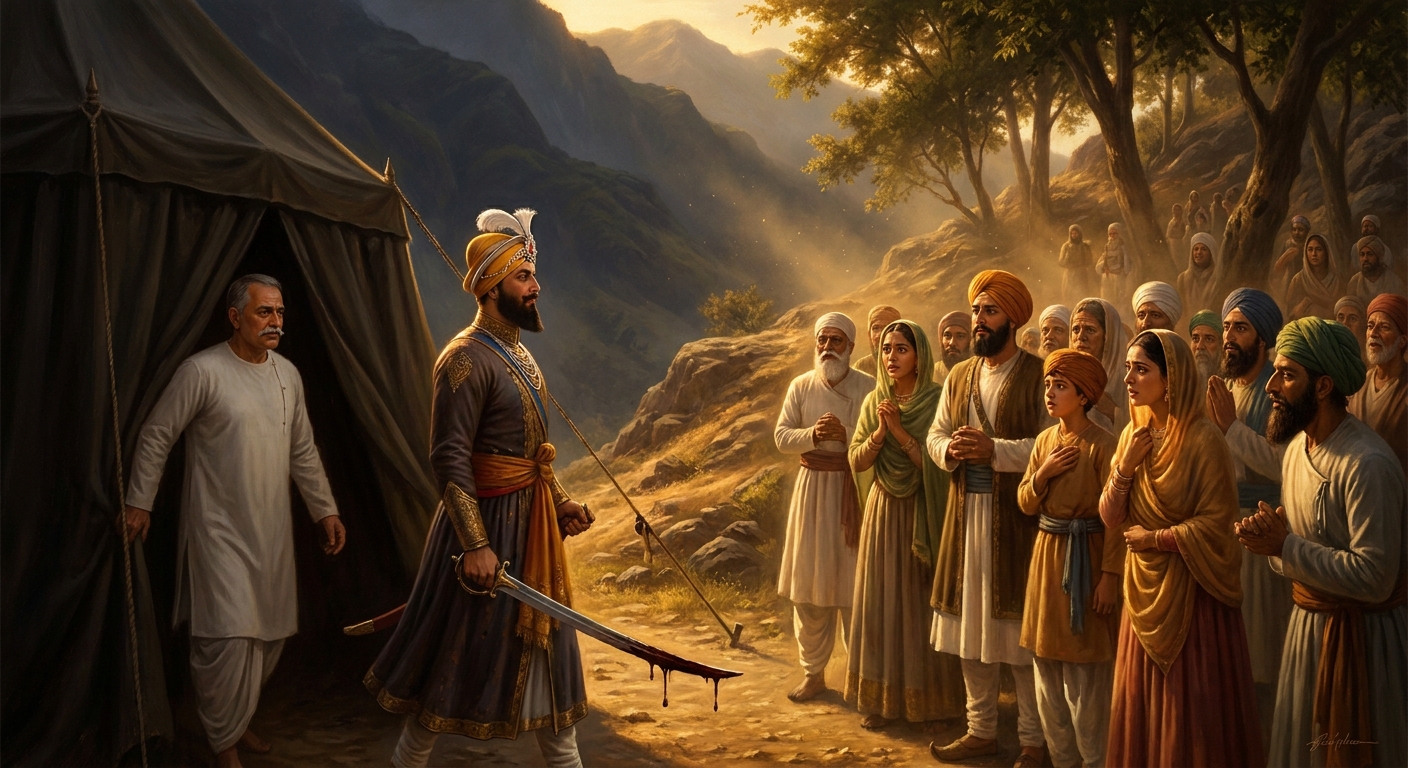
The flap opens. The Guru steps out alone. The sword is wet. He looks at the crowd and asks the question again: Is there another?
He asks four more times.
Dharam Das, a Jat farmer from Delhi, stands. He goes into the tent. The sword falls. The Guru comes out alone.
Mohkam Chand, a washerman from Dwarka. The sword falls. The Guru comes out alone.
Himmat Rai, a water-carrier from Jagannath Puri. The sword falls. The Guru comes out alone.
Sahib Chand, a barber from Bidar. The sword falls.
The crowd is now in open panic. Brahmins and Khatris and Mughal informers all shoulder for the exits. The remaining sangat stands rooted to the earth, terrified to move. Five men have walked into a tent. None has walked out. The Guru’s saffron robe is now blood to the shoulder. He stands on the dais holding the sword. He looks at the field and waits, as if asking for a sixth.
Then he turns and walks back into the tent.
The flap opens. The Guru emerges.
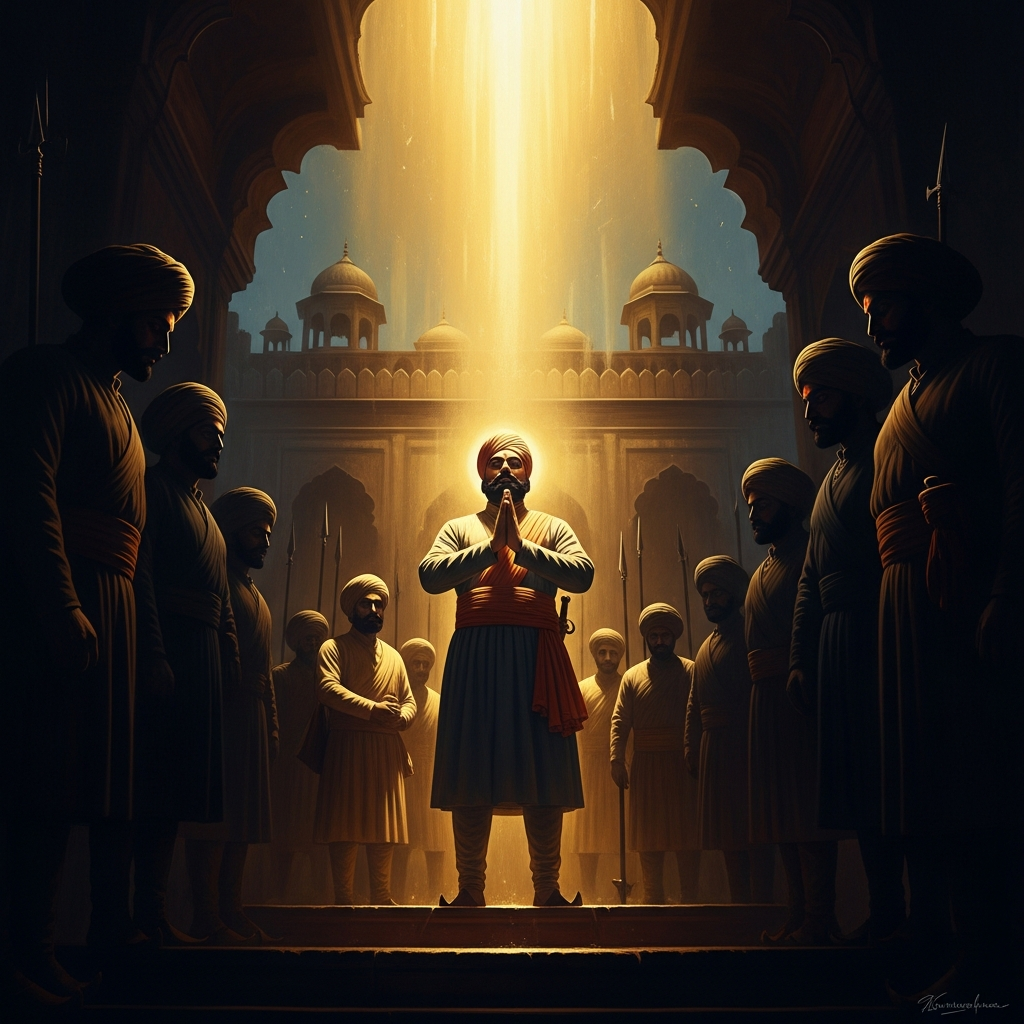
The five men are behind him.
They are alive. They are wearing identical saffron robes. They are radiant in a way that is not theatrical — they look, the eyewitness account says, like men who have already died and come back for a second life with nothing left to fear. The crowd cannot tell whether they were ever cut. The Guru does not say. He never will. The Bachittar Natak and the Gurbilas Patshahi 10 both leave the question unanswered: were five goats slaughtered, or five men, or five somethings else? The answer the tradition gives is: it does not matter. They walked out.
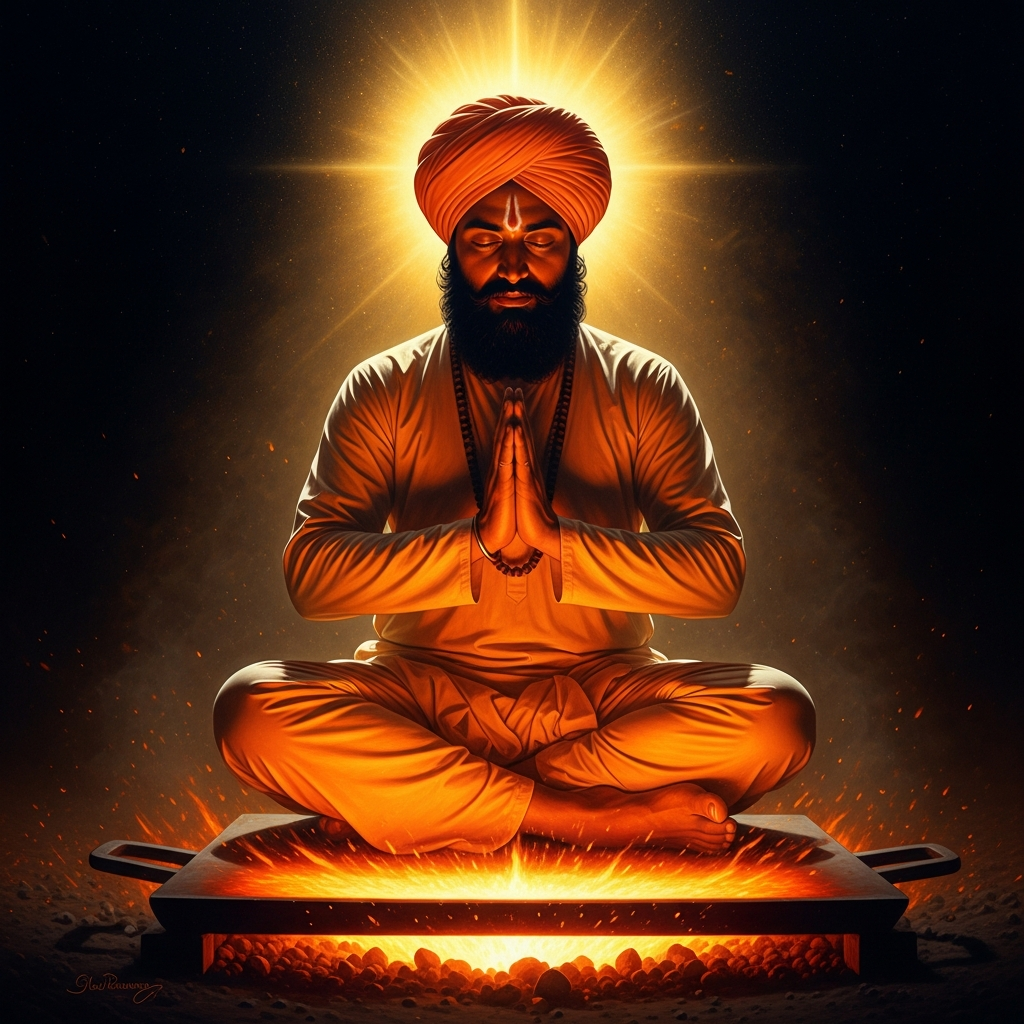
The Guru calls them the Panj Pyare — the Five Beloved. He calls for a steel bowl. Sweet water is poured in — patasa, sugar lumps stirred by his wife Mata Sahib Devan. He sets a double-edged sword in the water and stirs.
He recites five hymns over the bowl: the Japji, the Jaap, the Anand Sahib, the Sawayye, the Chaupai. The water becomes amrit.
He kneels.
The Five Beloved kneel before him. He takes the bowl in both hands. He pours amrit into each man’s cupped palms five times. They drink. He sprinkles it five times into their eyes. They blink. He pours it five times onto the topknots of their hair, which by his order they will never again cut. They are no longer who they were. Daya Ram is Daya Singh. Dharam Das is Dharam Singh. The barber and the washerman, the water-carrier and the farmer and the shopkeeper, all of them now bear the same surname — Singh, lion — and the four caste boundaries that separated them an hour ago are gone the way the river-name of a tributary is gone after the confluence.
Then the Guru does the thing no one expects.
He hands the bowl back to the Panj Pyare. He kneels in front of them. He says: Now baptize me.
They hesitate. They are five new men. He is the Tenth Guru, the descendant of Nanak in unbroken succession. He is asking five strangers, one of them a barber from Bidar, to confer on him the rite he has just invented.
He insists. They pour. They sprinkle. They anoint his hair. He is now Gobind Singh — no longer Gobind Rai.
The Khalsa is the only order in human history whose founder is also its sixth member.
He stands. He addresses the field that is left.
He gives them the rahit — the discipline. The Five Ks: Kesh, uncut hair, the body as God left it; Kangha, the wooden comb that keeps the kesh ordered; Kara, the iron bracelet on the right wrist, a circle without beginning; Kachera, the cotton breeches of restraint; Kirpan, the steel sword to defend the defenseless. They will eat together regardless of caste. They will not bow before image or shrine. They will rise before dawn for amrit vela. They will fight only when negotiation has failed, and they will fight to win.
The men of the Khalsa will be Singh. The women — when Mata Sahib Devan steps forward to receive amrit an hour later, the rite extended without alteration — will be Kaur, princess.
By sunset of Vaisakhi, twenty thousand have taken amrit. By the end of the week, eighty thousand. The Mughal informers in the crowd ride south to Delhi with reports the empire does not know how to read.
Within seven years, Aurangzeb’s army will lay siege to Anandpur. Two of Gobind Singh’s sons will be killed in battle; the younger two, ages seven and nine, will be bricked into a wall alive in Sirhind for refusing to convert. His mother will die of grief. The Guru will walk south through the Punjab with his original Five Beloved beside him, fighting a war the Khalsa will not finish for another century.
By 1799 the Khalsa under Maharaja Ranjit Singh will hold Lahore. By 1849 the British will take it. By 1947 the Sikhs will pay one of Partition’s heaviest prices. Through all of it, the rite Guru Gobind Singh invented in a tent on Vaisakhi 1699 will not change: an iron bowl, sweet water, a double-edged sword, five hymns recited over the surface, and the question — asked aloud, every initiation since — that began the order.
Is there one among you ready to give me his head?
The answer the Khalsa has given for three centuries, in three continents, in two world wars and in the fields of the Punjab, is the same one the Five Beloved gave: yes.
Scenes
April 13, 1699
 Generating art…
 The first volunteer, Daya Ram, follows the Guru into a tent
 Generating art…
 Five alive
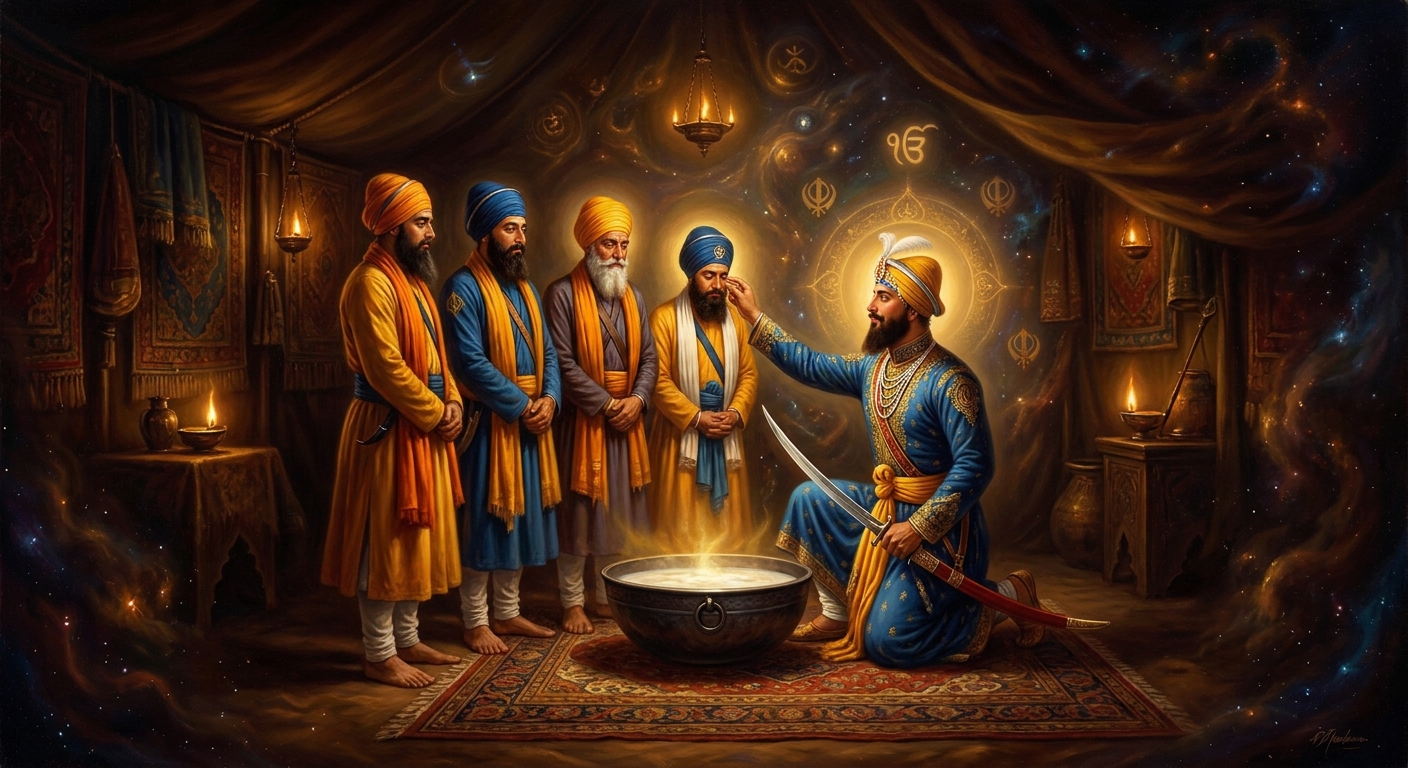 Generating art…
 Echoes Across Traditions
Entities
- Guru Gobind Singh
- the Panj Pyare (Five Beloved)
- Bhai Daya Singh
- Bhai Dharam Singh
- Bhai Himmat Singh
- Bhai Mohkam Singh
- Bhai Sahib Singh
- Mata Sahib Devan


Sources
- Guru Gobind Singh, *Bachittar Natak* (autobiographical verse, c. 1696)
- *Sri Dasam Granth* (the second Sikh scripture, attributed to Gobind Singh)
- Kuir Singh, *Gurbilas Patshahi 10* (1751) — earliest narrative of the Vaisakhi event
- Trilochan Singh, *Guru Gobind Singh: A Biographical Study* (Gurdwara Prabandhak Committee, 1968)
- Pashaura Singh & Louis Fenech (eds.), *The Oxford Handbook of Sikh Studies* (Oxford, 2014)
- Khushwant Singh, *A History of the Sikhs, Vol. I: 1469-1839* (Princeton, 1963), ch. 5
- J. S. Grewal, *The Sikhs of the Punjab* (Cambridge New History of India, 1990)