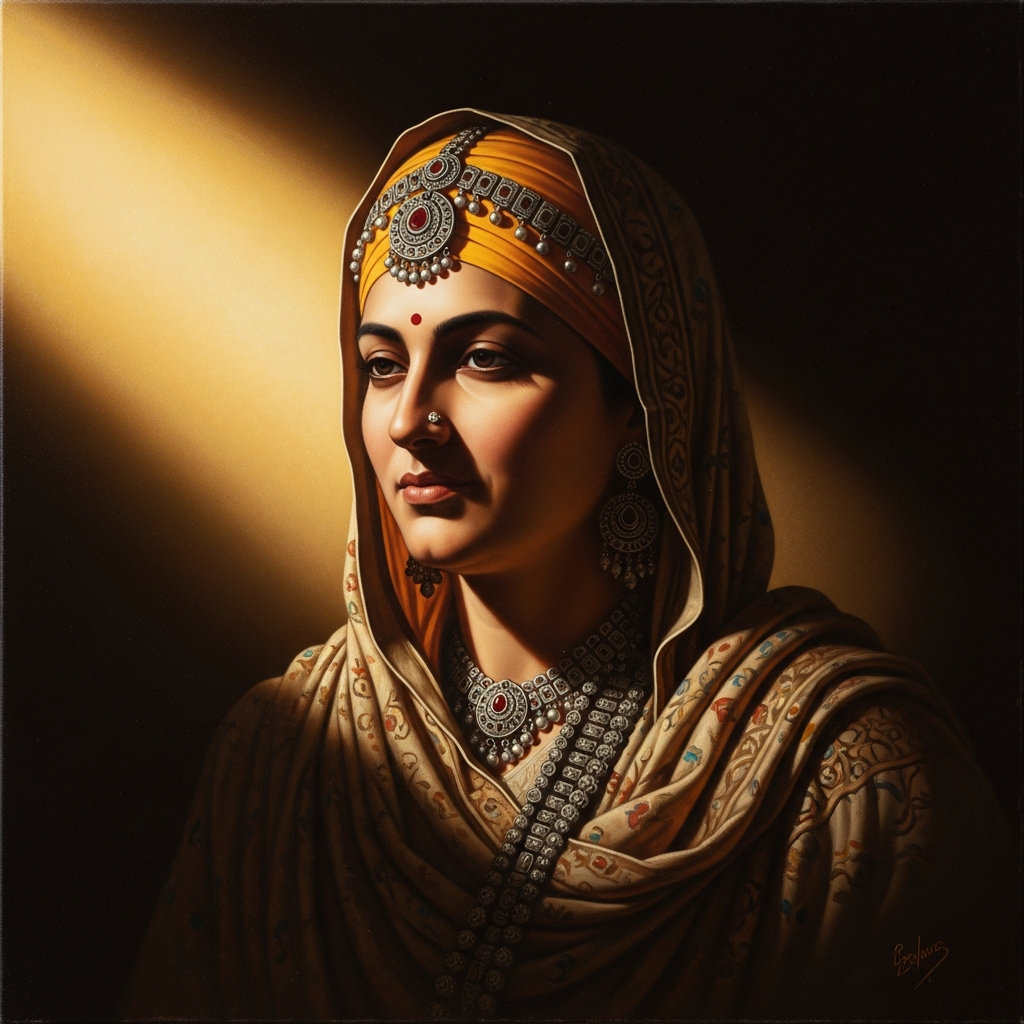
Combat Profile
Nectar of Immortality
sanctifies the amrit with divine grace, granting initiates spiritual invulnerability and eternal covenant with the Khalsa
Maternal Blessing
all who drink the sweetened amrit under her guidance gain unbreakable bonds of brotherhood and divine protection
| Source | Sikh tradition | | Epithets | “Mother of the Khalsa” (Khalsa di Mata), “Mata Sahib Devan Ji,” “She Who Sweetened the Amrit,” spiritual mother of every initiated Sikh | | Sacred Animals | None specifically | | Sacred Objects | Patashas (sugar crystals she added to the amrit bowl — the sweetening of the iron-and-water with human tenderness), the amrit (the Khalsa initiation nectar itself) | | Sacred Colors | Saffron/Blue (pan-Khalsa), White (maternal purity) | | Sacred Number | 1699 (the year she sweetened the amrit), 1 (she is the one mother of the entire Khalsa) | | Consort(s) | [Guru Gobind Singh Ji](/bestiary/sikh/guru-gobind-singh-ji-the-founder-of-the-khalsa/) (third wife; she maintained a spiritual rather than physical marriage — a celibate partnership in Sikh tradition) | | Sacred Sites | Anandpur Sahib (site of the 1699 Khalsa founding where she added the patashas); Gurdwara Mata Sahib Devan Ji, Nanded (Maharashtra — near where Gobind Singh died); Delhi (where she spent her long widowhood) | | Festivals | Vaisakhi (the Khalsa founding she participated in); her role is recalled at every Amrit Sanchar (Khalsa initiation ceremony) performed anywhere in the world | | Iconography | Depicted as a dignified, motherly figure adding patashas to the amrit bowl at the Khalsa founding; often shown standing beside Gobind Singh at the 1699 ceremony | | Period | c. 1681–1747 CE; present at the Khalsa founding in 1699; long outlived Gobind Singh | | Region | Punjab (active during the Khalsa founding), Delhi (long widowhood), Nanded (pilgrimage site) |
The structural placement of a mother into the Khalsa initiation is not accidental.
1 min read
Sikh tradition