The Head That Bought Another Faith's Survival
November 11, 1675 · Chandni Chowk, Delhi · the Kotwali (police station) at Chandni Chowk, in front of the Red Fort, the Mughal capital
Contents
The Ninth Guru is brought in chains to Chandni Chowk and given a final choice: convert to Islam, perform a miracle, or die. He chooses the third — not for his own faith, but to keep alive the faith of the Kashmiri Hindus who had asked him for help and the right of every conscience to refuse the empire's offer.
- When
- November 11, 1675 · Chandni Chowk, Delhi
- Where
- the Kotwali (police station) at Chandni Chowk, in front of the Red Fort, the Mughal capital
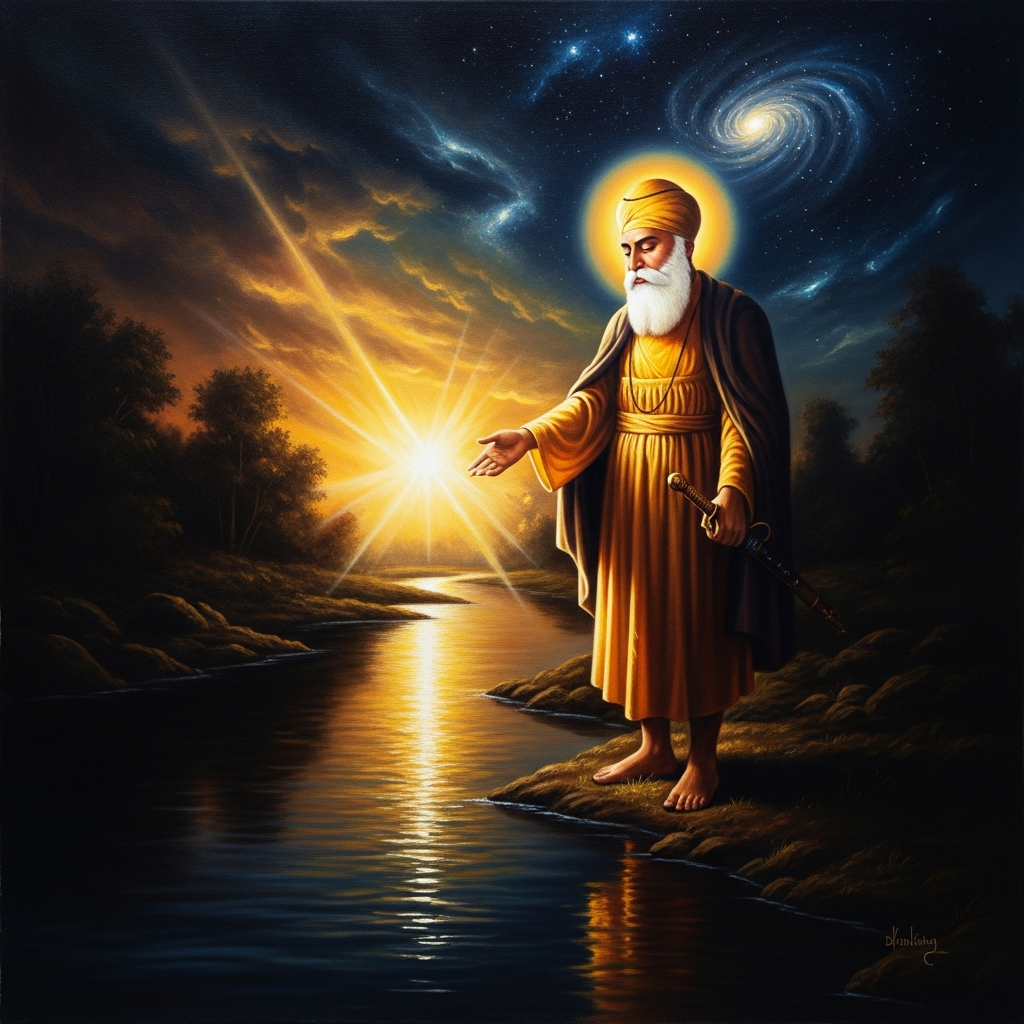
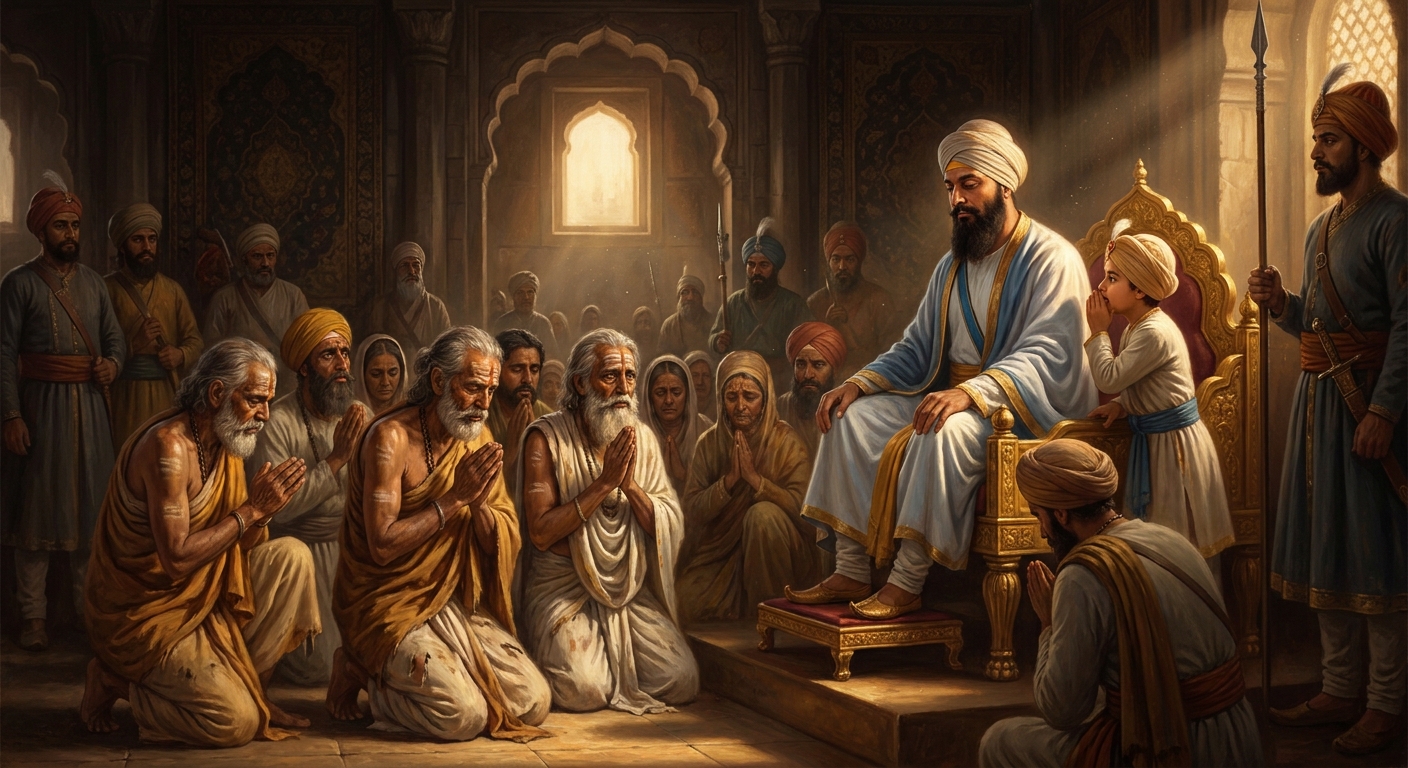
In the spring of 1675, five hundred Kashmiri Brahmins arrive at Anandpur in mourning.
They are led by Pandit Kirpa Ram. They have walked from the valleys above Srinagar, their sacred threads still on, the ash of unfinished funerals on their foreheads. Aurangzeb’s governor in Kashmir, Iftikhar Khan, has been given a quota of conversions per month. When the quota falls short, the soldiers go house to house. Brahmin homes have been burned. Daughters have been taken. The pandits have come to the only authority the Mughal court does not own.
They ask the Ninth Guru for help.
Tegh Bahadur — Brave of the Sword, the title he earned at fourteen on a battlefield against Shah Jahan’s troops — is fifty-four. He is sitting in the open courtyard. His son Gobind Rai, age nine, is at his side.
The boy listens to the pandits. Then he looks up at his father and says, in a voice everyone present remembers: Father, who is greater than you to give his head?
Tegh Bahadur tells the pandits to send a message to Delhi.
Tell the Emperor, he says, that if Tegh Bahadur converts, all the pandits of Kashmir will convert with him.
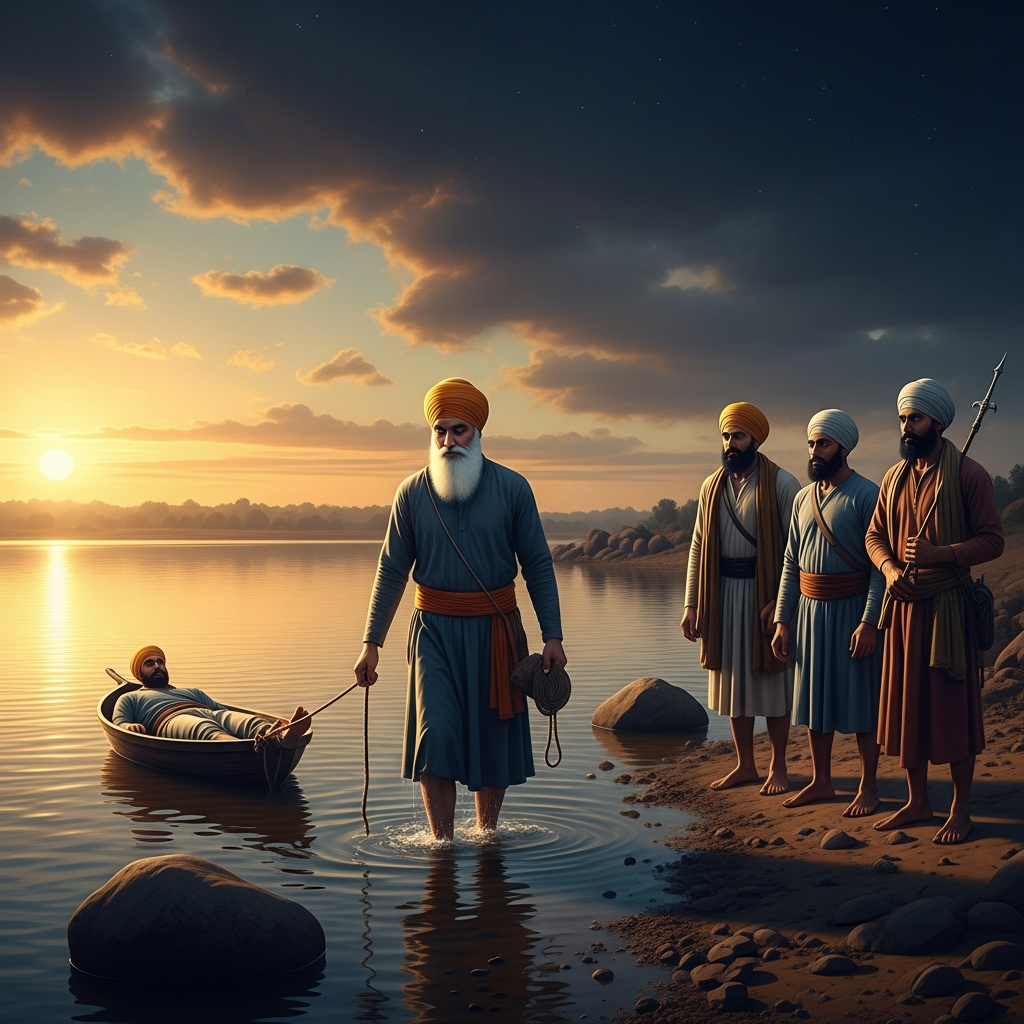
The message reaches Aurangzeb at the Red Fort. The Emperor is delighted. A single conversion will solve the Kashmir problem and humiliate the Sikhs in one stroke. Orders go out. The Guru is summoned. He sets out from Anandpur in July with three companions: Bhai Mati Das, Bhai Sati Das, and Bhai Dyala. They are arrested en route at Agra. They are brought in chains to Delhi and held in the Kotwali at Chandni Chowk, the police station opposite the Red Fort, in iron cages built for the purpose.
The interrogation lasts months. The Qazi’s offer is unchanging: convert, perform a miracle to prove your divinity, or die.
The Guru chooses none of the three.
Aurangzeb’s tacticians try theater first.
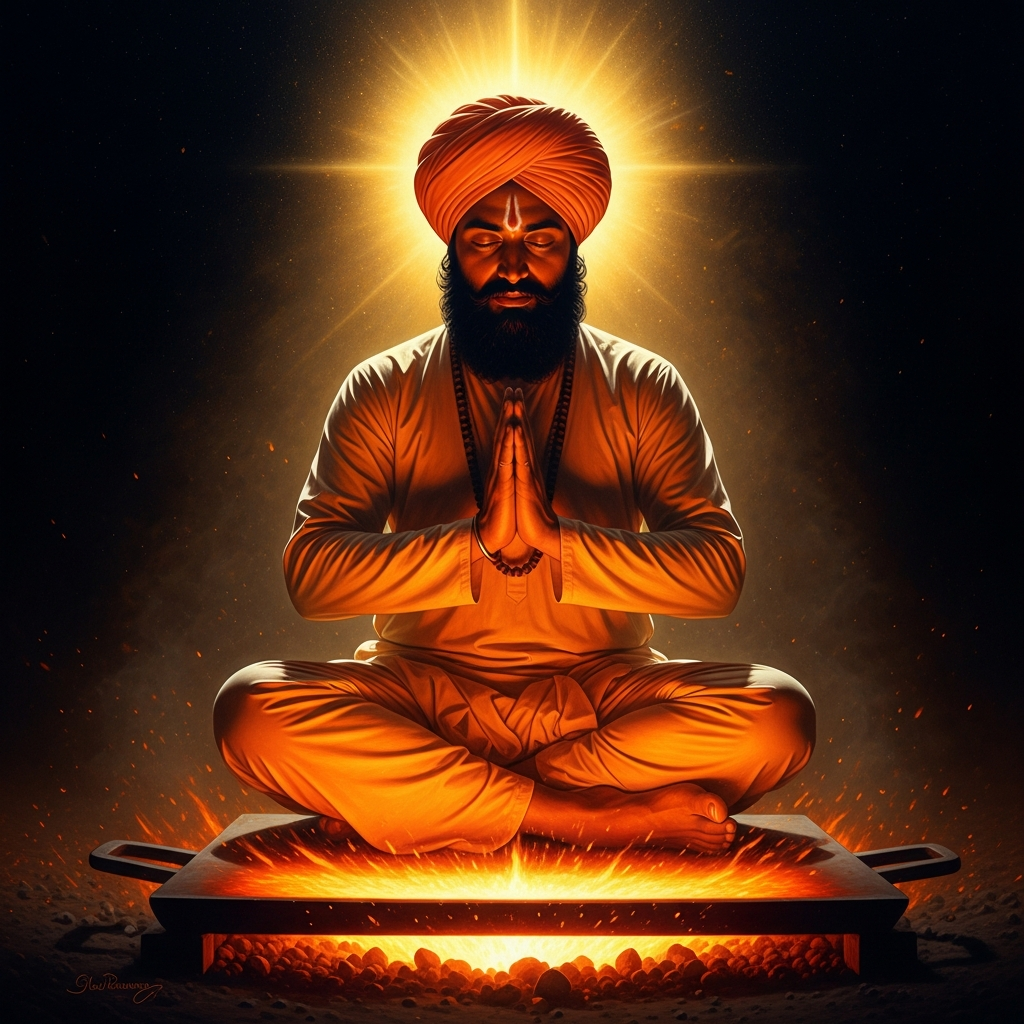
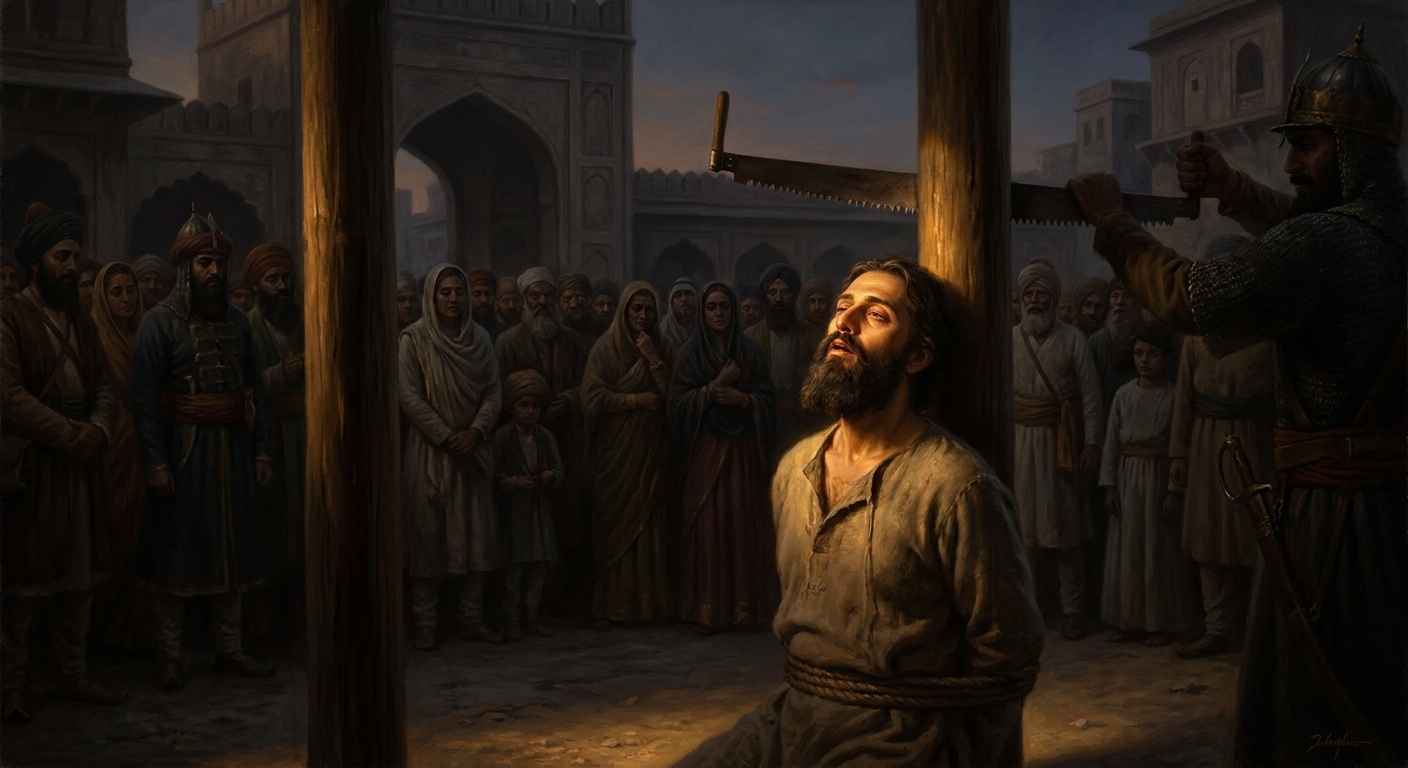
In November they bring Bhai Mati Das to the Kotwali courtyard. They place him between two wooden planks. They ask him, one final time, to convert. He refuses. He asks only to be allowed to face the cage where the Guru is held, so the Guru can see him. The request is granted. The saw begins at the crown of his skull. He recites the Japji Sahib — Nanak’s morning prayer — until the saw reaches his lungs.
The next day they boil Bhai Dyala alive in a cauldron. The day after, they wrap Bhai Sati Das in cotton soaked in oil and light him.
The Guru watches each of them die. Through each death he is offered the same choice. Through each death he gives the same answer.
The Mughal record-keepers, accustomed to a different arithmetic, do not know what to do.
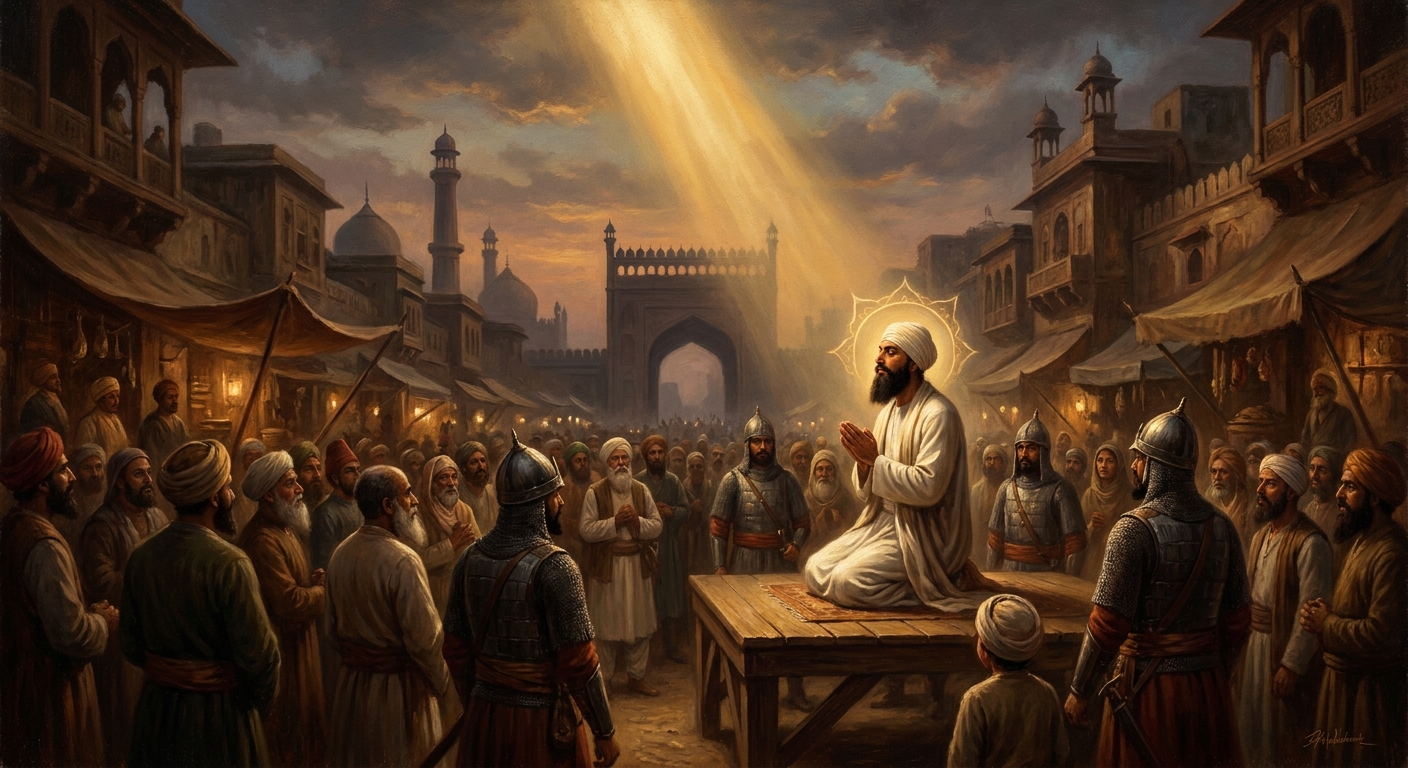
On the morning of November 11, 1675, they bring him out.
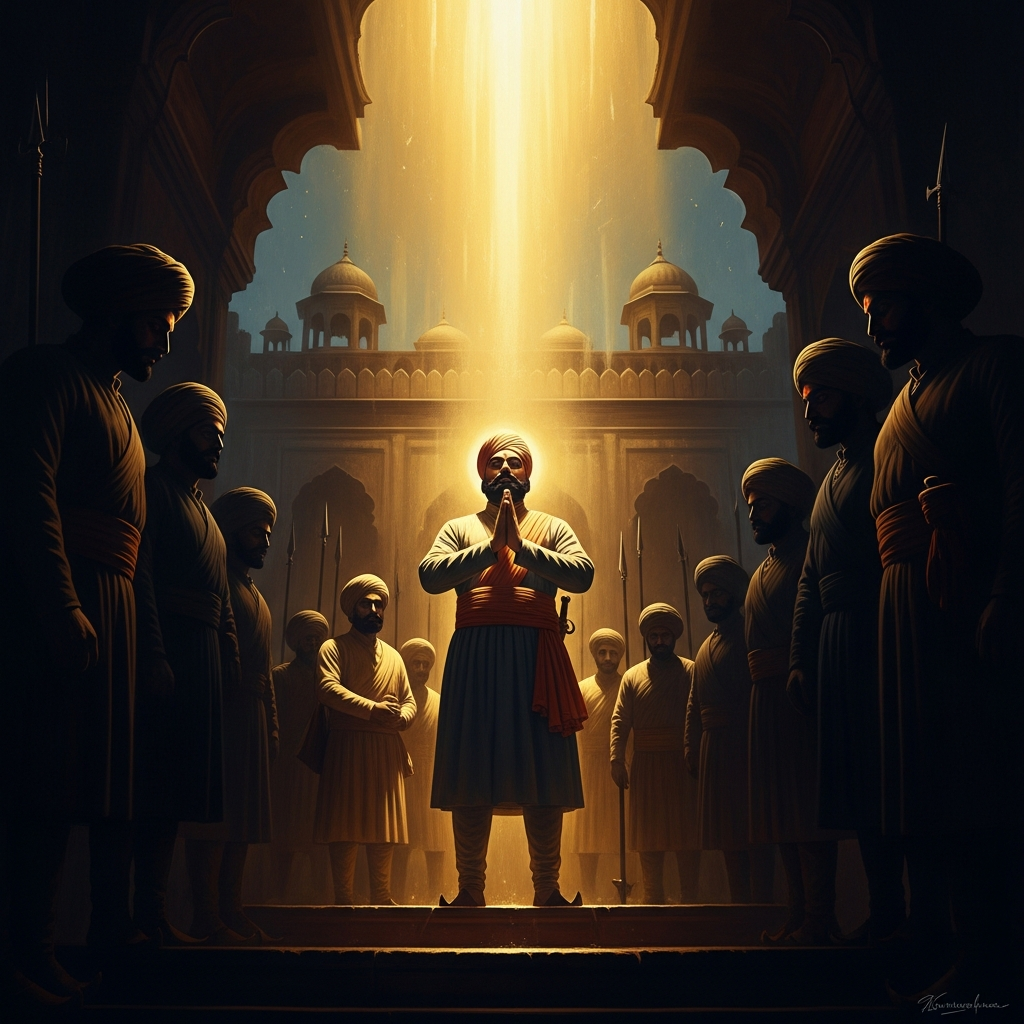
It is cold. The crowds in Chandni Chowk have been gathered by proclamation. A banyan tree stands at the edge of the square; under it a platform has been built. The Guru walks to it in a white robe. His feet are bare. The chains have been taken off so that the executioner has clean access. He climbs the platform without help.
The Qazi reads the charge. The offer is repeated for the last time. Convert. Or perform a miracle.
The Guru looks at the crowd. He looks at the executioner — a man named Jalaluddin, from Samana, whose name Sikh memory will preserve for three centuries. He says, in Punjabi, the line his son will record in the Bachittar Natak: I gave my head, but did not give my faith.
He sits down. He turns his face toward the north — toward Anandpur, toward his nine-year-old son.
Jalaluddin raises the sword.
The head falls.
The accounts diverge here, the way accounts of foundational deaths always do. A storm breaks over Delhi within the hour — the wind so strong, the Bachittar Natak says, that no one could keep his eyes open. In the confusion, two Sikhs steal the body parts in the dust-storm: Bhai Jaita carries the head north toward Anandpur, hidden in a cloth, riding through the night for three days; Bhai Lakhi Shah, a Delhi cart-driver, takes the body home and burns his own house down to cremate it without alerting the imperial police. The site of his cremation will become Gurdwara Rakab Ganj. The site of his execution will become Gurdwara Sis Ganj Sahib. Both stand within sight of the Red Fort to this day.
When the head reaches Anandpur, Bhai Jaita falls at the feet of the nine-year-old Gobind Rai and says: Sir, here is the head of your father.
The boy lifts it in both hands. He says, in the line that ends one chapter and starts another: He gave his head, but he did not give his faith. He gave it for those whose faith was not even his own.
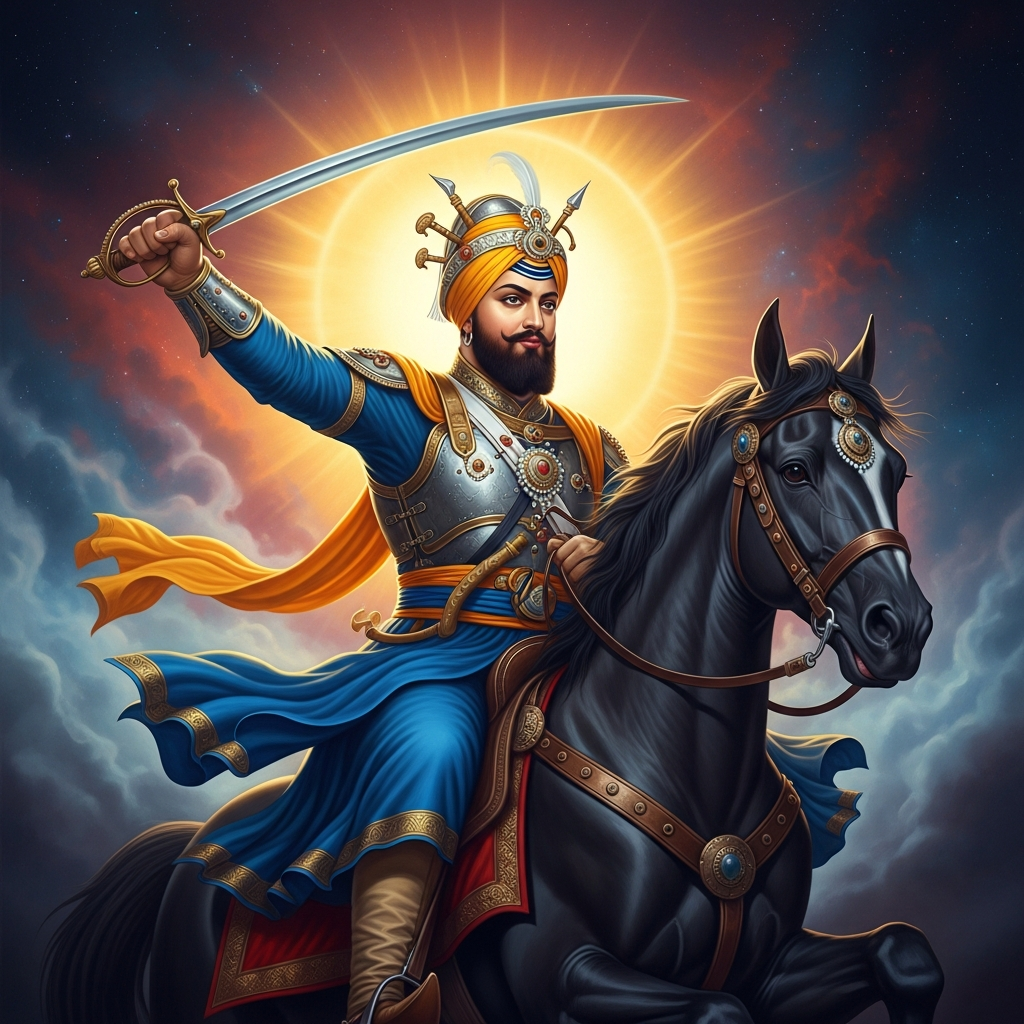
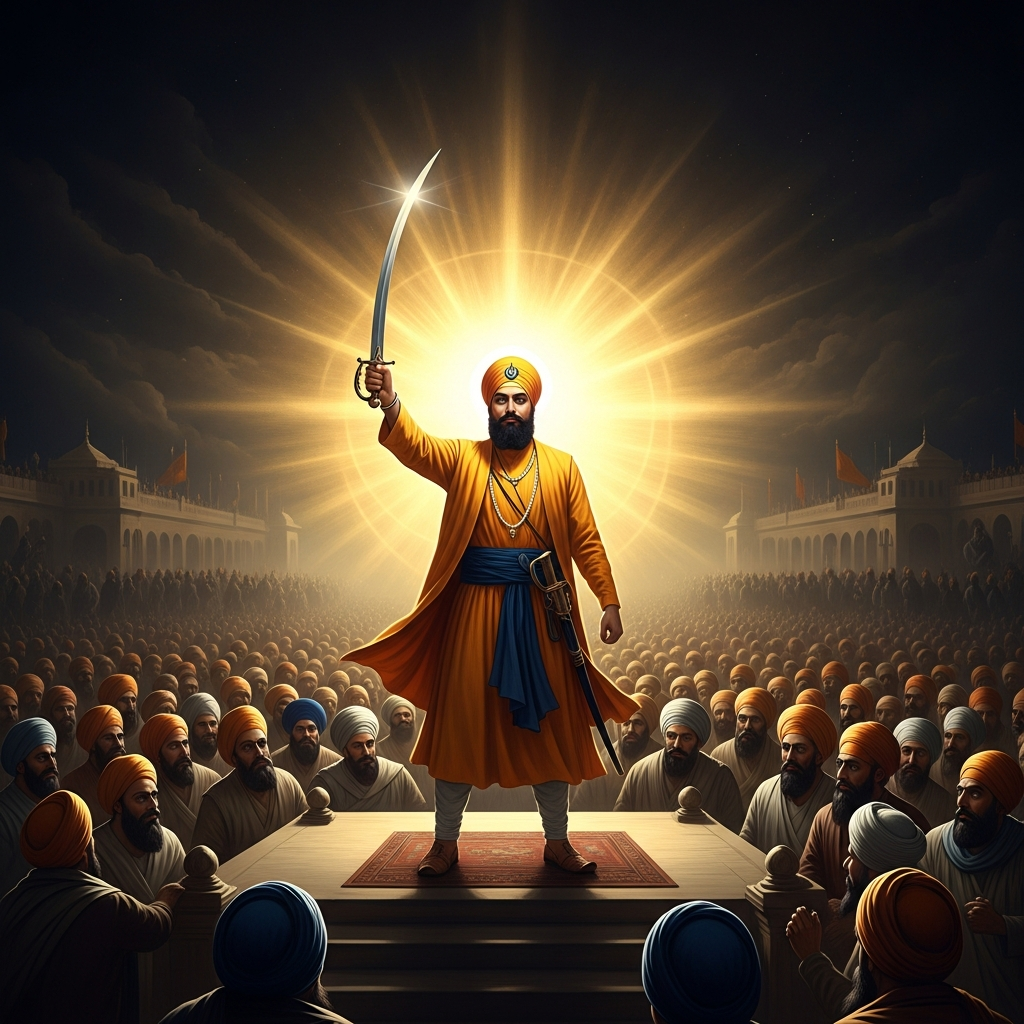
Twenty-four years later, on Vaisakhi 1699, that boy — now Guru Gobind Singh — will draw a sword in a different courtyard and ask for a head of his own.
He has not forgotten what the empire’s offer looks like. He has not forgotten what the empire’s executioner sounds like. He builds the Khalsa — the order of sant-soldiers, the unshorn hair and the iron bracelet and the steel kirpan worn always — so that the next time five hundred pandits or five hundred anyone else come asking for help, the answer will not have to be a single head on a platform under a banyan tree.
It will be a community ready, at all times, to give a thousand.
Tegh Bahadur is the rare figure in religious history who dies not for the survival of his own community but for the survival of someone else’s. The Kashmiri Brahmins he protected were Hindus; he did not ask them to convert in return. He did not even ask them, the records say, to remain. Many of them did go on to convert under continued pressure. He died for their right to choose, not for the choice itself.
Aurangzeb spent the next thirty-two years on the Mughal throne. He died in 1707. The empire he had tried to weld into a single confession lasted, in any meaningful sense, another generation.
The gurdwara at Chandni Chowk stands a hundred meters from the executioner’s platform. The banyan tree is gone. The principle it shaded is, in Sikh memory, indestructible: a head can be given. A faith cannot be taken.
Scenes
Spring 1675, Anandpur
 Generating art…
 November 1675, Delhi
 Generating art…
 November 11, 1675
 Generating art…
 Echoes Across Traditions
Entities
- Guru Tegh Bahadur
- Aurangzeb
- Bhai Mati Das
- Bhai Sati Das
- Bhai Dyala
- Pandit Kirpa Ram

Sources
- *Sri Guru Granth Sahib*, *Mahalla 9* — the 116 hymns of Tegh Bahadur added to the canon by his son
- *Bachittar Natak* (Guru Gobind Singh's verse autobiography, c. 1696) — the eyewitness account of his father's death
- Trilochan Singh, *Guru Tegh Bahadur: Prophet and Martyr* (Gurdwara Prabandhak Committee, 1967)
- Pashaura Singh & Louis Fenech (eds.), *The Oxford Handbook of Sikh Studies* (Oxford, 2014)
- Khushwant Singh, *A History of the Sikhs, Vol. I: 1469-1839* (Princeton, 1963), ch. 4
- J. S. Grewal, *The Sikhs of the Punjab* (Cambridge New History of India, 1990)