The Messiah Who Converted
Smyrna, Adrianople, and the Ottoman Empire, 1665-1666 CE · Smyrna and Adrianople, Ottoman Empire (present-day Turkey)
Contents
In 1665, Nathan of Gaza proclaims the erratic Shabbetai Zevi the long-awaited Messiah, and the Jewish world erupts in the greatest messianic fever of the post-Temple era. In 1666, the Ottoman sultan gives Shabbetai Zevi a choice: the stake or Islam. He converts. His prophet Nathan reframes the catastrophe as theology: the Messiah had to descend into the kelipot — the husks of evil — to rescue the sparks imprisoned there. Some followers convert with him.
- When
- Smyrna, Adrianople, and the Ottoman Empire, 1665-1666 CE
- Where
- Smyrna and Adrianople, Ottoman Empire (present-day Turkey)
The news travels faster than it has any right to in the seventeenth century.
From Gaza to Smyrna to Amsterdam to Hamburg to the Jewish communities of Poland and Persia and Yemen and Morocco — in six months in 1665, the word spreads that the Messiah has come. His name is Shabbetai Zevi, and he is from Smyrna, and he has been proclaiming himself the anointed one since his twenties, in the grip of what his contemporaries call his illuminations and what a later century would call his manic episodes. He has been expelled from communities for performing rituals that the tradition regards as blasphemous — pronouncing the divine name aloud, celebrating three major festivals in a single week, marrying Torah scrolls in public ceremonies. He has attracted followers and lost them and attracted them again. He is fifty years old in 1665 and nothing has happened.
And then Nathan of Gaza sees him.
Nathan ben Elisha Hayyim Ashkenazi is twenty-two years old and already known as an exceptional scholar and visionary when Shabbetai Zevi arrives in Gaza seeking spiritual help. What Nathan sees in him is not what Shabbetai Zevi sees in himself — Shabbetai Zevi’s relationship to his own messianic identity fluctuates with his moods — but something more total, more theological, more dangerous. Nathan has been working out a Lurianic framework for understanding how the Messiah would function, and Shabbetai Zevi fits it perfectly.
In Luria’s cosmology, the sparks of divine light are trapped in the kelipot, the shells or husks of the broken world. The process of repair, the tikkun, proceeds through the observance of Torah and the performance of directed prayer. But the deepest sparks — the ones most embedded in the domain of evil — require the Messiah to go after them personally. And to go after them personally, the Messiah must enter the kelipot from within. He must appear, to all outward eyes, to have become part of the domain of evil. His holiness must operate in disguise.
Nathan proclaims Shabbetai Zevi the Messiah in the spring of 1665. The proclamation tears through the Jewish world like a shock wave. Communities begin selling their possessions in preparation for the return to the Land of Israel. People stop planning for their futures. The Amsterdam stock exchange records anomalous trading patterns as merchants liquidate assets in expectation of an imminent end to ordinary commercial life. The rabbinical establishment largely condemns the movement. The condemnations are largely ignored.
Shabbetai Zevi enters the Ottoman Empire.
This is not, in retrospect, the wisest choice for someone proclaiming himself king of the Jews and planning to depose the Ottoman sultan and begin the messianic age. The Ottoman authorities arrest him in early 1666 at the order of the Grand Vizier and imprison him, first in Constantinople and then in the fortress of Gallipoli. The imprisonment, improbably, does not slow the movement. Pilgrims come from across Europe and the Middle East to visit him in his cell. He holds court. He issues proclamations. Nathan of Gaza produces a continuous stream of explanatory literature describing how the imprisonment is part of the plan.
And then the sultan summons him.
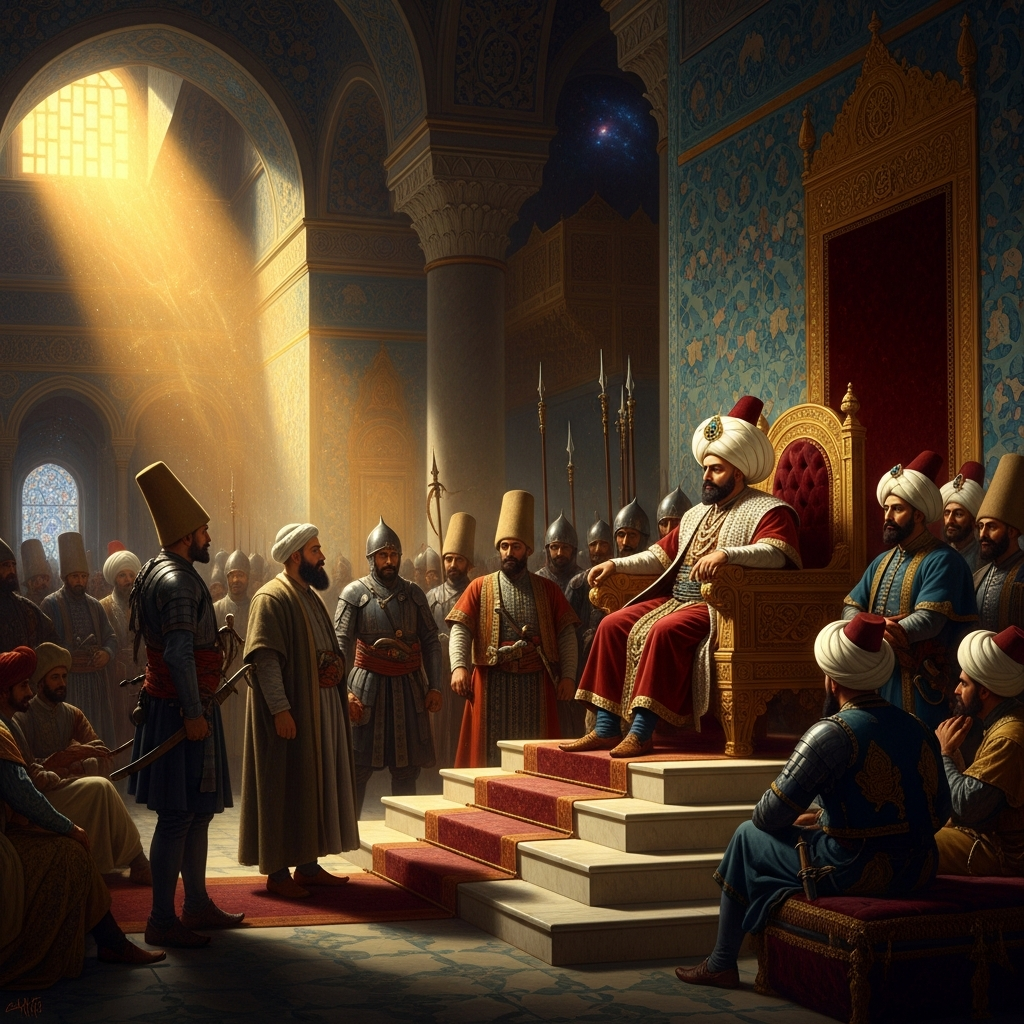
The sources on the meeting are sparse and contested. What is known: Shabbetai Zevi is brought before Mehmed IV or his advisors. He is offered a choice between execution and conversion to Islam. He accepts the turban. He is given a new name: Aziz Mehmed Effendi. He is appointed to a minor court position. He continues, in private, to perform Jewish rituals, and continues to receive visitors from his former community, and continues to maintain a version of the messianic claim that becomes, over the remaining decade of his life, increasingly incoherent.
The catastrophe falls on the Jewish world like a physical blow.
The response is not uniform. Many communities collapse back into the tradition with a kind of collective silence about what they had believed six months earlier. The rabbis who had condemned the movement point out that they had said so. Some communities rupture along lines that had been forming for a generation. A significant number of followers, in the Ottoman Balkans and in Smyrna, convert with him — the Donmeh, the converts, maintaining Jewish practice in secret beneath an Islamic surface, existing as a distinct community for the next three centuries.
And Nathan of Gaza, within weeks of the conversion, produces the theology that will allow the Sabbatean movement to survive its prophet’s failure.
He writes: the Messiah has not apostatized. The Messiah has descended.
The logic is Lurianic, and it is impeccable within its premises. The deepest sparks of divine light are imprisoned in the deepest layers of the kelipot — the domain of impurity that is Islam, the domain of impurity that is the appearance of apostasy. No ordinary Jew can enter that domain and survive it spiritually. Only the Messiah, whose soul is constituted differently, can descend into the depths of the husks and operate within them without being destroyed by them. The conversion is not failure. It is the final stage of the mission. Shabbetai Zevi, wearing a turban, is doing what no one else could do: retrieving the sparks that cannot be reached from outside.
Nathan spends the rest of his life propagating this interpretation. He dies in 1680, seven years before Shabbetai Zevi himself dies, in Albanian exile, oscillating between his Jewish and Muslim identities, still receiving visitors who regard him as the Messiah. Nathan never wavers.
The aftermath is everything.
The Jewish Enlightenment — the Haskalah — draws some of its energy from the Sabbatean catastrophe. The argument that traditional messianic expectation is dangerous, that it produces mass delusion and social disruption, and that the Jewish future lies in rational engagement with European culture rather than cosmic expectation — this argument gains force from what 1666 made visible. The rabbinical tradition’s response is to become more conservative, more cautious about kabbalah, more skeptical of visionary claims. Hasidism, which arises a generation later, routes its mysticism through personal piety and the relationship to the tzaddik rather than through public messianic proclamation, having learned something from what happens when the proclamation fails.
Scholem, who spent forty years reconstructing the Sabbatean movement, argues that its importance goes further than its failure. Sabbateanism reveals what messianic energy does when it has nowhere to go — it doesn’t dissipate, it transforms. In the eighteenth century, some of the movement’s antinomian energy flows into Frankism, which flows, distorted and again transformed, into certain strands of revolutionary politics. The belief that the deepest repair requires descent into the impure, that the messiah must pass through apostasy to retrieve what ordinary observance cannot reach — this is a structural idea that outlives the man who wore the turban.
The Donmeh community in Salonika, who converted with him and maintained their secret practices for centuries, contributed several significant figures to Turkish public life in the early twentieth century. The borders between faith and its appearance, between descent and defection, between mission and betrayal — the Sabbatean catastrophe spent three hundred and fifty years making those borders visible by crossing them.
What Shabbetai Zevi himself believed, in the end, is not recoverable. Nathan’s theology gives the conversion a purpose. The convert’s behavior after 1666 — the oscillations, the continued messianic pronouncements mixed with the performance of Muslim observance — suggests a man whose relationship to his own identity had become, like the sparks he was theoretically retrieving, scattered.
Nathan needed the descent to be intentional. He needed the Messiah to have gone in voluntarily, to have known what he was doing. The alternative — that the most celebrated messianic claimant in Jewish history simply found the choice between the stake and the turban, and chose the turban — was theologically unusable.
Perhaps both things were true. Perhaps the choice was ordinary and the theology was also true. The tradition of descent into the kelipot does not require the one who descends to understand what he is doing. The sparks, in the Lurianic system, are raised by the act, not by the intention.
Scenes
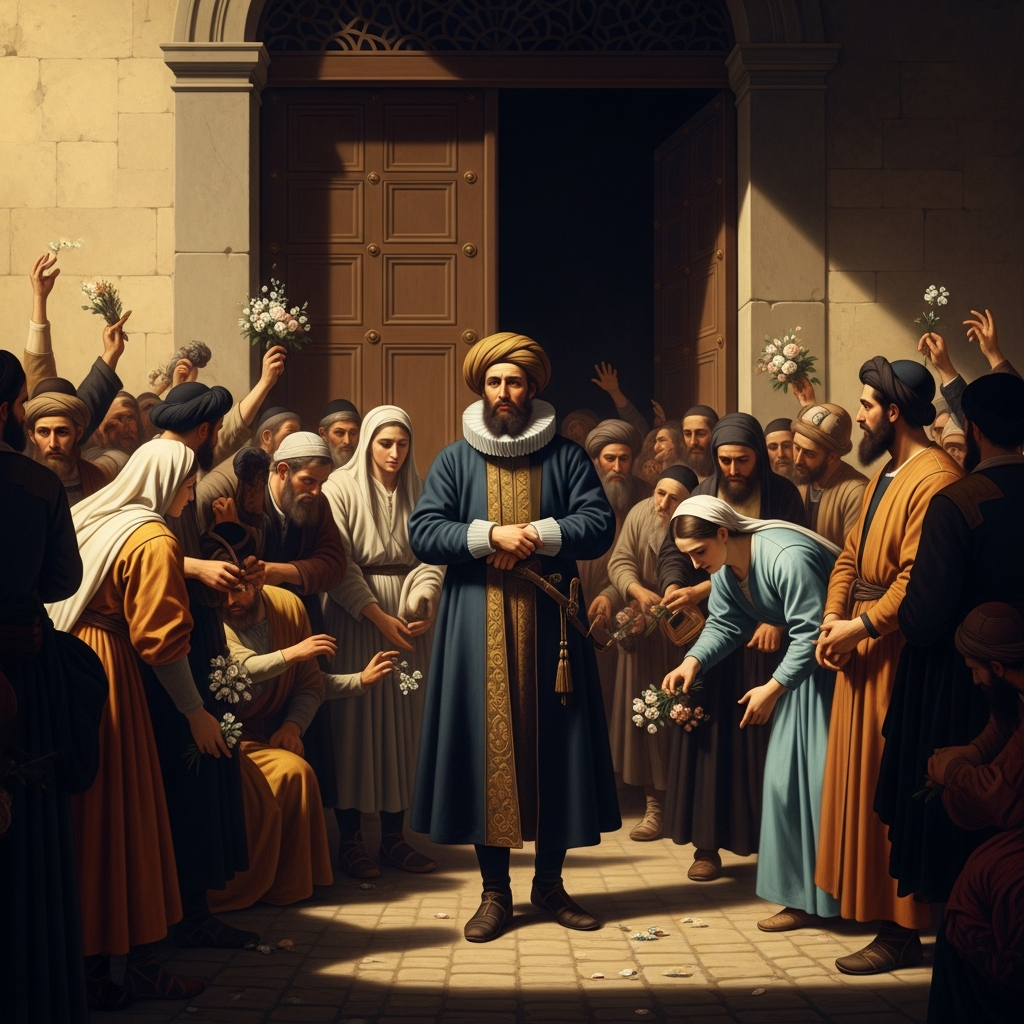
Shabbetai Zevi in Smyrna, 1665 — a crowd pressing toward him in the street, men weeping, women throwing flowers, the synagogue doors thrown open behind him
 Generating art…
 The court of Sultan Mehmed IV in Adrianople, 1666
 Generating art…
 Nathan of Gaza writing by candlelight in a bare room somewhere in the Ottoman Balkans, the year 1666
 Generating art…
 Echoes Across Traditions
Entities
- Shabbetai Zevi
- Nathan of Gaza
- the Kelipot
- the Donmeh
Sources
- Gershom Scholem, *Sabbatai Sevi: The Mystical Messiah*, trans. R. J. Zwi Werblowsky (Princeton University Press, 1973)
- Gershom Scholem, *Major Trends in Jewish Mysticism* (Schocken Books, 1941)
- Moshe Idel, *Messianic Mystics* (Yale University Press, 1998)
- Matt Goldish, *The Sabbatean Prophets* (Harvard University Press, 2004)
- Pawel Maciejko, *The Mixed Multitude: Jacob Frank and the Frankist Movement* (University of Pennsylvania Press, 2011)