George Fox and the Inner Light
1652 · Pendle Hill and Firbank Fell, Lancashire, England
Contents
George Fox climbs Pendle Hill in 1652 and sees a vision of a great people to be gathered. He descends and gathers them — a thousand Seekers on Firbank Fell, four hours, no pulpit, no sacraments, no priest. The theology is radical: Christ has come to teach his people himself, without intermediaries, through the Inner Light present in every person.
- When
- 1652
- Where
- Pendle Hill and Firbank Fell, Lancashire, England
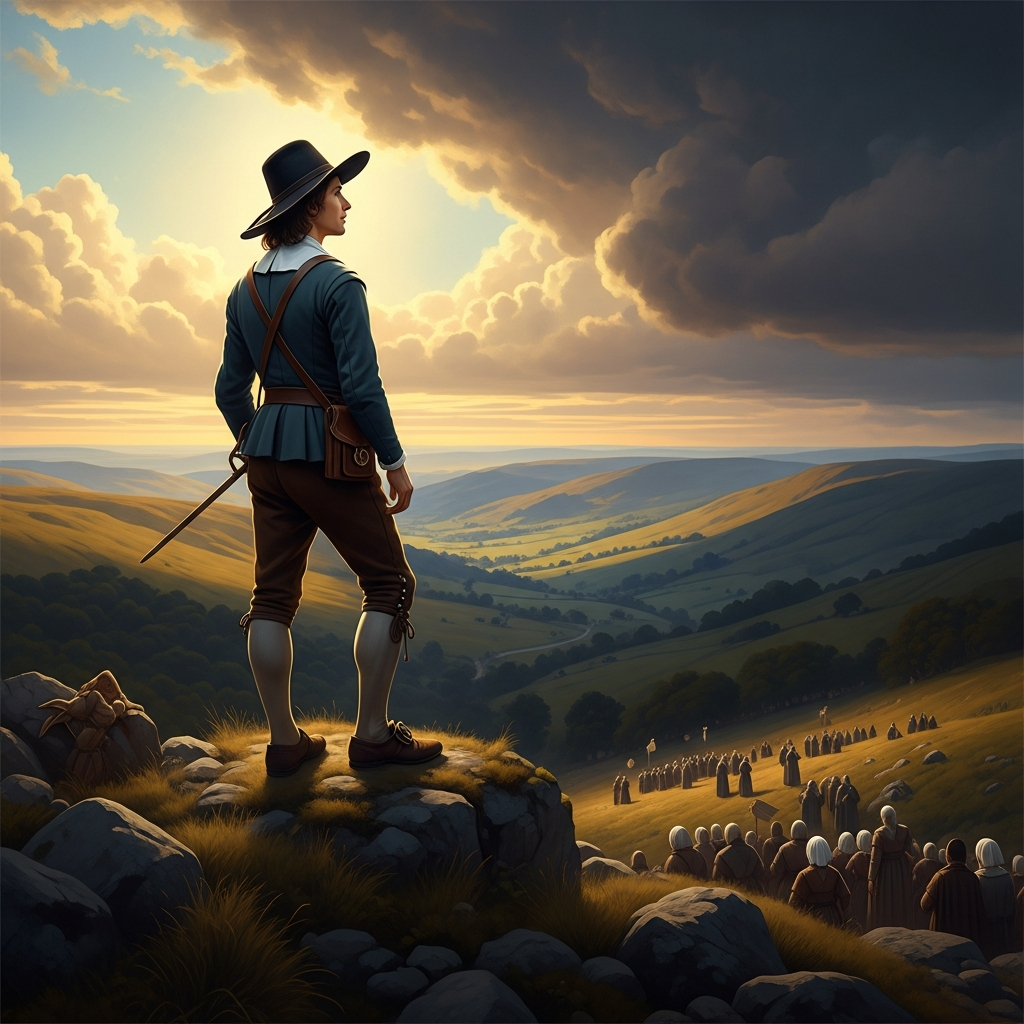
He climbs Pendle Hill alone on a June morning in 1652.
He is twenty-eight years old, the son of a Leicestershire weaver, and he has been walking the north of England for six years looking for something that the churches he has visited — Baptist, Presbyterian, Independent, Anglican — have not been able to give him. He is not, by 1652, an isolated eccentric. He is the center of a gathering movement. He has been preaching in churchyards, in fields, in market squares, interrupting sermons, being beaten and imprisoned. He has refused to remove his hat before magistrates and judges, because all persons are equal before God. He has refused to take oaths, because an honest man’s word is always under oath. He has been arrested and jailed at least twice. He keeps a journal, which is the most vivid personal document of seventeenth-century English religion.
On the summit of Pendle Hill, he sees — and he uses the word sees, not imagines — a great people to be gathered. Below him in the valleys of Lancashire are the Seekers: gathered congregations who have left all the existing churches and are waiting, in weekly meetings of silence, for the direct experience of God that the institutions cannot provide. They are waiting for someone who knows where to look.
He descends the hill and finds them.
The theology Fox has been working out in his journal and his speeches is simple enough to state in a sentence: there is that of God in every person.
This is what he means by the Inner Light, or the Light of Christ, or the Seed, or the that of God — he uses the terms interchangeably and is not greatly interested in the philosophical precision of the vocabulary, because the vocabulary points at an experience and the experience is primary. The Inner Light is not conscience in the ordinary sense, not the moral sense that tells you not to steal. It is a direct cognitive contact with divine reality, available to every human being without exception, present in every person whether they know it or not, requiring only the removal of the noise and self-will that prevents its recognition.
Christ has come to teach his people himself, Fox says. Not through a priest who mediates access to sacred things, not through a sacrament that physically transmits grace, not through a creed that defines the correct propositions to affirm, not even through the scripture, though Fox reads the scripture constantly and knows it in the way that people who have memorized it since childhood know it, in pieces and whole and sideways. Through Christ present now, here, in this person, speaking in the silence when you are quiet enough to hear.
The implication is enormous and Fox is aware of it. If Christ is directly present to every person, then no one can claim exclusive authority to mediate access to him. No priest. No bishop. No sacrament. No altar. No building.
Firbank Fell is a long open ridge above the valley of the Rawthey in Westmorland.
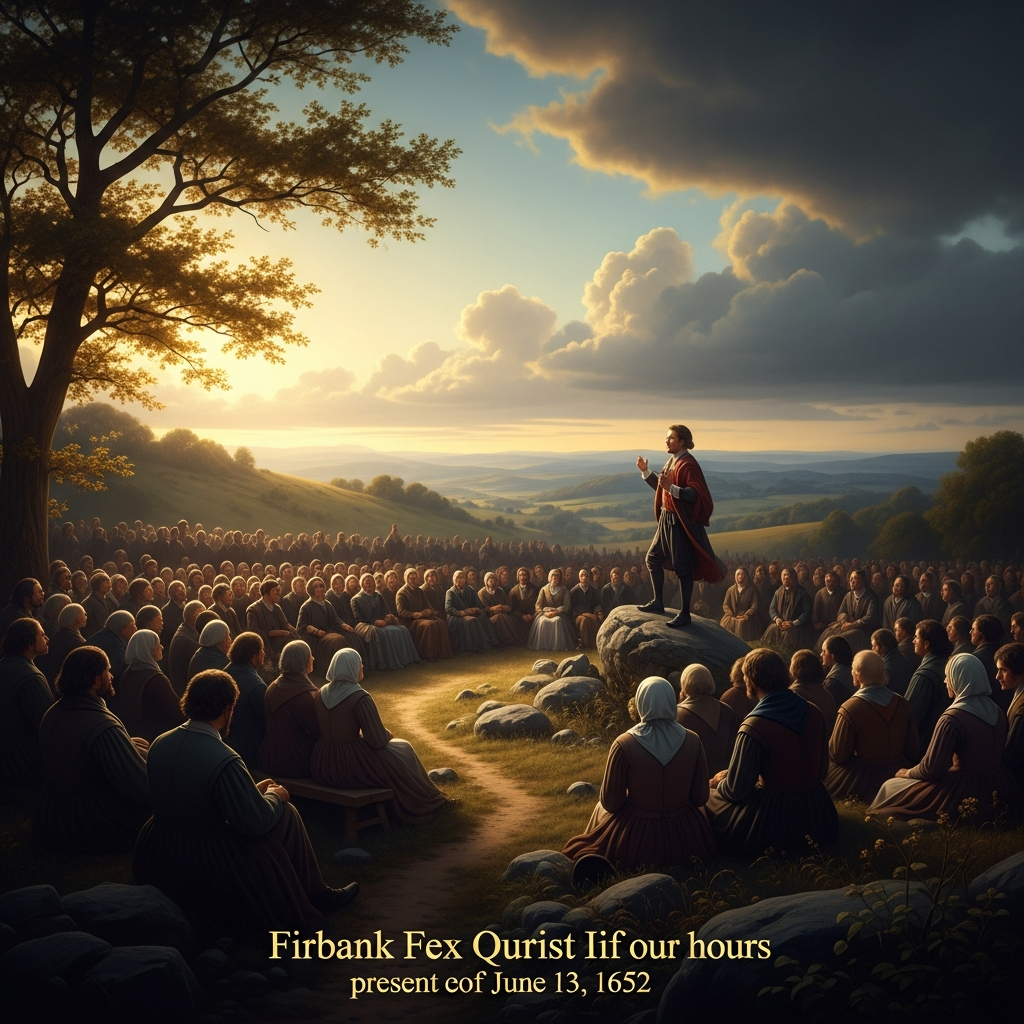
On June 13, 1652, a thousand people climb it in the June morning and sit down in the grass. They have come from the Seeker meetings of the entire north — from Kendal and Sedbergh and Preston Patrick, from the congregations that have been meeting in silence for years waiting for something they cannot describe except by its absence in everything they have tried before. A local minister, Francis Howgill, has preached to them that morning from a stone pulpit outside the chapel at the fell’s edge. They have listened to Howgill. They are waiting for something more.
Fox climbs a rock — the rock is still there, on the ridge above Brigflatts — and preaches for four hours.
There is no record of what exactly he says. His journal gives a summary: he directs them to the Light of Christ in themselves. He tells them they do not need the building behind them or the minister before them or the water of baptism or the bread and wine of communion. He tells them the meeting is the gathered body of Christ and the gathering makes it so. He tells them to wait, in silence, for the Light.
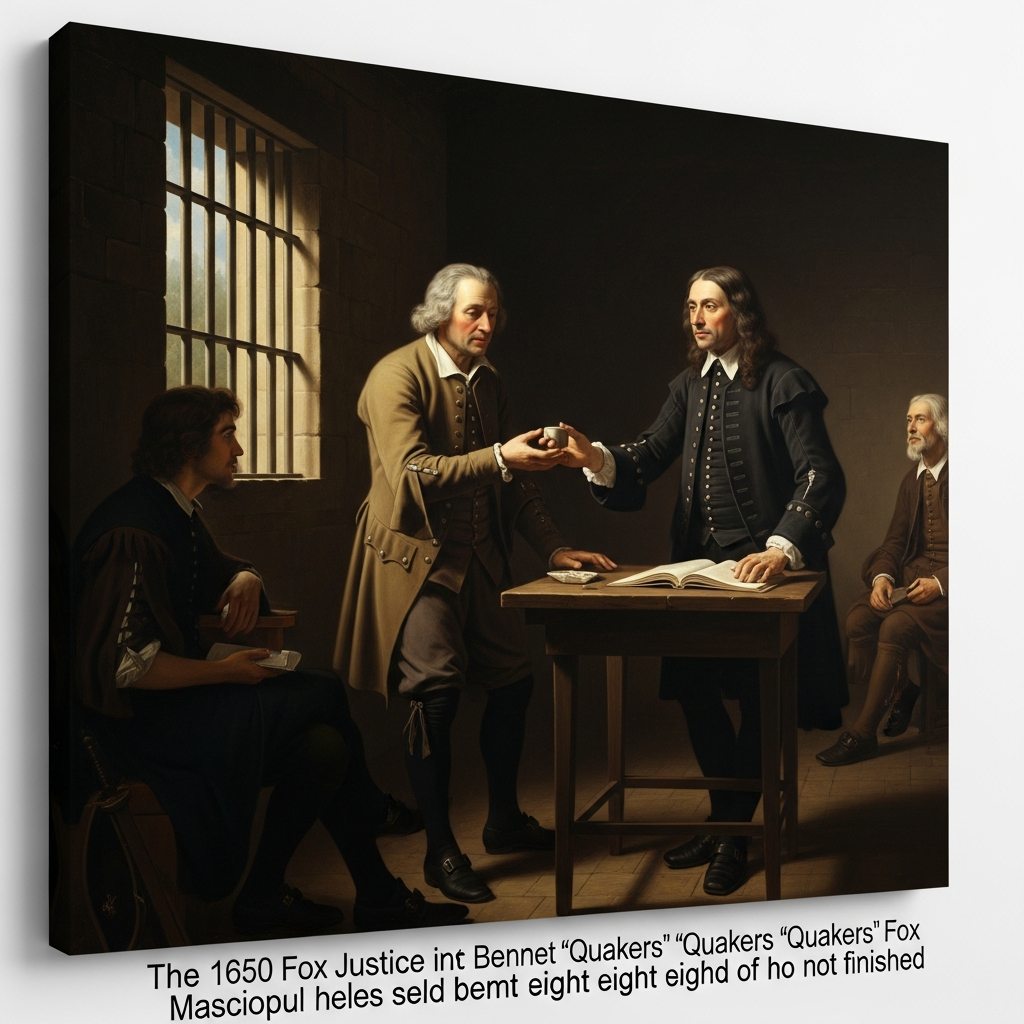
The thousand people on the hillside in the June wind are, by the end of the afternoon, Quakers — though the name is not their own and they do not yet use it. Justice Bennet of Derby had coined it two years earlier, mocking Fox’s instruction that people should tremble at the word of God. They accepted the name because it was accurate: something happened when you sat in the gathered silence, when you were still enough, something moved through the room that was not the room.
The silence is the practice.
A Quaker meeting does not begin with a hymn or a prayer or an opening scripture. It begins when the first person enters the meeting room and sits down. The room fills silently. The meeting continues until a Friend who is moved by the Spirit — moved, and this is important: not prepared, not scheduled, not authorized by office — stands and speaks. Any person in the room may speak. Women speak. The untrained and unordained speak. There are no pastors in the early Quaker meeting, no elders with doctrinal authority, no creed against which speech is measured. There is the community gathered in expectant silence, and there is what the Spirit says through any of them.
When no one is moved to speak, the meeting sits in silence for an hour and rises and shakes hands and goes home. The silence was the sermon. The silence is always the sermon.
This is not, to outside observers in 1652, a recognizable form of Christianity. The Puritans who run the parliamentary government view Fox with suspicion. Oliver Cromwell interviews him personally — the interview is cordial, and Cromwell is sufficiently impressed that he offers Fox a captaincy in the army, which Fox refuses on pacifist grounds — but the Cromwellian church settlement has no room for a theology that dispenses with ordained ministry and the sacraments and the authority of scripture as the final arbiter of doctrine.
After the Restoration in 1660, the hostility is more direct. The Quaker Act of 1662 makes it illegal to attend a Quaker meeting. Fox is imprisoned again. Margaret Fell, the Swarthmoor Hall widow who has become the organizational backbone of the movement, is imprisoned and her estate confiscated. Thousands of Quakers are jailed. Several hundred die in prison of disease and mistreatment.
They keep meeting.
The silence turns out to be very difficult to suppress. You cannot burn a meeting house that has no walls. The Quakers hold their meetings in the fields when the constables lock the meeting rooms, and the constables cannot arrest a thousand people for sitting quietly in a field, or they can but they cannot hold them long enough to matter. The movement spreads despite everything — to the American colonies, where William Penn founds Pennsylvania in 1681 as a Quaker experiment in religious freedom, to Ireland, to the West Indies, eventually to every continent.
The Inner Light theology, once established, produces its downstream consequences. If there is that of God in every person, then the institution of slavery is a direct assault on the divine — you are holding a vessel of God’s presence in chains. Quakers are the first religious group in England and the American colonies to formally condemn slavery, beginning in 1688 at a meeting in Germantown, Pennsylvania. The first sustained abolitionist campaigns in both countries are Quaker-led. The first public testimonies for women’s equal voice in spiritual leadership are Quaker. The first organized conscientious objection to military service is Quaker.
Fox dies in 1691 in London, sixty-six years old, worn out by decades of travel and imprisonment. His journal, published three years after his death, is the most detailed account of the gathered spiritual life of the seventeenth century. He records the visions on the hill, the silence in the meeting rooms, the beatings from hostile crowds, the conversations with Cromwell, the long imprisonments, the movement’s spread across the Atlantic.
He records all of it in the present tense.
The rock on Firbank Fell where Fox stood in June 1652 has a stone plaque now, placed there by the Religious Society of Friends in the twentieth century. The plaque quotes his journal. The fell is still open land. You can still climb it on a June morning and look out over the valleys of Lancashire and Westmorland, over the country where the Seekers were waiting.
The silence, Fox would say, is still there. It was always there. It has no beginning and no end.
Scenes
George Fox alone on the summit of Pendle Hill in Lancashire, June 1652 — a lean young man in leather breeches and a wide hat, looking north and west over the fells
 Generating art…
 Firbank Fell, June 13, 1652 — a thousand people on an open hillside in the June wind, seated in the grass, no building above them, no altar before them, George Fox standing on a rock speaking for four hours about the Light of Christ present in every soul
 Generating art…
 Derby jail, 1650 — Fox before Justice Bennet, who has just coined the word Quakers in mockery: they tremble at the word of God
 Generating art…
 Echoes Across Traditions
Entities
- George Fox
- Margaret Fell
- the Seekers
- the Inner Light
Sources
- George Fox, *The Journal of George Fox* (1694), ed. John L. Nickalls (Cambridge University Press, 1952)
- Diarmaid MacCulloch, *The Reformation: A History* (Viking, 2003)
- Hugh Barbour, *The Quakers in Puritan England* (Yale University Press, 1964)
- Rosemary Moore, *The Light in Their Consciences: Early Quakers in Britain 1646-1666* (Penn State University Press, 2000)