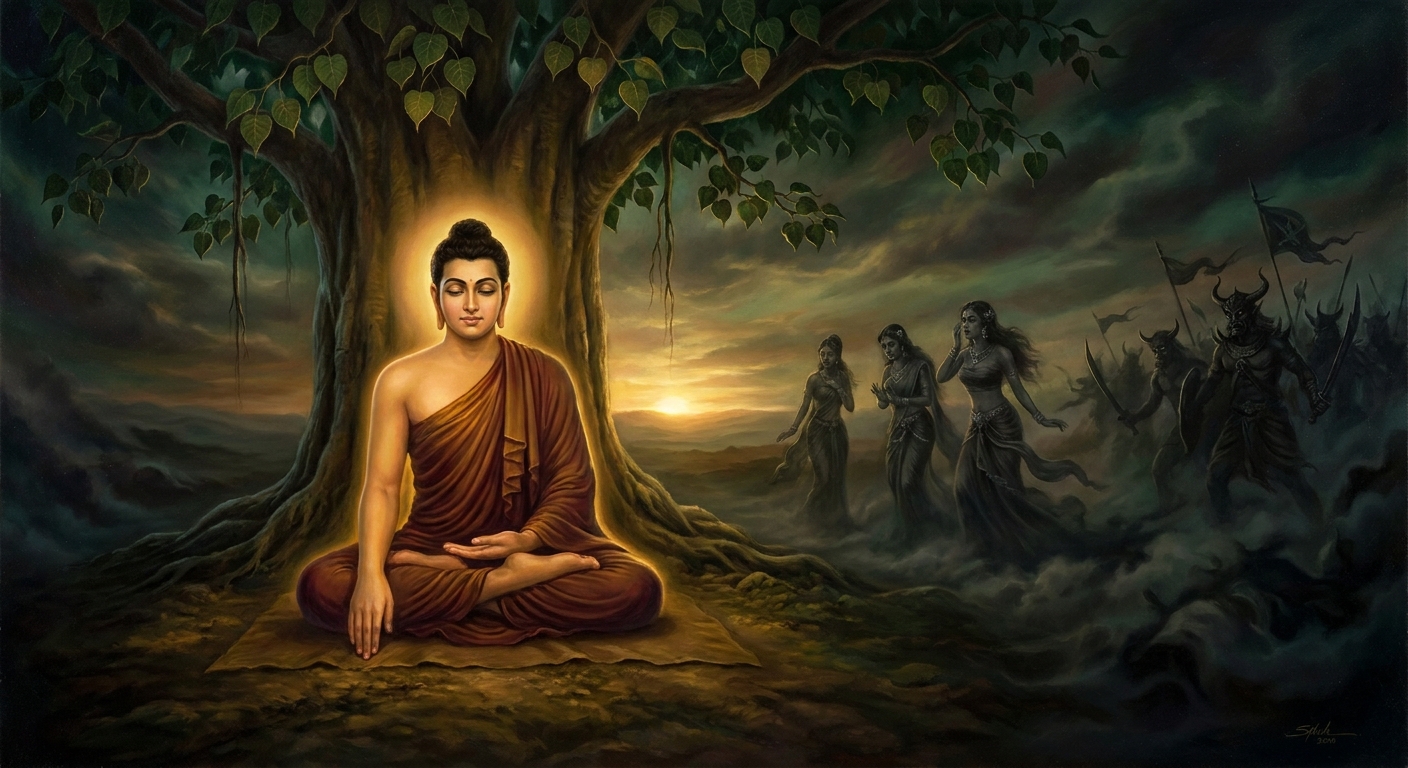
The Unborn Has No Name
1648 CE (breakthrough); c. 1690 CE (the samurai encounter) · Ako, Harima Province → Abbot's hall, Ryōmon-ji, Japan
Contents
Bankei Yōtaku has a breakthrough at twenty-six that requires no lineage, no technique, and no teacher to verify — the Unborn Mind is already here, was never lost. He spends the rest of his life telling this to anyone who will sit still, including a samurai sent to disrupt him.
- When
- 1648 CE (breakthrough); c. 1690 CE (the samurai encounter)
- Where
- Ako, Harima Province → Abbot's hall, Ryōmon-ji, Japan
He nearly dies finding it.
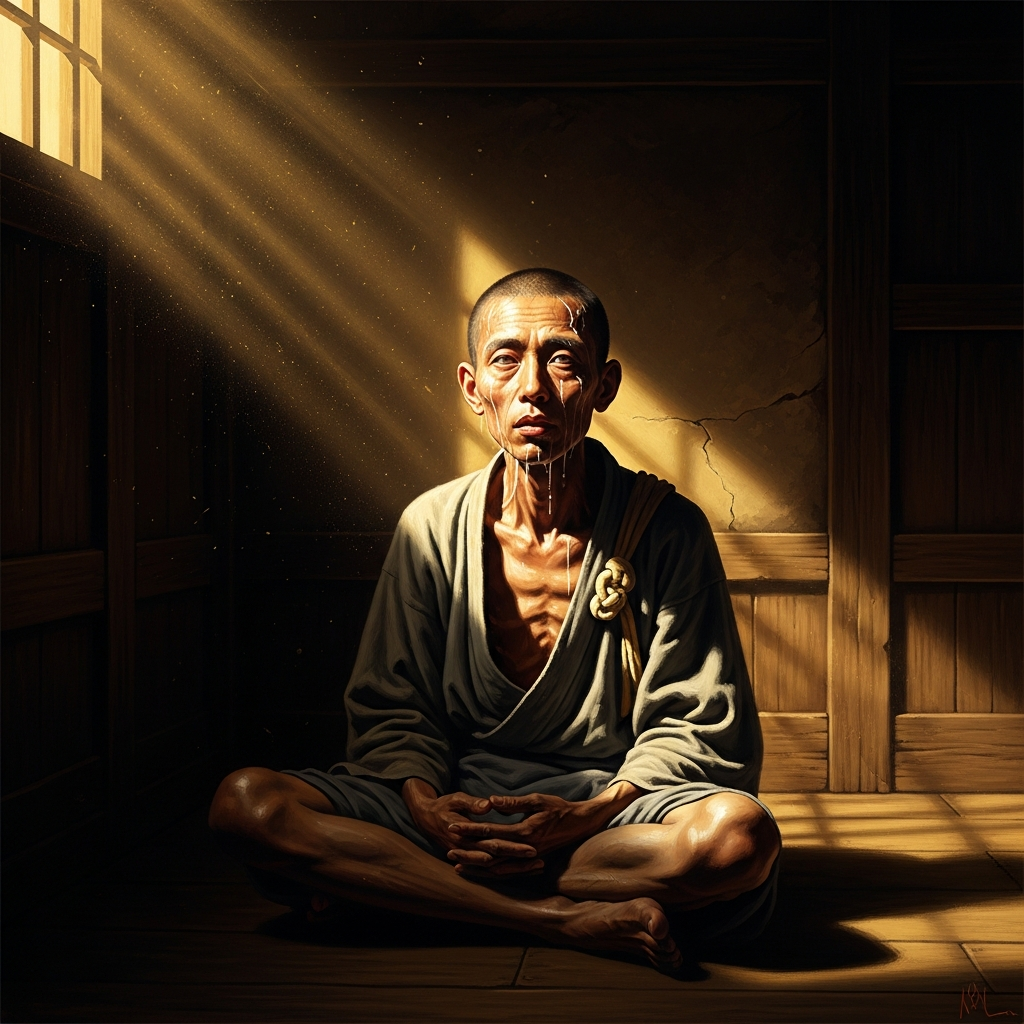
The year is 1648, and Bankei Yōtaku is twenty-six years old, and he is dying of what is probably tuberculosis in a hut at Ako, in Harima Province, on the Inland Sea coast. He has been ill for months. He has been ill, in a way, for the entire decade since he began his spiritual pursuit at the age of sixteen, when he read the phrase bright virtue in the Great Learning and found he could not understand it, could not understand it in the way that seizes a person and does not release them, the way a splinter in the foot will not leave your attention.
He has studied under every teacher he could find. He has kept austerities that have damaged his health — sitting in the cold without shelter, refusing to sleep, eating as little as possible, producing enough blood in his spittings to alarm the neighbors who brought him what food he would accept. He has sought the thing that the word virtue is pointing at, the thing behind all the pointing, the ground under the ground.
The illness comes on fully in the winter of 1648. He is moved to a small hut, given what care is available, and expected to die.
He does not die.
He comes very close. He loses weight his body cannot afford to lose. He hemorrhages blood. The family that has been sheltering him makes its preparations. Bankei, lying on his mat in the early morning of a day he does not expect to survive, becomes suddenly very still.
Something clarifies.
He will spend the rest of his long life trying to say what clarifies. The formulation he settles on is: I realized that all things are perfectly managed by the Unborn. The Unborn — fushō — is not a technical term he has learned from a teacher. It is the word that arrives in that morning when he is too sick to impose any framework on his experience. The Unborn is the mind before it was born into preferences, categories, the apparatus of a self that decides what it likes and what it fears. It is not an achievement. It is not a stage. It is the mind as it was before it learned to be otherwise. It has never not been here. The only thing that obscured it was the effort to find it.
He sits up. He is not cured — the illness takes another year to fully pass. But the seeking is over. He has found what he was looking for and found it by stopping the search at the exact moment the illness made continuing impossible.
He begins to teach.
This is the part that does not go as expected. He is recognized by the master Dōsha Chōgen, a Chinese-trained Rinzai teacher, and receives formal dharma transmission in the Rinzai line. He becomes the abbot of Ryōmon-ji in Harima. He is expected to teach in the manner of Rinzai masters: private interviews with individual monks, koan assignments, the rigorous training of students who have already entered formal practice.
He does not do this.
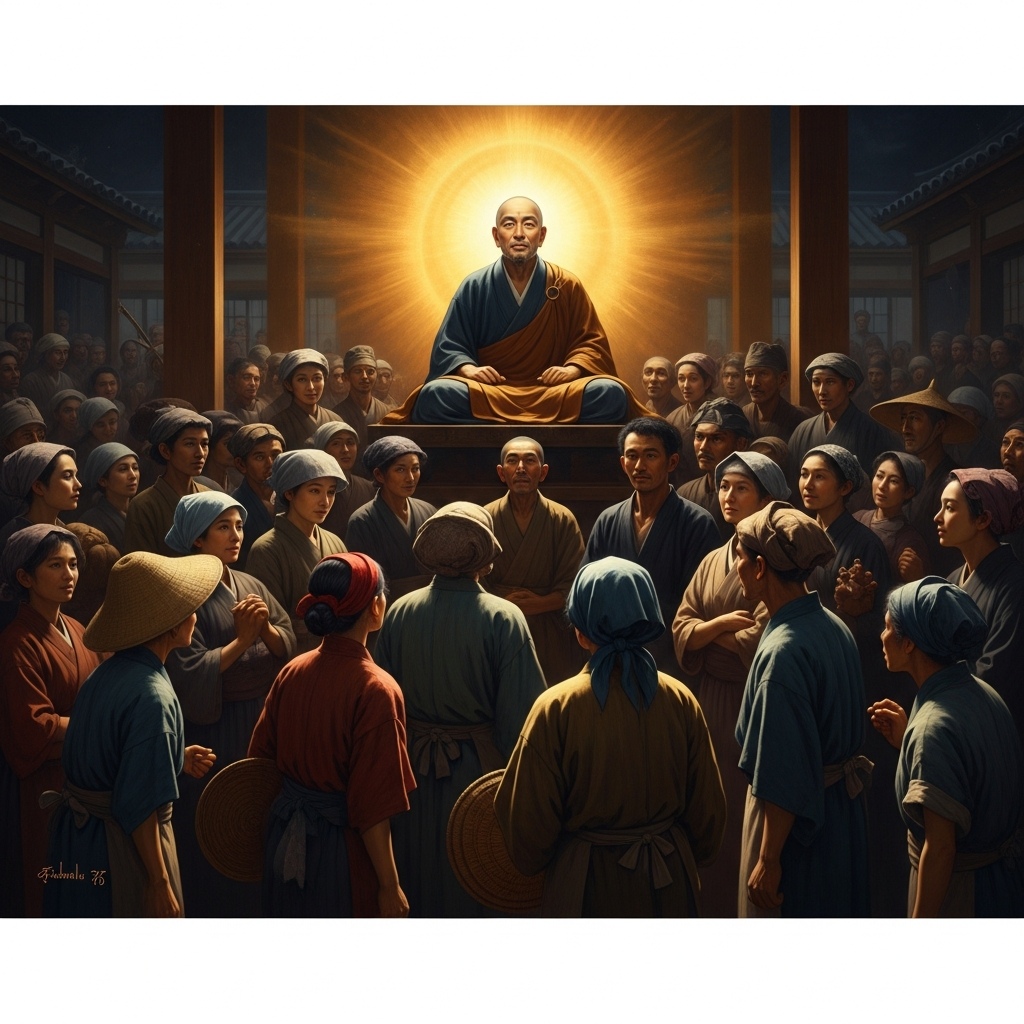
Instead he opens the teaching hall to everyone. Farmers come in from the fields carrying their smell and their questions. Women come — women who were traditionally excluded from the formal dharma halls of Rinzai monasteries. Criminals come; Bankei apparently does not ask about prior convictions. Merchants, servants, the simply curious. They fill the courtyard when the hall is full. He speaks to them in plain Japanese — not Sino-Japanese, the formal register of the sutras and commentaries, but the everyday vernacular of the Edo period, the language people used to argue about the price of fish. He refuses to translate himself.
The teaching he gives them is the same every time, varied only in its examples: you were born with the Unborn Buddha-mind. It is not something you have to achieve. Look — when a sparrow cries out unexpectedly, you hear it, before you have decided to hear it, before you have categorized it as a sparrow, before you have responded to it. That instant of pure hearing, before the self arrives to process it — that is the Unborn. You do it every moment. It is the only thing you do that you cannot do wrong.
A samurai comes to the talks.
He comes not as a student but as a test — or perhaps as a disruption, or perhaps both, since in the samurai tradition the distinction is not always clear. He sits in the back of the hall on the first day and picks a fight with the monk beside him, loudly enough to interrupt the teaching. Bankei continues without acknowledging him. On the second day the samurai shouts something during a pause in the teaching, a challenge or an insult; accounts differ on the content but agree on the intention. Bankei does not respond to him directly. On the third day he picks a fight with a different monk, and a scuffle breaks out in the back rows that takes some minutes to settle. Bankei waits. When the hall is quiet again, he continues the teaching he was giving.
Three days. The samurai is loud, deliberate, provocative. Bankei ignores him with the completeness of someone who has forgotten he exists.
On the fourth day the samurai comes back.
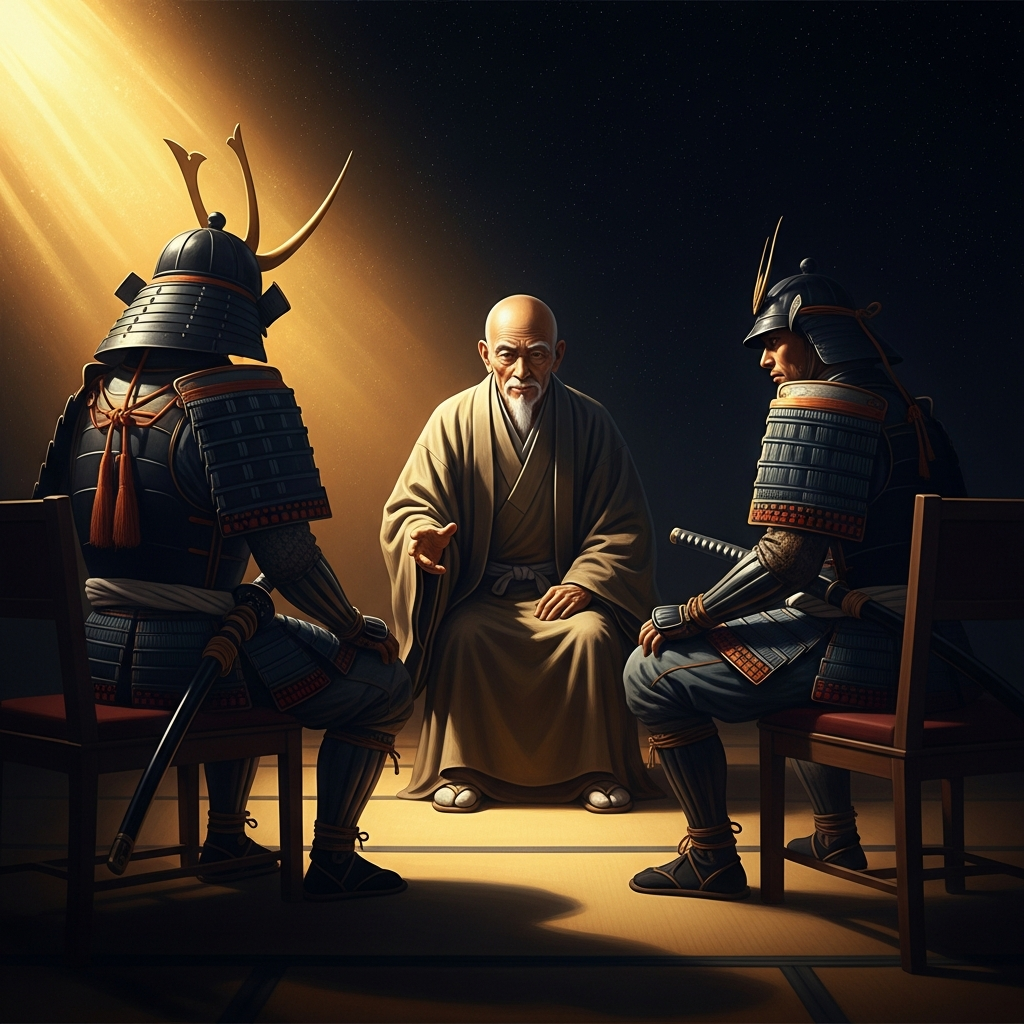
He sits in the back row again, but he does not pick a fight. He does not shout. He sits with the stillness of someone who has run out of disruption and found, on the other side of it, something he did not expect. Bankei looks up from the teaching at a natural pause and addresses him directly, in front of the full hall:
“You have been showing your Buddha-nature for three days.”
The samurai stares at him. The hall is very quiet.
“Your anger, your testing, your need to be noticed — you were not producing these from a contaminated nature. You were producing them from the same Unborn that everyone in this room produces everything from. The difference between the first three days and today is not that you have acquired something. It is that you have stopped insisting.”
The samurai, who came to test the master, finds himself the example in the teaching. He does not leave. He stays through the rest of the day’s sessions. He returns the following morning.
Bankei teaches for fifty years and writes almost nothing.
This is another deliberate asymmetry. He knows that the Unborn, once written down, will be mistaken for a concept. A concept can be argued about, refined, misapplied, institutionalized. The Unborn cannot be institutionalized; the moment it becomes a doctrine it has become exactly the kind of acquired knowledge that obscures it. He teaches in person, in plain language, and when he is done teaching he goes silent on the subject until the next time someone is in front of him.
After his death in 1693, his disciples compile records of his spoken teachings from notes and memory. The resulting text — the Bankei Zenji Goroku, the Recorded Sayings of Zen Master Bankei — is unusual among Zen transmission literature because it reads exactly like spoken Japanese. The formal, Sino-Japanese register of the great koan collections is absent. He sounds like a person talking to other people about something they can all verify immediately.
Bankei’s teaching is the most demanding kind because it refuses to be a teaching. It gives you nothing to practice, nothing to memorize, no steps to climb. It tells you only that the thing you are looking for is what is doing the looking, and that the search itself is the only obstacle.
The samurai who came to disrupt left having demonstrated the Unborn more vividly than any of the students who sat politely for three days. His anger, his disruption, his insistence on being met — all of it was the Unborn, which acts freely and naturally through every state, including the states we think are in the way. Bankei let him perform it for three days and then named what it was.
That is the whole teaching. It takes fifty years to give it completely, and it was already over in the first moment.
Scenes
Ako, 1648
 Generating art…
 Farmers, fishwives, servants crowd into the courtyard at Ryōmon-ji
 Generating art…
 The samurai sits in the back row on the fourth day, quiet for the first time
 Generating art…
 Echoes Across Traditions
Entities
- Bankei Yōtaku
Sources
- Bankei Yōtaku, *Bankei Zen: Translations from the Record of Bankei*, trans. Peter Haskel (1984)
- Norman Waddell (trans.), *The Unborn: The Life and Teachings of Zen Master Bankei* (2000)
- Heinrich Dumoulin, *Zen Buddhism: A History, Vol. 2: Japan* (1990)
- Thomas Kasulis, *Zen Action / Zen Person* (1981)