Eight Immortals Crossing the Sea
Mythic Time · canonized in Ming Dynasty popular literature, ~1368–1644 CE · The Eastern Sea · the Isles of the Immortals
Contents
The Eight Immortals refuse the Dragon King's boats and cross the Eastern Sea on their own magical objects — sword, gourd, lotus, paper donkey, flower basket, flute, fan, jade tablets — each one a different path to the same transcendence. The Dragon King tries to stop them and learns what Taoism has always known: the Way cannot be blocked.
- When
- Mythic Time · canonized in Ming Dynasty popular literature, ~1368–1644 CE
- Where
- The Eastern Sea · the Isles of the Immortals
The Dragon King of the Eastern Sea is not a small god.
His palace extends eleven thousand fathoms beneath the surface and is staffed by eight hundred varieties of fish-officer, shrimp-soldier, and crab-general. His jurisdiction covers everything between the eastern shore of the Middle Kingdom and the edge of the world where the sea meets the sky and they agree to pretend to be separate. He has, in his long career, received the Yellow Emperor’s emissaries, loaned his measuring staff to a monkey who should not have been trusted with it, and delivered rainfall on the schedule the celestial Drought Bureau sends down each spring. He is accustomed to being taken seriously.
So when the Eight Immortals arrive at the shore of his sea and decline his boats, he takes it personally.
They have come from the mainland to attend the Peach Banquet on the Isles of the Immortals, the great gathering hosted by Xi Wang Mu where the immortality peaches ripen and every transcended being in the Three Realms is expected to appear. The proper route involves boats. The Dragon King has boats. He has excellent boats.
The Eight Immortals look at the boats and look at the sea and look at each other, and something passes between them that is not quite a decision so much as a recognition — that this crossing is itself the point, that arriving is not the same as how you arrive, that the sea is not an obstacle but an opportunity.
“Each uses their own method,” says Zhongli Quan, who is the eldest and the largest and the one most comfortable with silence. He has a round belly and a fan made of palm leaves and the air of a man who has not hurried in several centuries.
He places the fan on the water.
He steps onto it.
Lü Dongbin goes next, because he is always second in the order and because his instrument is the most dramatic. He carries a sword — Chunyang Jian, the Pure Yang Sword — and he lays it flat on the surface of the Eastern Sea and rides it like a narrow bridge of light, cutting east through the waves with the ease of a man crossing a courtyard. Of all the Eight, he is the most human in his appearance and the most dangerous in his nature, a Confucian scholar who studied the Way and found it and became something the Confucian curriculum did not anticipate. His sword does not get wet. He does not get wet. The sea parts slightly for the blade’s passage and closes behind him without insisting on having had the last word.
Zhang Guolao unfolds his paper donkey.
This requires explanation: Zhang Guolao travels on a white donkey that he can fold to the size of a sheet of paper when not in use and re-inflate with a breath from his mouth when he needs it again. The donkey can travel ten thousand li in a single day, walks backward as easily as forward, and has by this point in Zhang Guolao’s very long life accumulated enough experience to avoid showing surprise at anything. It steps onto the water. Its hooves find purchase on the surface as if the sea were simply another kind of road, which from the paper donkey’s perspective it probably is.
He Xiangu comes third, the only woman among the Eight, and she rides her lotus flower — a single lotus blossom the size of a small raft, brilliant white, petals curved upward around her feet as she stands at the center like a figure on a seal. She achieved immortality by eating a peach of immortality that a divine being handed her in a dream when she was fourteen, and she spent the years after that learning to eat less and less until she could sustain herself on moonbeams and ground mother-of-pearl. She is the quietest of the Eight and the only one who arrived at transcendence without choosing it first, which gives her a relationship to the Way that is different from the others — not earned, not studied, but received, and then lived into over decades of careful practice.
The lotus moves across the water without a sound.
Lan Caihe steps onto the flower basket — a great woven basket filled with flowers and herbs that should not be able to support any weight at all — and rides it east with the expression of someone who decided long ago that the world’s opinion of what is possible was not particularly binding. Lan Caihe is the strangest of the Eight: a figure of uncertain gender who dresses in rags in summer and thin silk in winter, who sings begging songs in city streets and spends the money on wine and the poor in no particular order, who is either very wise or very mad or both, and who found the Way through total indifference to social convention, which is one of the things Taoism has always quietly suggested is the fastest route.
Han Xiangzi, the great-nephew of Han Yu the Confucian scholar, plays his flute.
This is how he crosses: not by standing on the flute but by playing it. The notes land on the water ahead of him and solidify into something like stepping stones — not visible, not substantial in any way the Dragon King’s engineers could measure, but real enough that Han Xiangzi walks east across the sea on music, one step per note, his feet never touching the water because the space between the water and the air is filled with sound at the right frequency.
The Dragon King watches all of this from below and feels something he does not usually feel, which is uncertainty.
He surfaces. He is spectacular when he surfaces — serpentine body a hundred yards long, scales the green of deep ocean, beard of sea foam, eyes the color of bioluminescence. He is the Lord of the Eastern Sea and he has come to clarify that this passage requires his authorization.
Zhongli Quan, riding his fan, looks at the Dragon King with the patience of a man who has been dead and returned and died again and returned again and who no longer finds large serpentine bodies particularly alarming.
“We are the Eight Immortals,” he says. “We are going to the Peach Banquet.”
“This is my sea,” says the Dragon King.
“Yes,” says Zhongli Quan.
There is a pause. The fan continues east. The Dragon King keeps pace.
“You need authorization,” says the Dragon King.
“From whom?” asks Zhongli Quan.
This is the question that causes the problem, because the honest answer is that the Eight Immortals are not under the Dragon King’s jurisdiction. They are not under anyone’s jurisdiction in the way that gods and lesser spirits are. They were human once, and they chose, through the specific disciplines of their specific lives, to become something that the hierarchy of heaven does not quite contain. Li Tieguai limps past on his gourd — a dried bottle gourd that should weigh nothing and supports him anyway — and the Dragon King looks at the row of ascending beings moving east across his domain and has the experience, unfamiliar and unpleasant, of understanding that some things simply will not be stopped.
Li Tieguai has an iron crutch because he was careless with his body once: he left his spirit to travel to heaven, instructed his disciple to wait seven days before cremating his body, and returned on the sixth day to find his body burned because the disciple had received news of his mother’s illness and could not wait. He took the first available body — a beggar who had just died of hunger, lame and ugly — and has occupied it ever since. The gourd he carries contains an elixir that heals. He offers it freely to anyone he meets who is sick, which is everyone. He is the least beautiful of the Eight and the most compassionate, and his crutch hitting the surface of the Eastern Sea makes a sound like a bell.
The Dragon King makes one more attempt. He sends his third son — a dragon-prince with lightning in his jaw and storm-scales on his back — to intercept the crossing.
Lü Dongbin draws his sword without breaking stride.
It takes, by any reasonable accounting, less than thirty seconds. The dragon-prince retreats. The Eight Immortals continue east. The Dragon King sinks back into his palace and files a complaint with the celestial Ministry of Maritime Affairs, who will forward it to the Office of the Three Pure Ones, who will read it and take no action because there is no action to take.
Cao Guojiu, who is last in the procession, crosses by standing on his jade tablets — the court credentials of a royal brother-in-law, polished white jade engraved with his name and rank from a previous life when he was a man of the imperial court. He gave that life away when he realized that rank was a cage that had been mistaken for a garden. The jade tablets carry him across the water as if they remember what he was and are not yet sure what he has become, and they support him anyway.
The Eastern Sea closes behind them.
At the Peach Banquet, the Eight Immortals arrive neither late nor early but at exactly the moment they were always going to arrive, because a person who has genuinely transcended the ordinary understanding of time does not hurry and does not wait. Xi Wang Mu receives them in the garden of her peach trees. The immortality peaches are ripe. The assembled gods and perfected beings fill the jade pavilions.
Cao Guojiu eats a peach and looks out at the sea, invisible now from this height, and considers the Dragon King below — still sovereign, still staffed, still important in his domain — and feels for him the uncomplicated compassion of someone who remembers being inside the same kind of authority and knows what it costs to let it define you.
The Eight Immortals are not superhuman beings descended from above. They are human beings who continued in one direction long enough to arrive at something else. A drunken poet. A lame beggar. A girl who ate moonlight. An old man who folds his transportation. A musician. A court official who walked away. A scholar who inherited his great-uncle’s Confucianism and found the Way instead. A man with a fan and a belly that has learned to breathe.
Eight people. Eight roads. One sea.
Taoism has always maintained that the Way is not a doctrine to be accepted but a motion to be aligned with, and that alignment looks different in every life because every life starts from a different place. The Eight Immortals are eight proof-of-concept demonstrations: a soldier’s crossing does not look like a musician’s crossing, a woman’s crossing does not look like a beggar’s crossing, but every crossing uses what is already there — the sword, the gourd, the fan, the lotus.
The Dragon King cannot stop them because he is trying to apply the logic of jurisdiction to beings who have moved outside jurisdiction. This is not defiance. It is what the Tao Te Ching has been saying since the beginning: “Yield and overcome. Bend and be straight.” The sea did not yield. The Eight crossed anyway, on the objects of their liberation, and the sea has not forgotten.
Each year in the temples of southern China and Taiwan, their images stand in a row on the altar: the fat man, the cripple, the woman, the old man, the poet, the musician, the scholar, the jester. Eight failures at the ordinary world who got so far past failure that it started to look like something else entirely.
Scenes
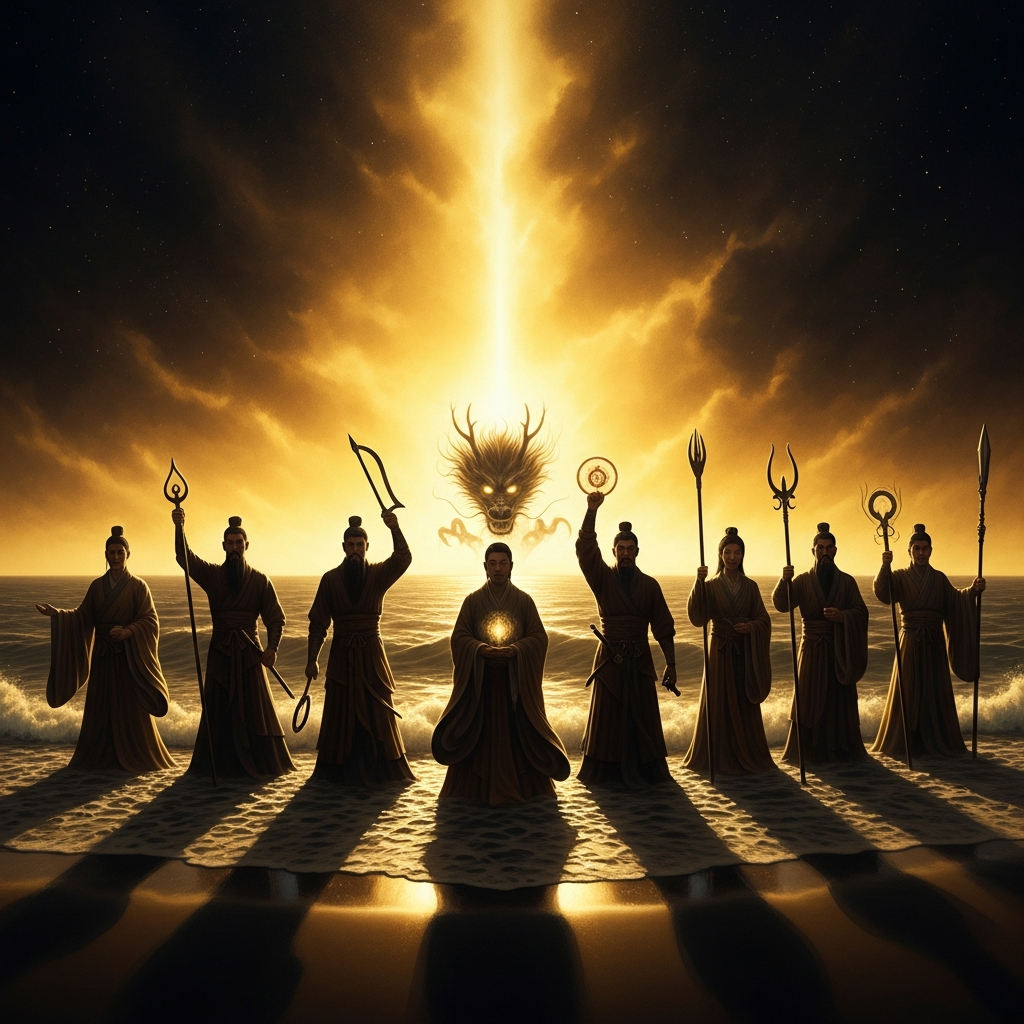
The Eight Immortals stand at the shore of the Eastern Sea, each raising their magical object to the horizon as the Dragon King watches from beneath the waves
 Generating art…
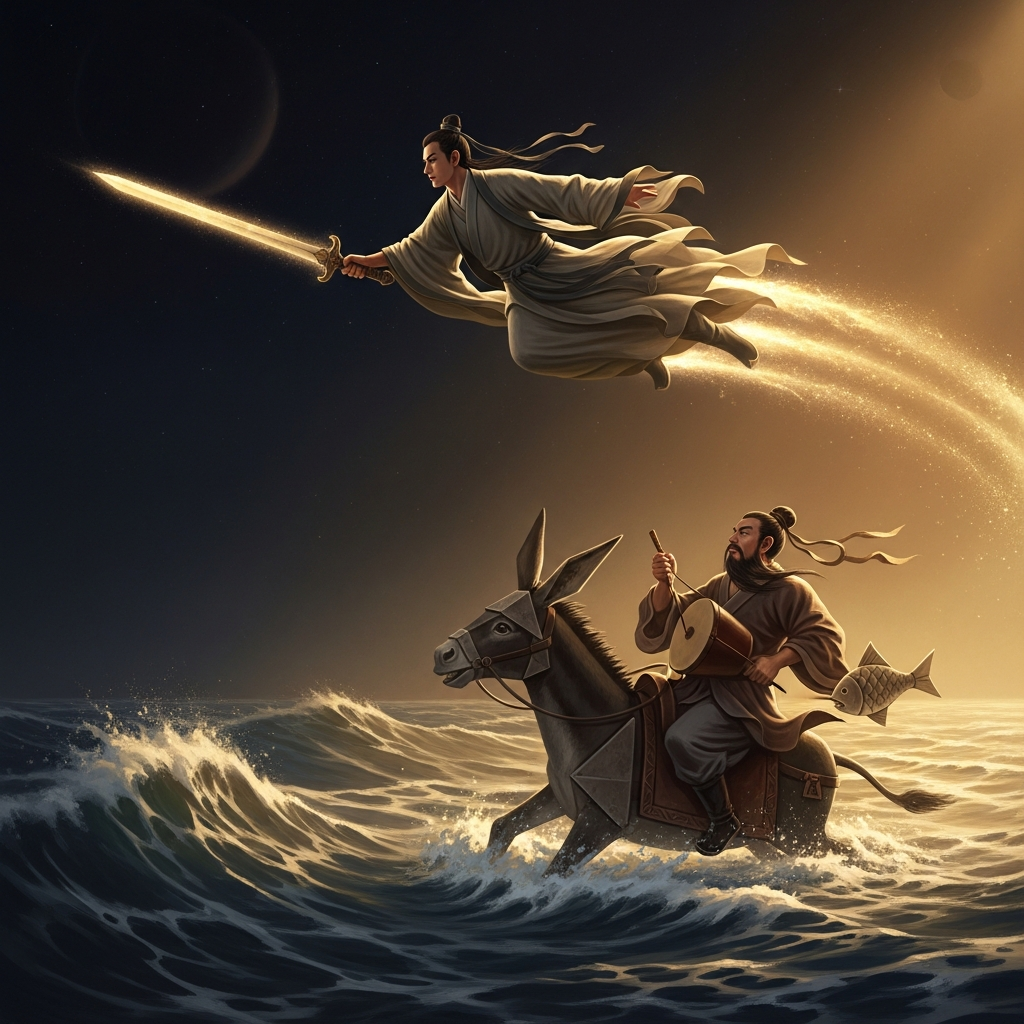
 Lü Dongbin rides his sword like a sliver of moonlight above the water while Zhang Guolao's paper donkey trots across the sea's surface as if the ocean were a mountain road
 Generating art…
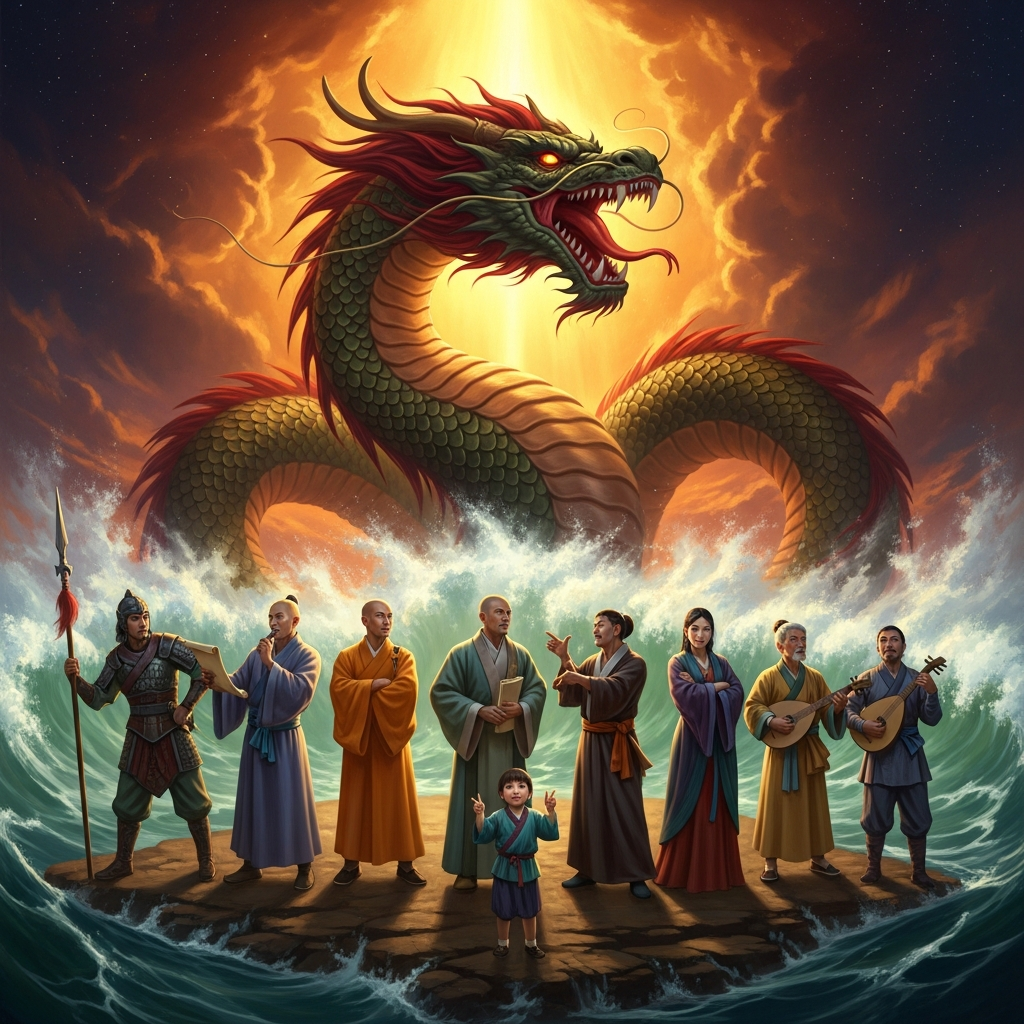
 The Dragon King rises from the sea in his full terrible form, only to find that eight beings who have forgotten how to be afraid are not easily impressed by a dragon
 Generating art…
 Echoes Across Traditions
Entities
- Lü Dongbin
- Li Tieguai
- He Xiangu
- Zhang Guolao
- Lan Caihe
- Han Xiangzi
- Zhongli Quan
- Cao Guojiu
- Dragon King of the Eastern Sea
Sources
- Wu Yuantai, *The Eight Immortals Cross the Sea* (Dongyou ji, Ming Dynasty, trans. various)
- Eva Wong, *Taoism: An Essential Guide* (Shambhala, 1997)
- Kristofer Schipper, *The Taoist Body* (University of California Press, 1993)
- Lionel Giles, *A Gallery of Chinese Immortals* (John Murray, 1948)