Mwindo and the Cave Beneath the World
Oral tradition · transcribed 1956 by Daniel Biebuyck from the bard Shé-Kárisi Rureke · Tubondo and the underworld of Muisa — the rainforest highlands of the eastern Congo
Contents
A hero born speaking, banished by his own father, descends through a cave into the underworld to wrest cosmic order from the man who tried to kill him.
- When
- Oral tradition · transcribed 1956 by Daniel Biebuyck from the bard Shé-Kárisi Rureke
- Where
- Tubondo and the underworld of Muisa — the rainforest highlands of the eastern Congo
He is born speaking.
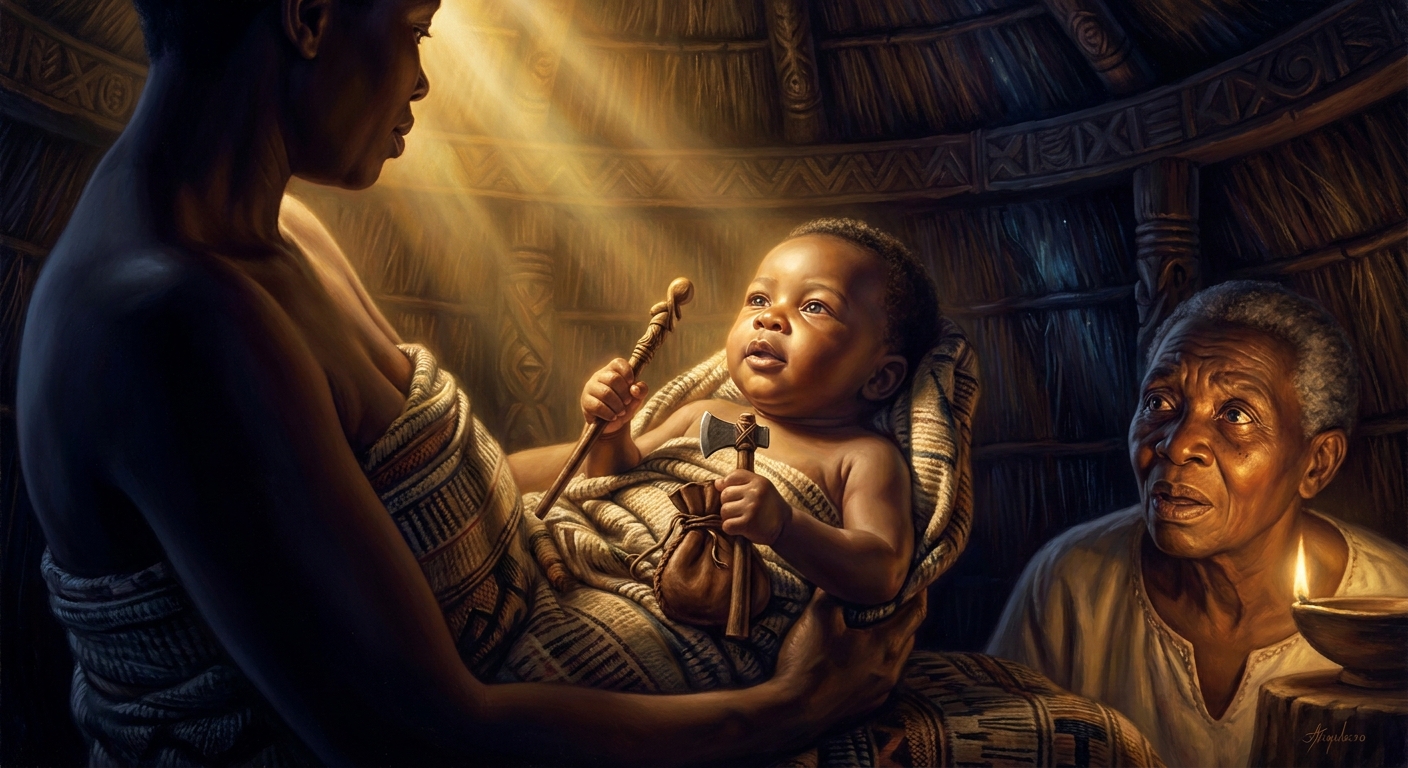
His father Shemwindo, chief of Tubondo, has decreed that all his wives must bear daughters only — sons threaten the throne, and the chief is the kind of man who solves a future problem by killing it before it walks. Six wives obey. The seventh, Iyangura’s sister, gives birth to a son who arrives already holding a conga-scepter, an axe, and a small leather bag of cosmic instruments. The midwives stare. The infant looks up from the floor of the birth-hut and announces his own name.
“I am Mwindo,” he says. “The little one just born he walks.”
Shemwindo hears the news and orders the boy buried alive in a banana grove. The earth refuses him. He is dug up. He is sealed in a drum and thrown into the river. The drum refuses him. The river carries him, singing, downstream toward his aunt Iyangura, who is married to a water-serpent and lives in the place where rivers know things.
Iyangura takes him out of the drum.
She is the only adult in the epic who looks at him without flinching. He is small. He is articulate. He is holding three weapons. She braids his hair the way one braids the hair of a king and a difficult child at the same time, because he is both, and she knows it.
“You will go back,” she tells him. “You will go back to Tubondo, and you will deal with your father. But you will not be a man who deals with his father by burning the village. Do you hear me, Mwindo?”
He hears her. He does not, in the end, listen. When he returns to Tubondo with his uncles and the lightning-god Nkuba walking beside him, he calls down fire from the sky and Tubondo burns to its foundations. Every one of his father’s people dies. Shemwindo escapes underground — through a pit at the base of a great tree, down into the kingdom of Muisa, the lord of the dead.
Mwindo follows him in.
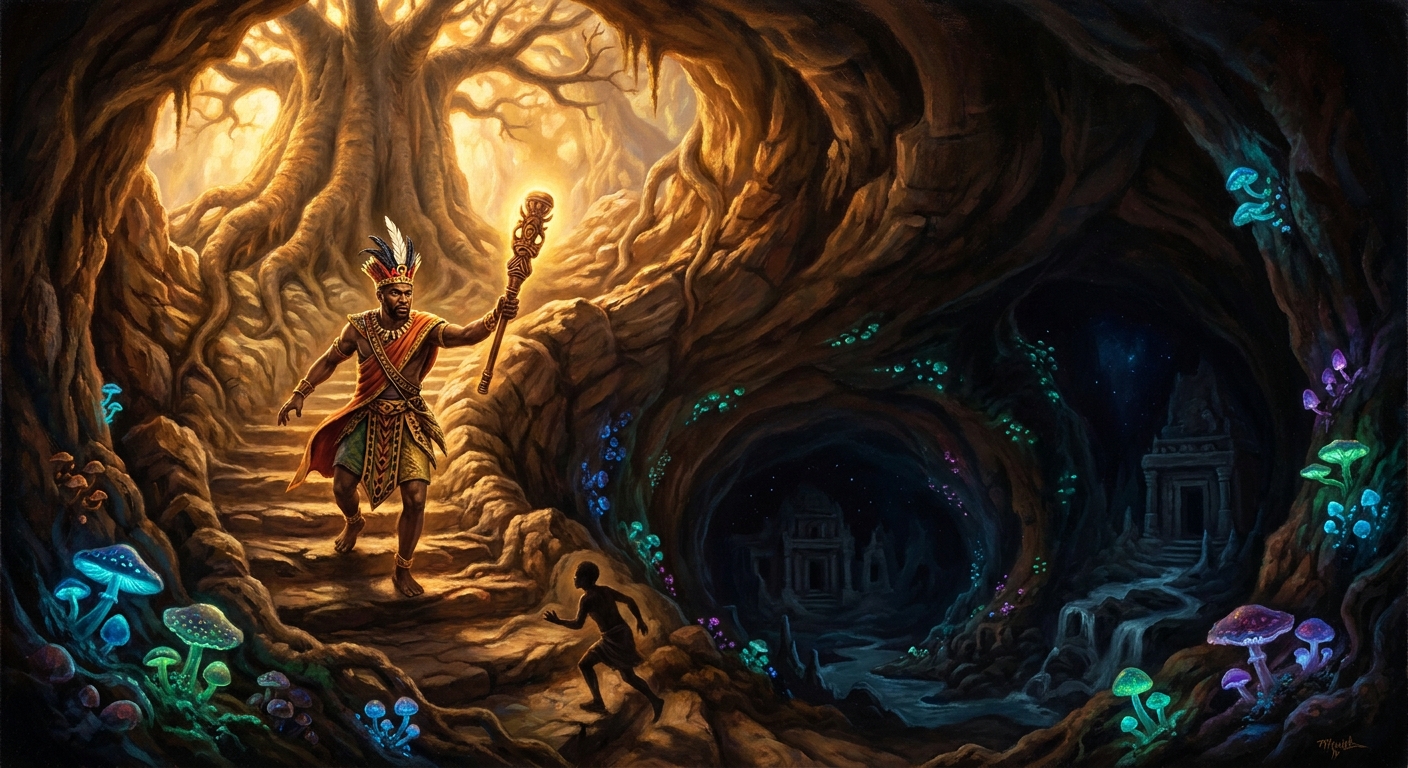
The cave does not narrow. It widens.
He had expected the throat of the underworld to close around him, but instead the walls fall back the deeper he goes, until the cave is no longer a cave — it is a country, with a sky of stone and a horizon of root. Down here the dead farm. The dead grind millet. The dead carry water on their heads to houses with no doors. Muisa’s village is the largest of them, and Muisa himself is sitting in the doorway of his house, chewing tobacco, watching the boy come.
“You are the son of Shemwindo,” Muisa says. He says it the way a creditor names a debtor.
Mwindo nods.
“Your father is here. I have given him work. Before you can take him back, you will do my work too. Three tasks. If you finish them, you may climb out. If you fail, you stay.”
The first task is to clear a banana grove with a single hoe-stroke. The second is to gather the honey of bees that live in the wall of the underworld itself. The third is unspoken — it is the task of not losing his temper, and Mwindo has been losing his temper since the moment of his birth.
He clears the grove. He gathers the honey. He returns to Muisa’s doorway scratched, stung, trembling with rage at the smallness of the work and the largeness of the indignity.
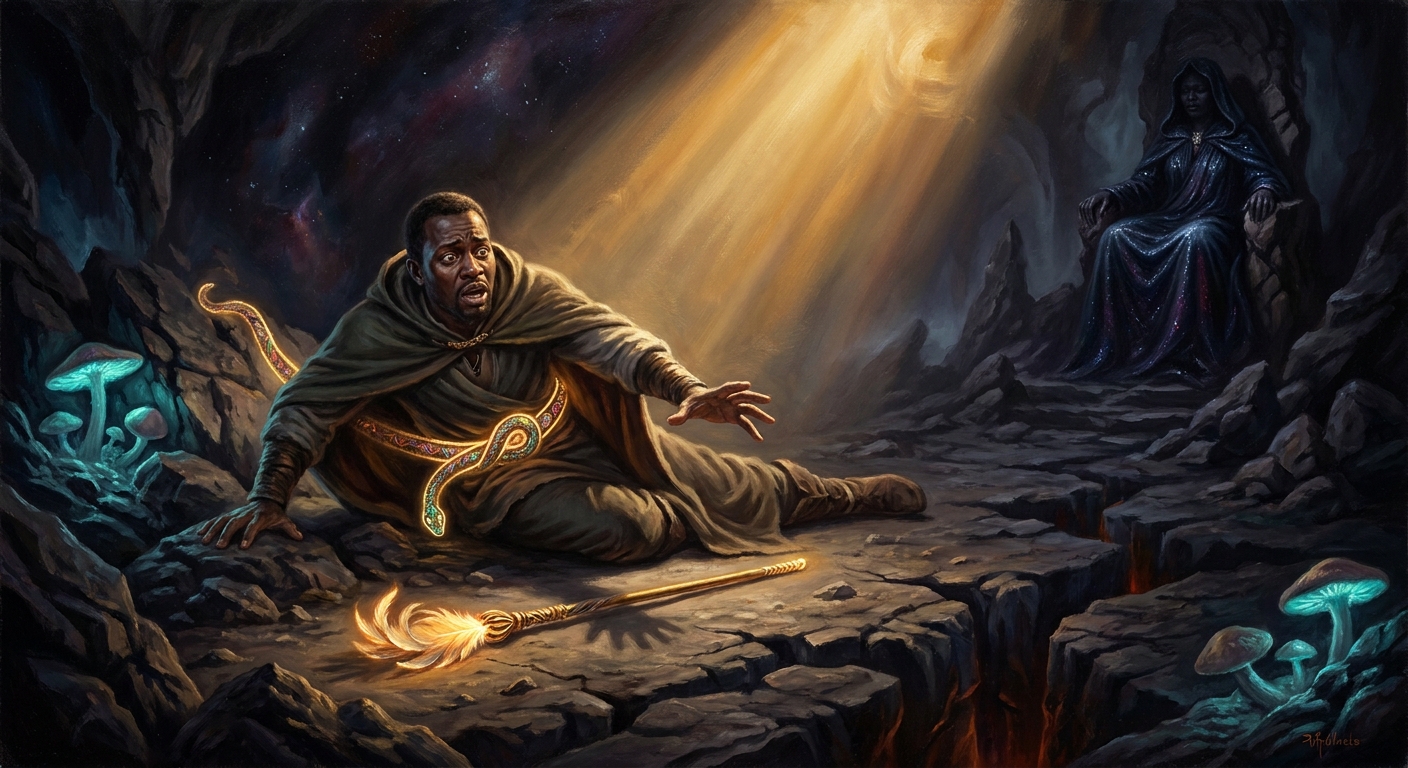
Muisa smiles and strikes him with a magic belt — karemba — that flings Mwindo to the floor of the underworld and pins him there, breath crushed out, ribs grinding. “You are strong,” Muisa says, “but you are still a child of the upper world. You do not yet know what the dead know.”
Mwindo lies pinned for a long time. He cannot move. He cannot speak — the conga-scepter, his birth-tool, has rolled out of his hand and lies just beyond his fingertips. He stares at it. He thinks about Iyangura. He thinks about the burning village. He thinks about his father working somewhere in the fields of the dead and not knowing his son has come.
The conga begins, very slowly, to roll back toward his hand.
It rolls because he is calling it, and he is calling it because — for the first time in the epic — he is afraid. Not of dying. Mwindo cannot really die; the cosmos has not given him that exit. He is afraid of staying. Of becoming one of the dead farmers, hoeing Muisa’s millet for an age of ages, while above ground his name becomes a story other people tell.
The conga touches his fingertips. He closes his hand around it. The karemba belt loosens. He stands up.
He does not strike Muisa. (Iyangura, even from the upper world, is watching.) He says, instead: “Give me my father. I have done your work. The bargain holds.”
Muisa, who is older than bargains, honors it. Shemwindo is brought up out of the millet rows in a torn cloth, hands cracked from underworld labor, eyes that no longer look like the eyes of the chief who had ordered his son buried. He looks at Mwindo. Mwindo looks at him.
Neither speaks. There is nothing in any human language for the sentence they would have to say.
They climb out together.
The cave that widened on the way down narrows on the way up, and Mwindo realizes the shape was never the cave’s — it was his. He had grown small to fit through the entrance and grown large at the bottom because the underworld required his full size to bargain with him. Coming back up, he must shrink again. By the time he reaches the surface, he is the boy who left, and his father is a man he can carry.
The council of the upper world — uncles, aunts, the lightning-god Nkuba who had walked with him to the burning — meets him at the cave’s mouth. They have decided, in his absence, that the destruction of Tubondo cannot stand unanswered. Mwindo is a hero. He is also a danger. The cosmos does not survive heroes who burn villages without learning to stop.
Nkuba takes him up into the sky for a year. There, in the realm of cloud and storm, Mwindo is taught the discipline he was born without — how power that is not constrained becomes a kind of underworld of its own, swallowing whatever it touches. He returns chastened. He restores Tubondo. He becomes the chief his father was not. He places the conga-scepter on a shelf and rules with words.
The Mwindo Epic was performed by a single bard, Shé-Kárisi Rureke, over twelve days in 1956 in a clearing in the Congolese rainforest. He held the entire architecture in his head — twelve days of verse, a hundred named characters, the shape of an underworld and the etiquette of its lord. Daniel Biebuyck and his colleagues transcribed every line. When Rureke finished, he asked for palm wine and slept for two days.
The epic survives because of that performance. Without Rureke, the cave would have stayed closed.
Mwindo is the rare hero who is corrected mid-story. Gilgamesh is corrected by death. Odysseus is corrected by Athena. Mwindo is corrected by his own aunt, his own uncles, and the sky-god who refuses to let him become a tyrant. It is an epic that knows what most epics forget: the descent into the cave is only half the work. The other half is what the hero agrees to be when he comes back up.
Scenes
The birth-hut at Tubondo
 Generating art…
 Mwindo descends into the pit-cave at the base of the great tree, following his fleeing father into the kingdom of Muisa
Generating art… Pinned to the floor of the underworld by Muisa's *karemba* belt, Mwindo calls his conga-scepter back to his hand across the stone
 Generating art…
 Echoes Across Traditions
Entities
- Mwindo
- Shemwindo
- Iyangura
- Muisa
- Nkuba (the lightning)
Sources
- Daniel Biebuyck and Kahombo C. Mateene, *The Mwindo Epic from the Banyanga* (1969) — the foundational scholarly transcription
- Daniel Biebuyck, *Hero and Chief: Epic Literature from the Banyanga, Zaire Republic* (1978)
- Isidore Okpewho, *The Epic in Africa: Toward a Poetics of the Oral Performance* (1979)
- John William Johnson, ed., *Oral Epics from Africa* (1997)