Lao Tzu at the Pass
~500 BCE · the late Zhou dynasty (likely legendary) · Hangu Pass, on the road west out of China
Contents
The keeper of Zhou archives loads a water buffalo and rides west toward oblivion. A border guard stops him. Three days later the most-translated text after the Bible exists — because one man asked.
- When
- ~500 BCE · the late Zhou dynasty (likely legendary)
- Where
- Hangu Pass, on the road west out of China
The dynasty is dying, and he knows it.
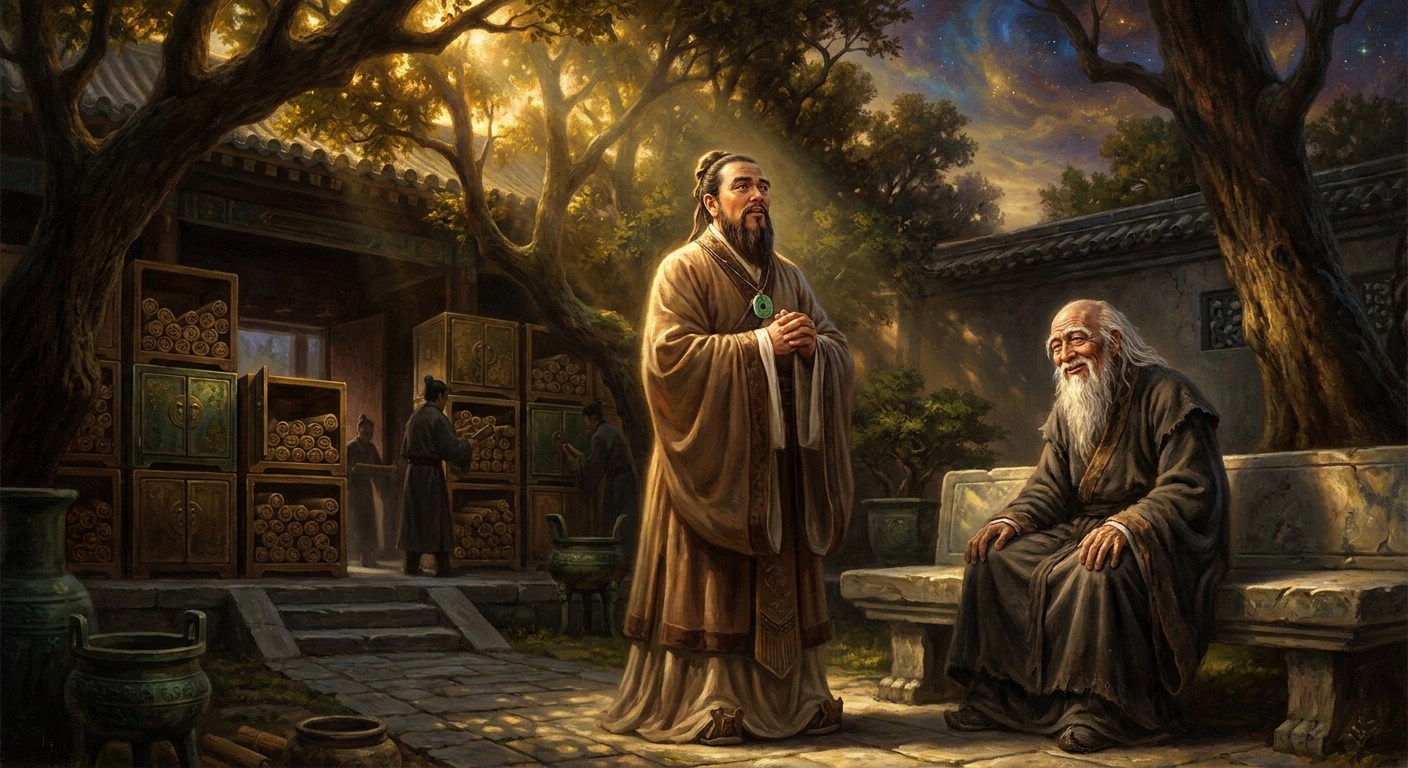
He has worked the Zhou archives for decades — cataloguing bronze inscriptions, silk manuscripts, the ritual records of a civilization that was once the world. Now the bronze is being melted for weapons. The silk is scattered. The lords who were once subordinate to the Son of Heaven have turned predatory, carving the kingdom into smaller and smaller pieces of ambition. Lao Tzu has watched this from the inside and drawn one conclusion: it is time to go.
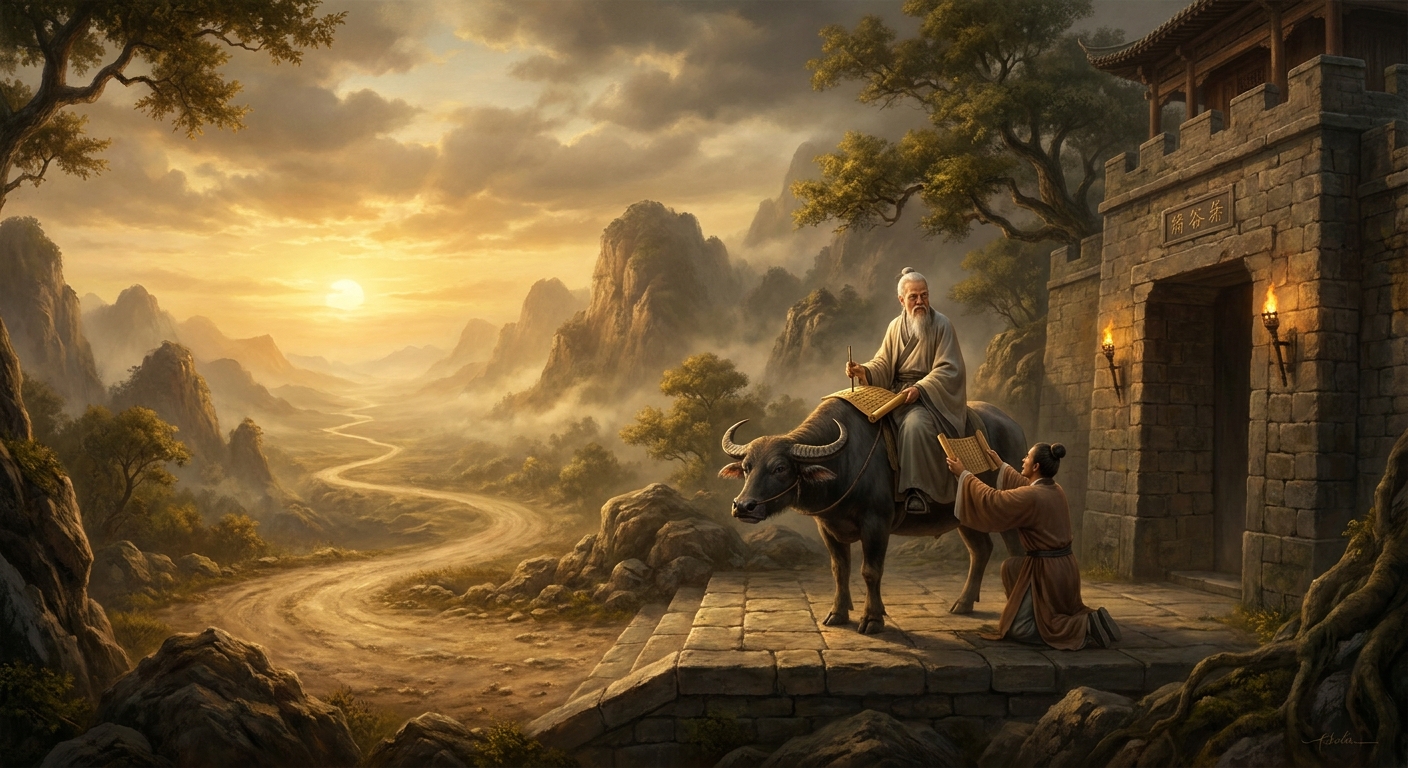
He loads a water buffalo. He says nothing to anyone. He rides west.
The road to the Hangu Pass cuts through limestone mountains, past villages that have changed hands three times in a generation. It is not a dramatic departure. There is no ceremony. The animals know nothing. The water buffalo — slow, reliable, indifferent to history — sets the pace, and the old man lets it.
He has outlived Confucius, the other great mind of the age, the one who rode in the opposite direction: into courts, into the thick of things, trying to remind kings what virtue looked like. Confucius compiled and preserved and instructed. He believed that if the right men held the right offices and performed the right rituals, the world could be called back to order. He was wrong, but he was magnificently, productively wrong — his failure built a tradition.
Lao Tzu draws the opposite conclusion from the same evidence. The sage who insists on teaching accelerates the problem. The ruler who governs hard breaks what he tries to hold. The archivist who clings to the archive burns with it.
He rides west. The Tao that can be named is not the eternal Tao. Better to say nothing. Better to go.
Yinxi sees him coming from a long way off.
The guard at Hangu Pass is, by the account Sima Qian records five centuries later, a man of unusual perception. He has watched travelers pass through this gate his entire career — merchants, refugees, soldiers, diplomats — and he reads them the way a physician reads a tongue. He sees the old man on the buffalo and understands, with the certainty of a man who has learned to trust what he cannot explain, that something irreplaceable is about to pass through his gate and not come back.
He steps out. He raises a hand.
Master. Before you go. Write down what you know.
Lao Tzu could argue. He has the material: the whole paradox-engine of Taoism, the way that acting with intent defeats intent, the way that the bowl is useful because it is empty. He could say that writing it down will kill it, that putting the Tao into characters will make it a cage, that Yinxi is asking the wrong question in the worst possible way.
Instead, he gets off the buffalo.
He sits at the gate. He stays for three days.
What happens in those three days is not recorded. Sima Qian offers only the result: five thousand characters, organized into eighty-one chapters, handed to the guard. The Tao Te Ching. The Daodejing. The Book of the Way and Its Virtue.
It is not a systematic work. It does not build arguments. Each chapter is a compression — a handful of images pressed together until something cracks and lets the light through. Thirty spokes share the wheel’s hub; it is the center hole that makes it useful. The highest good is like water. The Tao that can be told is not the eternal Tao. He opens with an impossibility and never stops.
The paradox is structural, not decorative. He is writing a book that announces it cannot be written. He is naming a thing he has just told you is unnameable. He does this on purpose, with the precision of a man who has spent a lifetime in the archives learning exactly what language can and cannot hold. The five thousand characters are not a failure of expression. They are a deliberate detonation — a text designed to blow out the reader’s tendency to mistake the map for the territory.
He hands it to Yinxi.
He climbs back onto the buffalo.
He rides on.
He is never seen again.
No grave. No school founded in his name by his own hand. No last words beyond the eighty-one chapters. The tradition will later deify him — Taishang Laojun, the Most High Lord Lao, appearing in visions, dictating revelations, his image carried in processions across two thousand years of Chinese religious life. But the man on the buffalo reaches the pass, leaves the book, and dissolves into the mountains as cleanly as smoke.
The book travels east without him.
It will be translated into Greek under the Han dynasty. Then into Sanskrit. Then into Tibetan. Then into Latin. By the twentieth century it has more translations into English than any other text except the Bible — hundreds of versions, each one confessing in its translator’s notes that something escaped. Mitchell’s version: clean and luminous, the Tao as a kind of grace. D.C. Lau’s: scholarly, hedged, alive to the Chinese’s tonal layering. Red Pine’s: annotated with classical commentary, each chapter a palimpsest. Every translator faces the same trap Yinxi set: asking the unnameable to give its name.
The question Yinxi asked at the gate — write down what you know — is the oldest and most violent demand humans make of their wisest people. Socrates submitted to it in the form of Plato’s dialogues. The Buddha submitted to it in five decades of teaching. Christ submitted to it in the upper room. Mani submitted to it in the letters he composed while awaiting execution.
The demand always carries the same subtext: don’t leave yet. We are not ready. Whatever you know, we need it in a form we can hold.
Lao Tzu’s answer is the strangest of all. He gives them the form. He fills it with five thousand characters. And then the characters themselves, from the very first line, keep trying to send the reader back toward the thing he got off the buffalo to write away from.
The Tao that can be told is not the eternal Tao.
He said this. It is the first sentence. He meant it.
Then he rode on and proved it.
The debate over Lao Tzu’s historicity has not been resolved and likely cannot be. Sima Qian, writing around 100 BCE, already hedges: there may have been multiple men, multiple texts, the story of Yinxi possibly invented to explain how the book escaped. The Tao Te Ching itself gives no author and no date. What is not in dispute: the text exists, it is very old, and it has been read continuously for at least 2,400 years. The man on the buffalo may be legend. The five thousand characters are fact.
The border guard saved them. That part survives every reading.
Echoes Across Traditions
Entities
- Lao Tzu
- Yinxi
- Confucius
Sources
- Sima Qian, *Records of the Grand Historian* (*Shiji*) 63 — the earliest biographical account
- *Tao Te Ching* / *Daodejing* — Stephen Mitchell (trans., 1988); D.C. Lau (trans., 1963); Red Pine (trans., 1996)
- *Zhuangzi*, Inner Chapters (esp. ch. 1–7)
- Holmes Welch, *Taoism: The Parting of the Way* (1957)