The Nine-Tailed Fox Chooses
Mythic time; folk tradition formalized in Joseon dynasty, 1392-1897 CE · Deep mountains of the Korean interior
Contents
The gumiho has lived a thousand years in the Korean mountains and is almost human. To become fully human she must eat one hundred human livers or hearts. She takes the form of a beautiful woman and finds a man she cannot bring herself to destroy. She spends a long season on the edge between becoming a demon and becoming a woman, and the story does not tell her which she chooses — only that she is still choosing.
- When
- Mythic time; folk tradition formalized in Joseon dynasty, 1392-1897 CE
- Where
- Deep mountains of the Korean interior
She has eaten ninety-nine.
This is the number that the tradition insists on. Not one hundred — not the completeness that would close the transformation, but ninety-nine, which is almost, which is the number that requires one more and makes the final decision impossible to defer. She has spent a thousand years in the mountains of Korea accumulating the vital essence she needs to become human, and the tradition is specific about the method: human liver, in most versions, or human heart, in the variants that the Joseon dynasty found more poetically resonant. Ninety-nine times she has done what the transformation required. Once more and she crosses.
She takes the form of a woman.
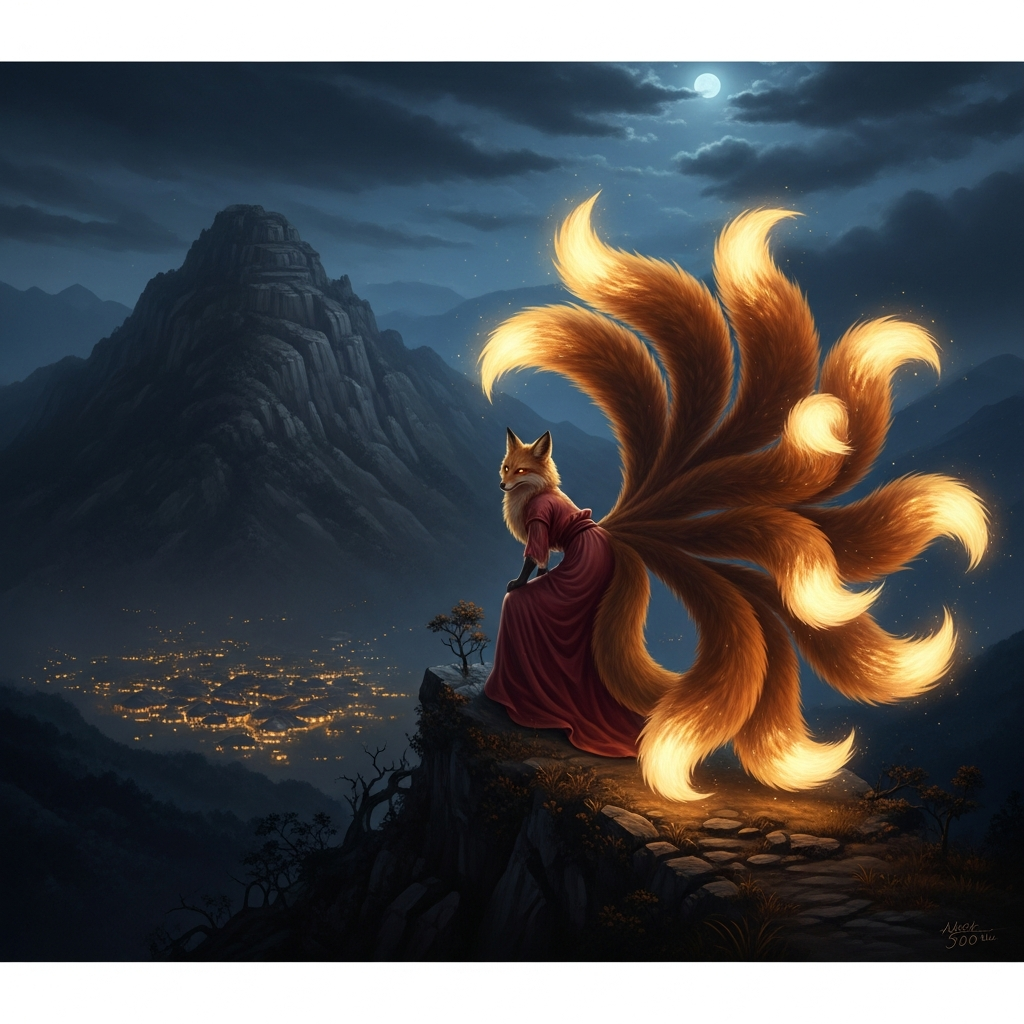
The form she takes is not a disguise she applies over her fox body the way a costume applies over a human one. It is the form she has been assembling for a thousand years, accumulating from the spiritual essence of the mountains and the moonlight and the human presence she has absorbed. In fox form, she glows — all nine tails trailing light in the dark, each one a century of accumulated life, a meter of phosphorescent fur that marks her as something the forest takes seriously.
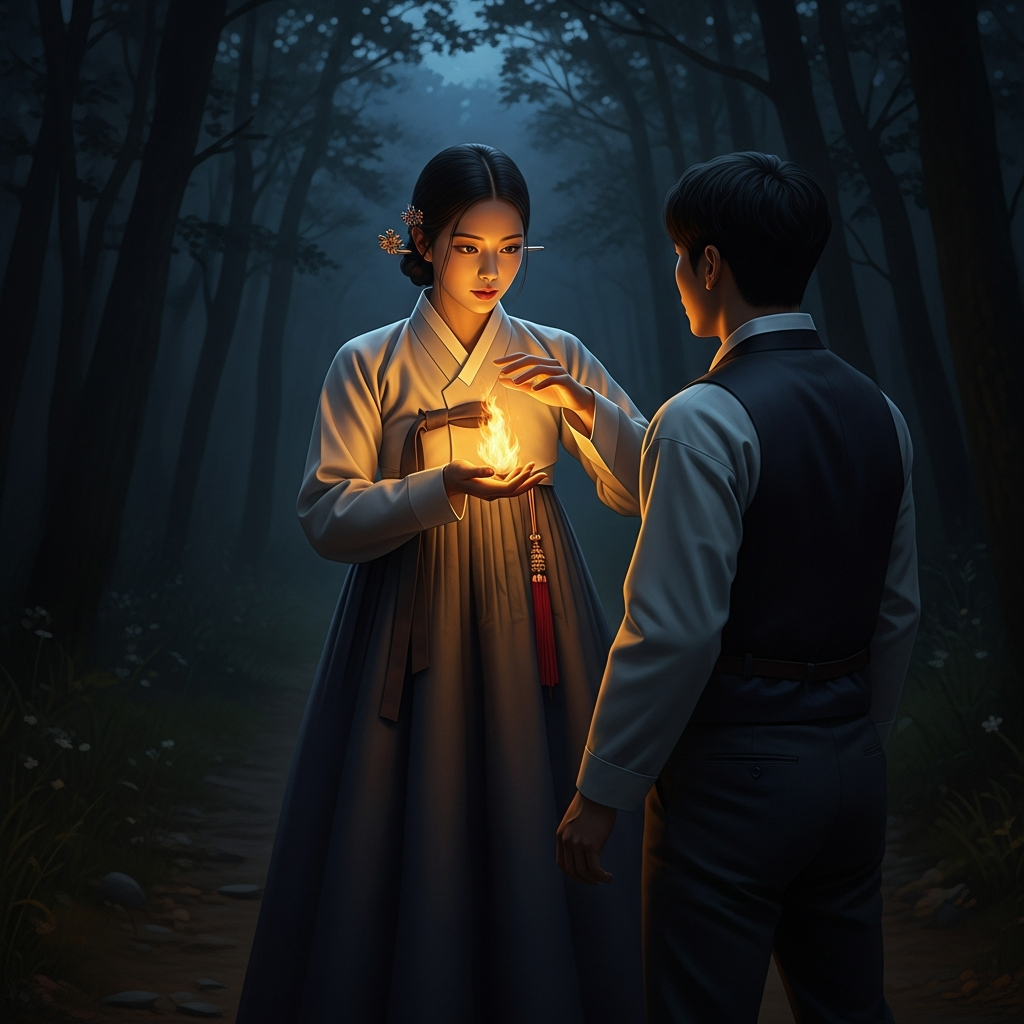
In human form, she is a woman in her twenties, the specific beauty that the Korean folk tradition associates with beings who have not had the ordinary accidents of human living — no smallpox scar, no weather-damage, no evidence that the body has been struggled in. The beauty is the tell, in the stories that go badly. The traveler who notices the woman is too beautiful, who notices the eyes catch light at the wrong angle, who notices there is no family, no origin, no explanation — that traveler sometimes survives. The traveler who accepts the beauty as simply beauty rarely does.
She finds a man who notices. He notices and he does not run.
His name in the story varies by version. The version from Gyeonggi Province calls him a scholar. The version from Gangwon-do makes him a hunter. The version that the television dramas drew on most heavily in the twentieth century makes him an ordinary man walking home late. The details of his particular ordinariness are not the point. The point is that she finds someone who sees her clearly and stays.
He is, in the structural terms of the story, the last one.
She needs one more liver. She has found the man she cannot eat.
This is not, in the tradition’s first telling, a romantic development. The gumiho in the early folk versions is not primarily a figure of love — she is a figure of hunger and proximity to humanity, which is not the same thing. What she feels for this man is not, initially, love in the courtly Chinese sense or the Confucian sense or the romantic sense. It is recognition. He is, somehow, the one whose vital essence is something she cannot treat as a resource. He is the one who is, in some way she cannot name, too much himself to consume.
She keeps the form. She does not eat him. She waits.
Waiting is the story’s longest movement.
She is in a shelter together on the mountain — the exact circumstances of their shelter together are arranged by the story’s structure to allow for days rather than hours. The hunter has been caught by weather. The scholar has missed the last village. The ordinary man has taken a wrong path. She is there when he arrives. There is a fire.
She cooks. She speaks. She asks questions that are more specific than an ordinary stranger’s questions, because she has spent a thousand years observing humans without being one, and her questions have a precision to them that makes him feel, in a way he cannot quite articulate, that someone is studying him with great care.
He asks questions back.
The questions reveal her obliquely. She knows too much about the mountain — its trails, its seasons, its particular spirit-weather, the quality of the light at certain hours. She knows too little about ordinary life — the names of common vegetables, the protocol for market day, the reflexive knowledge that humans acquire simply by living in proximity to other humans from birth. She is an expert in the deep world and a stranger to the surface of the human world, and this inverted expertise is the tell that a careful listener eventually notices.
He notices. He does not say anything. He lets her talk.
The Korean tradition offers two versions of what happens next, and the two versions are irreconcilable.
In the first version, she asks him for the thing she cannot take: voluntary consent. She reveals herself — not as demon, but as what she actually is, a being who has spent a thousand years becoming human and needs one final act of will to complete the crossing. She asks him to let her. He refuses. He is afraid, or he is principled, or he is simply unable to extend his sympathy to include what she is asking him to include. She goes back to the mountain with ninety-nine and one more decision to make.
In the second version, she makes a different choice. She simply does not eat him. She stays the season with him — days or weeks, depending on the version. She does not complete the hundred. She allows the window of the transformation to close. She goes back to the mountain in fox form, all nine tails, a thousand years of accumulated essence not sufficient for humanity because she chose mercy over the crossing.
In the second version, the tradition does not say she made a wrong choice. It does not say she made the right one either. It says she is still in the mountain. She is still choosing. The window closed but time continues. A new window will open. She will find another man on another mountain path and face the same decision.
The gumiho in the twentieth-century versions — particularly the television dramas that began in the 1990s and have not stopped — is almost always a figure who wants to love rather than a figure who wants to eat, and this adjustment of emphasis says something about what the audience needs from her. The tradition’s early versions do not make this distinction clean. The hunger and the longing are the same movement in the same direction. She wants to be human. Eating and loving are both modalities of this wanting.
The television dramas separate them and dramatize the conflict. She wants the man. She does not want to eat him. These become opposite impulses, and she navigates between them. This is more legible to a contemporary audience than the folk tradition’s version, in which the appetite is more ambiguous and the moral terrain harder to stand on.
Both versions agree on the structure: she is standing at the threshold of what she has been working toward for a thousand years, and the crossing requires something she cannot do without destroying what she loves, and the story does not tell her which matters more.
In the mountains of Korea, if you travel at night on the deep trails, you may encounter a woman where no woman should be. Her beauty is too complete. Her eyes catch the moonlight wrong.
She is not necessarily dangerous. She is a thousand years old and she is almost human and she is still deciding.
The folk tradition is clear that she can be encountered without being consumed. She can be spoken to. She can be seen clearly and accepted, in which case the seeing and the accepting are something the tradition treats as significant — as a kind of gift that the human gives to the creature at the threshold.
The story the tradition keeps telling is not: here is a monster that hunts you. It is: here is a being that wants to be what you are, and is paying a price for the wanting that you cannot see, and is still, after a thousand years, attempting the crossing.
The nine tails are still there. The mountain is still full of her. She is still choosing.
Scenes
The gumiho in fox form on a Korean mountain peak at night, all nine tails spread behind her in the moonlight, each tail tip glowing with a century of accumulated spiritual force
 Generating art…
 The gumiho in human form on a forest path — a woman of piercing beauty in traditional hanbok, appearing where no woman should appear
 Generating art…
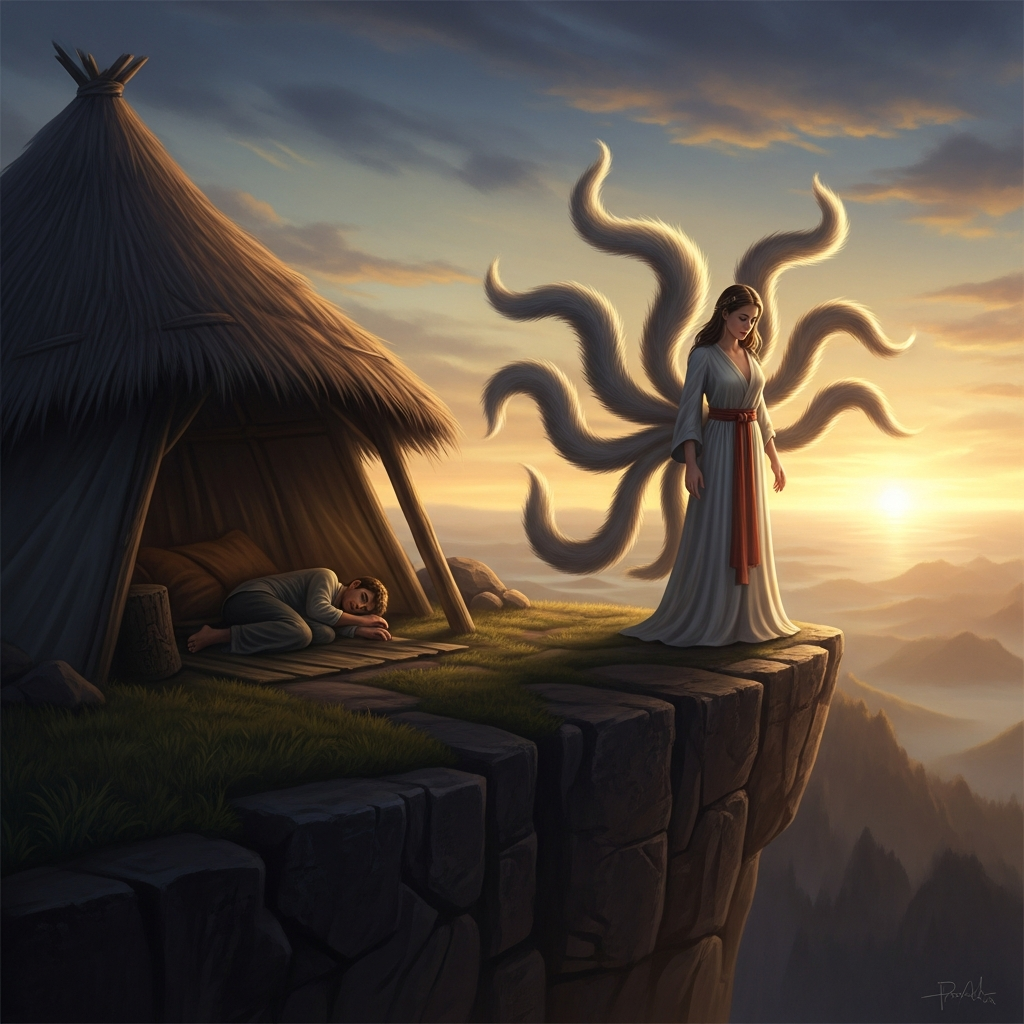
 The gumiho at the edge of a cliff at dawn, still in human form, her nine tails visible through her clothing like light through silk
 Generating art…
 Echoes Across Traditions
Entities
- Gumiho
- The Nine-Tailed Fox
Sources
- Zong In-sob, *Folk Tales from Korea* (Hollym, 1970)
- Lee Ik-seop, *Hanguk sinhwa* (Korean Mythology) (1981)
- Boudewijn Walraven, *Songs of the Shaman: The Ritual Chants of the Korean Mudang* (Kegan Paul International, 1994)
- Kim Tae-kon, *Korean Shamanism — Muism* (Jimoondang, 1998)
- Ha Tae-hung, *Guide to Korean Culture* (Yonsei University Press, 1978)