The Gumiho at the Mountain Road
Mythic time, Joseon period setting · A mountain road in the Korean interior, late at night
Contents
A nine-tailed fox lives a thousand years in the Korean mountains, eating human essence to fuel a transformation she has been working toward her entire existence. On the night she attempts the final crossing into humanity, she finds a scholar on a mountain road and asks for the one thing she cannot take by force: genuine acceptance. What follows is a theological argument about whether the monstrous can be loved into the human.
- When
- Mythic time, Joseon period setting
- Where
- A mountain road in the Korean interior, late at night
She has been alive for a thousand years in the form of a fox.
This is not a metaphor. The Gumiho of Korean mythology is a creature of accumulated time — she began as an ordinary fox in the deep forest of an unnamed mountain, and over centuries of living developed the kind of spiritual density that transforms a natural creature into something the shamanic tradition calls yaoguai, an animal that has crossed from the animal world into the spirit world without dying. Each century adds a tail. She has nine.
Nine tails means a thousand years. A thousand years means she has outlived every human civilization within fifty kilometers of her mountain. She has watched villages rise and burn and rise again with different names. She has seen the peninsula divided and unified and divided. She has eaten — the tradition is specific, and specific for a reason — the livers of the humans who crossed her mountain, because human liver is, in Korean folk cosmology, the seat of the vital essence she has spent a thousand years accumulating.
This is the part of the Gumiho mythology that the television dramas soften and the folk tradition does not. She has eaten people. Not out of malice — the myth is careful about this — but out of the metabolic need of a transformation that requires human essence to complete. She has been, in the plainest terms, a monster.
She is also one transformation away from not being one.
The final transformation requires something she cannot eat.
She can take human form already — has been able to for centuries. The Gumiho on a mountain road in human shape is indistinguishable from a human woman, which is why the stories always begin with a traveler encountering a beautiful woman in a place where no woman should be. But the form she takes is borrowed, not built. She can maintain it for hours or days, but the fox nature bleeds through in ways she cannot fully control: a tail glimpsed in a reflection, eyes that catch light the wrong way in the dark, the faint smell of the forest even in a closed room.
The final crossing requires a human being to see her for what she is and accept her anyway.
Not deceived. Not oblivious. Knowing — with full knowledge of the thousand years and the livers and the nine tails — and choosing to say: yes. I accept what you are. I will not turn away.
This is what she cannot eat or steal or deceive her way into. It has to be given freely.
She finds the scholar on the mountain road.
He is traveling between villages at the wrong hour for rational explanations. The moon is three-quarters full. The road through the mountain forest is the kind of road that requires attention to the ground underfoot, which is why he does not see her until she is already standing in the path at a distance of perhaps ten meters, perfectly still, a woman with no lantern and no companion and no visible reason for being on this road at this hour.
He stops.
She speaks first. Her voice is calibrated to be unremarkable — not too beautiful, because too beautiful triggers alarm in the educated class, who have read enough tales to know what beauty-on-a-mountain-road usually means.
She says she is traveling to the next village. She asks if he is going the same direction. It is a conversation someone has designed very carefully to sound like it has not been designed at all.
He looks at her in the moonlight. And then he looks at her in a different way — the way you look when you are not looking at the surface but at the weight of the thing.
He says: you have nine tails.
This is not how the encounter usually goes.
The usual version — the one that ends badly for the Gumiho — involves the scholar not knowing, or half-knowing but choosing not to look, or looking and then betraying her later out of fear when her nature becomes undeniable. The conditions of the final transformation are strict: she needs genuine acceptance maintained through a set period, often described as one hundred days, and the acceptance cannot be coerced and cannot be retroactively withdrawn. One act of betrayal — one moment of the scholar telling a third party what she is — breaks the possibility permanently. She goes back to fox-form. The accumulated thousand years resets to nothing.
He says: you have nine tails.
And she says: yes.
This is the moment. Everything is visible. She is standing on a mountain road in human form with nine tails barely visible at the edge of the moonlight, and a scholar who has already demonstrated that he can see what he is looking at, and the question is what he does with the seeing.
She does not plead. She does not perform. She simply stands in the road in the form she has spent a thousand years assembling and waits for him to tell her whether it is enough.
The scholar sits down on a stone beside the road.
He is not afraid — this is important, because the myth requires him to make a rational choice, not a reflexive one. He is a scholar. He has read the texts on fox spirits. He knows exactly what she is and approximately what she wants. He sits on the stone and thinks about it the way a Confucian scholar thinks about a moral problem: with method, with reference to principle, with the understanding that the decision will define him as much as it defines her.
She is a monster. She has killed people. She is also, in the most direct possible reading, a creature who wants to stop being what she is and cannot do it alone. She requires human recognition to complete a transformation she has been working toward for a thousand years.
He thinks about what it means to refuse that recognition.
He thinks about what it means to grant it.
The myth bifurcates here, as myths do.
In one version, he grants it. He says: I accept you. He does not say it is easy or that he is not afraid or that the liver-eating history is not a problem. He says it because he has decided, in the Confucian-scholar-sitting-on-a-stone way, that denying recognition to a creature who has earned it through a thousand years of becoming is a failure of the human virtue he is supposed to embody. He stays with her for the hundred days. She completes the transformation. She becomes fully human.
In the other version — the more common version, the one the tradition keeps telling because it is the one that carries the warning — he turns away.
Not in rage. Not in contempt. In the quiet failure of the ordinary: he cannot hold the seeing. He cannot maintain, for a hundred days, the willingness to know what she is and stay beside her anyway. He does not betray her dramatically. He simply tells a friend. He says, in passing, that he met a fox spirit on the mountain road. The information travels. The hundred days break.
She goes back to the mountain.
The nine tails are still nine. The transformation is still incomplete.
She will live another thousand years, eating what she must, becoming what she must become. She will find another road, another traveler, another scholar sitting on a stone.
The Gumiho is always one human choice away from humanity. This is the structure of her tragedy.
The myth does not say she is owed the transformation. It does not say the scholar is wrong to be afraid. It says only that the threshold between the monstrous and the human is narrower than it appears from the outside, and that what stands on that threshold is usually not the monster’s willingness to change but the human’s willingness to see.
She has been willing for a thousand years. She is still willing.
The road through the mountain is dark. She is still walking it.
Scenes
The Gumiho in fox form on the mountain at night — nine tails spread like a fan behind her, each one a century of accumulated life-force, each tip glowing faintly in the dark
 Generating art…
 The Gumiho in human form approaches the scholar on the mountain road — a woman of arresting beauty appearing on a road with no other travelers, at an hour with no rational explanation
 Generating art…
 The moment of the scholar's decision
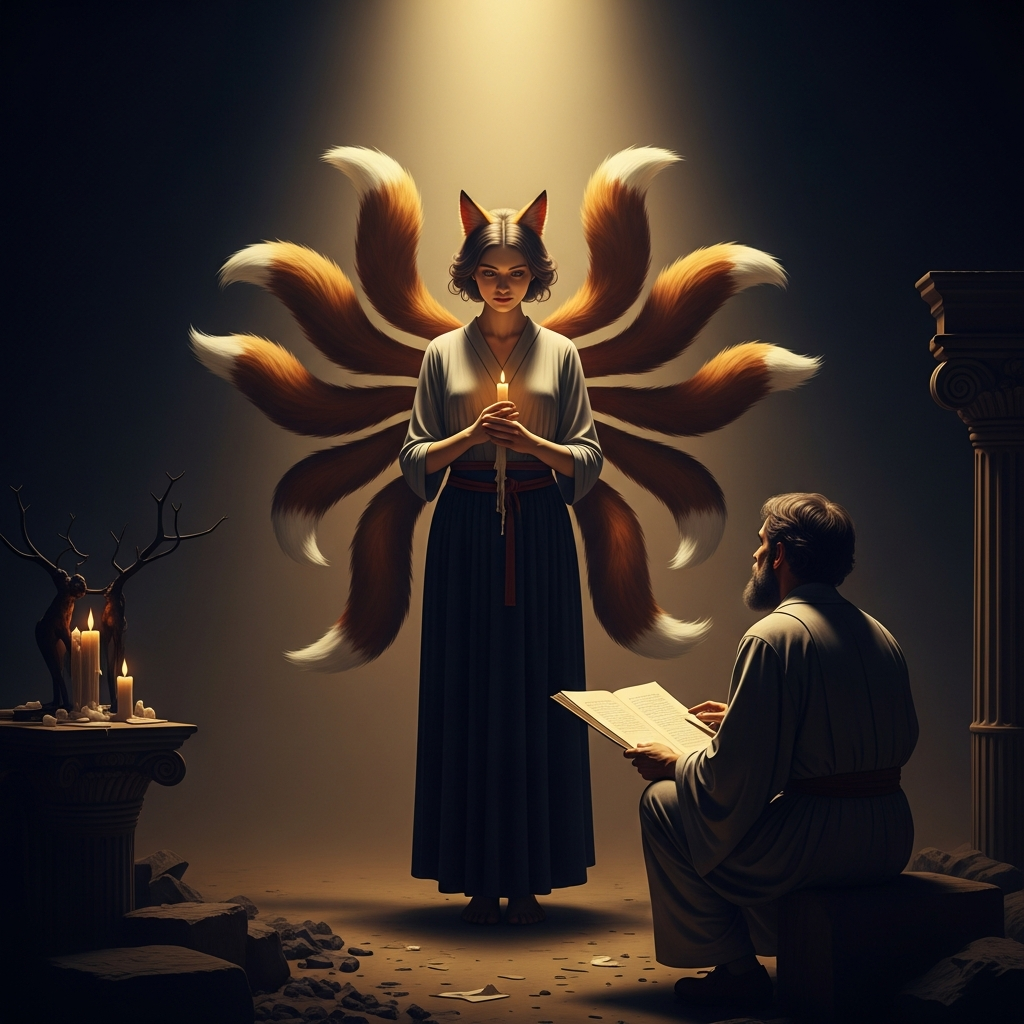 Generating art…
 Echoes Across Traditions
Entities
- Gumiho
- The Nine-Tailed Fox
Sources
- Lee Ik-seop, *Korean Folk Tales* (1981) — classical gumiho narratives
- Zong In-sob, *Folk Tales from Korea* (Hollym, 1970)
- Boudewijn Walraven, *Songs of the Shaman* (Kegan Paul International, 1994)
- Kim Tae-kon, *Korean Shamanism — Muism* (Jimoondang, 1998)
- Ha Tae-hung, *Guide to Korean Culture* (Yonsei University Press, 1978)