Jumong Founds Goguryeo
37 BCE, traditional date for the founding of Goguryeo · Buyeo in the north, then southward into what is now the Manchuria-Korea border region
Contents
The son of a sun-god and a river goddess's daughter is born from an egg, grows into the greatest archer in the world, and is therefore hunted by every power that sees him. He escapes on horseback across a river that opens for him and founds one of the Three Kingdoms of Korea. The drama of the divine hero is not the founding. It is surviving long enough to found anything.
- When
- 37 BCE, traditional date for the founding of Goguryeo
- Where
- Buyeo in the north, then southward into what is now the Manchuria-Korea border region
He is too obviously chosen.
This is the problem with Jumong from the beginning. Most heroes can be hidden — they grow up in obscurity, they discover their nature slowly, they have time to become what they are before the powers that fear them notice. Jumong has no such period. His nature announces itself before he is out of the egg.
His mother is Yuhwa, daughter of the river god Habaek. His father is Haemosu, the sun god, who comes to her in the form of a man and leaves before she understands what has happened. When King Geumwa of Buyeo finds her hiding in the wilderness, there is something about her that reads as divine-adjacent. He takes her to his palace and gives her a chamber, and the sun shines into that chamber in a way that follows her wherever she moves inside it — and she becomes pregnant.
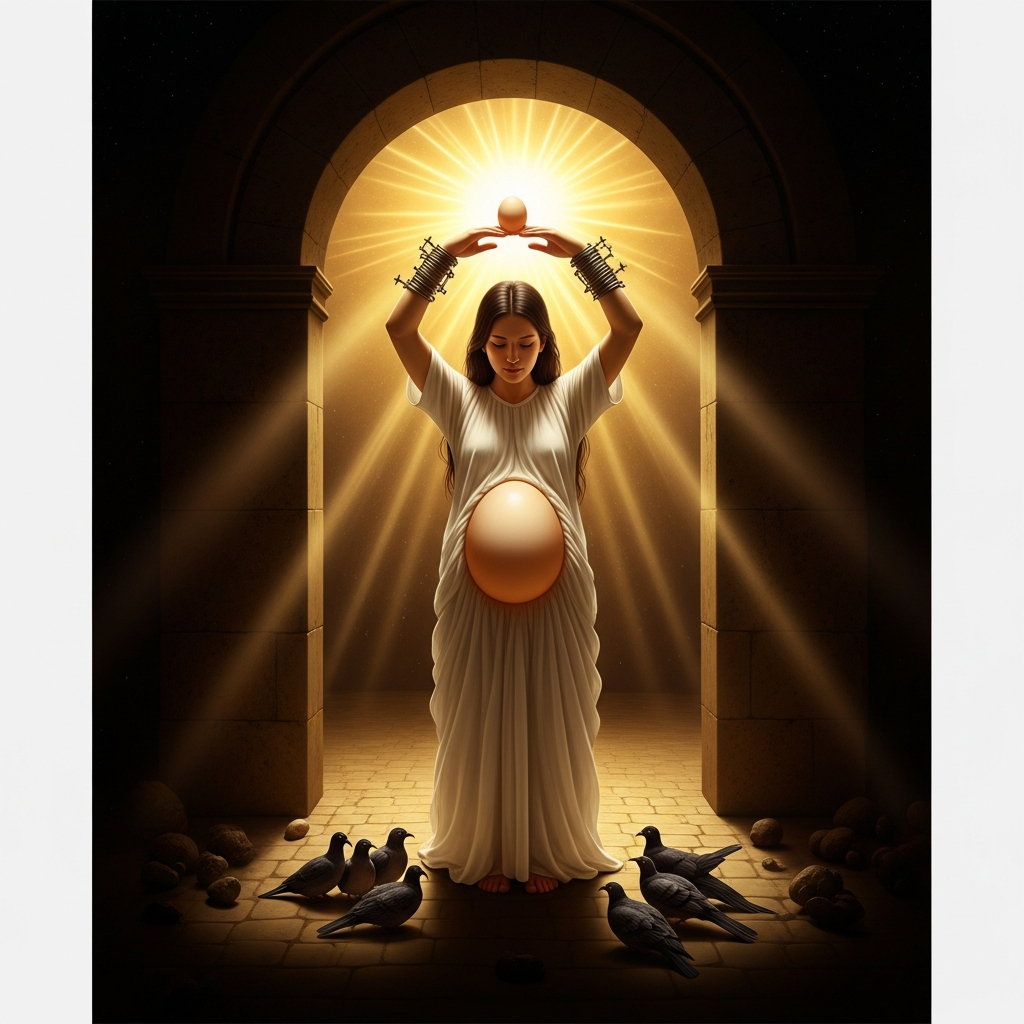
She does not give birth to a child. She gives birth to an egg.
The egg is enormous. Five pints, the chronicles say, using a measure that emphasizes the wrongness of the size — this is not an egg any animal has laid, not in any recognizable biology. King Geumwa looks at the egg and understands that whatever is inside it is not going to be convenient.
He gives the egg to his dogs. The dogs will not touch it. He gives it to his pigs. The pigs step away from it. He puts the egg in the road where horses will trample it. The horses step around it, forming a corridor of avoidance in the packed dirt road. He puts the egg in a field. Birds come and cover it with their wings.
He gives up trying to make it die and gives it back to Yuhwa.
She wraps it and keeps it warm.
The egg hatches on its own schedule. What comes out is a boy who is already — at the moment of emergence — more capable than any boy has a right to be. He grows at an unnatural rate, which is the myth’s way of saying: there is no time to waste.
By the time he is seven, he makes his own bow and arrows.
He hits everything he aims at.
Jumong means skillful archer in the old Buyeo language. He is not named for his archery because it is unusual among boys. He is named for it because it is supernatural among everyone. He does not miss. This is not a figure of speech. The chronicles are precise: he aims, he shoots, and what he aimed at is gone. Birds. Fish in the river. A man could defend a city with this.
He cannot keep it hidden.
King Geumwa’s sons — the crown prince and his brothers — watch Jumong shoot for a while and reach the conclusion that any rational prince reaches: he will outshine them at everything, including governing, and they cannot allow this. They go to their father with a plan. Jumong is too dangerous, the king’s natural sons say, and in the context of succession politics they are correct. He must be killed.
Geumwa does not give the order immediately. But his sons do not wait.
Jumong is given the worst horses. He is sent to the stable and told to care for the animals, which is the kind of assignment that communicates contempt without requiring explanation. But Jumong has his mother’s knowledge — she knows horses, she knows which animals are secretly exceptional — and he identifies the best horse in the stable, the one that is being starved deliberately to dull its intelligence, and he feeds it in secret while feeding the slow horse too much.
When the crown prince’s men come for him, he rides out on the good horse.
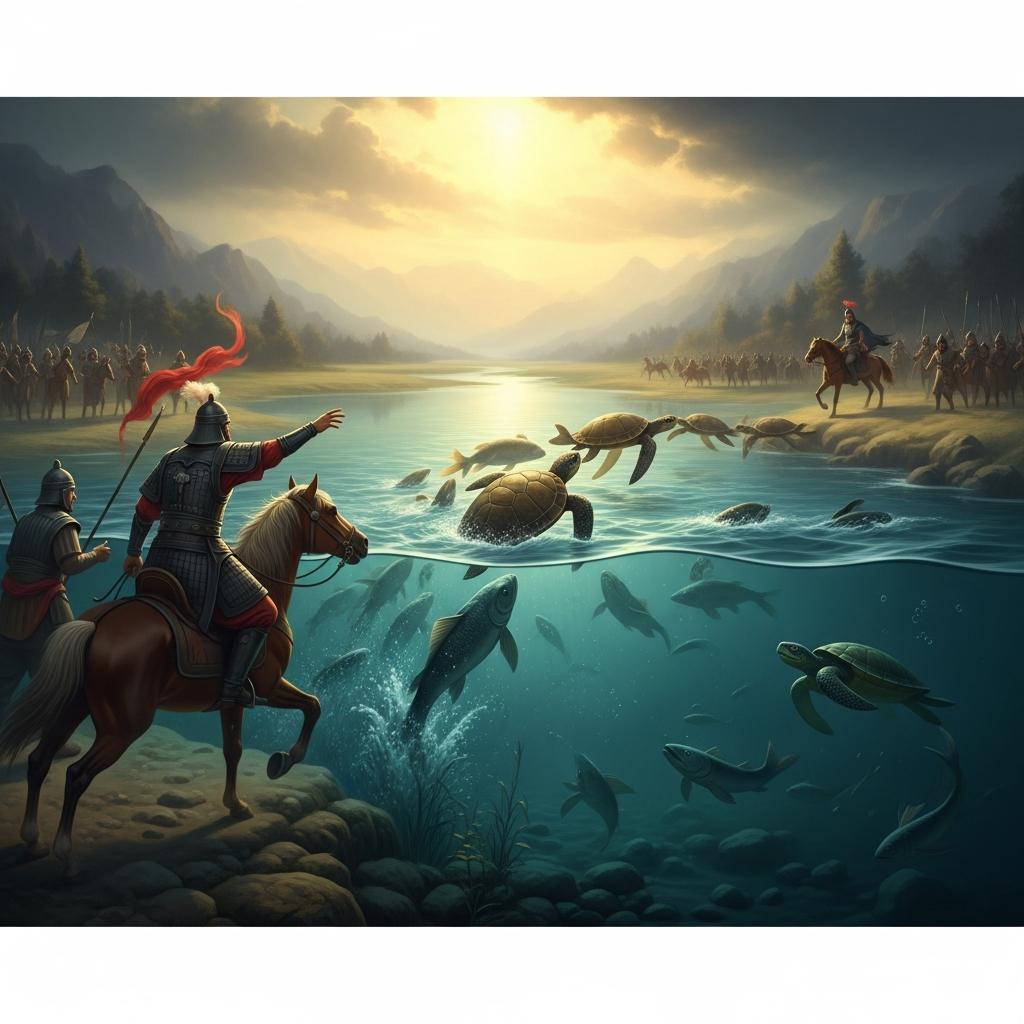
He goes south with three companions and the crown prince’s soldiers behind him. The road goes fast and then stops at the Eom River. There is no ford. There is no bridge. The soldiers are coming from the north.
He stands at the riverbank and speaks to the water.
He says what he is: son of the sun-god and the river god’s daughter, grandson of Habaek. He is making a genealogical argument at a river, which in Korean mythology is exactly the right argument to make. The river belongs to family. The river belongs to him.
Fish and turtles rise from the current and arrange themselves into a bridge.
He crosses.
They sink.
The soldiers arrive at the bank and there is no bridge.
He arrives in the south with three companions and no kingdom.
He builds one.
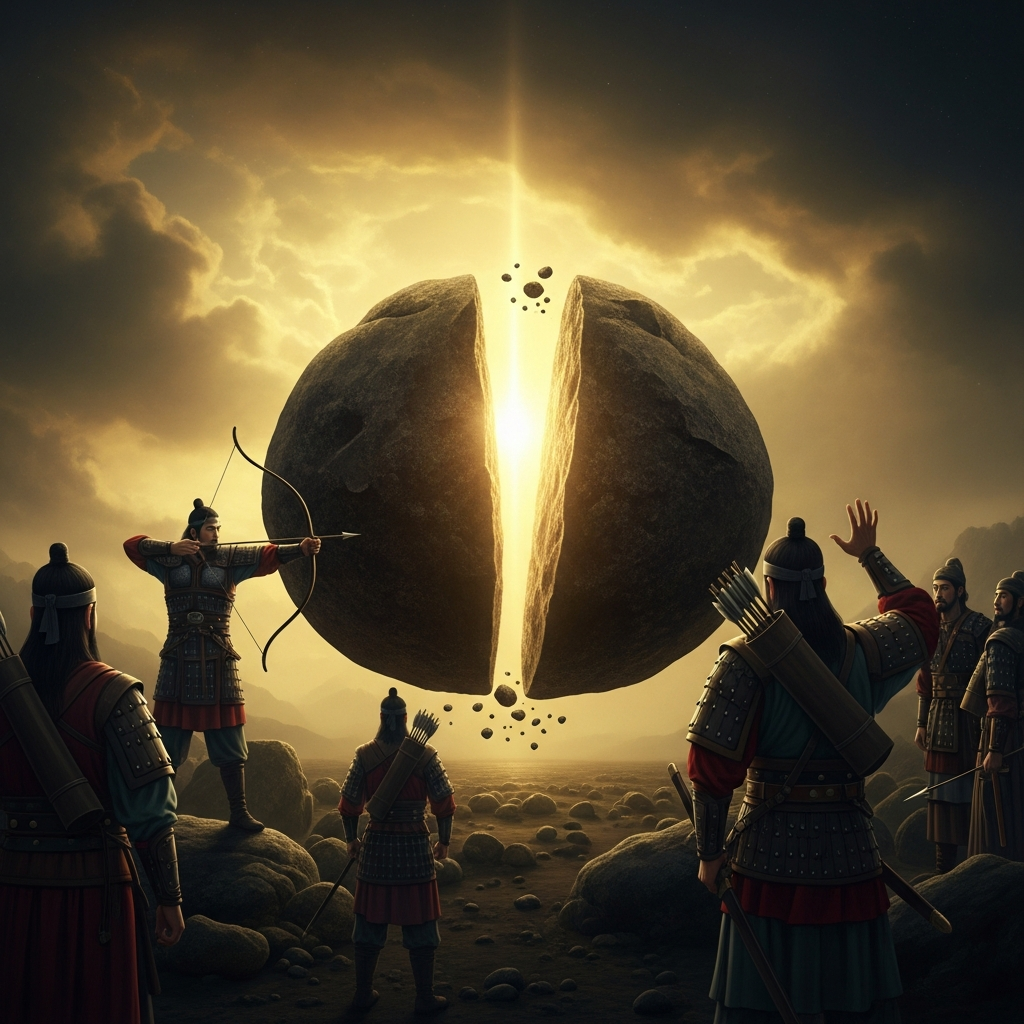
The founding demonstration is the boulder. It sits on the hill where he intends to build, the size of a statement. He takes his bow — the same bow he made at seven, or one like it — and shoots an arrow at the stone. The boulder splits in two, cleanly, along a line that was not visible before the arrow hit it.
The people watching understand: this is the one.
He founds Goguryeo in 37 BCE. The location is disputed — somewhere in the general territory of what is now the Manchuria-North Korea border — but the founding is not disputed. Goguryeo will survive for seven centuries. It will fight off the Tang Dynasty twice. It will define the northern limit of the Korean cultural sphere and give its name, through a later transformation, to Korea itself.
He rules it for nineteen years and then dies, or ascends, depending on which chronicle you follow.
His mother is still in Geumwa’s palace.
This is the part of the story that sits wrong even in the telling. Yuhwa is kept in Buyeo while her son runs south and founds the kingdom. She sends him horses when she can — the chronicles mention this, that she selected the best horses and sent them south to her son. Geumwa, who has imprisoned her, allows this. Why? Because Geumwa understands that Jumong’s power is already established and a diplomatic relationship with Goguryeo is worth more than revenge.
Yuhwa dies in Geumwa’s palace. Geumwa buries her with the honors due a queen, which is either genuine respect or the final acknowledgment that the woman whose egg could not be killed was always, regardless of her circumstances, a queen.
Jumong receives the news in Goguryeo. He sends a tribute of jade and silks in response to Geumwa’s funeral honors. The two kingdoms make peace over the grave of the river goddess’s daughter who was kept prisoner in the north while her son built a nation in the south.
The hero who is too obviously chosen is not a comfortable figure in any mythology. He requires too many people to cooperate in his survival. The dogs who will not bite the egg. The horses who step around it. The birds who cover it. The fish and turtles who rise for the bridge.
What the myth is saying is not that Jumong is lucky. It is that the natural world already knows what the human world will spend the whole story trying to deny. He is the one. The river knows it. The stone knows it.
The princes who want him dead are not wrong to want it. A man who never misses and crosses rivers by speaking to them is not a man you can rule beside. He is the kind of figure who requires everyone around him to become, at minimum, his ally. Neutrality is not available once you have seen him shoot.
He splits the boulder and founds the kingdom. The boulder had no choice. Neither did anyone else.
Scenes
Yuhwa, daughter of the river god Habaek, gives birth to an egg after the sun shines on her in the chamber where she is kept prisoner
 Generating art…
 Jumong flees south on horseback with the crown prince's soldiers behind him
 Generating art…
 Jumong arrives in the south at the site of what will become Goguryeo
 Generating art…
 Echoes Across Traditions
Entities
- Jumong
- Haemosu
- Yuhwa
- Dongmyeong
Sources
- Kim Busik, *Samguk Sagi* (History of the Three Kingdoms), 1145 CE — primary source for Jumong's biography
- Iryeon, *Samguk Yusa* (Memorabilia of the Three Kingdoms), c. 1281 CE
- Mark E. Byington (ed.), *Early Korea: Reconsidering Early Korean History through Archaeology* (Harvard, 2008)
- Ki-Baik Lee, *A New History of Korea*, trans. Edward W. Wagner (Harvard, 1984)
- James Huntley Grayson, *Myths and Legends from Korea* (Curzon, 2001)