Hwanung Descends to Earth
Mythic time, primordial era before 2333 BCE · Taebaeksan (the sacred mountain, now identified with Baekdusan on the Korea-China border)
Contents
The son of the Heavenly Emperor looks down at the green earth too long and asks his father for permission to go. Heaven opens. A god descends to a mountain with wind, rain, and cloud — and the first act of Korean civilization is a marriage between heaven and a woman who had the patience to wait in the dark.
- When
- Mythic time, primordial era before 2333 BCE
- Where
- Taebaeksan (the sacred mountain, now identified with Baekdusan on the Korea-China border)
The god looks down too often.
That is the first problem. The Heavenly Emperor Hwanin has a son who sits at the rim of the celestial court and stares through the cloud-floor at the green continent below — the peninsula with its mountain-spine, its rivers branching east and west like the calligraphy of a word he cannot stop reading. The other gods do not look down like this. They have the work of heaven to occupy them. Hwanung has that work too, and he does it, but his eyes keep going south.
Hwanin watches his son watch the earth.
He sees what the son sees. The human world below is not uninhabited — there are people down there, struggling in the way that people struggle without instruction. They eat what they find. They die of what they do not understand. They have fire but not yet the knowledge of how to use it for medicine, or how to read the clouds to know when to plant, or how to make the agreements between families that turn a cluster of people into something you could call a people. They are, in the language Hwanin would use if he used language, unfinished.
He asks his son which part of the human world draws the eye. Hwanung says: Taebaek. The great mountain. The highest peak on the peninsula. The place where the clouds are thickest and the air clearest and the sandalwood tree grows — the Sindansu, older than any human settlement, the axis the peninsula balances upon.
His father consents.
The descent takes no time at all when heaven decides to open.
Hwanung arrives on the summit of Taebaek with three thousand sindo — spirit-followers, a divine court portable enough to fit inside a mountain dawn. He carries three heavenly seals that correspond to the three great forces the agricultural world depends on: Wind. Rain. Cloud. Not lightning. Not war. Not gold. The seals are gifts for the food-growing enterprise, chosen with precision: a god who arrives with wind and rain is a god who intends to stay for the harvest.
He establishes Sinsi, the Sacred City of the Gods, in the cedar-shaded slopes below the summit. The city is not made of stone, because stone cities are what humans build later when they have learned to cut and fit. Sinsi is made of arrangement — of ritual territory and assigned responsibility. Hwanung appoints ministers: the Earl of Wind, the Master of Rain, the Master of Cloud. He takes governance over three hundred and sixty matters of human life. He institutes the grain calendar. He teaches the arts of medicine. He gives to the human settlements below the rules that allow families to become clans and clans to become a kingdom.
He comes down and gets to work.
The bear and the tiger find him.
They have been watching from the treeline. They are not ordinary animals in the way the forest is full of ordinary animals. They are already extraordinary — ancient, self-aware, capable of something that functions like prayer. They have seen the spirit-city. They have seen what Hwanung is making out of the humans below the mountain. They want it.
They present themselves to the god together, side by side at the edge of the sandalwood tree’s shadow. They want to be human. They say this the way that things are said in myths — not with words exactly but with the whole animal body oriented toward an intention, unmistakable in its meaning.
The god considers them.
He does not refuse, which is already unusual. Most gods, when approached by animals asking for the wrong body, refuse. Hwanung gives the bear and the tiger what looks like a refusal but is actually a corridor: a bundle of sacred mugwort, twenty cloves of garlic, a cave, and a time limit of one hundred days. Stay inside. Eat only this. See no sunlight.
The tiger says nothing. The bear says nothing.
They go into the cave.
The tiger is gone by the twentieth day.
This is not a failure the myth condemns — the tiger simply cannot be what the tiger is not. It is built for open ground, for the hunt, for light. The cave is the wrong shape for a tiger’s nature. It leaves through the cave-mouth on a morning when the square of sky visible from inside is the precise blue of something unbearable, and the tiger walks back into the forest and is never mentioned again.
The bear stays.
What the bear does inside the cave is the center of the whole myth, but the myth does not describe it. The Samguk Yusa says only: the bear stayed. It implies: the bear ate the bitter things. It implies: the bear held the darkness. What actually happens inside the cave during those twenty-one days is the part the myth keeps private, because transformation of this magnitude is private by nature — the chrysalis does not admit observers, the seed underground does not announce itself.
On the twenty-first day, a woman walks out.
She stands at the cave-mouth in the morning light and she is Ungnyeo — the Bear-Woman. She looks at her hands. She remembers what her hands were. There is no celebration waiting for her. The tiger is gone. The three thousand spirit-followers have their own work. The Sacred City does not pause to mark her arrival into humanity.
She is alone at the cave-mouth in the cold mountain air, already human, already aware that being human includes this: no one is waiting.
She goes back to the sandalwood tree.
She prays again — the second prayer, now in the voice of a human woman rather than the body of a bear. She prays for a child, because she can see what is around her and what is around her is the first Korean civilization taking shape, and she knows the shape of what is missing. She prays the way she waited in the cave: without hurry, without performance, with the full weight of her wanting applied steadily to the request.
Hwanung hears the second prayer the way he heard the first.
He takes the form of a man — briefly, the myth emphasizes briefly, as though the god is not comfortable in borrowed skin — and marries her under the Sindansu. The marriage is less a ceremony than an event: two incompatible natures meeting at the tree that stands between their worlds, one coming down and one coming up, producing at their intersection the figure the myth has been building toward.
Their son is born in the year that tradition names 2333 BCE.
His name is Dangun Wanggeom. He is the child of a god who wanted the human world and a bear who wanted the human body and was willing to eat nothing but bitterness in the dark until she had it. He is, in the fullest possible sense, the son of two people who chose this.
He founds the kingdom.
Hwanung has done what he came to do. He has given the three heavenly seals to the agricultural world, instituted the 360 matters, produced the child who will build the state. He does not leave dramatically. The myth simply moves on — to the son, to the kingdom, to the long work of governance that Dangun will carry forward for 1,500 years.
But Hwanung remains the reason any of it is possible. Not because he is a god. Because he was a god who found the human world insufficient not to love, who asked his father for permission to go down and tend it, and whose father — which may be the strangest and most Korean moment in the whole story — said yes.
The myth is not really about the descent. The descent is easy for a god. It is about what follows the descent: the god who stays, who governs grain cycles and weather and human law, who notices a bear praying at the edge of a tree, who gives the bear a corridor instead of a refusal.
Heaven looks down. Earth waits. The tree between them is where they meet.
That is what Sinsi is. That is what Korea, by this account, has always been.
Scenes
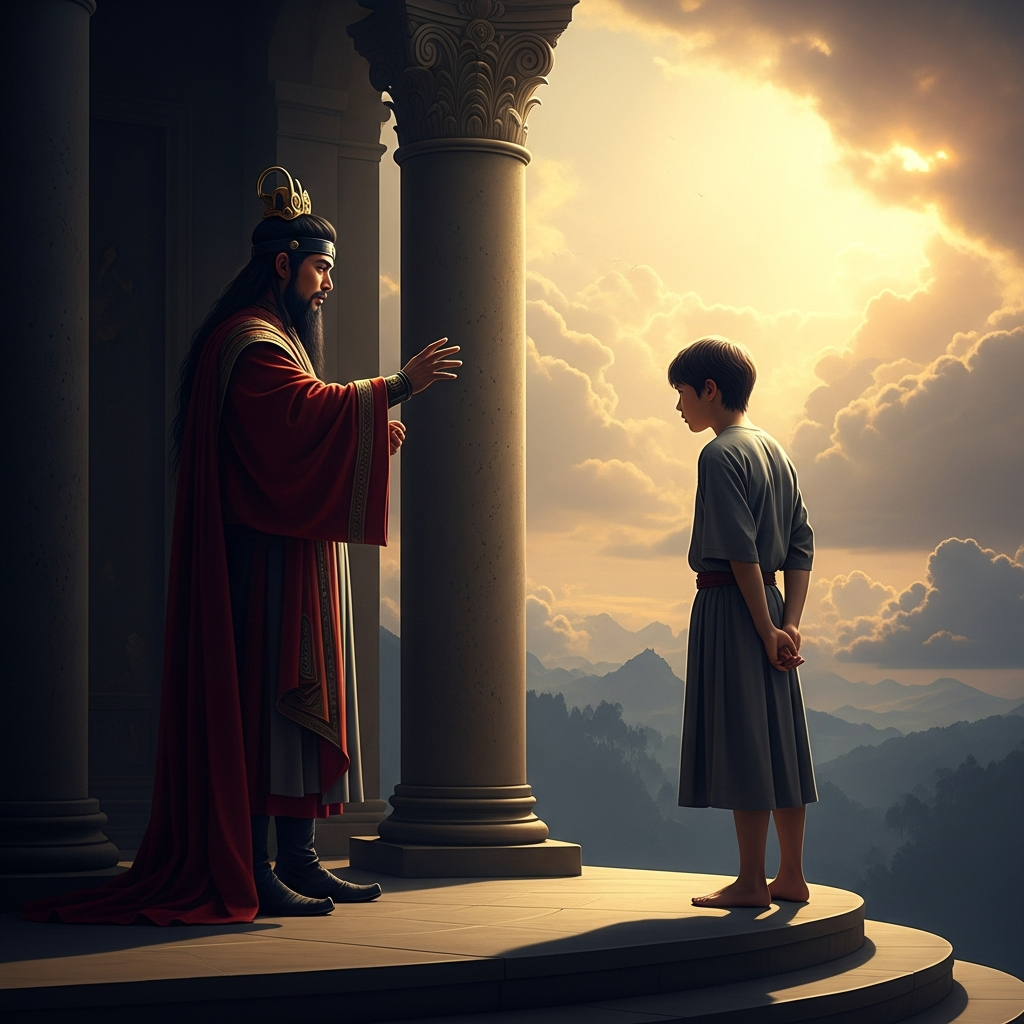
Hwanung stands at the edge of his father's celestial court and looks down at the world of men
 Generating art…
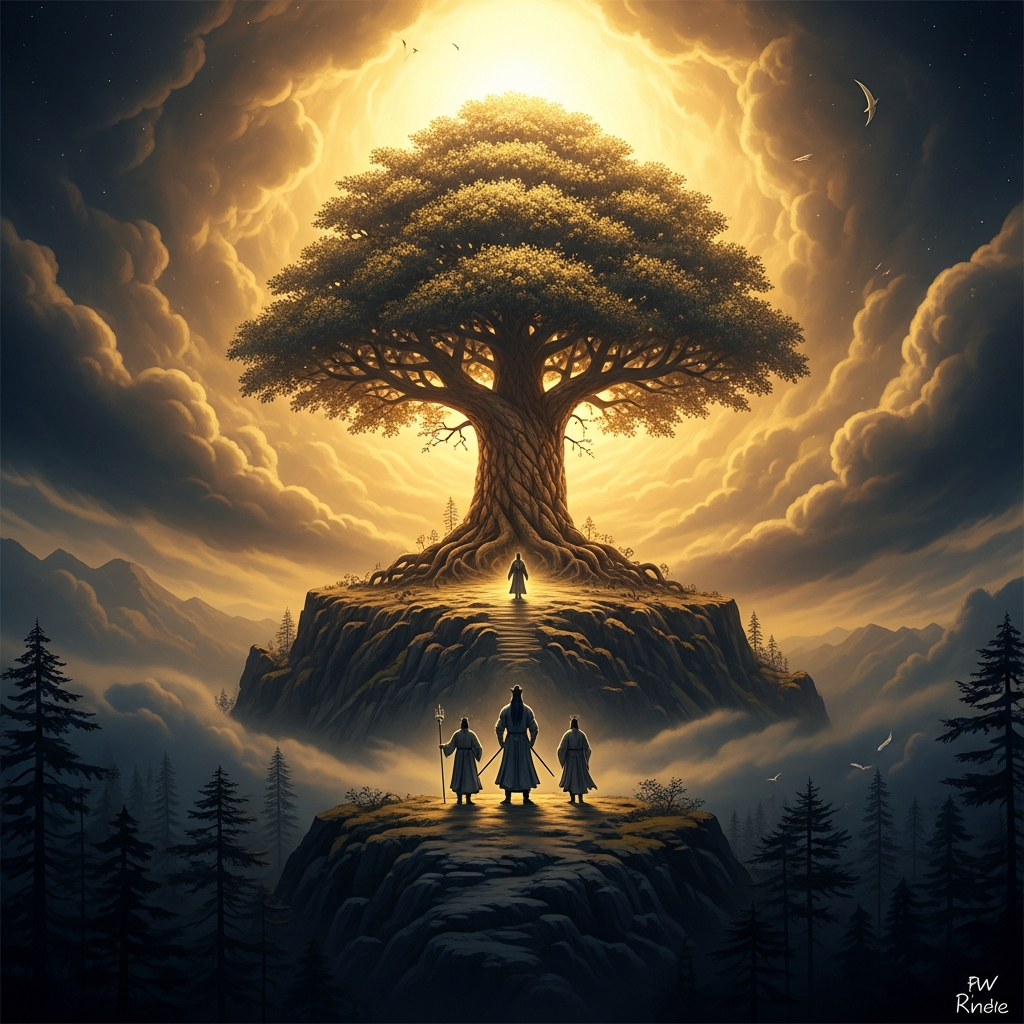
 Hwanung descends to the Sindansu — the divine sandalwood tree on the summit of Taebaeksan — with three thousand spirit-followers and three heavenly seals
 Generating art…
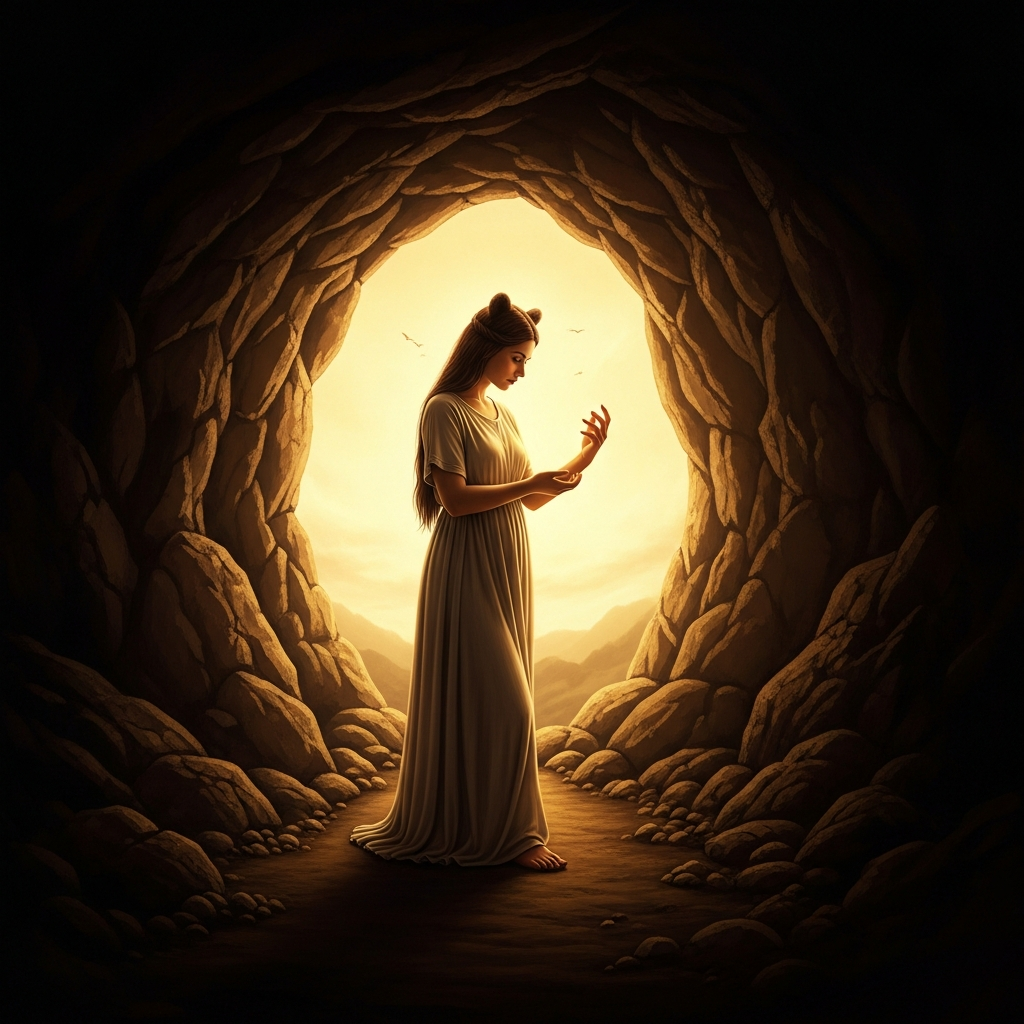
 On the twenty-first day, the Bear Woman walks out of the cave into the morning light
 Generating art…
 Echoes Across Traditions
Entities
- Hwanung
- Hwanin
- Ungnyeo
- Dangun
Sources
- Iryeon, *Samguk Yusa* (Memorabilia of the Three Kingdoms), c. 1281 CE — primary source for the Hwanung-Dangun cycle
- Yi Seunghyu, *Jewang Ungi* (Songs of Emperors and Kings), 1287 CE
- James Huntley Grayson, *Myths and Legends from Korea* (Curzon, 2001)
- Peter H. Lee (ed.), *Sourcebook of Korean Civilization*, vol. 1 (Columbia, 1993)
- Chungmoo Choi, *The Competence of Korean Shamans as Performers of Folklore* (PhD diss., Indiana University, 1987)