Krishna Lifts Govardhan
Mythic Time · Bhagavata Purana ~9th-10th century CE composition · Vrindavan — the cowherd country
Contents
A child cowherd talks his village out of worshipping Indra, king of the storm, and when Indra's fury drowns the valley in seven days of rain, Krishna lifts a mountain on his little finger and holds it there until the god of heaven kneels.
- When
- Mythic Time · Bhagavata Purana ~9th-10th century CE composition
- Where
- Vrindavan — the cowherd country
The argument begins at the fire.
It is the evening before the festival. Nanda, headman of the cowherds, is overseeing the preparations for the annual sacrifice to Indra — the god of rain, king of the Devas, sovereign of the sky that waters their pastures and fills the Yamuna. The ghee is ready. The priests are ready. The season’s harvest depends, as it always has, on Indra’s goodwill, and Indra’s goodwill depends on this ceremony. Everyone knows this. It has been known since before Nanda’s father’s father.
Then his son speaks.
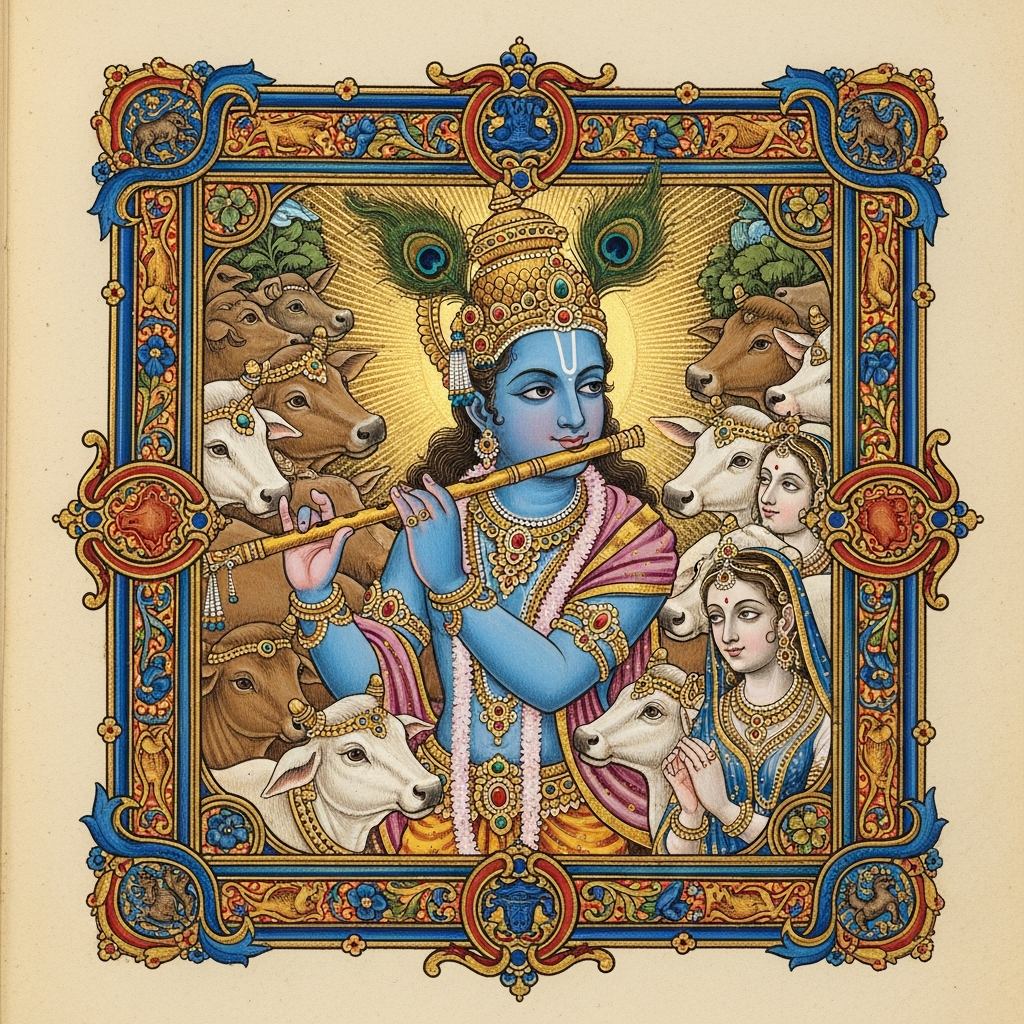
Krishna — the dark-skinned boy, the butter-thief, the flute-player who stops the gopis mid-step with three notes — squats beside the fire and asks a simple question. Why Indra?
The village falls quiet in the way that villages fall quiet when the child says the thing no adult dares to say.
He does not stop there. He walks them through it. The rain does not fall because Indra is pleased; the rain falls because it falls. Govardhan Hill shelters your pastures from the wind. Govardhan’s slopes feed your cattle. The Yamuna runs from Govardhan’s watershed. You live because of this hill, these fields, this earth — not because a king in the sky allows it. Worship what sustains you. Worship Govardhan.
The priests look at Nanda. Nanda looks at the hill.
By morning, the village has redirected the entire sacrifice — the ghee, the grain, the flowers, the fire — to the mountain. Krishna himself, in a form none of them quite sees, receives the offerings as Govardhan and blesses the people with his own hand.
In Svarga, the heaven of the Devas, Indra watches.
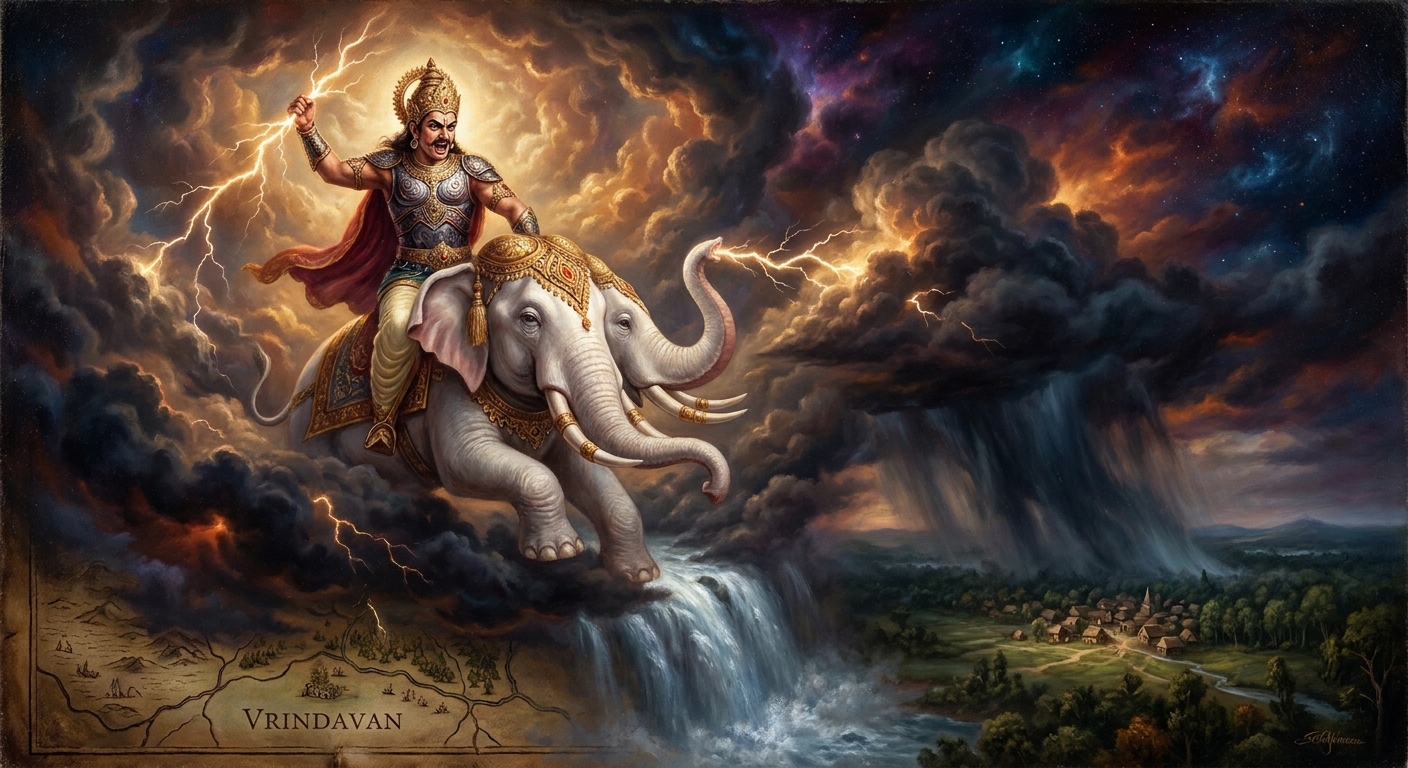
The king of heaven is ancient. He has routed the chaos-dragon Vritra. He has held the cosmos together through ages of gods and men. More hymns in the oldest scripture address him than any other being. His throne is the sky. His scepter is the thunderbolt. His elephant Airavata can be heard in the rumble that comes before rain.
He has never been so insulted.
A village of cowherds, instructed by a child, has simply stopped. No appeal. No negotiation. They looked at the hill and chose the hill. The laughter of the Devas rings in his ears — or perhaps it is just the silence where the prayers used to be. Either way, he will not endure it.
He summons the Samvartaka clouds. Not the ordinary monsoon — the clouds of dissolution, the ones held in reserve for the end of ages. He sends them south toward Vrindavan with a single instruction: drown it.
The rain begins on the first morning as something almost ordinary. By noon it is not ordinary. By nightfall it is a thing that has no name in the peacetime vocabulary. Lightning walks across the hills on legs of light. The Yamuna swells past its banks. The paths between houses become streams; the streams become rivers. Every calf is screaming. Every cooking fire goes out. The sky is a single black ceiling pressing down.
This is what a god looks like when he is embarrassed.
Nanda shouts to be heard over the water. The children are already soaked. The cattle are bunched in the high ground near the banyans, eyes white, bellowing at nothing. Yashoda holds Krishna’s wrist — a mother’s grip, the kind that comes before reason — and does not let go.
Krishna looks at the mountain.
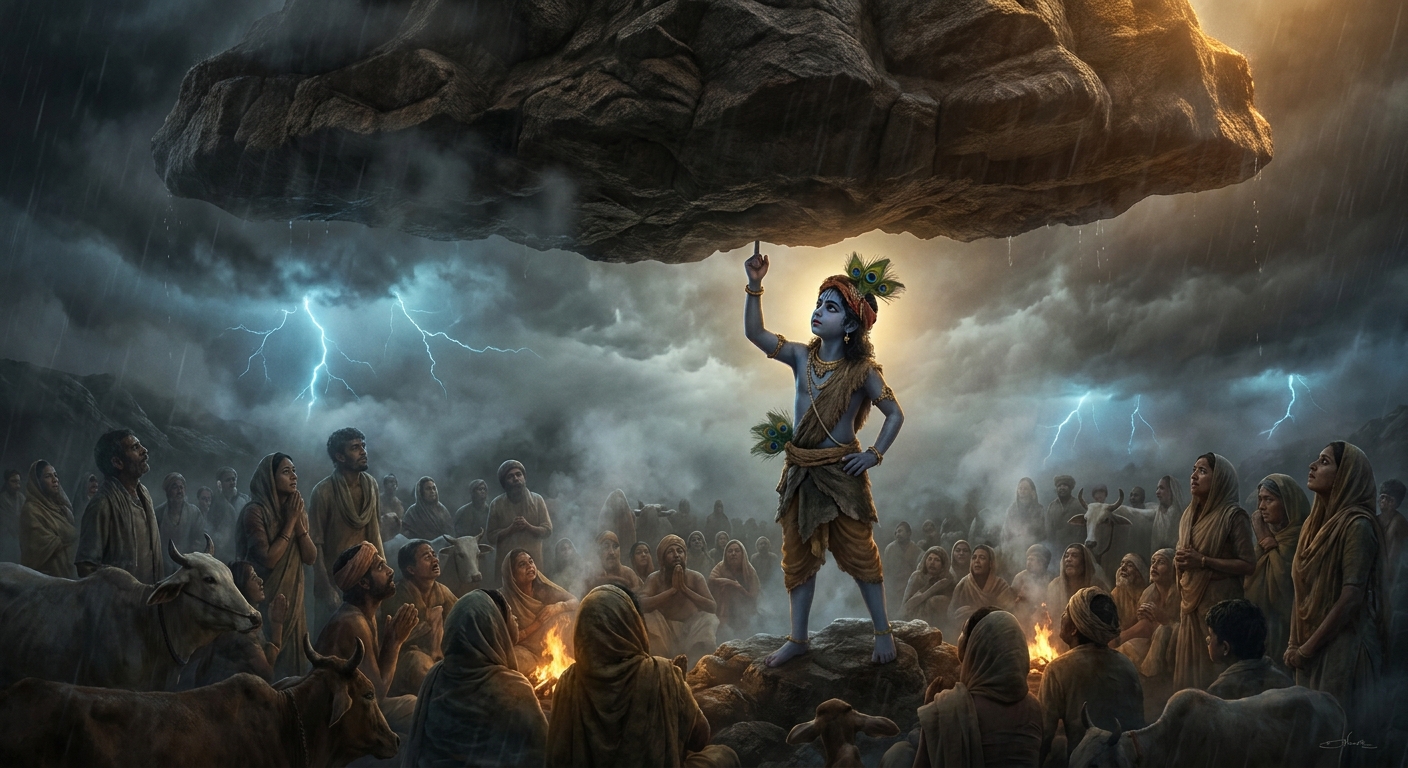
He walks to the base of Govardhan Hill, bends, and slides his little finger underneath the rock.
He lifts it.
Not dramatically. Not with a cry. He lifts it the way a man lifts a lamp to light a doorway — with attention, with the ease of someone for whom the weight is simply not the point. The mountain rises. A sound moves through the earth, a deep harmonic note, as the roots of Govardhan disengage from the substrate and the whole mass swings upward on a pivot of one small finger.
The shadow of the mountain falls across the village. The rain hits the underside of the rock and shatters into mist.
Come, he says.
They come. Every person in Vrindavan, every cow and calf, every dog who has ever stolen scraps from these fires, every bird who has built in these thatch roofs — they walk beneath the mountain the way you walk under a porch to get out of the rain. There is room. There is always room. The space beneath Govardhan opens as wide as it needs to be, which is one of the things that happens when the floor of the world is held up by a god who is not showing off.
Seven days.
Seven days the storm tries. Indra sends everything — cold, lightning, horizontal rain like needles, darkness at noon, winds that uproot the old peepal trees on the ridge. None of it reaches the valley below. The mountain intercepts every drop. The people beneath it light fires. They tell stories. They feed the cattle from the grain they carried inside. They sleep. On the third night, some of them forget to be afraid.
Krishna does not shift his weight. He stands with one arm raised, finger extended, holding a mountain in the rain, and he looks like a boy who has been asked to carry something and is simply carrying it.
On the seventh day, Indra stops.
It is not a decision, exactly. It is the recognition that arrives when you have done everything you know how to do and the thing in front of you has not moved. He pulls back the Samvartaka clouds. The sky over Vrindavan clears in an hour, from east to west, the way a cloth is pulled from a table.
Krishna sets the mountain down. The sound moves through the earth again, the return of the root-note. Govardhan settles into its old place as if it never left.
Indra descends.
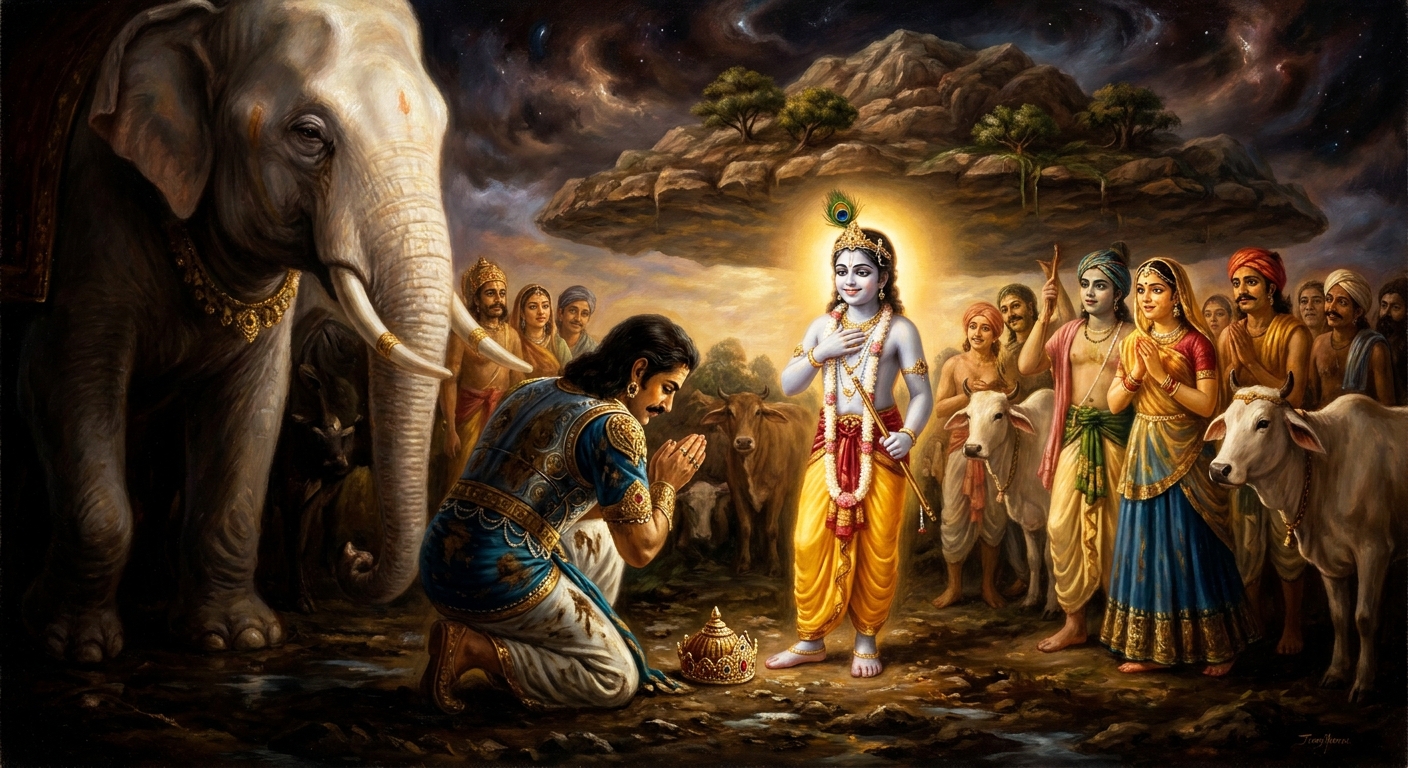
He comes in his proper form — crown, thunderbolt, the white elephant Airavata behind him like a living storm cloud — and he lands at the edge of the village and he removes his crown. He does not explain himself. He does not negotiate. He simply kneels before the dark-skinned cowherd boy and bows his head.
I acted from pride, he says. You acted from love. I know the difference now.
The Bhagavata Purana calls this episode the beginning of something. Not the end of Indra — the king of heaven goes on, plays his role in other stories, receives his hymns in other traditions. But something shifts in the order of devotion. The cowherds of Vrindavan have learned a fact that the Vedic priests never quite taught: the divine is not primarily something to be appeased. It is something that shows up when your village is drowning and lifts the mountain.
Bhakti — devotion from below, love directed upward — does not bargain with the cosmic bureaucracy. It does not calculate what sacrifice will purchase what rain. It chooses. It says: this is my god, this child, this flute-player, this impossible boy with mud on his feet who is holding a hill in the middle of a storm. And the choosing is the whole of it.
Indra had the thunderbolt. Krishna had a finger.
The finger was enough.
The Govardhan episode sits at the hinge between Vedic religion and bhakti — between the ancient priestly system that managed the gods through sacrifice and the later devotional tradition that collapsed the distance between worshiper and worshipped entirely. What changes is not theology but posture: from negotiation to love.
Indra’s humiliation here is precisely the humiliation of every institutional religion when the direct experience of the divine appears. The priests know the correct forms. The child holds the mountain. The village watches and decides which one is real.
Scenes
Krishna raises Mount Govardhan on his little finger, a living roof over every cowherd, every calf, every dog and sparrow of Vrindavan, while the storm breaks against the underside of the rock
Generating art… Indra's seven-day deluge — lightning stacked to the horizon, walls of water crashing down the hillsides, the Yamuna rising toward the village walls — the full fury of the king of heaven aimed at one valley
 Generating art…
 The storm breaks
 Generating art…
 Echoes Across Traditions
Entities


Sources
- *Bhagavata Purana* 10.24-25
- *Vishnu Purana*
- A.C. Bhaktivedanta Swami Prabhupada, *Krsna Book*
- Edwin Bryant, *Krishna: A Sourcebook*