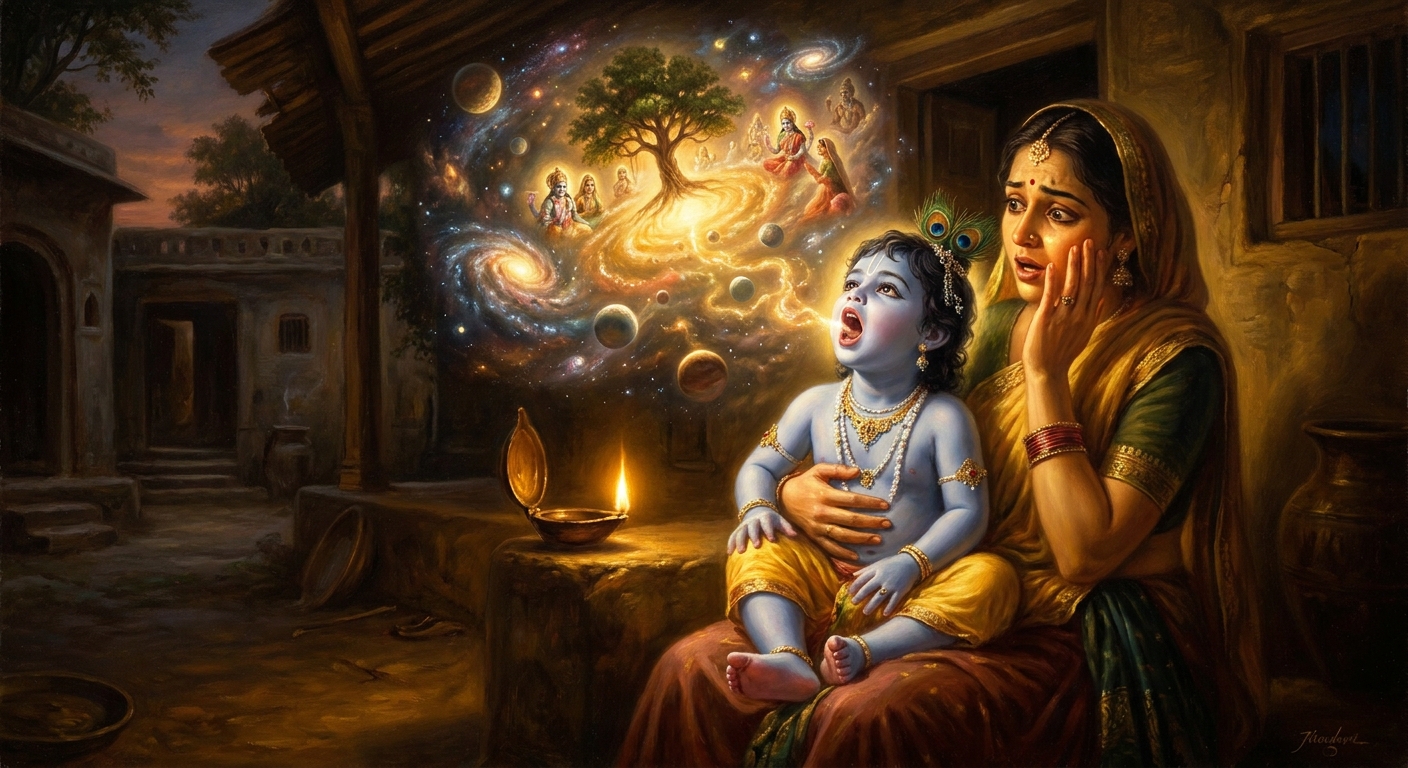
Krishna Shows Yashoda the Universe
Mythic Time · Bhagavata Purana ~9-10th century CE · Vrindavan — Yashoda's house
Contents
The infant Krishna eats dirt. His foster-mother demands he open his mouth. Inside, she sees the cosmos — stars, oceans, hells, herself looking in, infinitely — and is mercifully made to forget.
- When
- Mythic Time · Bhagavata Purana ~9-10th century CE
- Where
- Vrindavan — Yashoda's house
The boy has been eating dirt again.
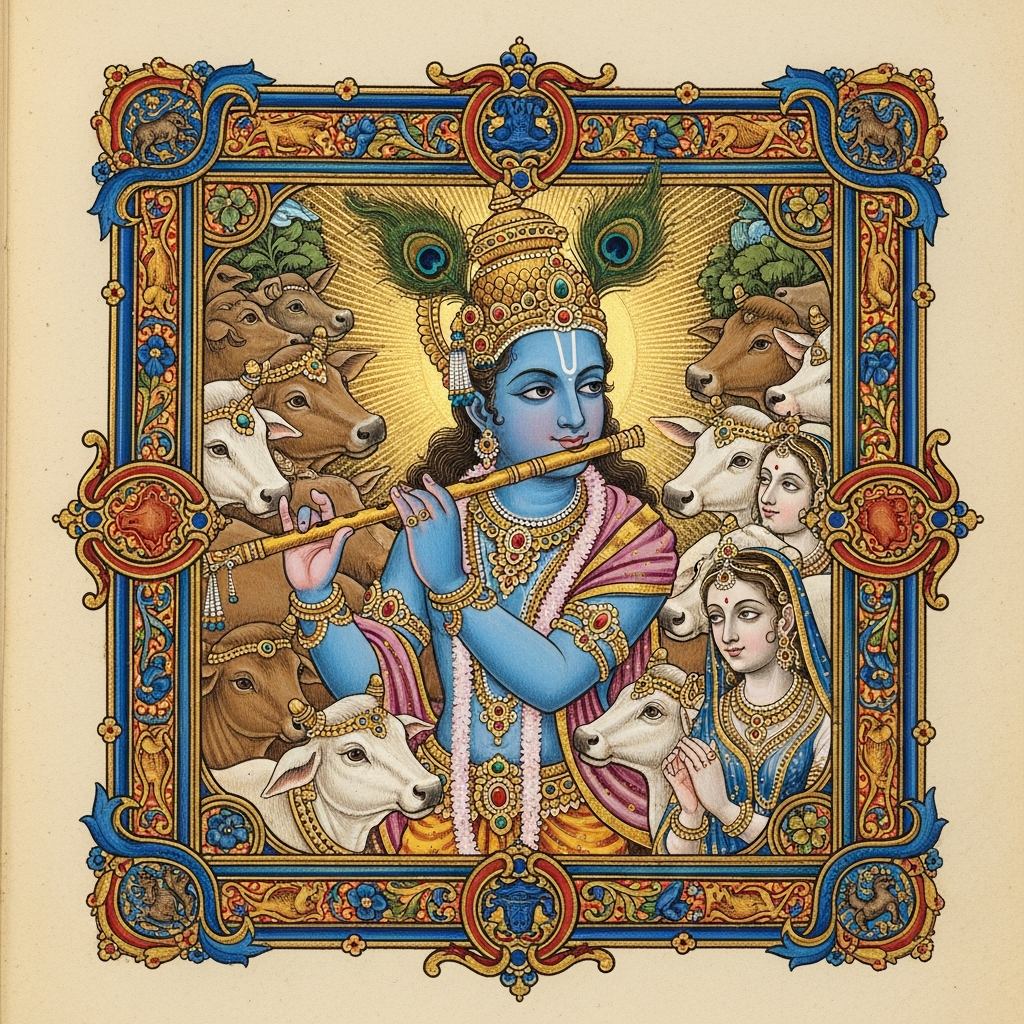
Yashoda finds the smear on his lip before she finds the complaint: the other children of Vrindavan have come running, voices already a half-step ahead of their bodies, saying Krishna, Krishna ate the earth, we saw him, he put a whole fistful in his mouth. She looks at her son. He looks at her. His face arranges itself into the expression it always arranges itself into — that particular mix of innocence and mischief that has no name in Sanskrit because the language had not yet met anyone who needed it.
She takes his chin in her hand.
“Open.”
He opens.
The texts say she sees the cosmos. They are not exaggerating, but they are also not conveying it, because no sentence can convey it. What she sees is not a representation of the cosmos. It is the cosmos.
There is the sun — her sun, the one she has watched rise over the Yamuna River since she was a girl, the one that reddens the dust of Vrindavan at evening — and it is in there, in the wet dark behind her child’s milk teeth, burning at its usual temperature. The moon beside it. The stars behind the moon, each one at its proper distance from the others, the whole canopy of night held open inside a mouth the size of a mango.
She does not yet scream. She is a mother. She has three seconds of pure diagnostic attention before the terror arrives.
There is the Yamuna, her river. She can see the bend where she washes his clothes. She can see the ghats where the priests perform puja at dawn. She can see the water-buffalo standing belly-deep in the shallows, flies circling their horns, entirely indifferent to the fact that they are inside an infant’s mouth and also outside it simultaneously.
The mountains. Meru at the center, its peak above the clouds. The lesser ranges radiating from it like ribs from a spine. Forests dark with old growth, forests cleared for paddy, forests the sun has never entered. Oceans — she counts, without meaning to count, without being able to stop: one, two, three, four, five, six, seven, each one a different color in the way the texts say, milk-ocean and salt-ocean and ocean of ghee.
She grips his chin harder. She does not know she is doing this.
The devas and asuras are at war. She can see them. Not as myth, not as the stories she tells at festival time — as men in armored chariots, as beings of fire and fury, crashing against each other across a plain that is also inside her son’s mouth and also, she understands now, inside every conflict she has ever watched from a doorway. She can see Brahma’s hells. She can count the realms — one, two, three — she knows there are seven and she is counting and the count keeps going and the number does not stop at seven.
She sees herself.
She is standing in Vrindavan. She is holding her child’s chin. She is looking into his mouth. And inside the mouth, she can see herself, smaller, standing in Vrindavan, holding her child’s chin, looking into his mouth. And inside that mouth, smaller still, is herself again, holding, looking. And smaller again. And again. And again.
The recursion does not bottom out. It goes in as far as in can go, which is to say: it goes in forever.
The Bhagavata Purana is careful here. It says she is overwhelmed. It says she cannot think. What it does not say — what it protects, perhaps — is what it costs, that moment. To be a mother of a child you have fed and bathed and sung to sleep, to look into that child’s mouth expecting to find dirt and to find instead the machinery of everything, the gears of creation, the seven realms, your own face looking back at you from inside the dark. To understand, in the space of three seconds, that the boy you were scolding is not a boy.
Has never been a boy.
Will never stop being your boy.
All of these at once. The ordinary love and the impossible scale. The cosmos and the kitchen.
She cannot hold it. No one could. This is not a failure of Yashoda — the text is precise about this, the commentators are precise about this. The maya that descends on her in this moment is not a punishment. It is a gift. It is the same grace that keeps a person’s heart beating without her having to think about it, that runs the breath in and out without a decision each time. The universe is too large to be seen directly and still lived in. You need a filter. You need to be able to look at the face and see your son.
Krishna closes his mouth.
She forgets.
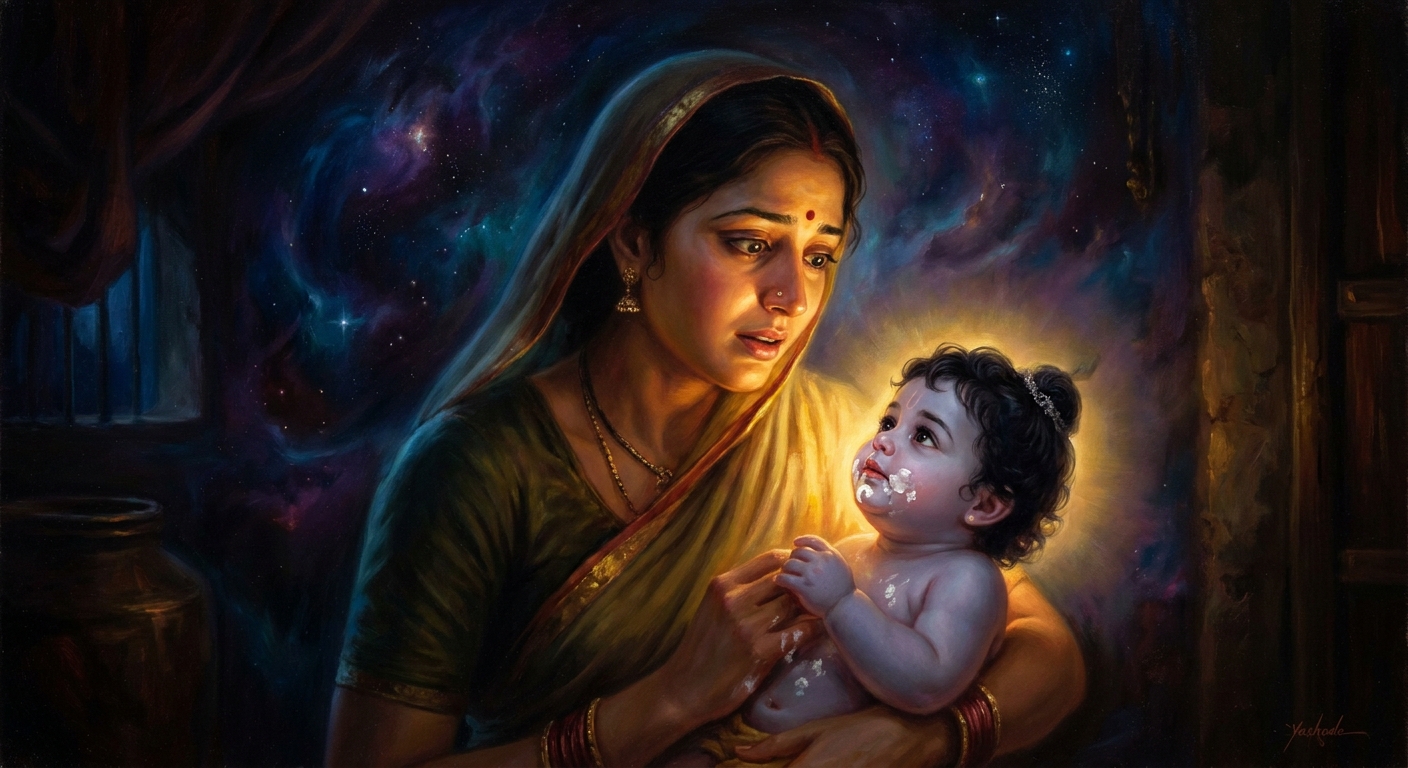
Not slowly. Not like forgetting a dream in the first minutes after waking, the images fraying and receding. She forgets the way a lamp forgets the dark when you light it — completely, immediately, by becoming something else. She is standing in Vrindavan. She is holding her child’s chin. His mouth is closed. He is looking at her with that expression.
She looks at him.
“There is no dirt in there,” he says, or seems to say, or does not say but somehow communicates in the way that children communicate with mothers when language would only complicate matters.
“Let me see,” she says.
He opens his mouth. There are his teeth. There is his tongue. There is the ordinary dark.
She looks for a long moment. She does not know what she was looking for. She releases his chin.
He smiles — that smile, the one that has no name — and runs toward the other children, and she watches him go, and she is so purely glad to have him, so flooded with the ordinary love of watching a healthy child run in good light, that the gladness is almost unbearable.
She does not know that she has just seen everything.
She does not need to know.
The Bhagavata Purana does not present this as a story about revelation. It presents it as a story about love — which is also a story about protection. Yashoda is not kept ignorant. She is kept able. The moment of vision is real; the forgetting is also real; and the love that persists through both is the point. The cosmos does not replace the mother. The cosmos is held inside the relationship between a mother and her son, which is ordinary, which is infinite, which are the same thing.
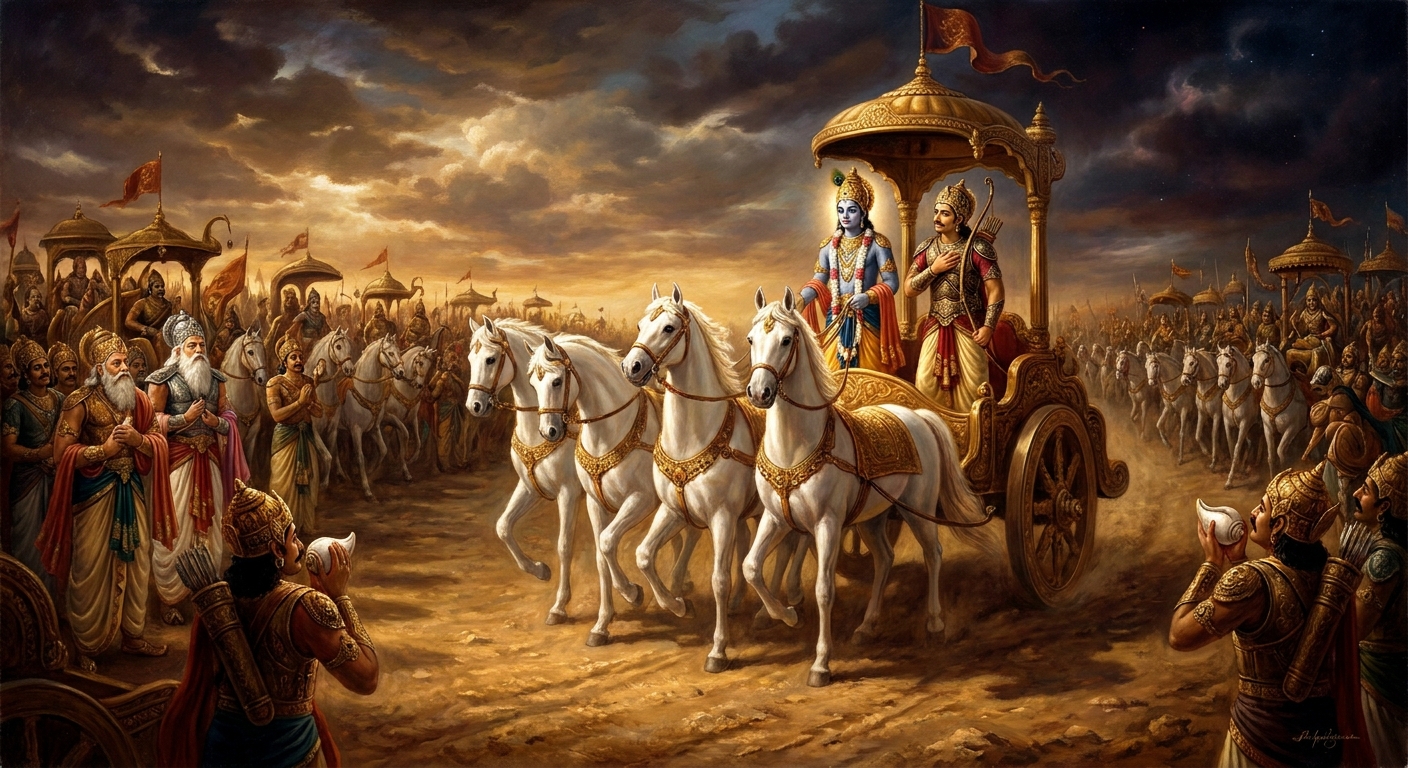
Every major tradition has its theophany: the moment the ordinary rips open and shows the machinery. Moses and the bush. Job and the whirlwind. Arjuna on the battlefield. Ezekiel and the wheels. The transfigured Christ on the mountain. In most of them, the human who sees is changed permanently — set apart, commissioned, burdened with knowledge.
This one is different. This one gives the vision and takes it back. And what remains is not wisdom or mission or grief — just a boy running toward his friends in the late afternoon, and a woman watching him, and the full weight of the universe in her chest, disguised as love.
Scenes
Yashoda peers into her infant son's open mouth and sees what no mortal was meant to see: the whole of creation, wheeling in the dark behind his teeth
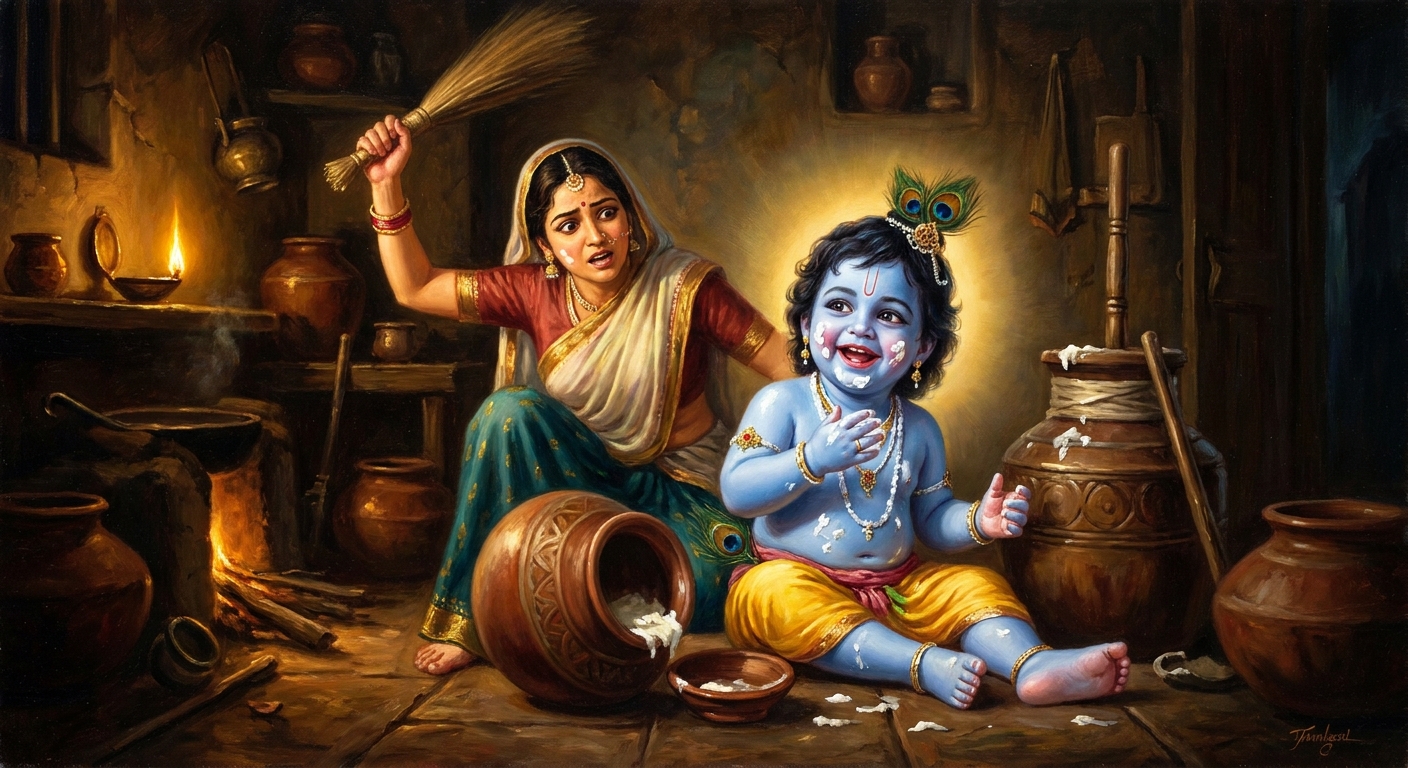
Generating art… The butter-stealing Krishna — playful, grubby, grinning — is the same god who holds the sun in his throat
 Generating art…
 She forgets
 Generating art…
 Echoes Across Traditions
Entities
- Krishna
- Yashoda
- Nanda

Sources
- *Bhagavata Purana* 10.7-8
- *Vishnu Purana* 5.6-7
- A.C. Bhaktivedanta Swami Prabhupada, *Krsna Book*
- Edwin Bryant, *Krishna: A Sourcebook*
- Wendy Doniger, *Hindu Mythology*