Samsin Halmoni and the Bargaining Mother
Yi Dynasty Korea (Joseon period), c. 1600-1800 CE · A household in rural Korea, the inner room, the ondol floor
Contents
A woman in Yi Dynasty Korea has buried three infants. She knows the Grandmother of Three Gods lives in the inner corner of her main room, tending the souls of children before they are born and for the first three years of life. She makes her offering of rice and seaweed soup, kneels on the warm floor, and begins the most intimate theological argument in Korean religion: a mother addressing the deity who keeps the count of children.
- When
- Yi Dynasty Korea (Joseon period), c. 1600-1800 CE
- Where
- A household in rural Korea, the inner room, the ondol floor
She makes the seaweed soup before dawn.
This is important — the soup must be made fresh, not reheated from the evening meal. Samsin Halmoni does not accept yesterday’s food any more than she accepts yesterday’s grief. The woman rises in the dark of the inner room and goes to the kitchen and makes the soup from dried miyeok and water and salt, the same soup Koreans eat on birthdays to remember the soup their mothers ate in the days after their birth — and the grandmother of three gods, who was present at all those births, remembers too.
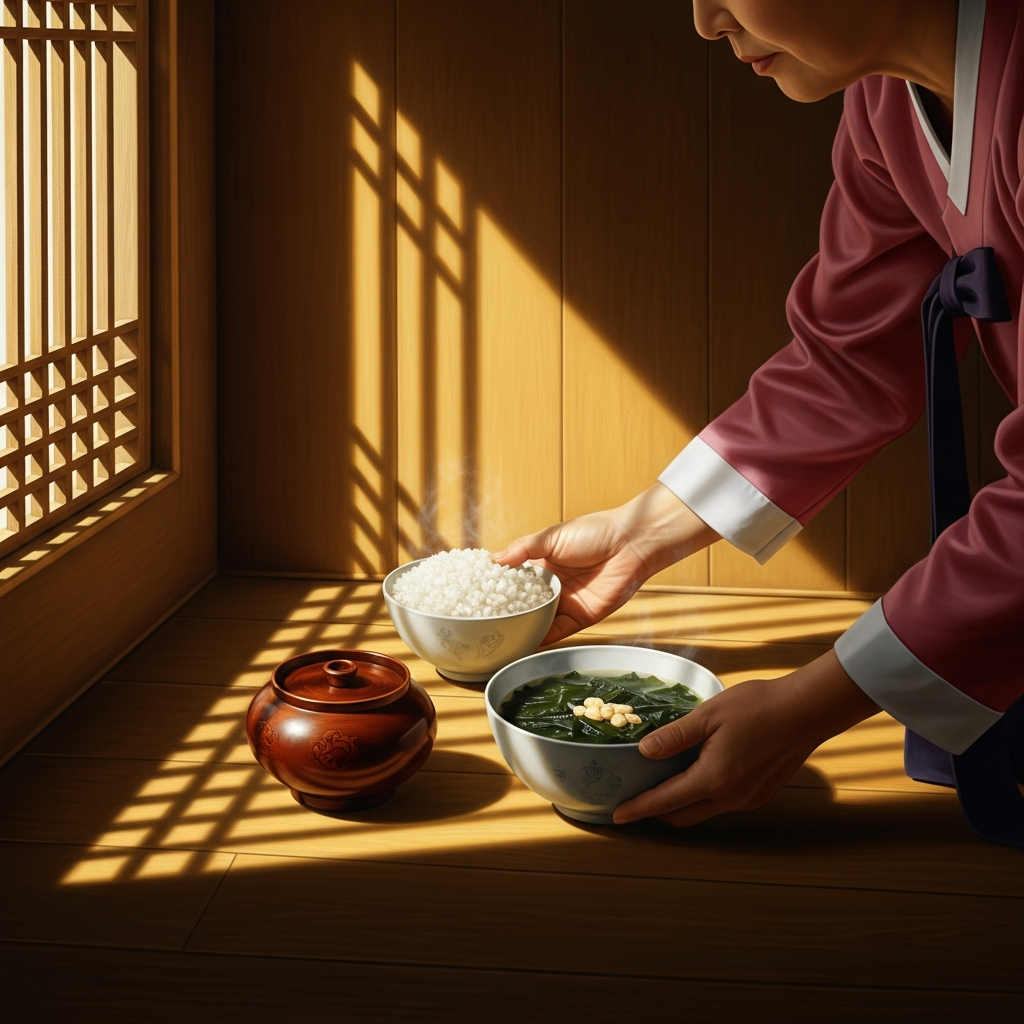
She boils the white rice. She fills two clean bowls — one with rice, one with soup — and carries them to the inner corner of the main room, the corner where the ondol floor is warmest, the corner where no one sits, where no one places anything except these offerings and the folded blankets that keep the good heat in.
The corner has no image. No idol. No shrine-box. Samsin Halmoni requires none of these things because she does not need pointing out. She is simply there, in every house where children have been born or might be born, in the particular density that the domestic sacred occupies in Korean religion: invisible, unmistakable, domestic as the floor-warmth and the soup-steam.
The woman kneels on the warm floor.
She is thirty-one years old. She has been married for nine years and she has buried three children — one at four months, one at eleven months, one at three years, which is the year when Samsin Halmoni is supposed to release a child fully into its parents’ keeping. The third child had almost made it.
She has not come to Samsin Halmoni with a new pregnancy. She is not yet pregnant again. She has come to the corner with rice and soup and grief that has been composting for three years into something harder and more precise than grief, which is the need to understand.
She does not say: give me another child. She is past that request. What she says is more complicated.
She says: I need to understand the accounting.
In the shamanic theology of the household, Samsin Halmoni keeps a kind of ledger. Souls waiting to be born live in her care — this is the specific image in the shamanic tradition, sometimes rendered as a garden of children, sometimes as a storehouse, sometimes simply as the grandmother’s own crowded embrace. She assigns them to mothers based on criteria that the living cannot see. She decides when a child is ready and when a mother is ready and whether the match between them will last.
She also, the tradition implies, decides when a child leaves.
The woman kneeling on the ondol floor is asking about this second function. Three times the grandmother assigned her a soul. Three times the soul departed before the three-year mark when Samsin formally releases a child into its permanent life. She wants to know: was the fault in the soul, or in her, or in the match, or in some accounting principle she does not have access to but that Samsin applies in every household the way the sun applies its light — without preference, without explanation, according to a logic that the recipients experience only as weather?
She speaks quietly.
This is the character of the Samsin ritual that distinguishes it from the mudang’s trance-work, from the public gut ceremony with its drums and costumes and spirit-possession. The Samsin ritual is private. It happens in an inner room at a domestic hour, conducted by a woman addressing a corner, in a voice barely above a whisper. The grandmother is in the house. You do not need to shout.
She says: I made the soup three times. I made the soup in the three days after each birth and for the week after that, for Samsin and for the recovery of my body, as the custom is. I kept the room clean for twenty-one days so that impurity would not touch the child. I did not wash my hair or go outside the gate. I hung the keum-jul rope and the pine branch and the charcoal to tell visitors the house was closed. I did everything the custom requires.
The soup sits in the corner, steaming.
She says: I am not claiming the children died because of me. I am asking whether there is something I cannot see that is different in my case. I am asking whether the ledger shows something I should know.
The grandmother does not answer in words.
This is the nature of the Samsin ritual: it is not a seance. Samsin Halmoni does not possess the woman. She does not speak through a mudang’s mouth. The answer, if it comes, comes in the way that domestic sacred answers come — in the subsequent weeks, in the quality of the silence in the room, in what happens next with the body and the household and the marriage and the subsequent pregnancy.
The woman knows this. She is not waiting for a voice. She is doing what the ritual requires: presenting herself to the deity who is already in the room, making the offering, speaking the need out loud so that the grandmother knows the shape of it.
She says: I am going to try again. I am thirty-one years old and my husband wants children and I want children and I am going to try again. I am coming to tell you this.
She is not asking permission. She is presenting the intention to the only being in the room who has the other half of the information she needs to understand her own life.
She bows.
Three times, forehead to the warm floor, the gesture of complete deference that is also, in Korean practice, the gesture of the person who knows they are addressing a power greater than themselves and is doing so anyway — which is its own kind of dignity.
She stays on the floor after the third bow.
The soup is cooling in the corner. The rice has gone from steaming to still. The house is quiet in the pre-dawn way that Korean houses are quiet — the ondol floor holds its warmth, the paper screen doors hold back the cold outside, the room is a vessel of heat and breath and the accumulated ordinary life of a family.
She says, finally, what she actually came to say.
She says: I know you were with them. In the four months and in the eleven months and in the three years, you were with them. You were in this room. I know you tend them for the first three years and then you release them into us. I know the three-year child almost made it, and that it was your presence in this room that was with him when he died, which means you were there, which means you know what happened in his last hours better than I do.
I am not angry at you. I am asking you to know what I lost, and to know that I know you saw it.
She stays on the floor for a long time.
The dawn begins to come in under the paper screen. The soup-bowl in the corner is cold now. The rice is set.
She rises, collects the bowls, and goes to the kitchen to wash them in the cold water of the morning. The ritual is complete. What she has done is not magic and not petition in the ordinary sense. What she has done is make a claim: I was here. My children were here. You were here. We are in relationship, whether the relationship produces what I ask for or not.
She becomes pregnant again in the spring.
The child lives. It lives past the three-year mark, past the age when Samsin formally releases it, past childhood entirely, into an adulthood that the woman is still alive to see. She makes seaweed soup every year on the child’s birthday, the custom that connects every Korean birthday to the soup eaten in the days after birth — the soup that is Samsin’s food and the mother’s recovery food and the reminder that these are not separate things.
She makes the soup in the pre-dawn. She fills two bowls and carries them to the inner corner. She kneels on the warm floor and bows three times.
She does not always know what to say after the bowing. Sometimes she says thank you. Sometimes she says nothing. Sometimes she sits in the warm corner of the room for a while with the cold soup and the cold rice and the particular silence of a house that has known grief and known its end, and lets the grandmother know that she is still here, still making the offering, still present in the corner of the room where the domestic sacred lives without being named.
The great temple religions have priests and texts and the authority of tradition accumulated in institutions. Samsin Halmoni has a corner in every Korean house that has ever had a child born in it.
She does not require a temple. She requires a clean bowl and fresh soup and a woman willing to kneel on the warm floor and say out loud what she needs.
This is the oldest theology in Korea. It does not have a name because it does not need one. It has been happening in inner rooms at dawn since the first house was built and the first mother knelt down and addressed the corner.
Scenes
The woman places a bowl of white rice and a bowl of seaweed soup in the inner corner of the main room — Samsin Halmoni's dwelling place in every Korean household
 Generating art…
 Samsin Halmoni as she appears in the shamanic imagination: an elderly woman of indeterminate age, white-haired, seated, surrounded by the souls of children waiting to be assigned to their mothers
 Generating art…
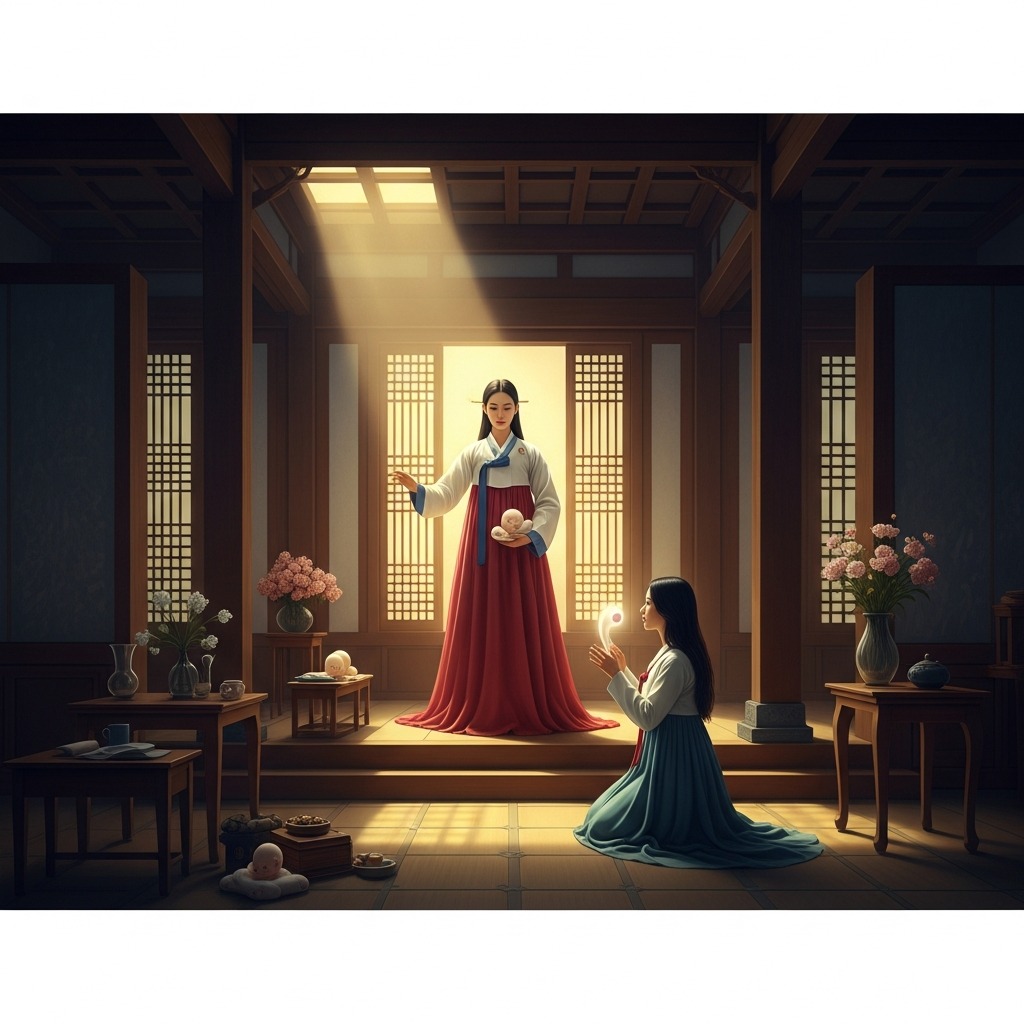
 The souls of unborn children, in Korean cosmology, wait in Samsin's care like seeds before planting
 Generating art…
 Echoes Across Traditions
Entities
- Samsin Halmoni
- Samsin
- The Three Birth Goddesses
Sources
- Laurel Kendall, *Shamans, Housewives, and Other Restless Spirits* (University of Hawaii Press, 1985)
- Laurel Kendall, *Getting Married in Korea: Of Gender, Morality, and Modernity* (California, 1996)
- Roger Janelli and Dawnhee Yim Janelli, *Ancestor Worship and Korean Society* (Stanford, 1982)
- Kim Tae-kon, *Korean Shamanism — Muism* (Jimoondang, 1998)
- Hyun-key Kim Hogarth, *Korean Shamanism and Cultural Nationalism* (Jimoondang, 1999)