The Feather of Maat
Composed ~1550 BCE · New Kingdom (Book of the Dead) · The Hall of Two Truths · the cosmic courtroom in the Duat
Contents
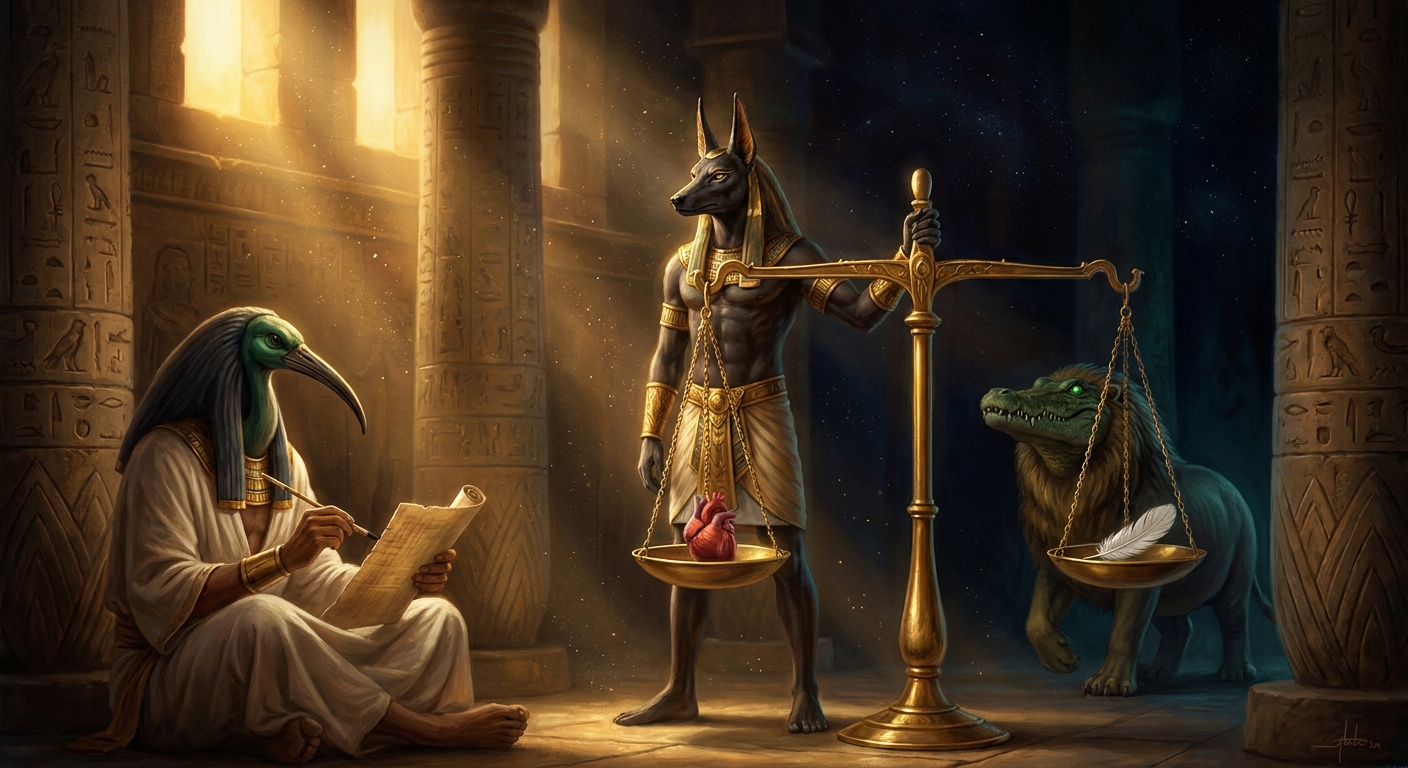
In the Hall of Two Truths the dead must speak forty-two denials to forty-two judges, and a single feather sets the standard against which a life is weighed. Anubis adjusts the balance. Thoth records. Ammit waits.
- When
- Composed ~1550 BCE · New Kingdom (Book of the Dead)
- Where
- The Hall of Two Truths · the cosmic courtroom in the Duat
The feather has no weight.
This is the first paradox of the Hall of Two Truths, the first thing the priests teach the scribes who paint the papyrus that will be tucked into your coffin. The feather of Maat has no weight. Plucked from the headdress of the goddess of cosmic order, white and faultless, it is laid on the empty pan of the scale at the moment of judgment, and the needle does not deflect. Zero is the standard. Anything heavier than absence is too heavy. The dead must arrive at the scale carrying less than nothing.
It is not a metaphor. The Egyptians believed the heart accumulated weight across a life. Every act done out of isfet — disorder, falsehood, violence against ma’at — added grams. Every act done in alignment with ma’at — a fair measure in the market, a true word at the council, a generous portion to the workman, a refusal to enrich oneself at another’s cost — kept the heart light. The good life made the heart smaller, not larger. The wicked life built up.
The scale, in this theology, is not vindictive. It is just a scale.
Maat does not enter the courtroom.
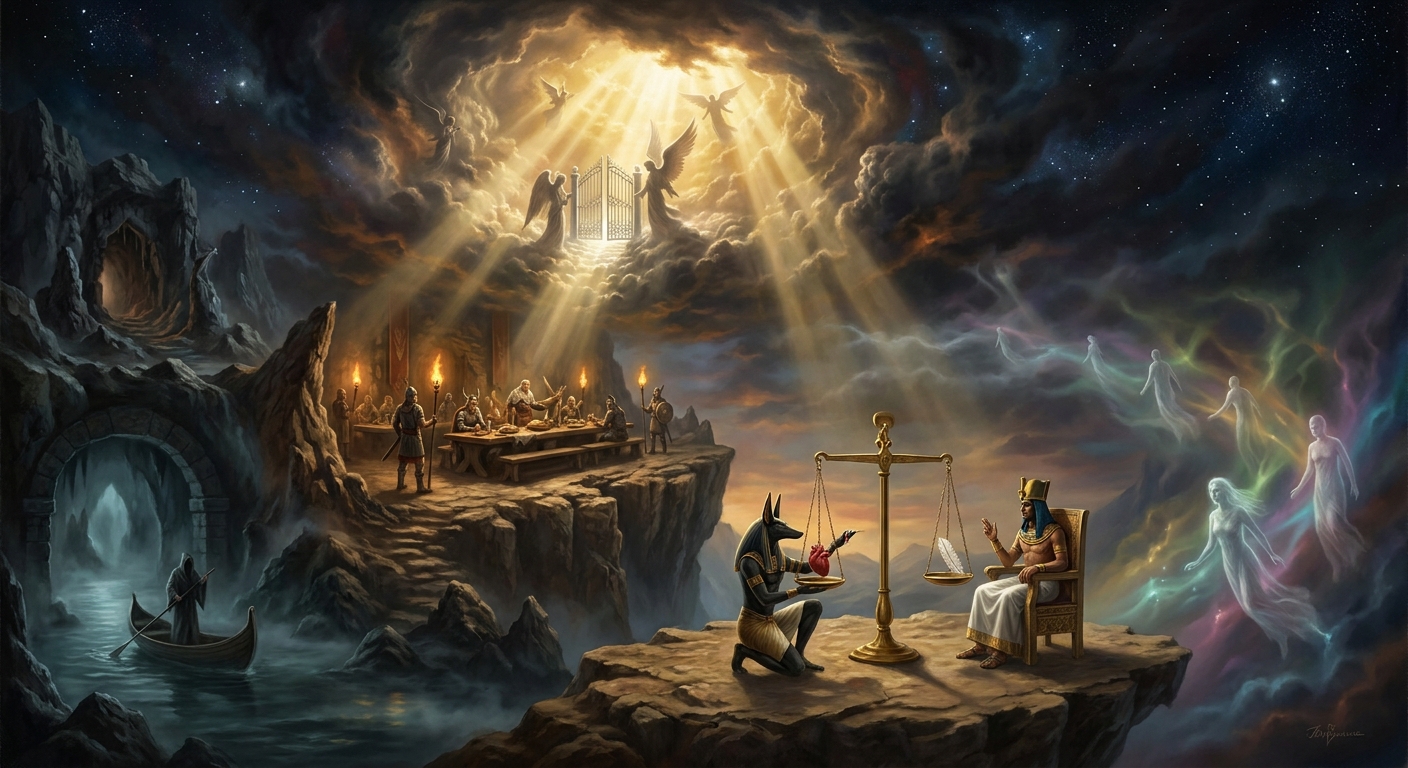
This is the second paradox, and the deeper one. The forty-two judges line the hall — each one named for a different nome of Egypt, each one assigned a specific failure of order: He of the Two Eyes from Heliopolis, who punishes envy. The Wide-Strider from Khemenu, who punishes false speech. The Devourer of Shadows from Memphis, who punishes oppression of the poor. Anubis is present. Thoth is present. Osiris presides on the throne. The forty-two assessors press forward to hear the negative confession.
But Maat herself does not speak.
She does not argue. She does not testify. She does not weigh in. She is not a participant. She is the standard the participants are measuring against. The feather on the pan is her presence in the trial — not an opinion, not a verdict, but a unit of measurement. To imagine Maat advocating for or against you is to misunderstand what kind of god she is. You cannot pray to a kilogram. You cannot bargain with a metric.
The Egyptians invented the moral universe by inventing a goddess who is also a unit.
The forty-two denials.
You speak them in turn, facing each judge. I have not done iniquity. I have not robbed with violence. I have not killed men or women. I have not stolen grain. I have not eaten my heart in vexation. I have not committed sacrilege. I have not stolen the property of a god. I have not borne false witness. I have not lied. I have not snatched away food. I have not caused pain. I have not committed fornication. I have not made any to weep. I have not eaten the heart. I have not attacked any man. I have not been a man of deceit. I have not stolen cultivated land. I have not been a slanderer. I have not been angry without cause. I have not seduced any man’s wife. I have not polluted myself. I have not terrified any man. I have not transgressed the law. I have not been wrathful. I have not closed my ears to the words of truth. I have not blasphemed. I have not been violent. I have not stirred up strife. I have not acted with undue haste. I have not pried into matters. I have not multiplied my words in speaking. I have wronged none. I have not worked witchcraft against the king. I have never stopped the flow of water. I have never raised my voice. I have not cursed god. I have not acted with arrogance. I have not stolen the bread of the gods. I have not carried away the cakes offered to the dead. I have not snatched bread from the child. I have not driven away the cattle of the temple-estates. I have not turned back the water at its time of flowing.
Forty-two failures. Forty-two refusals. Each one keyed to a god who has been judging the dead since before Egypt remembered when the first dead were judged.
The needle moves with each statement. Truth makes it lighter. Falsehood makes it heavier. There is no thumb on the scale.
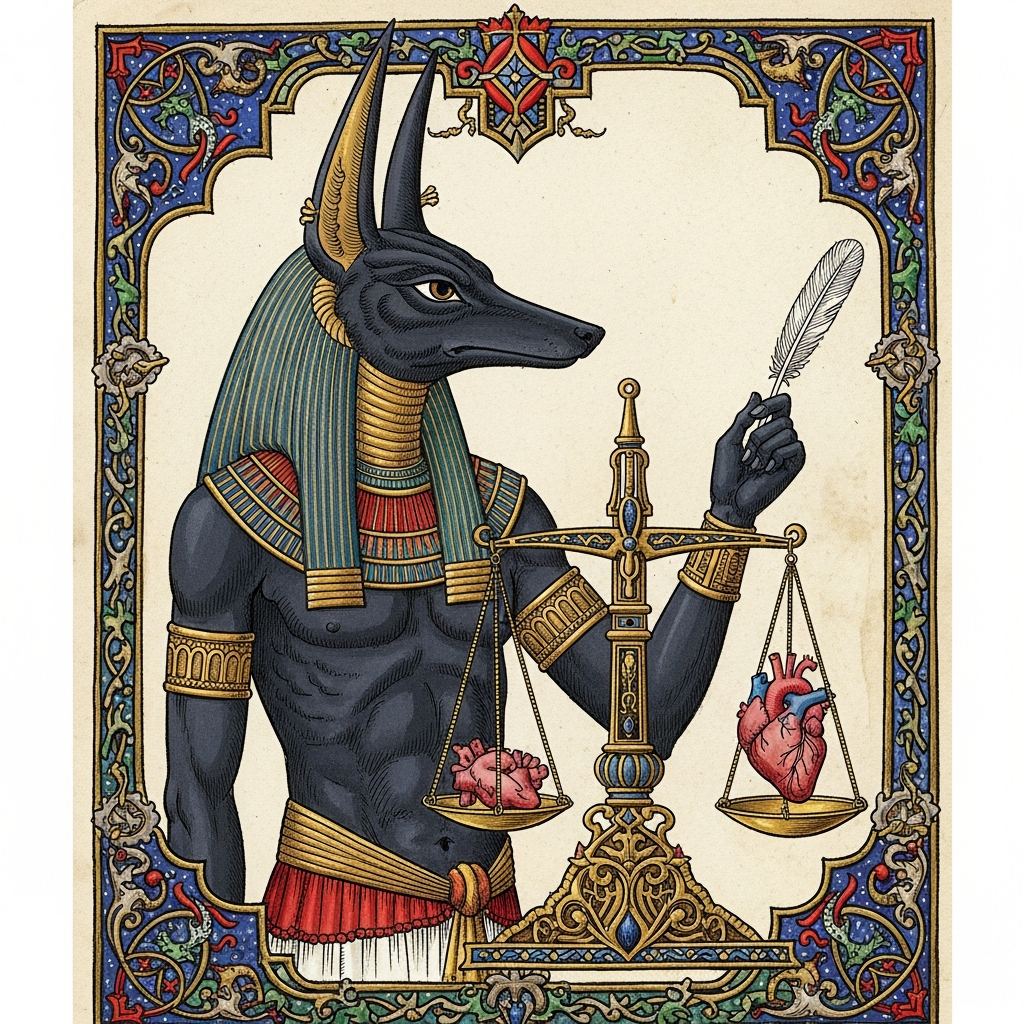
Anubis adjusts the balance.
This is the part the painters love. In the Papyrus of Ani — the most famous surviving copy, painted in Thebes around 1275 BCE — Anubis crouches at the central beam of the scale, his jackal head turned slightly, one paw on the plumb-line. He is not cheating. He is calibrating. The scale must be true. The plumb-line must hang straight. If the apparatus is off by a hair, the verdict is unjust, and an unjust verdict is itself a violation of ma’at, and a violation of ma’at undoes the cosmos.
So Anubis spends a moment, before each weighing, making sure the scale is right.
It is a small detail. It is the most important detail in the painting. The Egyptians understood that the integrity of the system requires the integrity of the instrument, and that even the gods of judgment must subject their tools to inspection. The cosmic court is not arbitrary. It is mechanical, and the mechanism is checked.
When Anubis is satisfied, he straightens. He nods. The weighing begins.
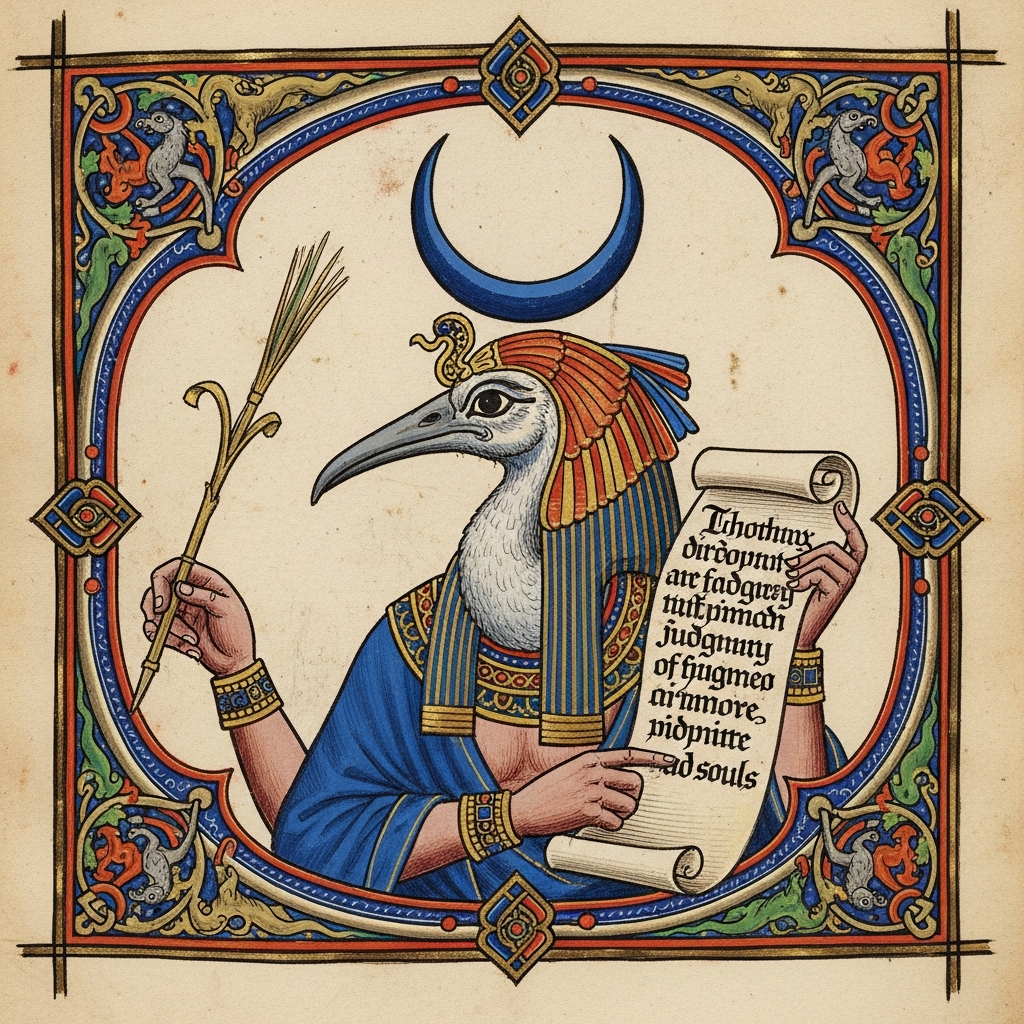
Thoth waits with the reed.
He is ibis-headed, calm, the scribe of the gods, the inventor of writing. The papyrus across his knee is the longest document in the universe; it contains every verdict ever rendered in this hall, and the verdicts to come, and the entries that have not been written are blank only in the way that future entries in a ledger are blank — provisional, awaiting their hour.
He records two things.
First, the verdict — light or heavy, true-of-voice or condemned. Maa-kheru, the Egyptians called the saved: true of voice, the one whose words and deeds aligned. The judgment is binary. There is no purgatory in this system. There is no partial credit. You either matched the feather or you did not.
Second — and this is the detail later religions will preserve — Thoth records the proceedings themselves. Not just the verdict, but the testimony. Every denial, every motion of the needle, every accusation by the forty-two judges. The cosmic court keeps minutes. The papyrus is not just a list of names; it is a transcript. The Egyptians believed that to die was to enter a record-keeping system more thorough than any lived experience could match. Everything is written down.
This terrifies people in a particular way. The Christian Book of Life will inherit it. The Islamic kitab recorded by the Kiraman Katibin, the angel-scribes on each shoulder, will inherit it. The Tibetan mirror of Yama will inherit it. You are being recorded. This is the Egyptian intuition, fifteen hundred years before any other religion makes it explicit: the universe is taking notes.
Ammit waits below.
The artists never let her dominate the painting. She is small, crouched, the size of a large dog. Lion’s mane, hippopotamus haunches, crocodile head. She does not pace. She does not snarl. She is patient in a way only mythological creatures are patient — the patience of a thing that has eaten one heart per condemned soul since Egypt was Egypt and that will keep eating until Egypt is no longer Egypt and then for some time after.
If the heart is heavy, the scale tilts toward Ammit’s pan. Anubis releases the heart. It falls. She catches it without rising. There is no scream. There is no grand devouring. The heart is consumed, and the soul that contained it ceases to exist.
The Egyptians were precise about the consequence: not torment. erasure. The condemned does not suffer in a hell. The condemned simply stops being. The Field of Reeds — Aaru, the Egyptian heaven — does not have a counterpart. There is no opposite afterlife. There is only the afterlife, and the absence of the afterlife. To fail at ma’at is to be unmade.
This is, when you sit with it, a more terrifying theology than torment. Hell is at least a place. Ammit is no place at all.
The feather settles.
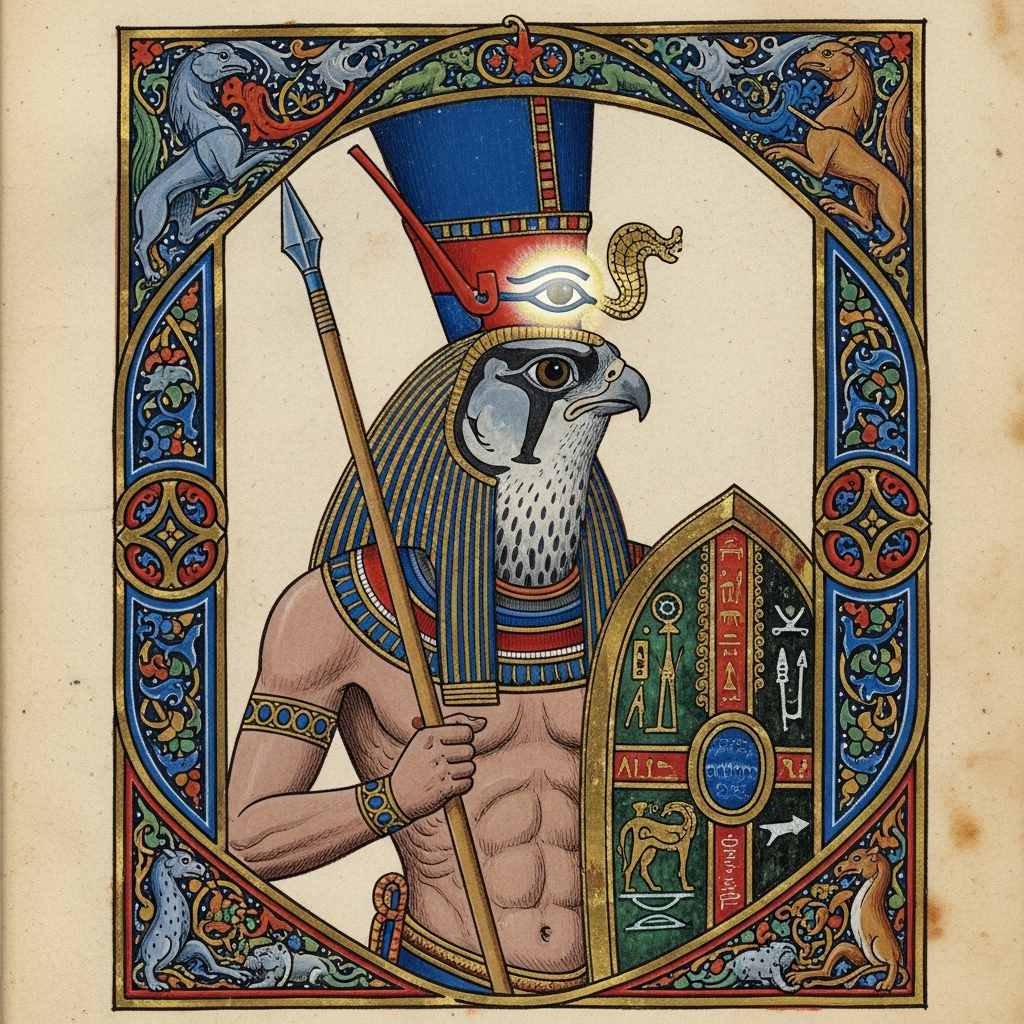
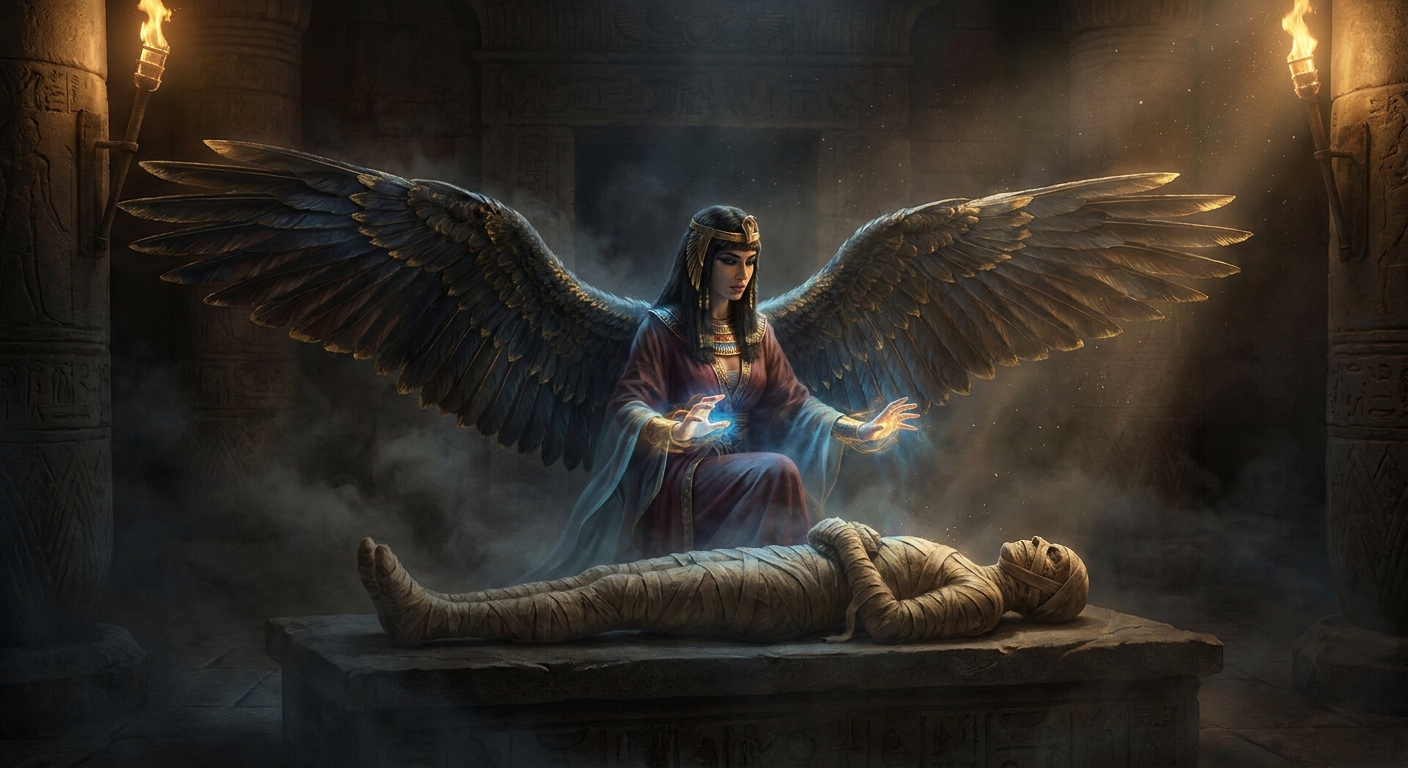
Thoth marks the verdict. Anubis releases the heart back into the chest cavity it came from — if you have passed. The bandages reseal. The chamber lights. Horus steps forward, falcon-headed, son of Osiris, and takes the saved hand the way a brother takes a sister’s at a wedding. He leads you past the forty-two judges, past Thoth’s papyrus, past Ammit, who does not stir, through the far door of the hall and out into the Field of Reeds.
Or — the heart is heavy. Anubis hesitates. Thoth’s reed pauses. Ammit lifts her head. The verdict is rendered without speech. The scribe writes a single mark on the papyrus, and the papyrus rolls itself back, and the soul that held this name is gone.
The hall continues. The next dead enters. The feather is still on the pan, still weightless, still the standard. It has not moved. It will not move. It is the one thing in the universe that does not change.
The Egyptians did not invent the idea of judgment. They invented the idea that judgment requires a standard, and that the standard must be a god, and that the god must not be the judge. Maat is the most sophisticated theological move in the ancient world. She refuses to advocate. She refuses to intervene. She is the measure, full stop, and the cosmos is held together by people behaving as though the measure were real, because the measure is real.
Every later monotheism inherits the idea of divine judgment. Most do not inherit the elegance of separating the standard from the judge. The God of the Hebrew Bible, the God of the Quran, the God of Christian eschatology — all are simultaneously lawgiver, witness, judge, and executioner. The Egyptians refused to collapse those roles. They distributed them across Maat (standard), the forty-two assessors (witness), Anubis and Thoth (court officials), Osiris (judge), and Ammit (executioner). It is a system designed to be checked.
The feather was the first instrument of justice that did not have a thumb on it. It is also still, after thirty-five centuries, one of the few.
Scenes
The Hall of Two Truths — Anubis at the balance, Thoth at the reed, Ammit waiting at the foot of the scale, the feather of Maat steady on the empty pan
 Generating art…
 The forty-two judges line the hall, each named for a city and a sin
 Generating art…
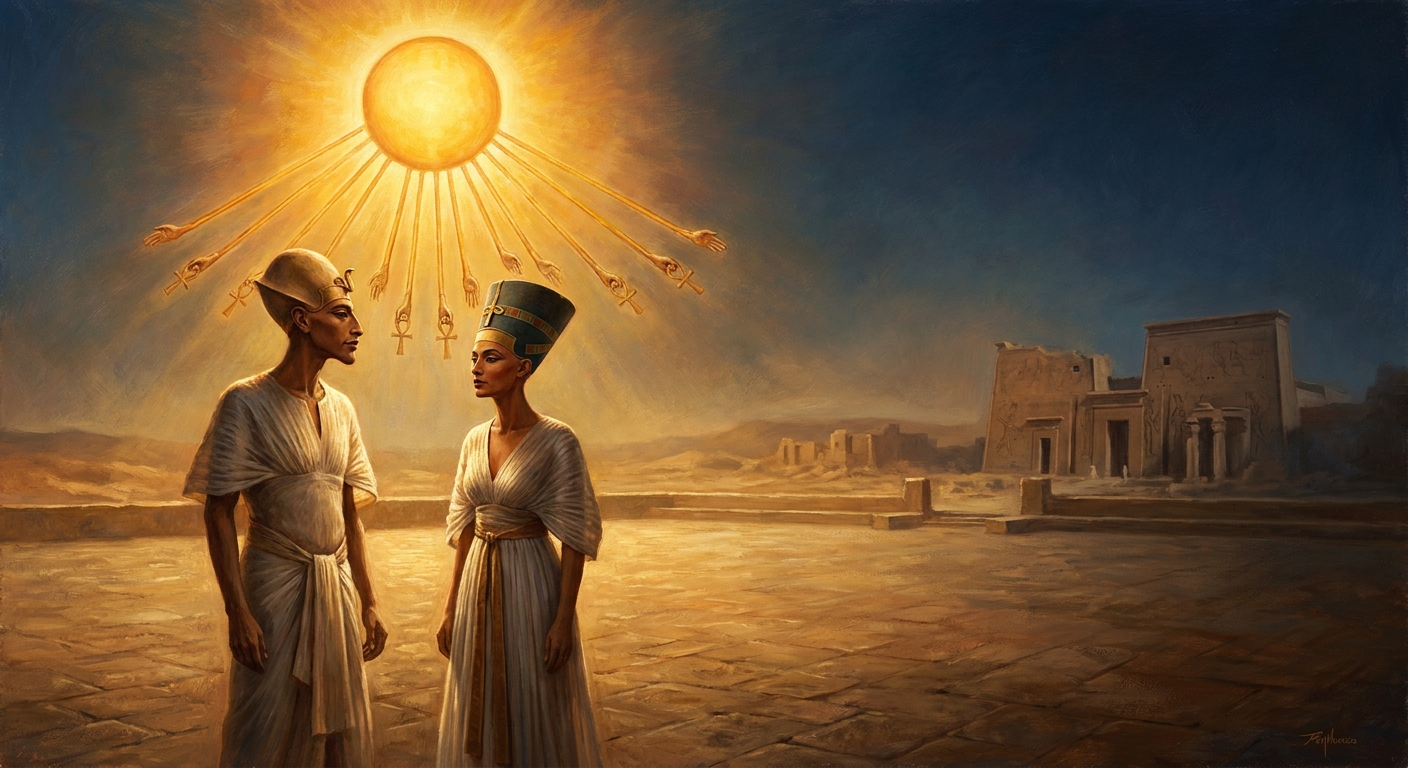
 Osiris on the green throne, crook and flail crossed, presides over the verdict — the murdered king who became the judge of every other soul's death
 Generating art…
 Echoes Across Traditions
Entities


Sources
- *The Egyptian Book of the Dead* (Papyrus of Ani, ~1275 BCE) — Spell 125, the Negative Confession
- R.O. Faulkner (trans.), *The Ancient Egyptian Book of the Dead* (British Museum, 1972/1985)
- *Coffin Texts* (Middle Kingdom, ~2055-1650 BCE)
- James P. Allen, *The Ancient Egyptian Pyramid Texts* (SBL, 2005)
- Jan Assmann, *Ma'at: Gerechtigkeit und Unsterblichkeit im Alten Ägypten* (C.H. Beck, 1990)
- Erik Hornung, *Conceptions of God in Ancient Egypt* (Cornell, 1982)