The Lupercalia and Caesar's Last Refusal
February 15, 44 BCE · Rome — the Lupercal cave on the Palatine Hill, and the Forum
Contents
Every February 15th, Rome's oldest festival strips two noble young men naked, smears their foreheads with the blood of a sacrificed goat, and sends them running through the city's streets striking everyone they pass with strips of animal hide. The festival is older than Rome can remember. Julius Caesar attends his last Lupercalia in 44 BCE. Antony offers him a crown three times. He refuses it three times. Everyone in the Forum knows it is theater. The Senate will answer the real question one month later.
- When
- February 15, 44 BCE
- Where
- Rome — the Lupercal cave on the Palatine Hill, and the Forum
The goat dies at first light.
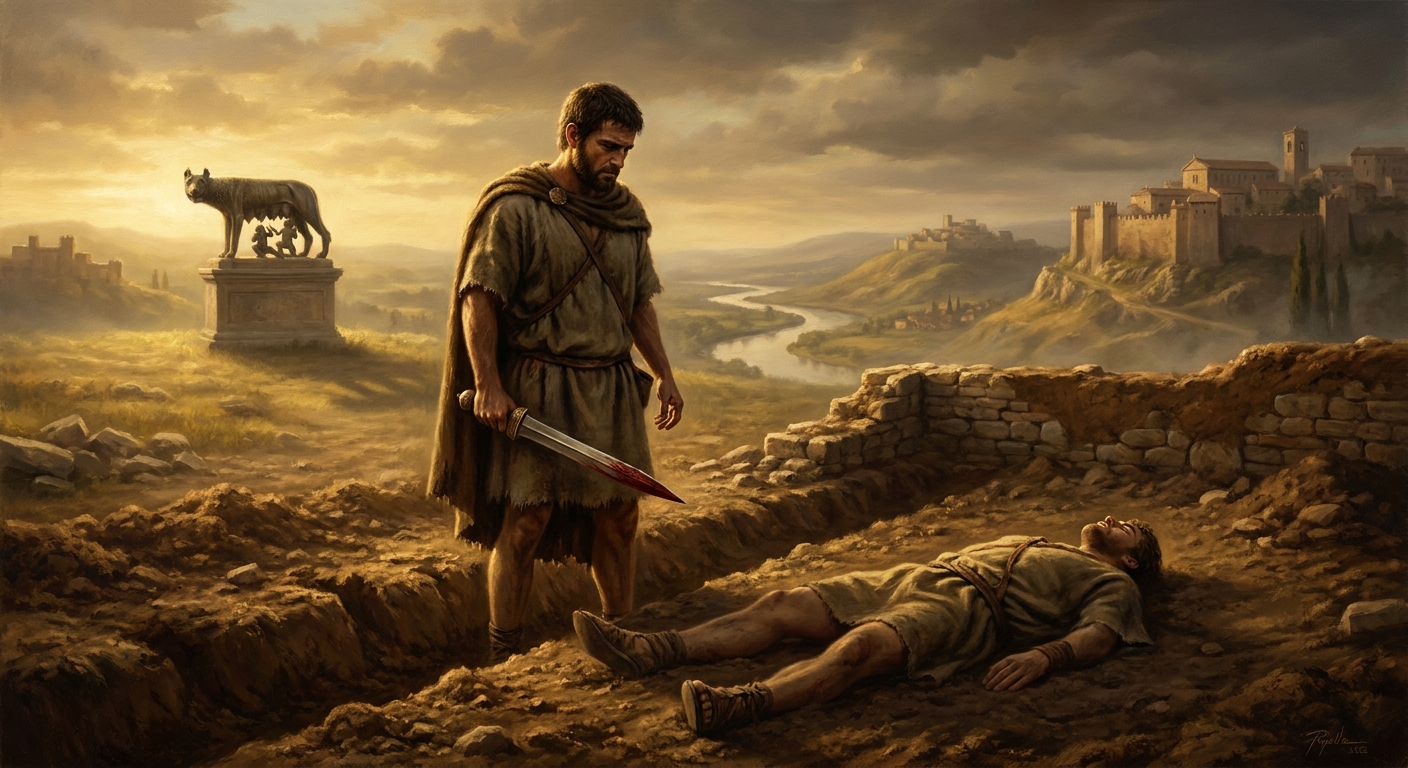
The sacrifice happens at the mouth of the Lupercal — the cave on the southwest slope of the Palatine Hill, shaded by a fig tree, smelling of old wet rock and the particular density of sacred sites that have been sacred too long for anyone to remember why. The priests who perform the Lupercalia are called the Luperci, and they are divided into two colleges, and their priesthood is older than any other in Rome, older than the Vestals, older than the augurs, old enough that even the Romans of the late Republic are not entirely sure what they are priests of. Faunus, they say — the Italian god of forests and wildness and the uncontrolled. Or the she-wolf. Or the cave itself. Or Romulus and Remus, nursed here in the myth, and the act of their nursing.
The goat falls. The blood is thick in the cold February air.
Two young men of noble birth come forward.
This is the office: to be young, to be male, to be from the right families, and to stand still while the Luperci dip a knife in the blood of the sacrifice and touch it to each young man’s forehead, and then immediately wipe the blood away with wool soaked in milk. Both young men must laugh while this is being done. The laughter is required. It is a ritual response to a ritual act, and its meaning is not clear to the Romans themselves, or at least not clear in a way they can easily explain — some connection between the blood and the milk, between death and nourishment, between the wolf’s cave and the twins it sheltered, between the sacred and the absurd.
Then both young men strip off their clothing.
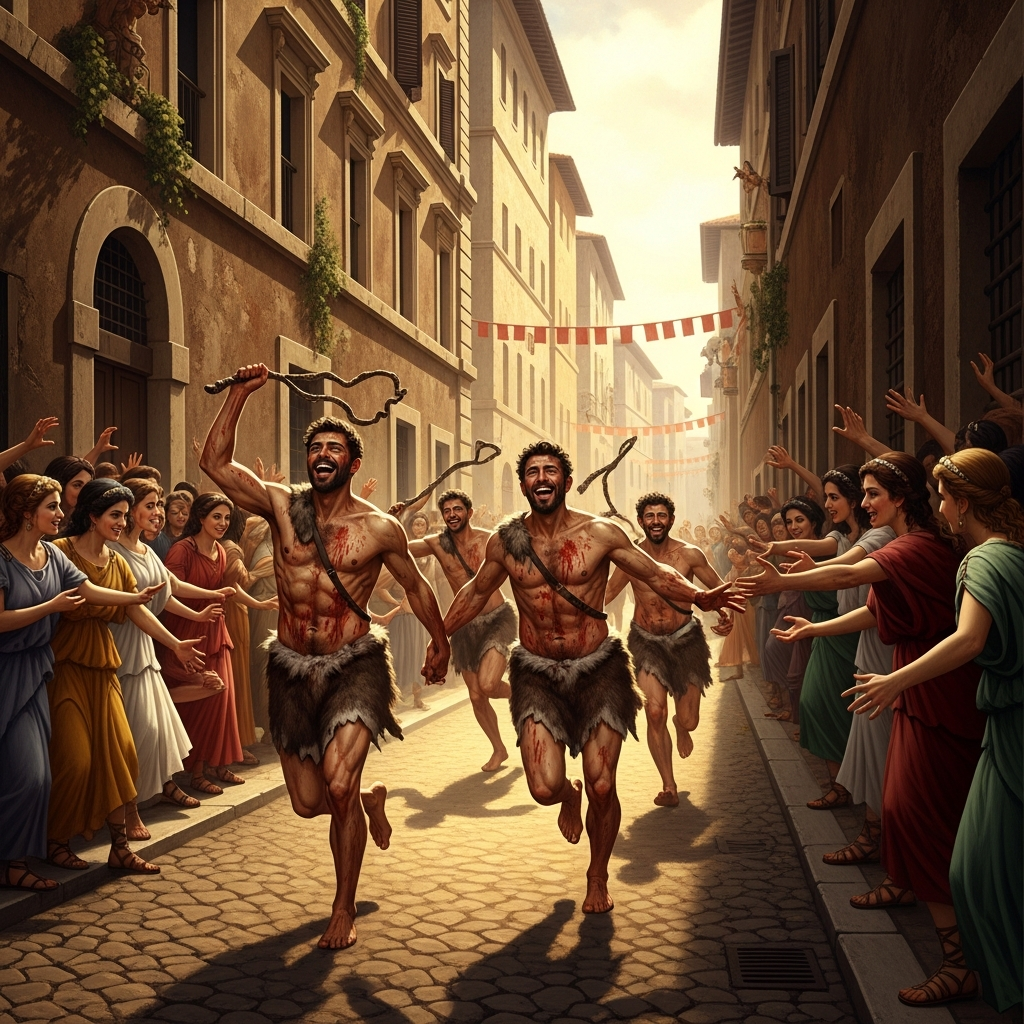
They are given thongs — februa — cut from the hide of the sacrificed goat, still wet, still carrying the smell of the animal. They hold these thongs in their hands and they begin to run.
The Lupercalia route goes down from the Palatine into the streets of Rome and back up, and it is not a private ceremony. The city lines the route. Women in particular crowd to the front, reaching out their hands, and when the running Luperci strike their hands and arms and bodies with the goat-hide strips, the women believe they will conceive. This is old medicine. This is older than medicine — this is the place in religion where the sacred and the physical are so entangled that no one has tried to separate them. The goat is fertile. The cave is ancient. The runners carry something from the wolf’s mouth into the streets, and women who want children hold out their hands.
Ovid, writing in the Fasti, is cheerfully puzzled by all of it. He tries several explanations, takes none of them fully seriously, and seems to find the whole festival amiable in the way that things are amiable when they are so far older than you that you cannot quite bring yourself to criticize them. The naked running is happening. It has always been happening. Somewhere in Rome’s distant past this made clear sense, and the sense has faded but the running has not, and this is February in Rome and the fig tree at the mouth of the Lupercal drops a little shadow on the spot where the she-wolf is said to have sat.
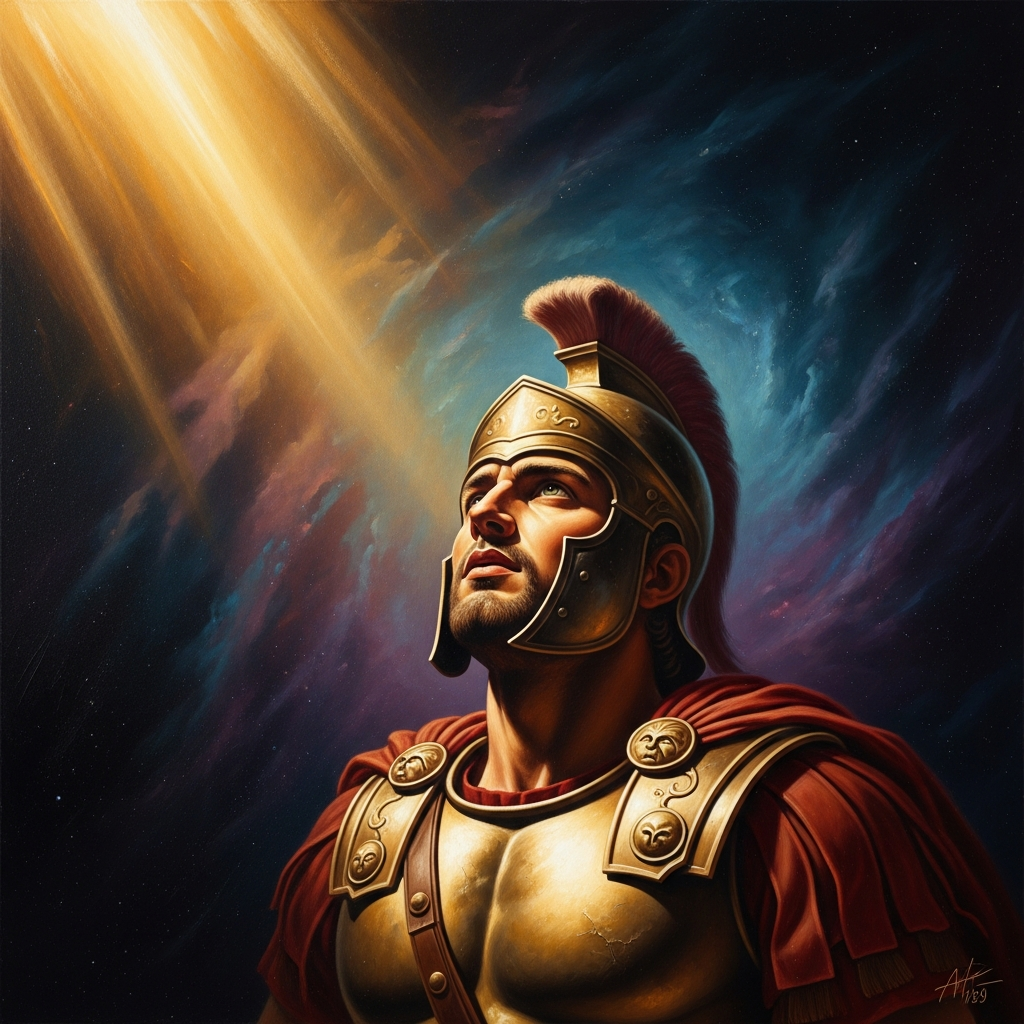
Julius Caesar attends this Lupercalia from the rostra.
He is fifty-five years old. He has been declared dictator perpetuo — dictator in perpetuity — which is a Roman legal category that has never been used in perpetuity before because the Romans have always understood that a permanent dictator is a king with a different name. He sits on the rostra in a chair that has been moved there for him, a gold chair, dressed in a triumphal toga of purple and gold, attended by senators, while the naked priests run their circuit below him.
Plutarch says the crowd cheers the runners and cheers Caesar and cheers Rome.
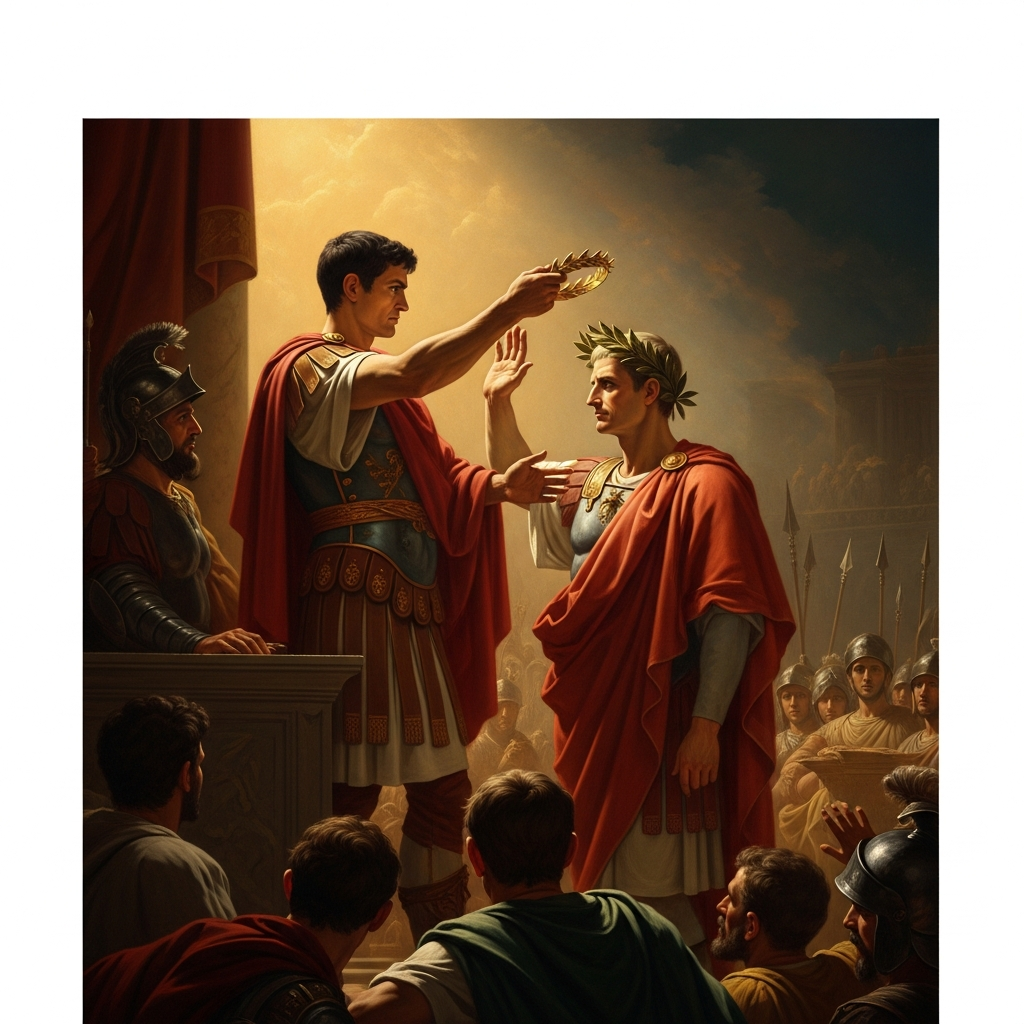
Mark Antony, consul, is one of the running Luperci this year. He is covered in sweat and goat blood and he is holding his thong of goat-hide and he is also holding something else: a diadem. A crown of laurel twisted into a royal diadem. He climbs the steps to the rostra and he holds it out to Caesar.
Caesar pushes it away.
The crowd cheers.
Antony holds it out again. Caesar pushes it away again. The crowd cheers louder.
Antony holds it out a third time. Caesar pushes it away a third time. The crowd cheers loudest of all.
Plutarch watches this carefully. So does Cicero, who is in the Forum and whose account in the Philippics is scalding and precise. So does everyone, because everyone in the Forum that February afternoon is watching the most important political theater of their lives and they know they are watching theater and they watch anyway because the theater is also, somehow, the reality. The question being posed in mime above their heads is whether Caesar will accept the title of king, which the Romans hate, which is the word they use for Tarquinius Superbus, which is the reason Lucretia died. The Tarquins were expelled from Rome five hundred years ago and the Romans have not forgotten.
Caesar refuses three times. The crowd applauds the refusal. Everyone goes home.
The question has not been answered.
The theater has been staged. The conclusion is ambiguous. Caesar is not king — he said so, three times, in public, at the Lupercalia, with the crowd watching. Caesar is dictator perpetuo. Caesar controls the armies, the treasury, the appointments, the courts. Caesar has effectively the power of a king with the title of a Republican office, and everyone in Rome with eyes can see this, and the question of whether the Republic still exists is the question that the Lupercalia’s ritual diadem-refusal is trying to answer and failing to answer because the answer is not a ceremonial one.
The Senate will convene on the Ides of March. That is one month from the Lupercalia, almost exactly. The men who will assassinate Caesar — Brutus, Cassius, sixty others — are in the Forum on February 15th, watching Antony offer the diadem and Caesar push it away. They watch the crowd cheer the refusal. They draw their own conclusions about what the crowd wants, and about whether Caesar’s refusal was sincere or theatrical, and about whether the theatrical refusal is any kind of answer to the constitutional question.
They have made their decision before Antony climbs the rostra. The Lupercalia is not changing anything. The bodies of the senators are pressed into the February crowd, watching naked priests run with goat-blood on their faces, and they are counting weeks.
The she-wolf cave survives everything.
The Lupercal exists at the foot of the Palatine through the Republic and through the Empire and through the conversion of Constantine and through the centuries of Christian Rome. Augustus, who understands the politics of foundational myth better than anyone, restores it. His biographer Suetonius mentions the care he takes with it. In 2007, Italian archaeologists excavating beneath the Palatine find a decorated cave approximately sixteen meters underground, its walls covered in seashells and colored marble and pumice, its interior richly ornamented. The archaeologists believe it is the Lupercal. They cannot get to it fully without damaging the structures above. It sits there in the dark below the hill, the oldest address in Roman religion, waiting.
The goat’s blood has been dry for two thousand years. The cave still smells like wet rock.
The Lupercalia lasted longer than the Republic it eventually swallowed, longer than the Empire that replaced the Republic, longer than the emperors who tried to make it dignified, longer than the Christian Empire that tried to make it stop. Pope Gelasius killed it in 494 CE. By that point it had been running for perhaps eight centuries, possibly more, since before Rome could write.
In that time it had seen: the founding; the kings; the Republic; Caesar; the Ides; Augustus; the Julio-Claudians; the Year of the Four Emperors; Trajan’s campaigns; Marcus Aurelius on the Danube; Diocletian’s division of the empire; Constantine’s conversion. Every February 15th the goat died at the Lupercal and the young men ran.
The deepest thing Rome knew about itself it expressed by running naked through the streets with strips of goat-hide in the middle of winter. It did not stop until a Pope told it to. Even then, it is said, the people of Rome missed it.
Scenes
The Luperci priests, blood-smeared and laughing, run through the streets of Rome with the thongs of goat-hide
 Generating art…
 Antony holds the diadem above Caesar's head at the rostra
 Generating art…
 The cave of the Lupercal on the Palatine Hill at dawn — the wolf's cave, where Rome's founders were nursed — wreathed in the smoke of the morning sacrifice
 Generating art…
 Echoes Across Traditions
Entities
- Julius Caesar
- Mark Antony
- Romulus
- Remus
- Faunus
Sources
- Plutarch, *Life of Caesar* 61; *Life of Antony* 12
- Livy, *Ab Urbe Condita* 1.5
- Ovid, *Fasti* 2.267-452
- Cicero, *Philippics* 2.34
- Gelasius I, *Letter to Andromachus* (494 CE)
- T.P. Wiseman, *The Myths of Rome* (2004)