Cernunnos at the Hinge of Winter
c. 50 BCE, Gaul under late Republican Roman pressure · The oak forests of central Gaul, at the seasonal threshold
Contents
A Gaulish nobleman in 50 BCE prepares the winter hunt ritual at the threshold moment between seasons. What the antlered god Cernunnos represents: not death but transition, the liminal instant when the wild animals move between worlds and the boundary between human and animal is most permeable.
- When
- c. 50 BCE, Gaul under late Republican Roman pressure
- Where
- The oak forests of central Gaul, at the seasonal threshold
The nobleman Vercinnus knows when the season turns by the behaviour of the deer.
He has watched the forest around his hillfort for forty winters. He knows the feeding patterns of the red deer in the oak-mast months, the way the stags begin to cede territory in Samhain, the way the movement of the herds goes quiet just before the first hard frost as if something — some attention in the forest, some organizing will — is passing through and settling the question of who goes where. He is not a Druid. He does not know the doctrine behind what he observes. He knows that on the day the movement stops, something has arrived that was not there before, and that this is the day for the ritual at the stone.
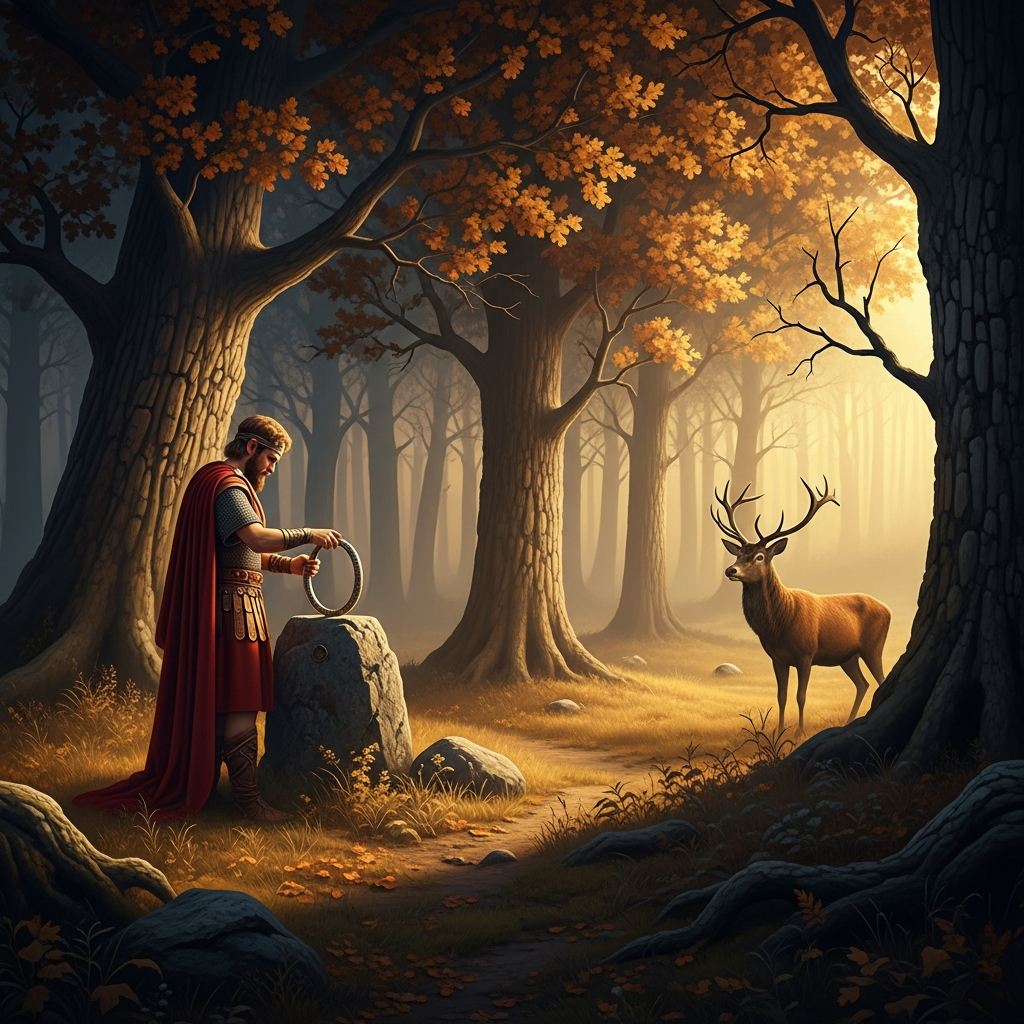
He takes the torq from the box in his sleeping chamber. It is old — older than him, older than his father, possibly as old as the settlement itself. It is gold, twisted, with ram-headed serpents at the terminals, and it is not his to wear. He carries it to the oak grove at the edge of the cultivated ground and sets it on the flat stone where the forest begins. He does this every year. He does not know, precisely, what receives it.
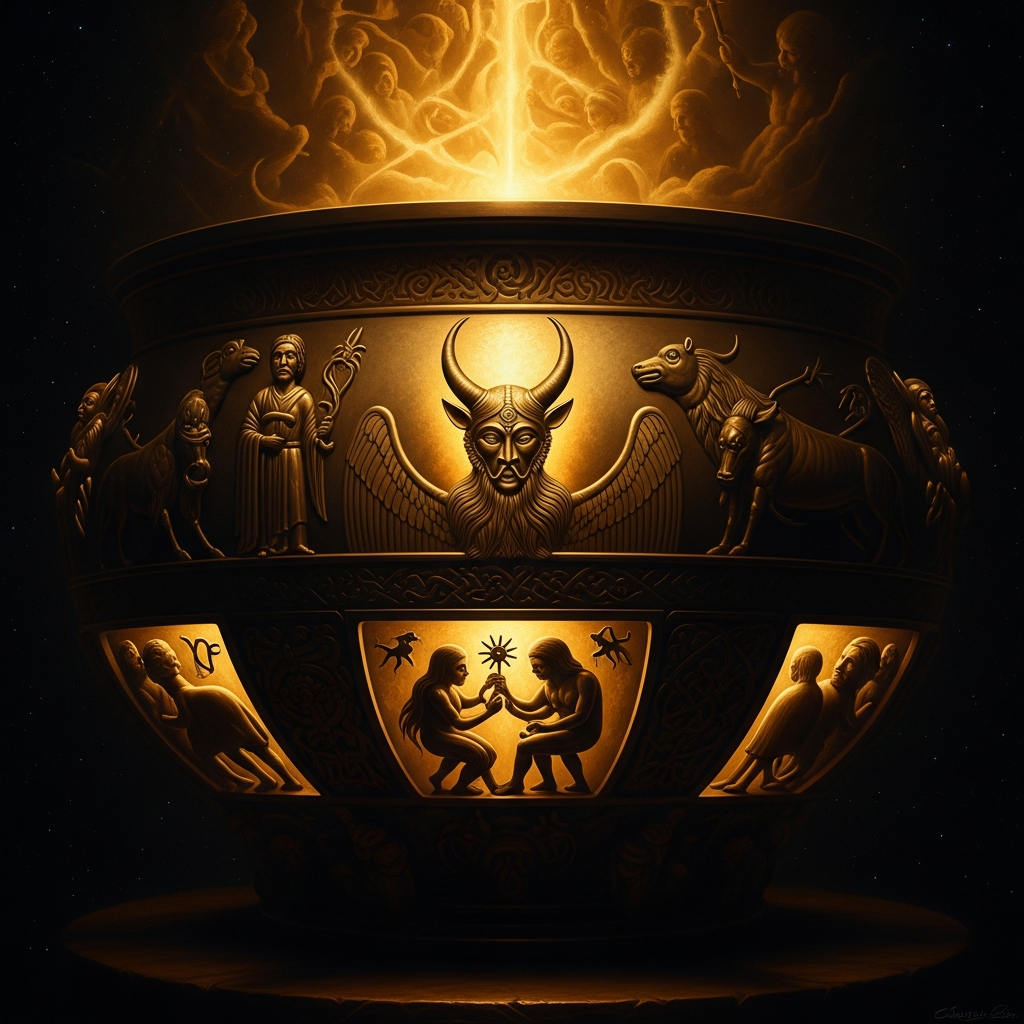
The image on the Gundestrup Cauldron — hammered in silver sometime in the first century BCE, found in a Danish bog, circulated through the long trade routes of the Celtic world — shows Cernunnos seated cross-legged in the posture of a man who has nowhere to be. He holds a torq in his right hand; a ram-headed serpent writhes in his left. From his skull branch the antlers of a red stag, not as a crown or a helmet but as part of his anatomy, as natural to him as the serpent is to the serpent. Around him are the animals: stag, bull, lion, boar, dolphin, smaller creatures at the margins. None of them are in flight. None of them are being eaten.
This is the crucial observation about the image. Every other divine scene in the ancient world that involves a god surrounded by animals is a scene of dominion: the animals are tamed, subdued, displayed as evidence of the god’s power over nature. Cernunnos’s animals are not tamed. The stag beside him is a wild stag. The serpent in his hand is a wild serpent. They are there because this is where they are, and this is where they are because Cernunnos is the condition of the wild country, not its ruler.
He is what the wild is when the wild has a centre.
Vercinnus waits at the stone until the light goes.
He is not expecting an apparition. The Gauls, as best the Romans record their theology — which is imperfectly, and with the agenda of people who fear it — do not think of their gods as figures that appear in the way Jupiter might appear in a dream or Apollo might come to a temple. The gods are conditions. They are the character of places and seasons, the quality of the ford in flood, the nature of the oak-grove in leaf-fall, the particular hinge-quality of the day when the season ends and the next has not yet begun.
Samhain is that hinge. All the boundaries between worlds are thinnest at Samhain — between living and dead, cultivated and wild, human and animal. This is the moment when the herds move from summer pasture to winter forest and the hunters can follow them across a boundary that is not, on ordinary days, crossable. You can find things in the forest at Samhain that you cannot find in June. You can find things that can find you back.
The torq on the stone is an acknowledgement that the hunter borrows something from the wild country each time he enters it. He takes a deer; the forest is diminished by one deer. The torq is not payment — you cannot pay the forest — but it is recognition. It is the hunter saying: I know what I am entering. I know what it costs. I know that the one who holds this place has a prior claim on everything in it including me, and I am asking permission rather than assuming it.
This is what Cernunnos is for. He is the god of the permission that makes hunting possible without making it theft.
The Romans who arrive in Gaul in the 50s BCE do not understand this. Julius Caesar’s account of Druidic religion is intelligent and curious and almost entirely wrong about the thing it is describing, because Caesar is looking for the Roman structures — temple, priest, deity, doctrine — and the Druids have all of these but in a different configuration. The Druids’ sacred groves are not temples. The ceremonies at Samhain are not festivals in the Roman sense. The god they do not name in any text the Romans can find is not absent; he is simply not named, because naming him in the Roman way would make him into something he is not.
After Caesar, the grove at Marseilles that the Romans chop down for siege timber — that grove the soldiers did not want to cut, that had to be ordered on pain of punishment — that grove had a theology underneath it, and the theology was something like: this is not land that belongs to no one. This is land that belongs to the wild. Every tree we take from it is borrowed.
Cernunnos is that theology made into a face and a pair of antlers and a cross-legged posture that looks, to a Roman eye, like a man sitting still. To the eye that knows what it is looking at, it looks like a god sitting at the place where the cultivated world ends, holding the gate that permits you to pass, and expecting the torq.
Vercinnus walks home in the dark.
Behind him, the forest is beginning its winter configuration: the deer drifting toward the deeper valley, the night birds working the field margins, the oak grove absolutely still in the way that oak groves are still when the wind is not in them — a stillness that is not absence but presence compressed, the whole weight of the season gathered into the bare branches and the frost beginning on the stone.
He does not know whether the torq was received. He never knows. This is part of the theology: you make the recognition and you go home, and the forest does what the forest does, and next year you will count the deer in the valley and know whether the count went up or down, and either way you will bring the torq back at Samhain, because the accounting is not a transaction. It is a practice.
In the spring there will be calves. In the summer the stags will be in velvet. In autumn they will fight for dominance in the rutting valleys, a sound like wood striking wood, carrying across the hillfort walls at dusk, and Vercinnus will hear it from his sleeping chamber and know that the god of the hinge is listening, as he always does, at the place where one thing ends and another begins.
Cernunnos appears by name only once in the epigraphic record: on the Nautae Parisiaci pillar, first century CE, found under Notre-Dame de Paris. Everything else is image without caption, votive object without explanation, archaeology without text.
The Romans destroyed the Druidic oral tradition as policy, not incidentally. What we have of Gaulish theology is what survived in the objects that went into the ground: the cauldrons, the torqs, the votive figures dropped into sacred springs and lakes as the armies closed in. The objects are eloquent. The sentences that explained them are gone.
What remains is the image of a god who sits where the tame world ends and holds both a torq and a serpent, and looks out at the viewer from a posture of absolute stillness, surrounded by animals that are not afraid of him. He is not hunting. He is not protecting. He is being the hinge, and the hinge is enough.
Scenes
The Gundestrup Cauldron's inner plate: Cernunnos cross-legged, torq in one hand, serpent in the other, antlers branching from his skull, every animal in the forest gathered around him as if by magnetism
 Generating art…
 The Gaulish noblemans preparation at dusk: the oak grove, the torq being placed on the stone, the first breath of winter in the air
 Generating art…
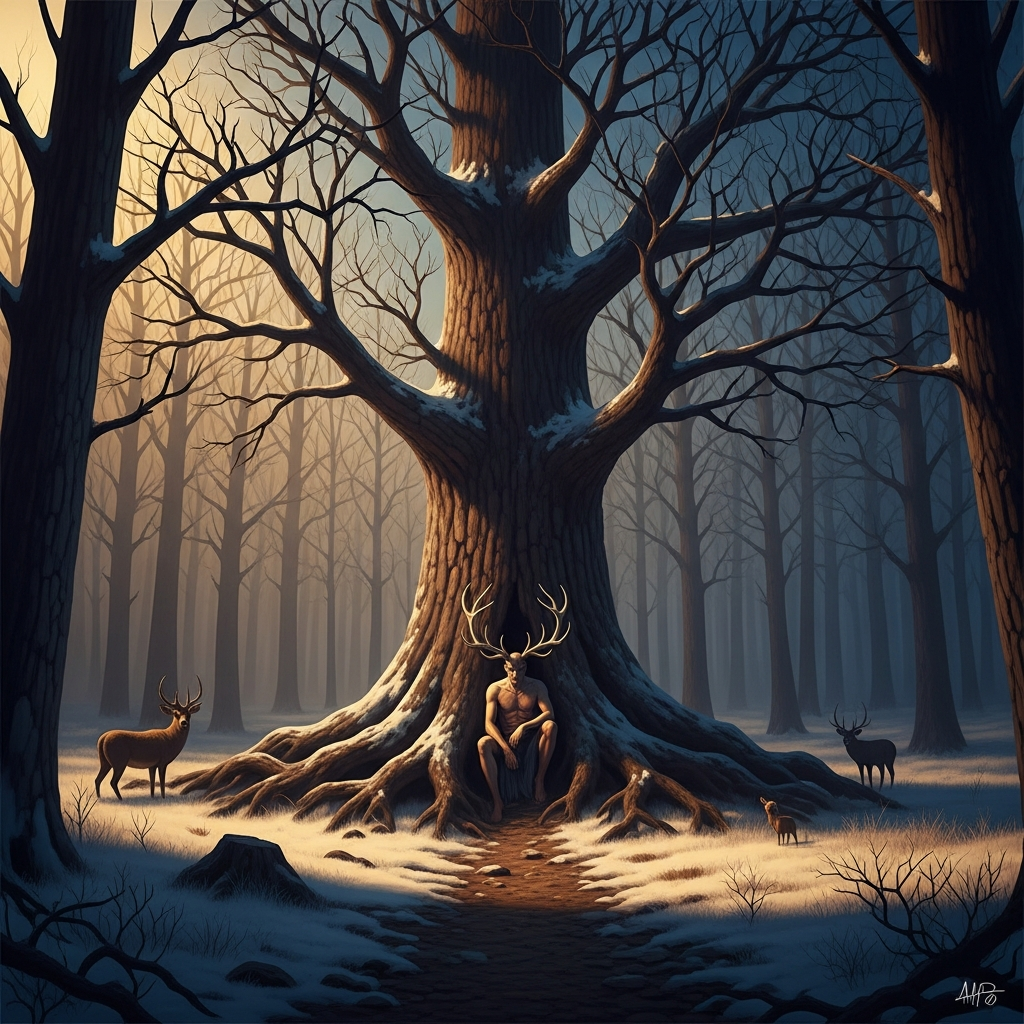
 Deep winter forest, bare oaks, a figure seated at the root of the largest tree
 Generating art…
 Echoes Across Traditions
Entities
- Cernunnos
- the Stag King
- Herne

Sources
- Miranda Green, *Celtic Myths* (British Museum Press, 1993)
- Proinsias Mac Cana, *Celtic Mythology* (1970)
- Anne Ross, *Pagan Celtic Britain* (1967)
- Jean-Louis Brunaux, *The Celtic Gauls: Gods, Rites and Sanctuaries* (1988)
- Barry Cunliffe, *The Ancient Celts* (1997)