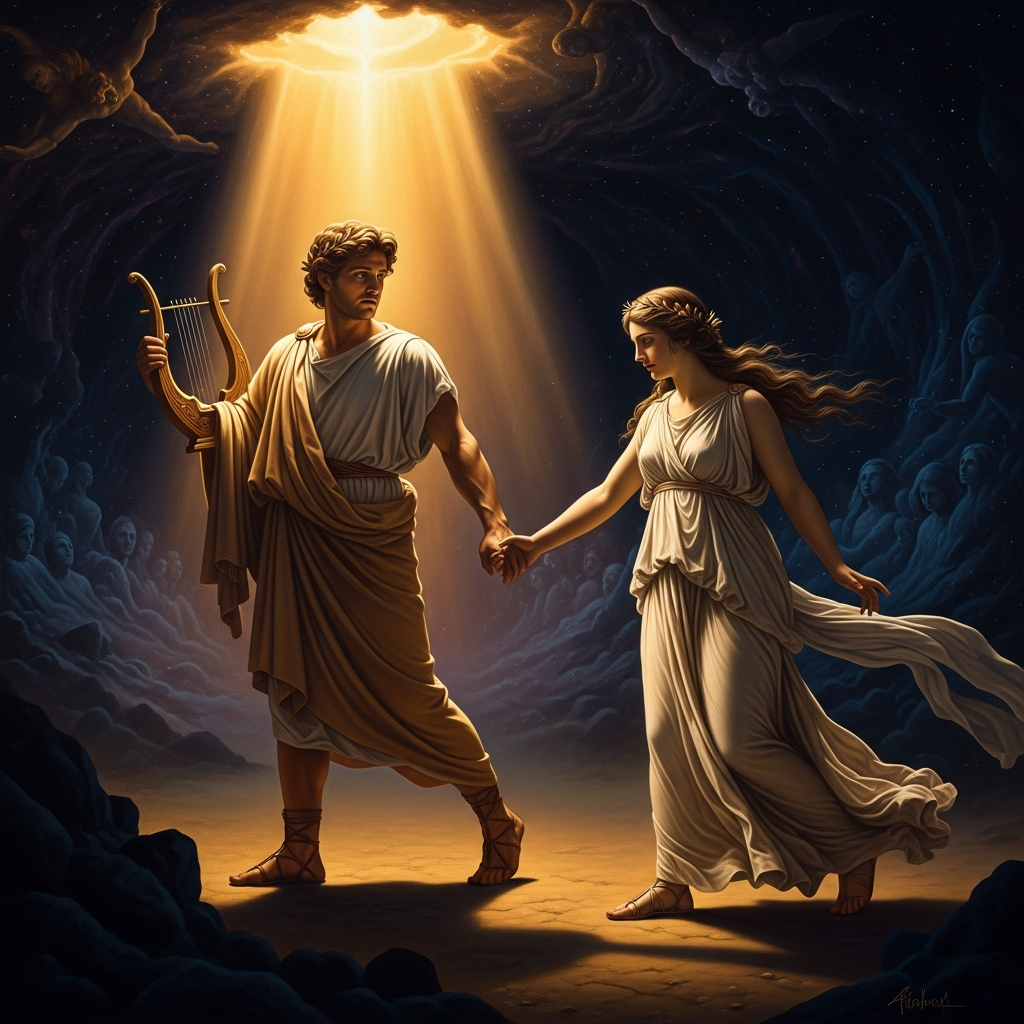
Orpheus and Eurydice
Mythic Time · sung by archaic poets, fixed by Virgil 29 BCE and Ovid 8 CE · Thrace, the Stygian marshes, the halls of Hades
Contents
A serpent kills the bride on the wedding day. The poet descends into Hades with his lyre. He plays so beautifully that the ferryman crosses for free, the three-headed dog lies down, and the Furies weep. Hades and Persephone grant him his wife on one condition: do not look back. He looks back.
- When
- Mythic Time · sung by archaic poets, fixed by Virgil 29 BCE and Ovid 8 CE
- Where
- Thrace, the Stygian marshes, the halls of Hades
The wedding is on a meadow above the river.
She is barefoot. The grass is high. The procession is laughing. Orpheus has been singing all morning, the way grooms sing on wedding days when they are also the most famous singer in Thrace, and the bridesmaids are scattered through the field gathering flowers because that is what bridesmaids did in this part of the Aegean before the gods started to keep track.
Eurydice steps on the snake.
It is a small one. It is in the grass. It strikes her ankle once, almost casually, and slides away through the stems before anyone has registered what color it was. She does not cry out. She sits down in the grass. She looks at her foot. The bridesmaids notice the silence before they notice the bite. By the time Orpheus reaches her, she is gone — gone the way a candle goes when a draft catches it, with no fuss, no negotiation, the entire light simply absent.
He stands over her in the meadow and the music in him stops.
He goes to the river.
He has decided what he is going to do before he has put it into words. He carries his lyre. He walks the way a man walks when he has stopped consulting his body for opinions. The Stygian shore is grey — not the grey of stone, but the grey of light that has been filtered through too many griefs to remember what color it was originally — and the dead are gathered there in a crowd that does not move.
Charon waves him off.
The ferryman does not take the living. The ferryman has not taken the living since the rule was made. He gestures with his pole at the queue of pale shapes waiting their turn, and he opens his mouth to say what he has said to every other living trespasser who has tried to cross —
Orpheus plays.
The first chord is the chord that played in the meadow when Eurydice walked toward him in her wedding garland. The second is the chord he was going to play at the feast. The third is one no one has ever played, because no one has ever needed to. Charon lowers the pole. Charon, who has not changed his expression in three thousand years, changes it. He gestures Orpheus into the boat. He poles him across without a coin.
This is the first impossible thing.
Cerberus is at the gate.
Three heads. Three throats. Three sets of teeth that do not need to coordinate because the dog has practiced. He has eaten heroes whose names you would recognize. He sees Orpheus coming and his three heads rise in unison, and his three sets of jaws open, and the sound that comes out of him is the sound the underworld uses to terrify the living back where they came from.
Orpheus plays.
The middle head’s eyes close first. Then the head on the left. Then the right. The dog lies down. He puts his three muzzles on his enormous paws. His tail, long enough to drag in the dust behind him, slows and stops. He sleeps. He has not slept since Hades chained him at the gate and gave him the work, and now he sleeps because a man with a lyre has reminded him of something he had forgotten he ever needed.
This is the second impossible thing.
The Furies come next. They have hair of writhing snakes and eyes that do not blink because eyelids are mortal. They have driven matricides mad. They have hunted oath-breakers across continents. They cluster around Orpheus to do to him what they do, and he plays, and the snakes in their hair stop hissing, and tears — actual tears, the first the Furies have ever shed, the kind of tears that the underworld did not previously contain — run down their faces.
This is the third impossible thing.
He walks past them into the throne room.
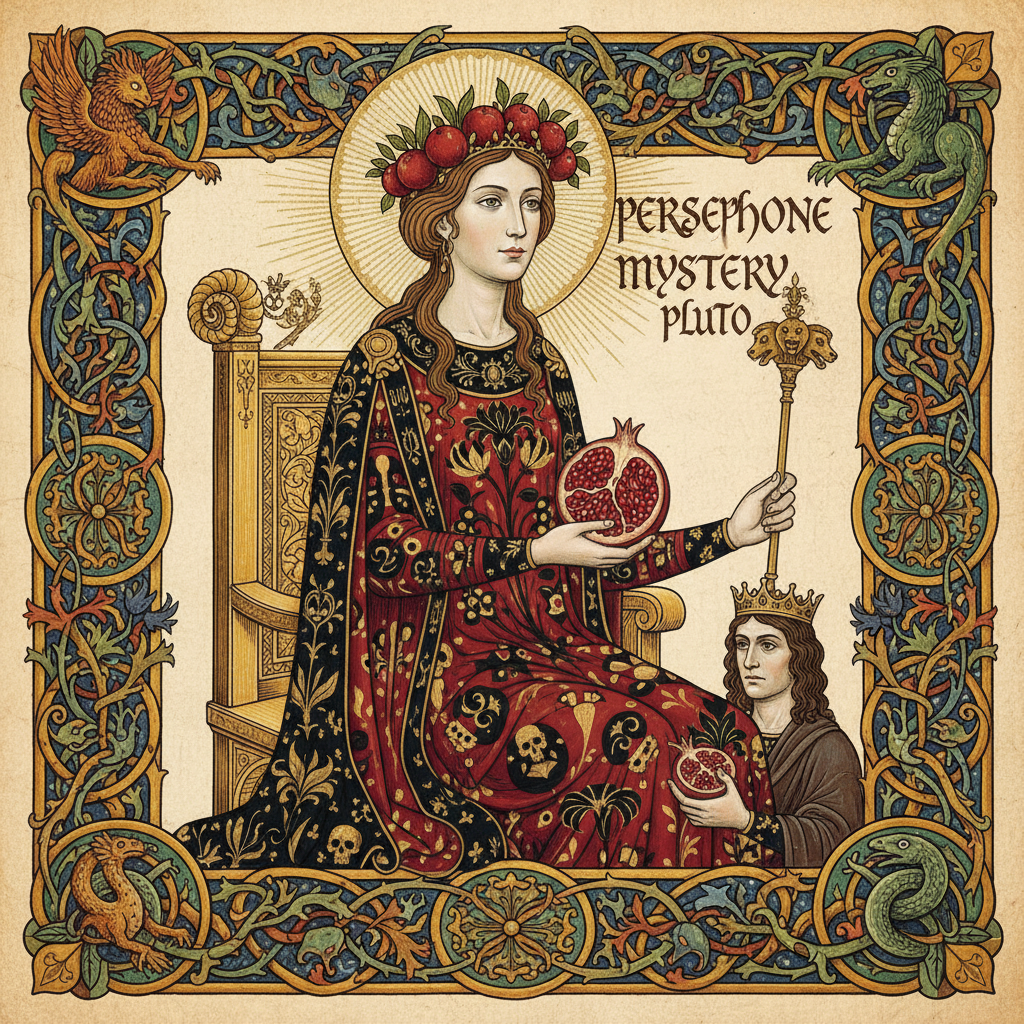
Hades sits on the throne. Persephone sits beside him.
She is six months in, six months out, the way the bargain has held since Demeter forced it. She is the part of the underworld that remembers fields above. Hades is the rest of it — the king who has not smiled in any extant text, the lord of every shade who has ever crossed the river, the one whose name even the Greeks would not say aloud unless they had to.
Orpheus plays.
He plays Eurydice in the meadow. He plays the snake in the grass. He plays the silence after. He plays what it is to be alive and walking and to have someone who was alive and walking yesterday simply not be there. He plays for as long as it takes, and when he stops, Hades is sitting forward on his throne, and Persephone is weeping the way she has not wept since her mother lost her, and the assembled dead — the dead, who have nothing left to feel — are listening.
Hades speaks.
He says: Take her.
He says: Walk ahead of her toward the upper world. She will follow. Until you cross the threshold of light, you will not look back. Not once. Not for any reason. The moment you turn, she returns to me, and the bargain is over.
Orpheus accepts. Of course he accepts. He has not come this far to negotiate.
He walks.
The path out of the underworld is long, and dark, and uphill. He cannot hear her footsteps — the dead do not make footsteps — and so he is walking through a darkness in which the only evidence that she is behind him is that Hades said she would be. He has to choose, with every step, to believe a god who has no reputation for kindness.
The light begins, far ahead.
It begins as a smear, the way dawn begins. He sees the entrance to the upper world taking shape against the black. A stone arch. A field beyond it. The smell of grass — actual grass, grass that grows under a sun. He is almost there. He is almost out.
He cannot hear her.
He has been walking for hours. The silence has been working on him the entire walk. He has not asked, because he was told not to ask. He has not turned, because he was told not to turn. But she is silent. She has been silent since he started. What if Hades lied? What if she was never released? What if he is leading nothing up out of the dark, and the joke of his life is that he played the lyre well enough to move three impossible audiences and was rewarded with a phantom?
His foot crosses the threshold of light.
Hers does not. There is a step’s distance between them — a step, and the rule of the bargain, and the trust he could not hold for one more second.
He turns.
She is there.
She has been there the whole walk. She is a shape just behind him, half-shadow, half-bride, her face turning up to meet his at the precise moment he turns to see her. Her eyes find his. There is no surprise in them, only the particular sadness of someone who has watched another person do the thing she warned them against and could not warn them against, because warning was forbidden.
She says: Farewell.
It is the only word she has spoken since the meadow. It does not echo. It travels through him without sound. Her shape falls away from him — backward, lightly, the way a leaf falls when a branch finally gives up on it — and the path behind her is dark again, and Charon will not take him a second time, and the lyre against his chest weighs more than it has ever weighed.
He stands at the threshold of light with one foot in each world and Eurydice in neither.
He climbs back to Thrace alone.
He does not play for seven days. When he does, he plays only for trees and rocks. The trees lean toward him; the rocks soften. He refuses every woman who comes to him. The maenads — the women of Dionysus — find this an insult, and they tear him apart on a hillside, and his head, still singing, floats down the river Hebrus toward the sea. The lyre floats with him. They reach the island of Lesbos. The lyre is set in the heavens as the constellation Lyra. The head, by some accounts, gives oracles for years.
He never sees Eurydice again.
Or — depending on which poet you trust — they meet in Hades when he finally dies in earnest. Ovid says they walk together in the Elysian fields, and sometimes she walks ahead of him, and sometimes he walks ahead of her, and now he can turn and look at her as much as he wants. Virgil does not say this. Virgil ends with the third sigh of her departing shade, and that is where the Georgics leaves it.
Virgil tells this story inside a frame: the bee-keeper Aristaeus, whose pursuit caused the snake-bite, must perform a ritual to recover his lost hive. Orpheus and Eurydice are nested inside an agricultural manual — a poem about bees — because Virgil knew that the worst losses in human life were always nested inside ordinary work, the meadow on the way to the wedding, the grass underfoot, the snake no one was watching for.
The single backward glance is the most quoted gesture in Western myth. It has been Lot’s wife and Izanagi at the cave-mouth and every lover who has destroyed the thing they were carrying out of the dark by checking on it one second too soon. The instruction is always the same. Walk. Do not look. The failure is always the same. They look.
What the myth does not resolve is whether the glance was love or doubt or both. Orpheus’s hand does not tremble until he is almost at the threshold. He walked through three impossibilities trusting a god. He could not walk through the last ten yards trusting himself.
Echoes Across Traditions
Entities
- Orpheus
- Eurydice
- Charon
- Cerberus
- Hades
- Persephone


Sources
- Virgil, *Georgics* IV.453-527 (29 BCE)
- Ovid, *Metamorphoses* X.1-85, XI.1-66 (8 CE)
- Apollodorus, *Library* 1.3.2
- Plato, *Symposium* 179d
- Edith Hamilton, *Mythology* (1942)
- Charles Segal, *Orpheus: The Myth of the Poet* (1989)