Heraclitus and the River
c. 500 BCE · Ephesus, on the Ionian coast of Asia Minor · Ephesus — the city of Artemis, on the Aegean coast of what is now Turkey
Contents
Heraclitus of Ephesus refuses to write philosophy as argument. He writes fragments — deliberately obscure, deliberately incomplete — and deposits his book in the temple of Artemis. His central teaching: everything flows, opposites are one, the world is fire, and there is a Logos that underlies all change.
- When
- c. 500 BCE · Ephesus, on the Ionian coast of Asia Minor
- Where
- Ephesus — the city of Artemis, on the Aegean coast of what is now Turkey
He does not explain himself.
This is deliberate. This is the philosophy. Heraclitus of Ephesus writes in fragments — short, compressed, oracular — at a time when the philosophers of Miletus just down the coast are building cosmological systems in careful prose. Thales: the principle of all things is water. Anaximenes: the principle is air. Anaximander: the principle is the apeiron, the boundless, the indefinite. They are trying to answer the same question Heraclitus is answering, and they write their answers down clearly enough that a student can copy and transmit them.
Heraclitus writes: Eyes and ears are poor witnesses for men if their souls cannot understand the language.
He means: if you cannot already hear what I am saying, reading it slowly will not help you.
He comes from a distinguished family.
The hereditary kingship of Ephesus is his by right of birth — Ephesus is a city old enough to have hereditary kingships in 500 BCE, when most Greek cities have long since become republics. He renounces it. He gives the kingship to his brother. He has no interest in ruling a city; he is trying to understand the principle by which the cosmos rules itself. You cannot do both.
He withdraws from the civic life of Ephesus with a contempt he does not bother to disguise. He writes: The many are bad; the few are good. He writes: I searched myself. He writes: Most people live as though they have private understandings, when there is only one. He is not making friends. He does not want friends. He wants to see the thing clearly, which requires removing every obstruction, including popularity.
He is called the Obscure in antiquity, and the Weeping Philosopher — Democritus, the atomist, weeps at the stupidity of humanity; Heraclitus weeps at it. Whether he actually wept is unknowable. The epithet captures something true about the tone.
The river.
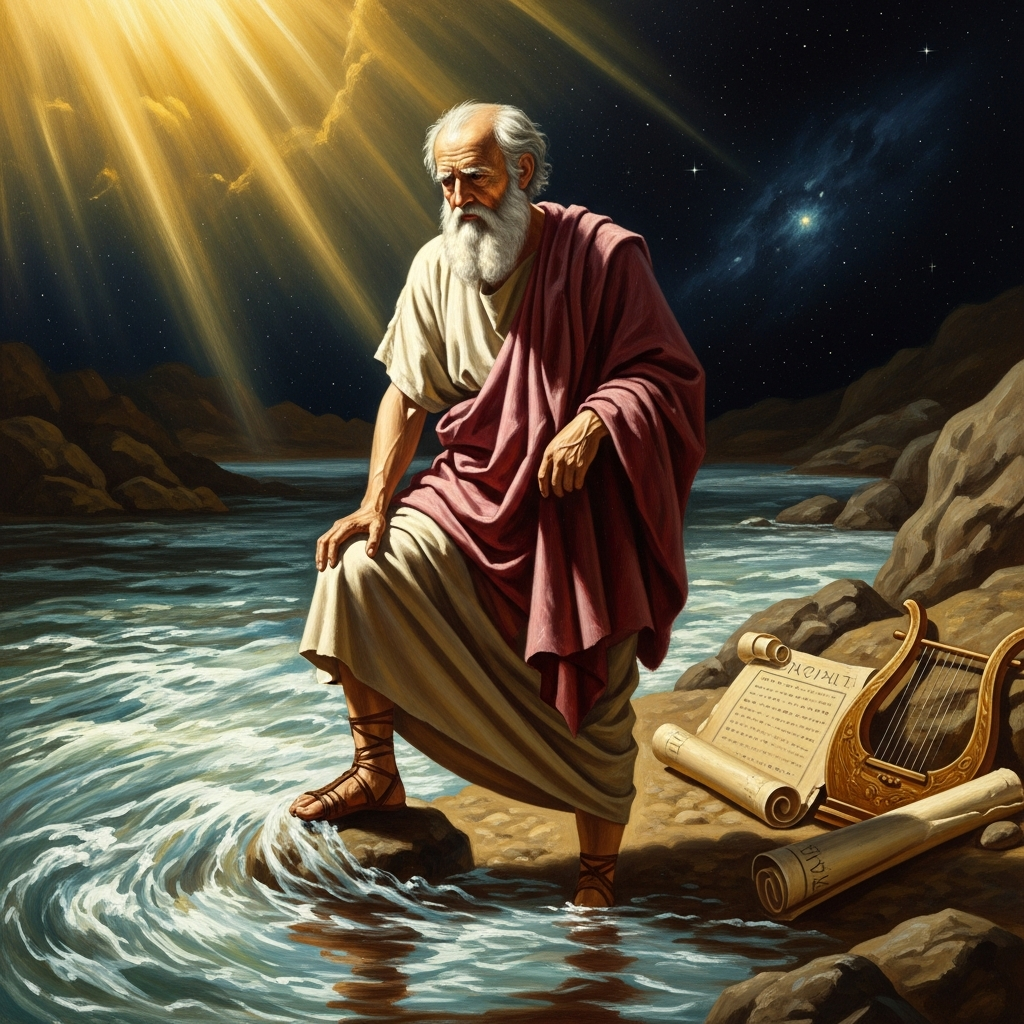
He goes to the river — the Cayster, probably, which runs through the hills above Ephesus before emptying into the Aegean — and he looks at it for a long time. He is not the first person to look at a river and notice it moves. He is the first to make the river’s movement the center of a metaphysics.
You cannot step into the same river twice. This is the famous fragment. In some reconstructions it is: Into the same river you step and you do not step, you are and you are not. The two formulations say different things and both are correct. The water that was there when you first stepped in has flowed downstream. The river is not a thing but a process, an event, a pattern that maintains itself by ceaseless change. If it stopped changing — if the flow stopped — it would not become a stable river; it would become a stagnant pool, which is not a river at all.
He is not making an observation about rivers. He is making an observation about everything.
Opposites are one.
The river flows in two directions simultaneously — the water moves one way, the channel remains, the river is both movement and form, always changing and always the same. Heraclitus extends this: The road up and the road down are one and the same. The same physical path, walked in opposite directions, is one road with two aspects. Cold things warm, warm things cool; wet things dry, dry things grow moist. The opposites are not in conflict. They are aspects of a single process, phases of the same cycle.
God is day and night, winter and summer, war and peace, satiety and hunger. Not: God includes all these things. God is all these things — not simultaneously in a confused blur, but as the principle that holds all these contraries in dynamic tension, the way a bowstring holds together opposite forces and produces something capable of sending an arrow.
He writes: They do not comprehend how a thing agrees at variance with itself: it is an attunement of opposite tensions, like the bow and lyre. The bow and the lyre: instruments of destruction and of music, both dependent on the principle of the taut string. The universe is strung the same way.
The world is fire.
Not that fire is the archê, the primary substance — though he says something like this, and the later Stoics interpret him as saying exactly this. More precisely: the world has the character of fire. Fire is not a thing but a process — it consumes what feeds it and transforms it into something else; it is constantly dying into smoke and ash and rising from new fuel; it maintains its form through ceaseless transformation. The world is like this. The world is fire in the sense that the world is a process, a ratio, a logos, not a collection of stable substances arranged in space.
This world, which is the same for all, no one of the gods or humans has made; but it was always and is and shall be an ever-living fire, with measures of it kindling and measures going out.
No creator. No creation event. No moment before the cosmos. The fire was always burning. The Logos was always operating. The measure of kindling and going out is what we call time, history, the rise and fall of things — and it is not a tragedy. It is the structure of the real.
He deposits the book.
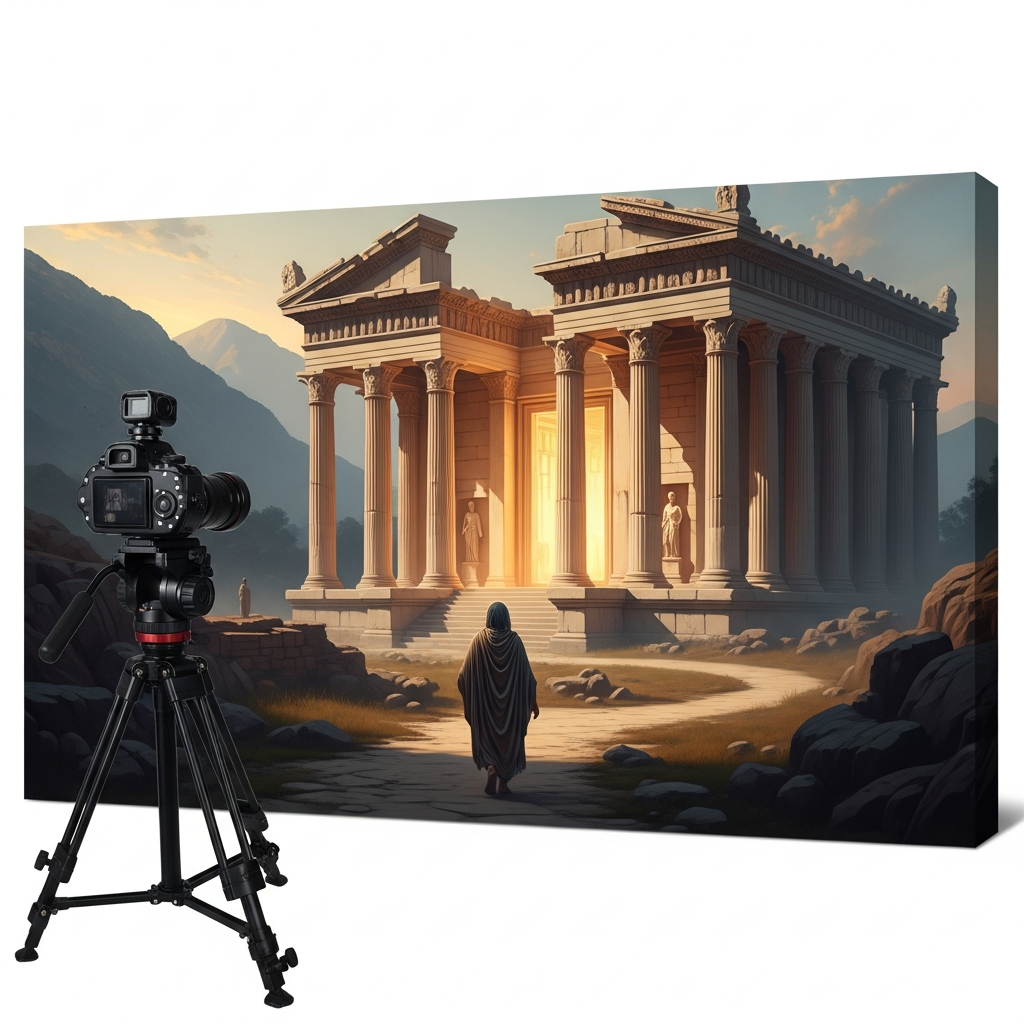
The account says he writes his thoughts down — a single book, or something like a book, a collection of fragments on a papyrus or clay — and carries it to the temple of Artemis at Ephesus, which stands on the marshy ground outside the city walls, one of the largest buildings in the ancient world. He deposits it in the inner sanctuary, where only the priests go. This is not publication. This is preservation. He is not trying to teach everyone. He is not trying to debate. He is placing the book where it will be safe, among the few who might one day be able to read it, and walking away.
He retires to the mountains. There are stories of the end — he develops dropsy, retreats to the hills, tries to cure himself with cow manure drawn over his swollen limbs, dies when a pack of dogs does not recognize him under the dung and tears him apart. The stories are probably not literal. They are shaped to make a point: the philosopher who scorned the masses dies at the hands of animals, alone on a mountain, unreported and unmissed by the city he spent his life dissecting.
He is perhaps sixty years old. He has written fewer than two hundred sentences.
Ninety percent of those sentences have been lost. What remains — approximately a hundred and thirty fragments — is the most compressed and generative body of thought in Western philosophy.
Every Stoic who ever wrote about the fiery logos is commenting on Heraclitus. Every Christian theologian who ever wrote about the divine Word-made-flesh is commenting on Heraclitus. Every physicist who ever wrote about thermodynamic processes, about systems that maintain themselves through constant energy exchange, about the arrow of time and the second law — is, without knowing it, commenting on Heraclitus.
The river is still there. The water has changed a hundred million times since he stood at its edge in Ephesus in 500 BCE. The channel remains. The ratio of kindling and going-out has not been disturbed.
He did not weep at this. Or perhaps he did. The sources disagree, and Heraclitus himself would have expected them to.
Scenes
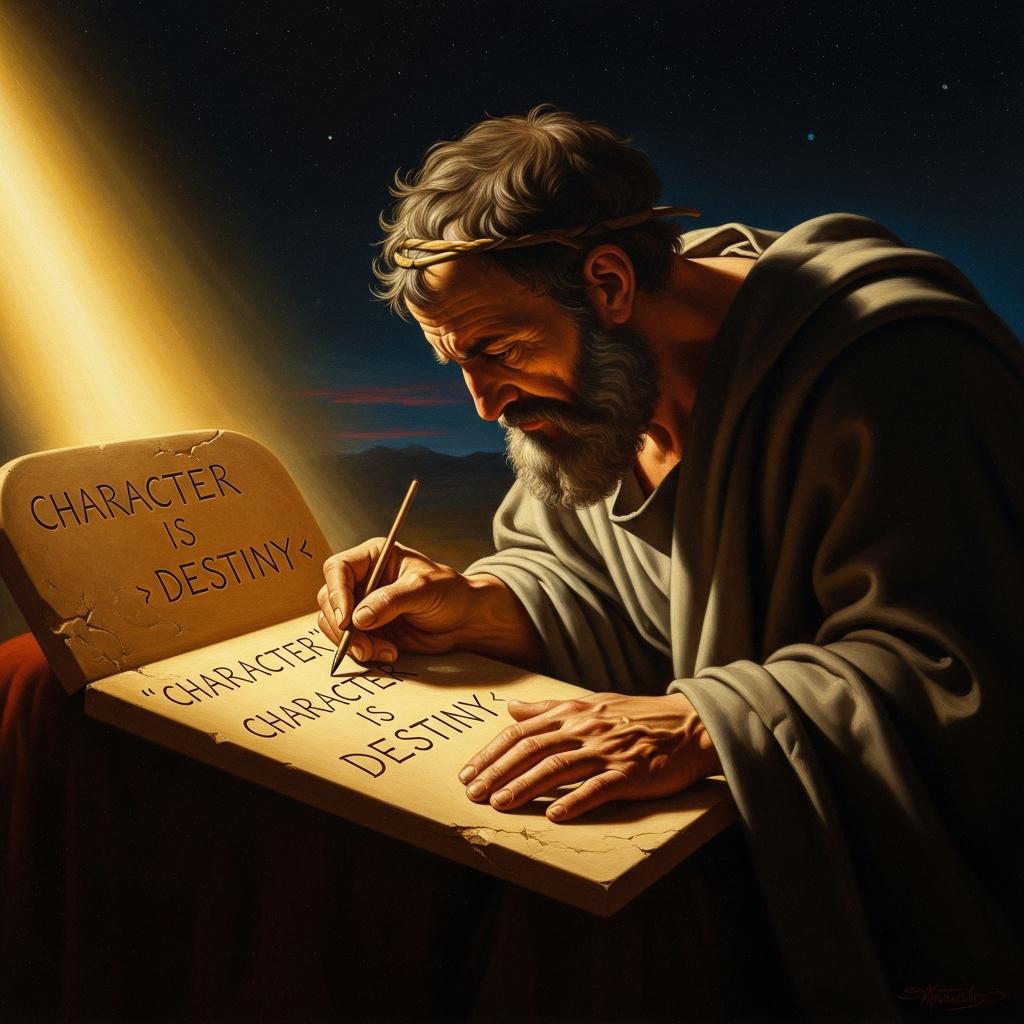
Heraclitus bent over a clay tablet at dusk, writing a fragment — a sentence that will require a lifetime to understand — then setting it aside
 Generating art…
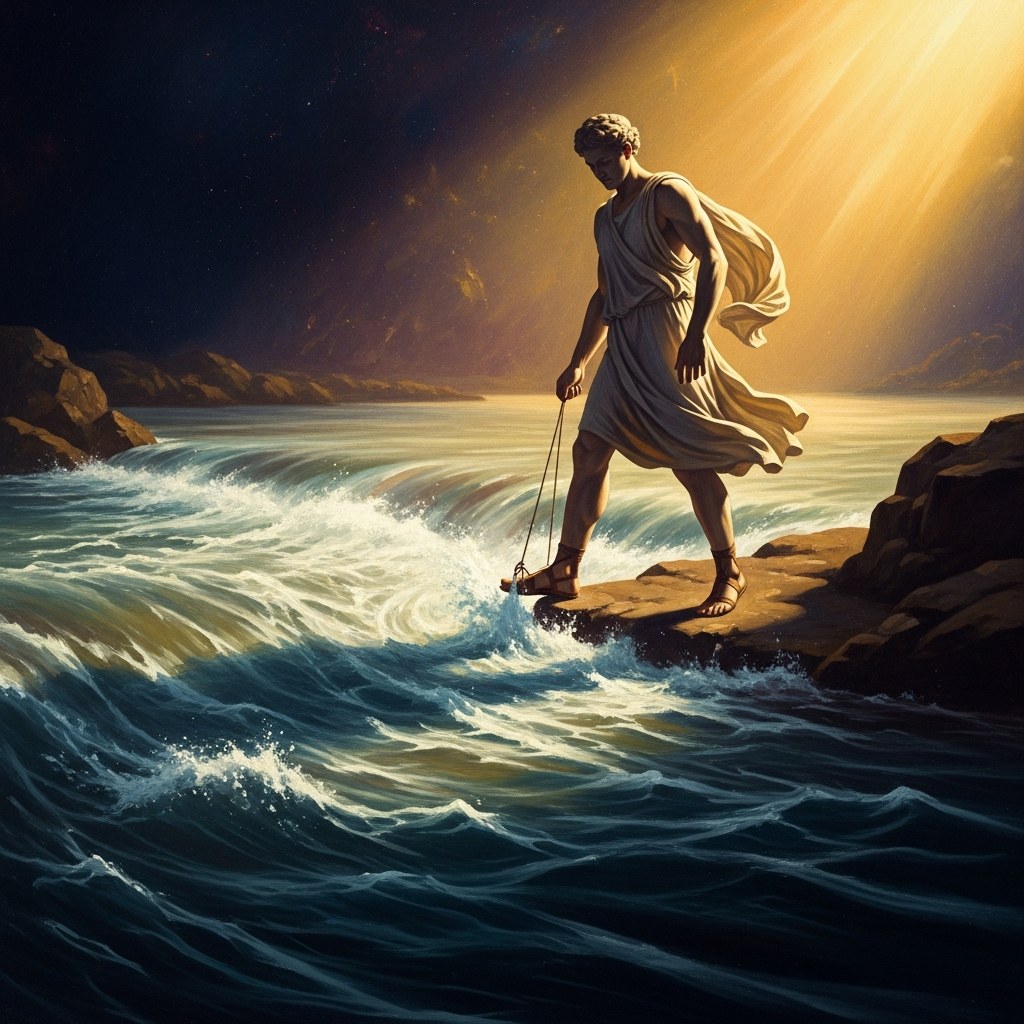
 He stands at the edge of the river, one foot in the water
 Generating art…
 He deposits his book in the inner chamber of the temple of Artemis at Ephesus — one of the seven wonders of the world — and walks away into the mountains, alone
 Generating art…
 Echoes Across Traditions
Entities
- Heraclitus
- the Logos
- the River
- the One
Sources
- Heraclitus, *Fragments* (trans. Charles Kahn, *The Art and Thought of Heraclitus*, Cambridge, 1979)
- Heraclitus, *Fragments* (trans. Brooks Haxton, *Fragments: The Collected Wisdom of Heraclitus*, Penguin, 2001)
- Diogenes Laertius, *Lives of the Eminent Philosophers* IX.1-17
- Charles Kahn, *The Art and Thought of Heraclitus* (Cambridge University Press, 1979)
- G.S. Kirk, J.E. Raven, M. Schofield, *The Presocratic Philosophers* (Cambridge, 1983)