Job in the Ash
Composed ~6th-4th century BCE; the events undated, archaic · The land of Uz — east of Israel
Contents
A righteous man is stripped of everything — children, wealth, health — sits in ash, and demands an answer from God. The answer that comes is not an answer.
- When
- Composed ~6th-4th century BCE; the events undated, archaic
- Where
- The land of Uz — east of Israel
The Wager
In the land of Uz there is a man named Job. Blameless. Upright. Feared God and turned from evil. The text does not say he was good the way a warrior is good at war — it says this goodness was the shape of his entire life. He had seven sons and three daughters. Fourteen thousand sheep. Six thousand camels. A thousand yoke of oxen and a thousand she-asses. A household so great the text has to count it twice to make you believe it.
And then — in the way of the book’s cold opening — we rise up out of human affairs to see what humans cannot see.
God sits. The divine court gathers, and HaSatan walks among them. Not a demon yet in the old sense. Not yet the devil. Just the Accuser — the one whose job is to find the flaw in the creation, to test the seams. God says, “Have you considered my servant Job? There is none like him on the earth, a blameless man.”
And HaSatan answers: “Does Job fear God for nothing? Haven’t you put a hedge around him, around his household, around all that he has? You have blessed the work of his hands. His possessions spread through the land. But put out your hand. Touch what he has. I wager he will curse you to your face.”
It is the cruelest wager in scripture because both parties know exactly what they are wagering. God does not accept out of arrogance or blindness. God accepts it knowing what will happen next — that Job will lose everything. That the test is real. That the answer Job will receive will not console him.
“All that he has is in your power,” God tells the Accuser. “Only do not put out your hand against the man himself.”
Permission given. The machinery set in motion.
The Stripping
A messenger arrives while Job’s sons are feasting. The Sabeans have fallen on the oxen and asses. Taken them. Killed the servants. Job’s son dies in the next sentence.
Another messenger: fire has fallen from the sky and burned up the sheep. Another: the Chaldeans have taken the camels. Another: a wind has come from the desert and collapsed the house where his seven sons and three daughters were eating bread together.
The text will not let you process one loss before the next arrives.
Job rises. Tears his robes. Shaves his head. Falls to the ground. And says: “Naked I came from my mother’s womb, and naked shall I return. The Lord gave, and the Lord has taken away. Blessed be the name of the Lord.”
This is the first act of the drama, and it is almost unbearable. Not because Job has suffered — but because he has done what theodicy demands. He has accepted it. He has found meaning in the loss. He has not cursed God.
HaSatan returns to the divine court. “Skin for skin,” the Accuser says. “All that a man has he will give for his life. But put out your hand and touch his bone and his flesh, and he will curse you to your face.”
God does not argue. “He is in your hand,” God says. “Only spare his life.”
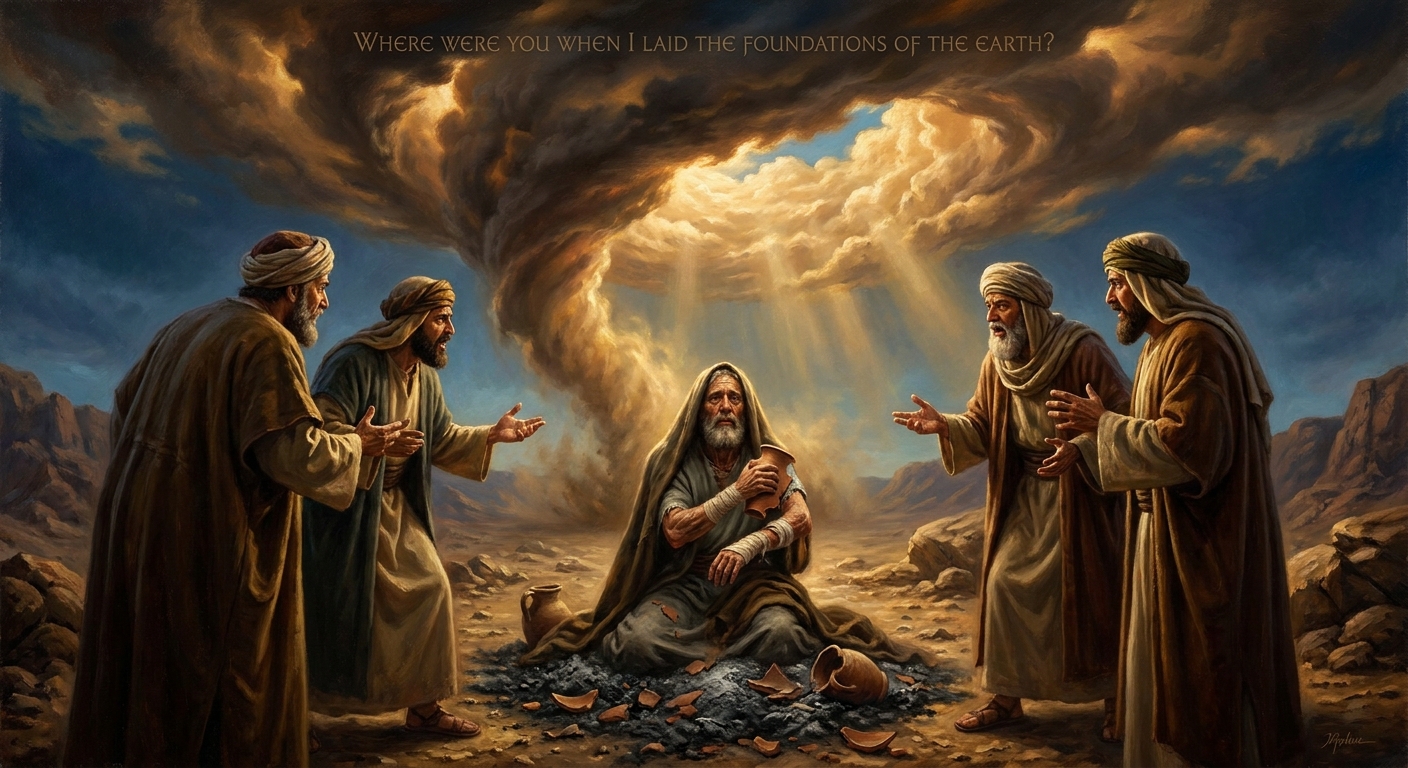
HaSatan strikes Job with sore boils from the sole of his foot to the crown of his head. Job takes a potsherd to scrape himself. He sits in ash. His wife, who has watched him lose seven sons, three daughters, fourteen thousand sheep, six thousand camels, a thousand oxen, a thousand asses, and now his own flesh, stands at the edge of his ash heap and says: “Do you still hold fast your integrity? Curse God and die.”
And Job answers her: “You speak as one of the foolish women speaks. Shall we receive good from God and not receive evil?”
The text says: “In all this Job did not sin with his lips.”
The Friends’ Argument
Three friends hear of Job’s suffering and come to sit with him. Eliphaz of Teman, Bildad of Shuah, Zophar of Naamah. The text gives us the first rule of grief: “They sat with him on the ground seven days and seven nights, and no one spoke a word to him, for they saw that his suffering was very great.”
Silence is the answer.
But Job breaks it. He curses the day he was born. He did not curse God — but he cursed the dawn that brought him into being. And once he speaks, his friends speak, and everything breaks.
Eliphaz is gentle. He suggests that no one is truly innocent. That perhaps Job has forgotten what suffering is for — it is instruction. Divine discipline. Repent, and God will restore you.
Bildad is more insistent. He quotes tradition: “Our fathers found it to be so.” The wicked man is bent like a palm tree. The godless man’s hope will perish. This is how the world works. Obey the order you are given.
Zophar is blunt. You deserve worse than this. You must have hidden sin. Confess it.
Job does not confess. He does not accept their explanation. And here the book becomes something else entirely — it becomes a dialogue, then a trial, then something closer to a scream.
Job says: “I am not inferior to you. But I would speak to the Almighty, and I desire to argue my case with God.”
His friends insist that suffering is always earned. That God does not wound without reason. That the moral order of the universe is not negotiable.
Job says: “I am righteous. You know it. I do not understand why I am in this place.”
This is the raw nerve the book will not cauterize. The friends offer answers. Job offers only silence and the refusal to lie.
Elihu, a younger man who has been listening, erupts. He has a different argument: suffering is not always punishment. Sometimes it is preparation. A warning. A way to turn a man from a pit. But even Elihu’s kindness is another answer, another system, another attempt to make sense of the senseless.
The Whirlwind
Then God speaks.
Not to comfort. Not to explain. Not to justify or to answer the question Job has been asking — “Why am I righteous and destroyed?” — with anything resembling an answer.
“Who is this that darkens counsel by words without knowledge?” God says. “Gird up your loins like a man; I will question you, and you shall declare to me.”
And then the catalogue begins.
“Where were you when I laid the foundation of the earth? Tell me, if you have understanding. Who determined its measurements — surely you know! Or who stretched the line upon it? On what were its bases sunk, or who laid its cornerstone when the morning stars sang together and all the sons of God shouted for joy?”
God does not answer the question. God asks it back, and the question itself is the answer. You were not there. You do not know the names of the cosmic architecture. You have never commanded the dawn or shown the morning its place. You have never walked on the floor of the sea or entered the springs of the sea. You have never entered the treasury of the snow or the treasury of the hail.
“Can you bind the chains of the Pleiades or loose the cords of Orion? Can you lead forth the Mazzaroth in their season, or can you guide the Bear with its children? Do you know the ordinances of the heavens? Can you establish their rule on the earth?”
On and on. Ostrich and hawk. Lion and raven. Wild goat and wild ass. The leviathan — that great serpent with teeth like swords, breath like fire, a creature so vast and terrible that only God can control it.
“Will you play with him as with a bird? Will you put him on a leash for your maidens? Will traders bargain over him? Can you fill his skin with harpoons or his head with fishing spears?”
Job does not get an answer to his suffering. Job gets a vision of the cosmic indifference, the terrible beauty, the architectural knowledge that is forever outside human reach. He gets to see the shape of a world whose purposes are not his purposes, whose logic is not human logic, whose justice is not the justice of a trial.
And Job bows his head.
“I had heard of you by the hearing of the ear,” he says to God, “but now my eye sees you. Therefore I despise myself and repent in dust and ashes.”
Not because he understands. Because he has glimpsed the scale of what he does not understand. Because the answer that is not an answer has done something an answer could never do — it has broken the machinery of complaint, not by explaining suffering away, but by showing that explanation itself is small.
The Restoration and the Wound
The text does restore Job. Twice his wealth returns. His children come back — seven sons and three daughters, named for beauty this time: Jemimah, Keziah, Keren-Happuch. “And in all the land there were no women so fair as Job’s daughters.”
He lives a hundred and forty years, sees four generations, and dies old and full of days.
It is a conventional ending to an unconventional book. It tells you that the righteous are rewarded, that God sees innocence, that the story closes. But the wound is still there. The wound is the question itself — the book will not let you forget that for the first forty chapters, Job had no answer. For forty chapters, he sat in ash and the world offered only silence or lies.
The restoration does not undo this. It sits alongside it. And anyone who has ever suffered knows the truth that the book understands: sometimes the suffering ends and sometimes it does not, but either way, you have sat in ash, and no answer will ever fully reach that place where you sat.
The Book of Job is the most honest text in the Hebrew Bible because it refuses to let you leave the ash heap before you are ready. It refuses to trade righteousness for explanation. It sits with the silence long enough that when God finally speaks, what God says is not a consolation.
It is the cosmos itself.
And that is what Job receives, and it is enough, because it has to be.
Echoes Across Traditions
Entities
- Job
- HaSatan
- Eliphaz
- Bildad
- Zophar
- Elihu
- Behemoth
- Leviathan

Sources
- Book of Job (esp. ch. 1-2, 38-42)
- Robert Alter, *The Book of Job: A Translation and Commentary* (2010)
- Stephen Mitchell, *The Book of Job: A New Translation* (1987)
- *Tanakh* (Hebrew Bible) tradition