Job and the Voice from the Whirlwind
Composed ~6th-4th century BCE; the events deliberately archaic, pre-Mosaic · The land of Uz — east of Israel, the far side of the covenant
Contents
Job loses everything — children, wealth, health. His friends argue he must have sinned. He insists he is innocent and demands an audience with God. After thirty-five chapters of argument, God answers from the whirlwind: not with an explanation, but with a question. Job says: I have heard of you with my ear, but now my eye sees you. He is satisfied.
- When
- Composed ~6th-4th century BCE; the events deliberately archaic, pre-Mosaic
- Where
- The land of Uz — east of Israel, the far side of the covenant
In the land of Uz there is a man named Job.
The book opens with this sentence the way a legal brief opens: stating the facts. The man’s name is Job. His character: blameless and upright, fearing God and turning from evil. His household: seven sons, three daughters. His wealth: seven thousand sheep, three thousand camels, five hundred yoke of oxen, five hundred she-asses. A very great household in the east.
His sons feast in one another’s houses in rotation. After each feast-cycle, Job rises early and offers burnt offerings for each of them, in case any of them has sinned or cursed God in their hearts. He does this continually. He is a man who prays proactively, who wraps the people he loves in precautionary holiness. He has thought of everything.
He has not thought of the divine court.
The frame of the book rises above the human world to show us a scene that Job will never see and that changes everything: the divine council assembles, and among the bene elohim — the sons of God, the divine beings — there comes HaSatan. Not the Satan of later theology, not the red-horned adversary of medieval iconography. The Accuser: the one whose function in the divine court is to probe, to challenge, to find the flaw. A prosecutorial role, not yet a cosmic enemy.
God says: Have you considered my servant Job? There is none like him on the earth.
The Accuser says: Does Job fear God for nothing? You have made a hedge around him, around his household, around everything he has. You have blessed the work of his hands. His possessions spread through the land. Of course he fears you. Anyone would fear a god who made them this prosperous. But put out your hand and touch what he has. I wager he will curse you to your face.
The wager is not cruel because God does not know what will happen. The wager is cruel because God knows exactly what will happen to Job — the loss of all of it, the ash heap, the years of suffering — and accepts the wager anyway.
All that he has is in your power, God says. Only do not touch the man himself.
The machinery is set in motion. This is the last scene Job is absent from, and Job will spend thirty-five chapters demanding to know what happened here, and he will never be told.
The messengers arrive while Job’s sons and daughters are feasting.
The Sabeans fell on the oxen and asses. Fire fell from heaven and burned the sheep. The Chaldeans took the camels. A wind came from the desert and collapsed the house where the seven sons and three daughters were eating bread and wine together.
The text does not pause between messengers. The losses arrive in the same sentence structure, one after another, the grammar of catastrophe. Each messenger’s first sentence is a loss and each messenger’s last sentence is: I alone have escaped to tell you. The lone survivor. The one who gets away from every disaster in time to report it and then stands there while the next messenger arrives.
Job rises. He tears his robe. He shaves his head. He falls to the ground and he says: Naked I came from my mother’s womb, and naked shall I return. The Lord gave, and the Lord has taken away. Blessed be the name of the Lord.
In all this, the text says, Job did not sin or charge God with wrongdoing.
The Accuser returns to the divine court. Skin for skin, he says. All that a man has he will give for his life. Touch his bone and his flesh and he will curse you to your face. And God, again, consents.
Job is struck with sore boils from the sole of his foot to the crown of his head. He sits in ash. He takes a potsherd to scrape himself. His wife stands at the edge of the ash heap and says: Do you still hold fast your integrity? Curse God and die. Job answers her: Shall we receive good from God and not receive evil? In all this, the text says, Job did not sin with his lips.
Three friends come: Eliphaz of Teman, Bildad of Shuah, Zophar of Naamah. They sit with him on the ground for seven days and seven nights and no one speaks a word, because they see that his suffering is very great.
This is the correct response. The silence is the right answer.
Then Job breaks it.
He does not curse God. He curses the day he was born. He wishes he had been a stillbirth, that he had gone from womb to grave without the interval that has brought him here. He asks why God gives light to those whose suffering makes life a burden. He asks to die.
And once he speaks, his friends speak, and the argument that will not end begins.
Eliphaz is the gentlest. He reminds Job of all the good he has done for others. He says: no one who was innocent ever perished. Suffering is the divine discipline that corrects, not punishes. Despise it not. The Almighty will restore you.
Bildad quotes tradition. The fathers found it to be so: God does not reject a blameless man or take the hand of evildoers. The reed without water withers. The godless man’s confidence collapses like a spider’s web. If you were pure and upright, God would rouse himself for you.
Zophar is bluntest: Know then that God exacts from you less than your iniquity deserves. You must have hidden sin. The capacity of man to understand God is like the capacity of a wild donkey’s colt to become human. Stretch out your hand. Put away iniquity from your tents. Then your life will be brighter than the noonday.
All three are saying the same thing, with increasing confidence: the moral order of the universe is transactional. Righteousness brings blessing. Suffering signals sin. You are suffering; therefore you have sinned. The system is intact. You are just not seeing it.
Job does not accept this.
His refusals grow longer and angrier with each round. He says: I know this as well as you do. Who does not know such things? He says: I have spoken and suffered, and I am not less than you. He says: Will you speak falsely for God and speak deceitfully for him? Will you show him partiality? Will you plead God’s case? He calls his friends worthless physicians, healers of no value, plasters of ash over a wound.
Most astonishingly: Though he slay me, yet I will hope in him — but I will argue my ways to his face.
He is not letting go. He knows that God is the one who has done this. He knows that the divine court exists, though he has not seen it. He has turned over every theological explanation the tradition offers and found each one a lie — not a lie about God but a lie about him, about his actual innocence, about what he actually did and did not do. He refuses to confess to sins he did not commit.
I am innocent, he says. I do not know why I am here. And I will argue this before God himself if I have to.
He argues for thirty-five chapters.
A young man named Elihu has been listening, holding his peace because he is younger than the others and waited his turn. When Zophar and Bildad and Eliphaz fall silent — not because they have persuaded Job or been persuaded by him, but because they have run out of arguments — Elihu erupts.
He is angry at Job for justifying himself rather than God. He is angry at the three friends for not answering Job better. His theology is more subtle than the friends’: suffering is not always punishment, he says. Sometimes it is instruction. Sometimes it is the means by which God opens the ear of a proud man and leads him away from the pit. The medicine is bitter but the disease is worse.
Elihu is the kindest of Job’s interlocutors. He is also wrong, and God will say so, because even the kindest systematic answer to a specific innocent sufferer is still telling a specific innocent sufferer a general principle instead of looking at their face.
No one answers Elihu. The text moves directly from his speech to the whirlwind.
Then the Lord answered Job from the whirlwind.
Not from the sky, not from the temple, not from the burning bush or the still small voice. From the whirlwind — the storm, the chaos that precedes order, the thing that does not explain itself.
Who is this that darkens counsel by words without knowledge? Gird up your loins like a man. I will question you, and you shall declare to me.
The divine response is not an answer. It is forty-four verses of counter-question, one of the most overwhelming passages in all of world literature, and it does not once address the question Job has been asking. Not once does God say: here is why you suffered. Not once: the Accuser and I made a wager and you were the stakes. Not once: I know it was unjust and here is the justification.
Instead: Where were you when I laid the foundation of the earth?
Who determined its measurements — surely you know? Who stretched the measuring line over it? On what were its bases sunk, or who laid its cornerstone, when the morning stars sang together and all the divine beings shouted for joy?
The cosmological questions pour out. Have you entered the springs of the sea? Have you comprehended the expanse of the earth? Where is the way to the dwelling of light, and where is the place of darkness? Have you entered the treasuries of snow? The Pleiades — can you bind their chains? Orion — can you loose his cords? Can you guide the Bear with its children?
The biological questions: Does the hawk fly by your wisdom and stretch its wings toward the south? Is it by your command that the eagle mounts up and makes its nest on high?
The monsters: Behemoth, whom I made as I made you — look at its strength in its loins, the power in the muscles of its belly, its tail swaying like a cedar. Leviathan — can you draw it out with a fishhook? Will you put a rope in its nose? Will you play with it as with a bird? Will you keep it for your girls? Will traders bargain over it? Can you fill its skin with harpoons?
On and on, for two full speeches.
Job answers after the first speech. He says: I am of small account. What shall I answer you? I lay my hand on my mouth. I have spoken once, and I will not answer. Twice, but I will proceed no further.
Then God speaks again, still from the whirlwind, still asking questions Job cannot answer.
Job answers after the second speech.
I know that you can do all things, and that no purpose of yours can be thwarted. Who is this that hides counsel without knowledge? Therefore I have uttered what I did not understand, things too wonderful for me, which I did not know. Hear, and I will speak. I will question you, and you declare to me. I had heard of you by the hearing of the ear, but now my eye sees you. Therefore I despise myself and repent in dust and ashes.
He is satisfied.
This is the moment that has troubled every reader for three thousand years. Job has not received an explanation. He has received a vision of the scale of the world in which his suffering is a fact among an uncountable number of facts, each one as real and as ungovernable as his own. The whirlwind does not explain why innocent people suffer. It asks whether the person demanding an explanation has any idea of the complexity of what they are asking an explanation of.
The question is either the deepest wisdom in scripture or the most profound silencing of protest in the name of sheer power. Theologians have been arguing about which for three thousand years and have not finished.
What is recorded is that Job found it enough. Not because the suffering was explained. Because he saw God. Because the encounter was direct — no friends, no theodicy, no tradition, no system — just Job standing in the ash and the whirlwind speaking, and Job finally receiving something real instead of someone’s account of something real.
I had heard of you by the hearing of the ear, but now my eye sees you.
The encounter itself is the answer. Not the content of the whirlwind’s speech, but the fact of the whirlwind speaking at all — the acknowledgment that Job exists, that his protest reached somewhere, that the universe did not remain silent.
God restores Job afterward. Twice his wealth. Seven sons and three daughters — the daughters named this time, which is unusual: Jemimah, Keziah, Keren-Happuch. And in all the land there were no women so beautiful as Job’s daughters. He lives a hundred and forty years and sees four generations and dies old and full of days.
God also rebukes the friends: You have not spoken of me what is right, as my servant Job has. Not the friends with their systematic theology and their moral accounting. Job, who accused and argued and demanded and refused to confess what he had not done. Job spoke of God what is right.
The restoration is not the resolution. The restoration is something that happens after a resolution the text declines to name. The resolution is a man sitting in ash receiving a whirlwind that does not explain itself, and saying: Now my eye sees you. And meaning it. And being satisfied by it.
The Book of Job is the text that refuses to protect God from the accusation of innocent suffering. Every other biblical text finds a way to locate the cause of catastrophe in human sin, in divine discipline, in the larger purposes of history. Job insists on the pure case: blameless man, unearned catastrophe, no explanation.
What God answers from the whirlwind is not an answer to the question Job asked. It is a redirection — not away from the question, but into the scale of the universe in which the question lives. The cosmos is not organized around human suffering or human vindication. The morning stars sang when the cornerstone was laid. Leviathan plays in the deep. The Pleiades have chains that no human hand bound.
Job hears this and it is enough. Not because he understands it. Because he has, for the first time, seen the thing directly instead of hearing about it. The hearing-of-the-ear is tradition, report, secondhand. The seeing-of-the-eye is encounter. What he sees is not an explanation but a presence.
Elie Wiesel, who survived Auschwitz, wrote a play in which God is put on trial by inmates in a concentration camp. The verdict is guilty. The rabbi who delivers the verdict then says: it is time for the evening prayer. They pray. Job prays. The tradition that indicts God also prays to God. These are not contradictions. They are the full arc of the most honest relationship the text knows how to describe.
Scenes
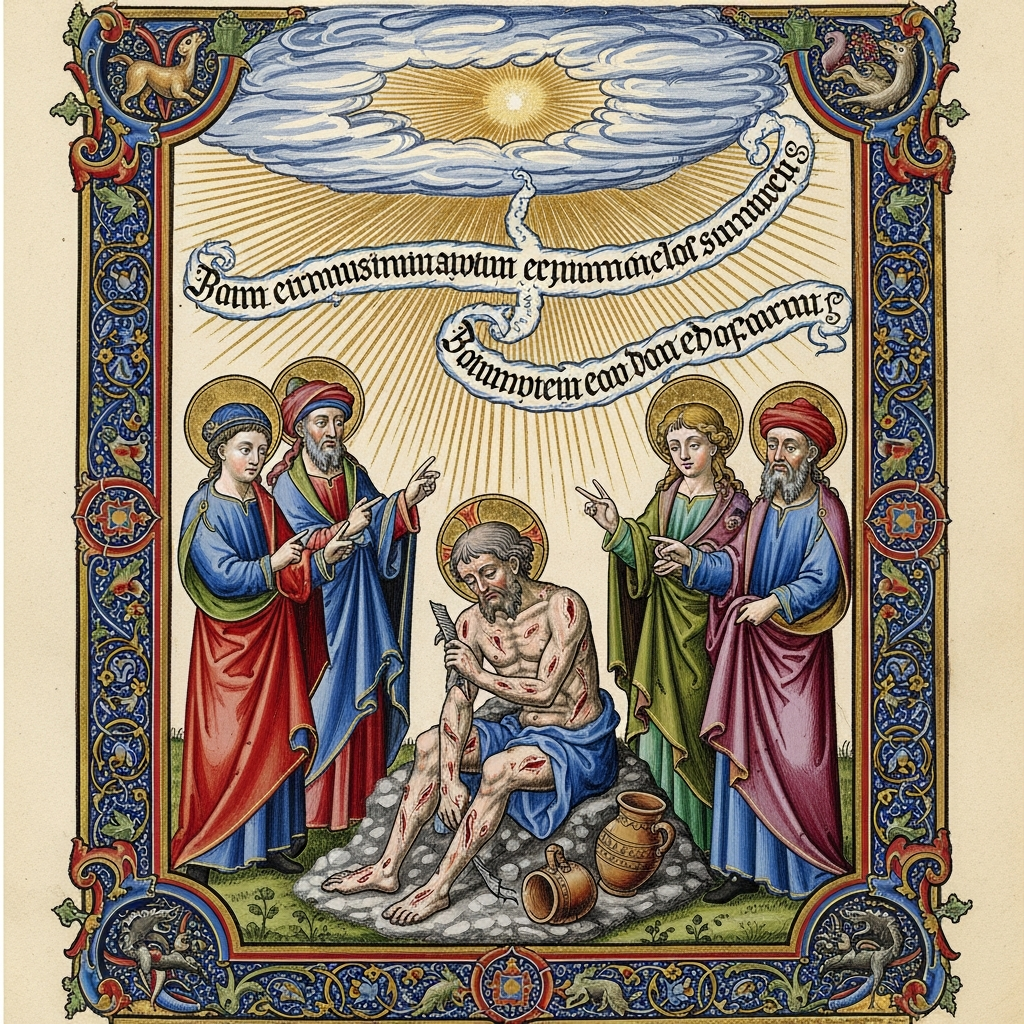
Job sits in ash, scraping himself with a potsherd, while his three friends — Eliphaz, Bildad, Zophar — sit on the ground around him in the seventh day of their silence
 Generating art…
 God speaks from the whirlwind on the horizon
 Generating art…
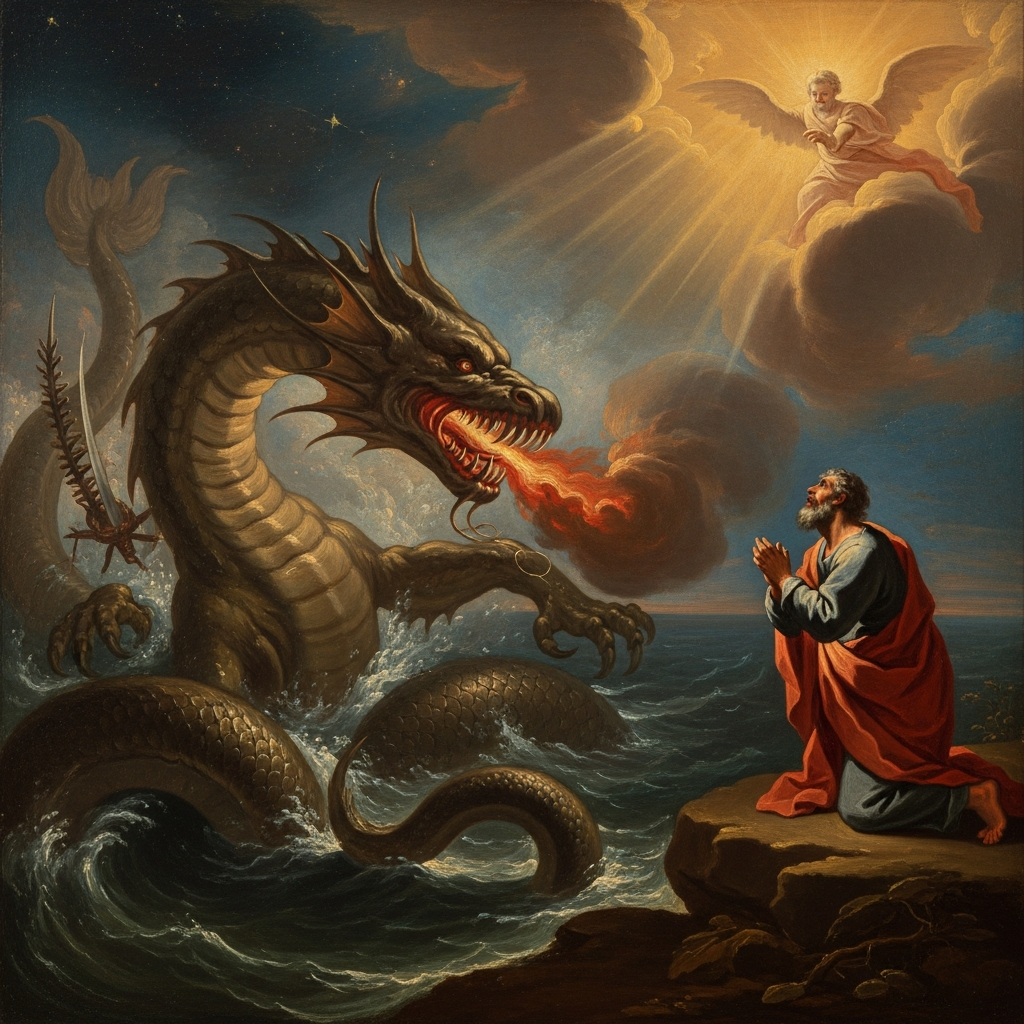
 God describes Leviathan to Job — the sea-monster with sword-like teeth and breath like fire, so vast that beside it Job's suffering is a fact in a universe of facts, each one as real and as ungovernable as the last
 Generating art…
 Echoes Across Traditions
Entities
- Job
- HaSatan
- Eliphaz
- Bildad
- Zophar
- Elihu
- Leviathan
- Behemoth

Sources
- Book of Job, chapters 1-2 and 38-42 (Robert Alter, trans., *The Book of Job: A Translation and Commentary*, Norton, 2010)
- Stephen Mitchell, *The Book of Job: A New Translation* (North Point Press, 1987)
- Elie Wiesel, *The Trial of God* (1979) — a play staging God as defendant; Wiesel witnessed a literal trial of God in Auschwitz
- Harold Kushner, *When Bad Things Happen to Good People* (1981)
- Carol Newsom, *The Book of Job: A Contest of Moral Imaginations* (Oxford, 2003)