Kali and the Demon Who Bled Armies
Mythological time · The cosmic battlefield; the Devi Mahatmya's mythological cosmos
Contents
The demon Raktabija possesses a boon that makes him impossible to kill: every drop of his blood that hits the ground spawns a full-grown demon identical to himself. The goddess Durga and her seven Matrika warrior-forms are losing the battle. From Durga's own brow Kali erupts — skeletal, black, beyond ferocity — and drinks every drop of Raktabija's blood before it can fall, swallowing his army back into herself until the demon stands alone, dry, and dies.
- When
- Mythological time
- Where
- The cosmic battlefield; the Devi Mahatmya's mythological cosmos
The problem with Raktabija is not that he is strong.
The problem is that he is precise. His boon — granted by Brahma in a moment of cosmic generosity that will be regretted — is not invincibility in the conventional sense. He can be wounded. His flesh opens to blade and spear like any flesh. What he cannot do is bleed onto the ground, because each drop of his blood that touches the earth rises immediately as a new Raktabija, fully formed, fully armed, carrying the same boon. He is a self-replicating catastrophe. The more you cut him, the more of him there is.
Durga has been fighting him for three days, and the number of Raktabijas on the battlefield has grown from one to thousands. Her seven Matrika companions — Brahmani, Vaishnavi, Maheshvari, Kaumari, Varahi, Narasimhi, Aindri, the warrior-forms of the gods wearing female faces — have fought with skill and fury and have made the situation worse with every wound they’ve opened. The battlefield is a field of mud and blood and identical demons, each one grinning with the same grin, each one knowing that exhaustion is on his side.
The conventional arsenal of heaven has been tried and found wanting.
Durga is many things. She is the goddess who emerged from the combined fury of all the male gods when they could not defeat the buffalo-demon Mahishasura — she is their power concentrated and feminine and mobile, carrying their weapons but wielding them according to her own intelligence. She is the preserver of the cosmic order that the demons threaten. She fights with strategic competence and without fear, and she has been known to kill with a smile so calm it is more terrifying than fury.
But she is also a form of limitation. She fights within the structures of divine war — weapon against weapon, force against force, the logic of battle applied with superior divine skill. Raktabija has exited that logic entirely. He has weaponized his own biology. Every conventional act of warfare against him is an act of creation on his behalf.
She stops fighting.
She goes still in the middle of the chaos, weapons lowered, eyes closed, the battlefield churning around her. The Matrikas, seeing this, form a protective circle, buying her a moment.
What emerges from her forehead is not a decision. It is a force she has been holding back because forces of this kind tend to be difficult to stop once started. It is older than strategy. It is what remains when every civilized response to evil has failed and the only honest answer left is one that cannot be framed in the language of civilization.
Kali erupts.
She is black, which does not mean the absence of light but the presence of everything light has not touched. She is skeletal — or rather, she wears her skeleton on the outside, her bones and their articulations visible in the thinness of her form, which is itself a statement about what she is: she is what is left when the flesh-claims of ordinary existence have been stripped away. Her hair is loose and vast, a storm around her skull. Her tongue is out — red, enormous, a canopy beneath her open mouth — and she is already moving before she has fully resolved herself into form.
She wears a garland of severed heads. They clatter as she runs. She carries weapons but does not use them in the way weapons are conventionally used.
She opens her mouth and she eats.
Not the demons directly, not at first. She catches Raktabija’s blood. Every wound already opened on the original Raktabija, every drop already falling — she is beneath it, tongue extended, and she drinks. She drinks the clones as they rise, drawing them back into herself before they can fully form, swallowing armies at a pace that does not look like drinking but like the closing of a drain. The battlefield empties. She moves through the multiplication of Raktabija like a fire through a field of dry grass, not fighting the fire but being it, consuming back into herself what his blood has generated.
The Matrikas watch. They have seen terrible things. They are themselves the concentrated war-fury of the greatest gods in creation. They stop what they are doing and watch.
The last Raktabija stands alone.
The others are gone — absorbed, swallowed, drunk back into the goddess who is herself a stomach for chaos. The original demon is still whole, still bearing his boon, still the source of all the multiplication that is no longer multiplying. He is bleeding freely from a hundred wounds. None of the blood falls. Kali is everywhere beneath him, tongue extended, catching each drop with a completeness that is almost meditative.
He understands what is happening. The understanding does not produce panic; demons of his magnitude tend to face death with a certain philosophical equanimity, having anticipated it eventually despite every precaution. He has simply run out of the mechanism that was supposed to prevent it.
He dies standing up. The wounds are enough, once the blood stops reproducing him. He falls in stages, like a large tree. Kali catches the last drops.
She stands in the empty field and does not immediately stop. This is the theological difficulty she presents, the thing that makes the gods nervous even in victory: once started, she does not easily end. She has swallowed an army and the swallowing has become its own momentum. She is turning now toward the battlefield at large, toward the ordinary dead, toward everything the long fight has left behind, and the logic of her hunger does not distinguish cleanly between the demonic and the divine.
Shiva appears. He lies down in the path she is walking. She steps on him.
She stops.
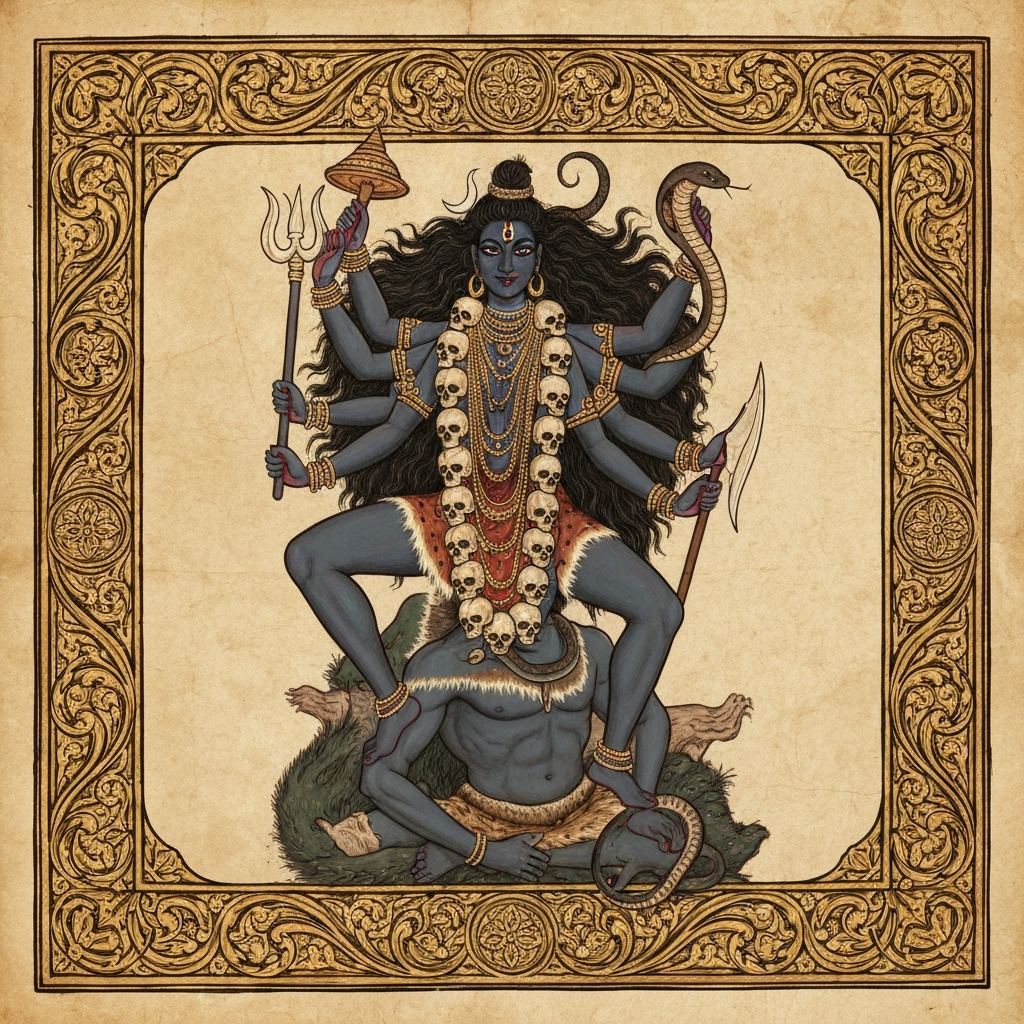
The image is famous enough to have become one of the central icons of the tradition: Kali standing on the prostrate body of Shiva, one foot on his chest, tongue still extended, the skirts of severed heads swaying. It is interpreted variously. The simplest reading is that Shiva, her husband, is the only being whose presence can recall her from the consuming absorption she enters in battle. She steps on him; she recognizes him; she is recalled to relation, to particularity, to the specific love that pulls her back from the general devouring.
The deeper reading is structural: Kali is Shakti without Shiva, which is to say she is energy without consciousness, power without direction, the feminine divine force in its pure active state unchecked by the stillness that gives it meaning. Shiva is that stillness — the meditating absolute, the unmoving ground. She stands on him and the image shows what each one requires of the other.
She sheathes the tongue. The battlefield is quiet.
The thing she has swallowed does not re-emerge. It is hers now, integrated, the specific quality of violence she has consumed added to the total of what she contains. She does not purify it. She does not transform it into something else. She holds it. This is the function that no other divine figure in the tradition performs: the goddess who keeps the worst thing inside herself so that it cannot continue to replicate in the world.
The theology of Kali is the theology of the container. Every other divine response to evil attempts to eliminate it — to burn it, exile it, transform it, bind it, redeem it. Kali swallows it. She is the stomach of the cosmos, the organ that processes what the rest of the system cannot.
The Shakta practitioners who worship her — the Tantrikas of Bengal, the Kapalika ascetics who meditated in cremation grounds — understood her in exactly these terms. She does not offer comfort. She does not promise that the terrible things will stop being terrible. She promises only that she is larger than they are, that her mouth is wider than the worst thing you have encountered, that she can take it in.
The demon who bleeds armies cannot defeat the goddess who drinks the blood. This is not because she is more powerful in the conventional sense. It is because she is a different kind of thing entirely: the force that is not frightened of what it must contain.
Scenes
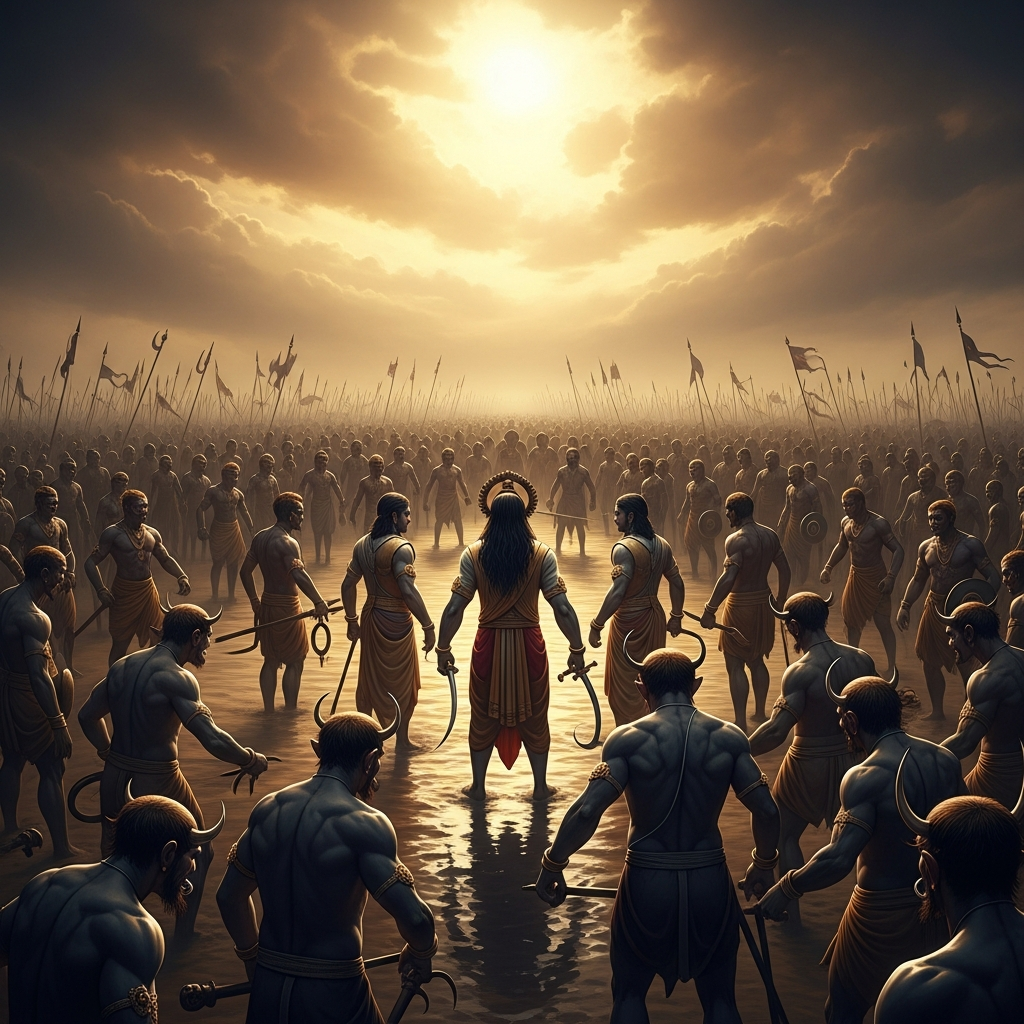
The battlefield is a chaos of identical demons — Raktabija reproduced a thousandfold, each one whole and armed, risen from a drop of blood in the churned mud
 Generating art…
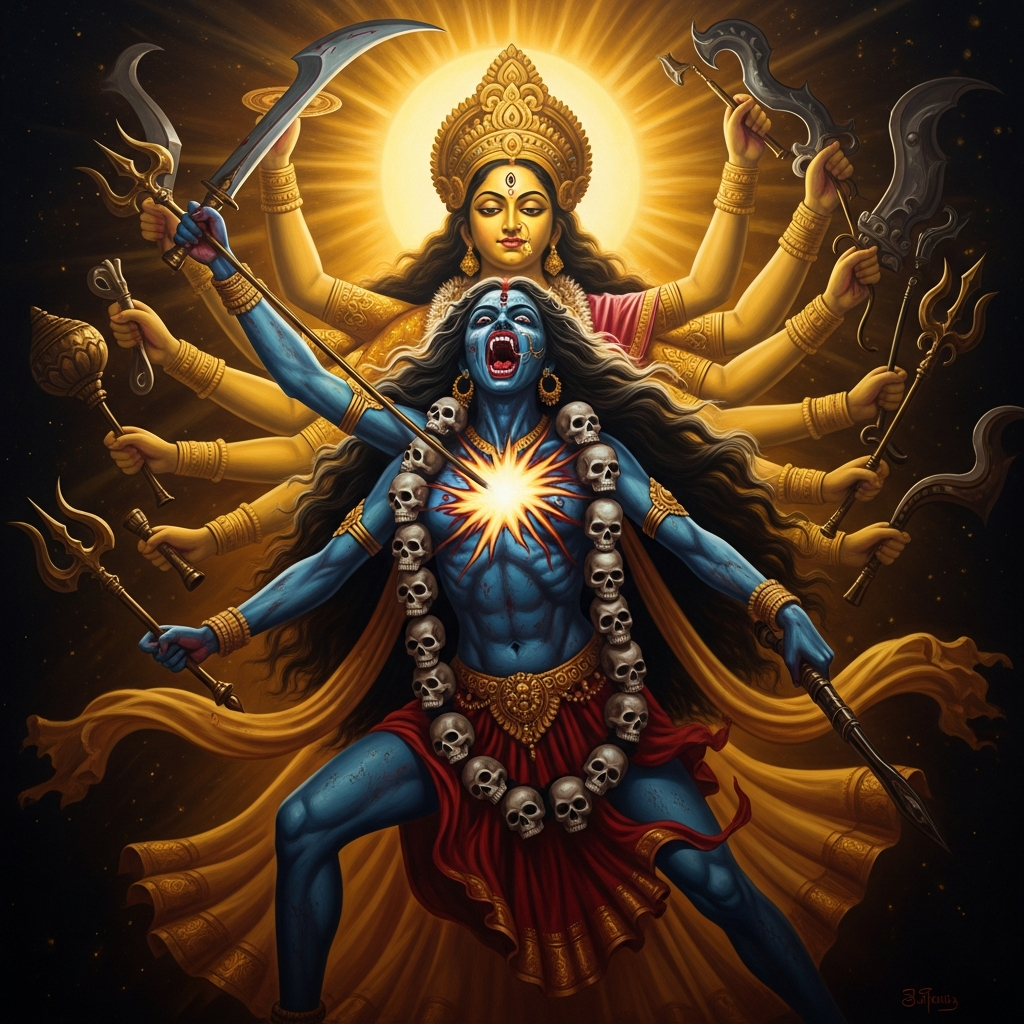
 Kali tears herself free from Durga's forehead — black against the goddess's gold, mouth open in a howl that is also a laugh, tongue already extended, the garland of severed heads still settling around her neck as she enters the battle
 Generating art…
 Kali stands over the last Raktabija, her tongue a dark canopy beneath the demon's wounds, catching every drop before it lands
 Generating art…
 Echoes Across Traditions
Entities


Sources
- David Kinsley, *The Sword and the Flute: Kali and Krsna, Dark Visions of the Terrible and the Sublime in Hindu Mythology* (University of California Press, 1975)
- Ajit Mookerjee, *Kali: The Feminine Force* (Destiny Books, 1988)
- Thomas Coburn, *Encountering the Goddess: A Translation of the Devi-Mahatmya* (State University of New York Press, 1991)
- June McDaniel, *Offering Flowers, Feeding Skulls: Popular Goddess Worship in West Bengal* (Oxford University Press, 2004)
- Rachel Fell McDermott, *Mother of My Heart, Daughter of My Dreams: Kali and Uma in the Devotional Poetry of Bengal* (Oxford University Press, 2001)