Kibuka Falls From the Trees
Mythic time and pre-colonial history — Buganda Kingdom, present-day Uganda · The Kingdom of Buganda, northern shores of Lake Victoria, present-day Uganda
Contents
Kibuka, the war god of Buganda, is invincible as long as he stays above the battlefield. He is told never to sleep with a captive woman. He sleeps with a captive woman. She escapes and tells the enemy where he hides in the trees. The arrows find him.
- When
- Mythic time and pre-colonial history — Buganda Kingdom, present-day Uganda
- Where
- The Kingdom of Buganda, northern shores of Lake Victoria, present-day Uganda
In the time when the Buganda kingdom is new enough to feel its boundaries and old enough to have enemies, the Kabaka calls on Wanema for help.
Wanema is the lame god — musota, the limping one — the brother of Mukasa who lives in the island shrine on Lake Victoria, who receives offerings from fishermen and traders who need the lake to be kind. Mukasa is the great deity, the one the Buganda call on for the large things. Wanema is smaller, more accessible, the intermediary god, the one who moves between the divine and the particular need. The Kabaka comes to Wanema with a particular need: the Bunyoro are pressing from the north, and the Buganda are losing.
Wanema says: I will send you Kibuka.
Kibuka is the war god.
He is Wanema’s brother and Mukasa’s brother, one of the great balubaale — the hero-gods, the ones who were once powerful men and have become divine through the accumulation of mana that exceptional men accrue in death. He is specifically the god of war, not the god of strategy or the god of bravery or the god of justice in war. He is the raw fact of military superiority — the divine guarantee that where Kibuka goes, the Buganda win.
He comes to the Kabaka before the battle and he says what he always says: I will fight for you. But you must honor my conditions.
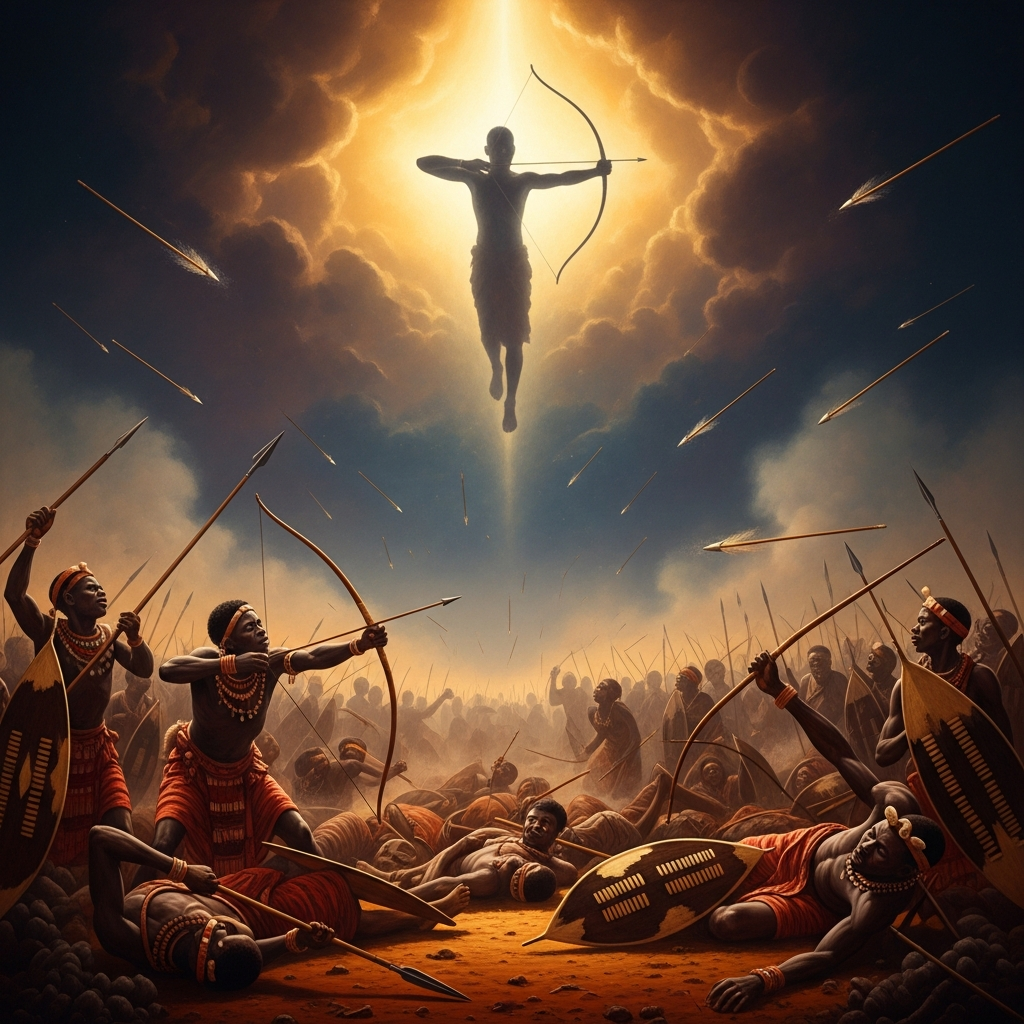
The conditions are specific. While the battle is being fought, Kibuka will be in the air above the battlefield — hidden in clouds or in the high canopy, invisible to the enemy below. He will rain arrows down on the Bunyoro warriors. They will not be able to see what is hitting them. This is the nature of his power: it operates from a position of invisibility that the enemy cannot reach. He must not come down. He must not be on the ground.
And: he must not sleep with any captive women.
This is the second condition, the one that matters for what comes next. It is stated clearly. It is not a suggestion or a preference. It is the same category of requirement as the first — a condition of the power itself, a ritual law that defines the frame inside which divine assistance is available. Break the frame and you break the assistance. The war god’s power is conditional on its conditions.
The Kabaka agrees.
The first days of the battle go perfectly.
Kibuka is above the field — no one on the ground can see him, but the Bunyoro warriors are dying. Arrows fall from a clear sky. Men fall in open ground with no one near them. The Bunyoro commanders look at the sky and then at their falling men and cannot find the source. The Buganda advance behind their own lines while something above the battlefield does the killing. By the second day the Bunyoro are pulling back.
Among the Bunyoro captives taken in the early fighting is a woman.
Kibuka should not touch her. The condition was stated clearly and he knows it. The condition is not only a moral rule — it is a structural requirement of the power itself, the kind of specific prohibition that the divine always attaches to divine assistance because the divine understands that power without constraint is not divine assistance but divine abandonment. The prohibition protects Kibuka as much as it restrains him. It defines the condition under which his invincibility holds.
He is in his camp at night and the woman is there and he is a war god who has been fighting for several days and she is close and the prohibition is — he tells himself — a rule for the battlefield, not the camp, or a rule for the fighting, not the resting. He finds reasons. The gods who fall always find reasons. The reasons are always almost adequate.
He sleeps with the captive woman.
She listens while he sleeps.
The captive woman is not a passive victim in this story. She is a person doing what captive people have always done when they find themselves in possession of information that can change their situation: she pays attention. She learns where Kibuka is. She learns his patterns. She learns the time at which he rises from the camp and ascends to his position in the trees at the battlefield’s edge, the specific trees above the specific section of the fighting where his arrows fall.
At the first opportunity, she escapes.
She goes back to the Bunyoro lines and she tells the commanders everything. She tells them where Kibuka is hiding. She tells them the trees. She tells them the time of day when he is in position and what he looks like when he is not guarding against being seen, because he believes he is invisible and a god who believes he is invisible stops being careful.
The Bunyoro archers prepare.
The next morning, Kibuka ascends to his position.
He settles into the canopy above his section of the battlefield, invisible in the leaves, above the sight-line of anyone on the ground. He begins his work. Below him, the battle continues. He raises his bow.
The arrows from the Bunyoro lines find him.
They do not find him by accident. They come to the exact tree, the exact branch, the exact position. They come from the ground, from archers who have been told exactly where to look by a woman who listened in the dark and remembered what she heard. Kibuka is invisible to the battlefield — but not to people who have been told where to aim.
He falls from the trees.
He falls as gods fall who have violated the conditions of their own power — not immediately, not cleanly, not in a way that permits any argument that the condition was ambiguous or that he did not know or that the consequence was disproportionate. The violated ritual law and the death are the same event. The captive woman’s knowledge and the arrows and the fall are the mechanism by which the law enforces itself. There is no distance between the transgression and the consequence.
Kibuka falls from the trees, and the war god of the Buganda falls to earth, and the Buganda lose the divine military advantage they were given.
He does not simply die.
His spirit becomes a lubaale in the specific way of the hero-gods of Buganda — present, accessible, still available to the people who know how to reach him, but available now through the shrine rather than through direct divine presence on the battlefield. The shrine of Kibuka is at Mbaale, on a hill above the lake, where his priests maintain the relationship between the war god and the kingdom. Offerings are brought. The drums are played in the pattern that calls his name.
But Kibuka will not fight above the battlefield again.
The Kabaka goes to Wanema and explains what happened. Wanema does not say: I did not tell you the conditions. Wanema does not say: I am surprised. Wanema says nothing particular. He receives the report of the fallen war god with the patience of a divine being who understands that conditional power given to unconditional men almost always ends this way, and that the tragedy is not that the condition was unclear but that the man — even the divine man — believed his desire was an exception.
The Buganda kingdom continues. The war with Bunyoro continues for generations. But the divine military advantage, the god in the trees whose arrows fell from a clear sky, is gone. What remains is the story.
The story is told specifically to warriors and to kings.
Not as entertainment. As instruction. The ritual context of the Kibuka story is the pre-battle purification — the night before a campaign when the priests call the balubaale and the warriors undergo the rites that make them ready. The Kibuka story is told in this context because the war god’s failure is the most useful possible reminder of what ritual law is for.
It is not symbolic. It is not metaphorical. Ritual law is the specific technical frame inside which divine assistance operates. Outside the frame, the assistance ends. There is no divine override for a broken condition. There is no prayer powerful enough to retroactively undo the captive woman’s night in the camp, no sacrifice sufficient to make Kibuka invisible again once she has seen him.
The lesson is structural: the power and its conditions are one thing. You cannot accept one and decline the other. The Kabaka who wants Kibuka’s military assistance must also accept Kibuka’s conditions — and more importantly, must make sure that Kibuka himself accepts them, because the god’s own compliance is the foundation of the god’s own power.
A war god who breaks his own ritual law is not a god who has made a personal mistake. He is a god who has ended himself.
On the hill at Mbaale, the shrine priests still maintain the relationship. The drums still call Kibuka’s name. He is still a balubaale, still present, still accessible to the people of Buganda who know how to reach him. But he is reachable now through the shrine, through ceremony, through the careful maintenance of the relationship that the captive woman’s information broke. He watches from above, as he always did. He is just no longer above the battlefield. He is above the shrine, which is smaller, and quieter, and which never required him to choose between his power and his desire.
Scenes
Kibuka hovers above the battle at Bunyoro — invisible, invincible, his arrows falling from a cloudless sky, the warriors below unable to see what is killing them
 Generating art…
 The captive woman in Kibuka's camp at night — her face turned away, her mind already on the route back to the Bunyoro lines, the knowledge of where the war god hides forming in her silence
 Generating art…
 Kibuka falls from the trees, the arrows of Bunyoro finding him where the woman said he would be, the war god's invincibility ended by a single broken ritual law
 Generating art…
 Echoes Across Traditions
Entities
- Kibuka
- Wanema
- Mukasa
- Kabaka
- Bunyoro
Sources
- John Roscoe, *The Baganda: An Account of Their Native Customs and Beliefs* (Macmillan, 1911)
- John Mbiti, *African Religions and Philosophy* (Heinemann, 1969)
- Kiwanuka M.S.M. Semakula, *A History of Buganda from the Foundation of the Kingdom to 1900* (Longman, 1971)
- Sylvia Nannyonga-Tamusuza, *Baakisimba: Gender in the Music and Dance of the Baganda People of Uganda* (Routledge, 2005)
- Wangari Maathai, *The Challenge for Africa* (Pantheon, 2009)