Ganga Through Shiva's Hair
Mythic Time · Ramayana and Mahabharata era, ~5th century BCE compositions · From heaven, through Shiva's hair on Mount Kailash, to the Ganges plain
Contents
The river goddess Ganga descends from heaven to purify the ashes of 60,000 ancestors — but her fall would shatter the earth. Shiva stands beneath her, catches her in his matted hair, and releases her in trickles. The Ganges is born.
- When
- Mythic Time · Ramayana and Mahabharata era, ~5th century BCE compositions
- Where
- From heaven, through Shiva's hair on Mount Kailash, to the Ganges plain
In heaven, Ganga does not think of earth.
She flows between the stars in a current the Vedas call Mandakini — the Milky Way, the slow river of light that wheels above every sleeping village. She has always been there. She is not impatient to descend. The work of purification, she understands, is not her choice to make.
Then Bhagiratha comes.
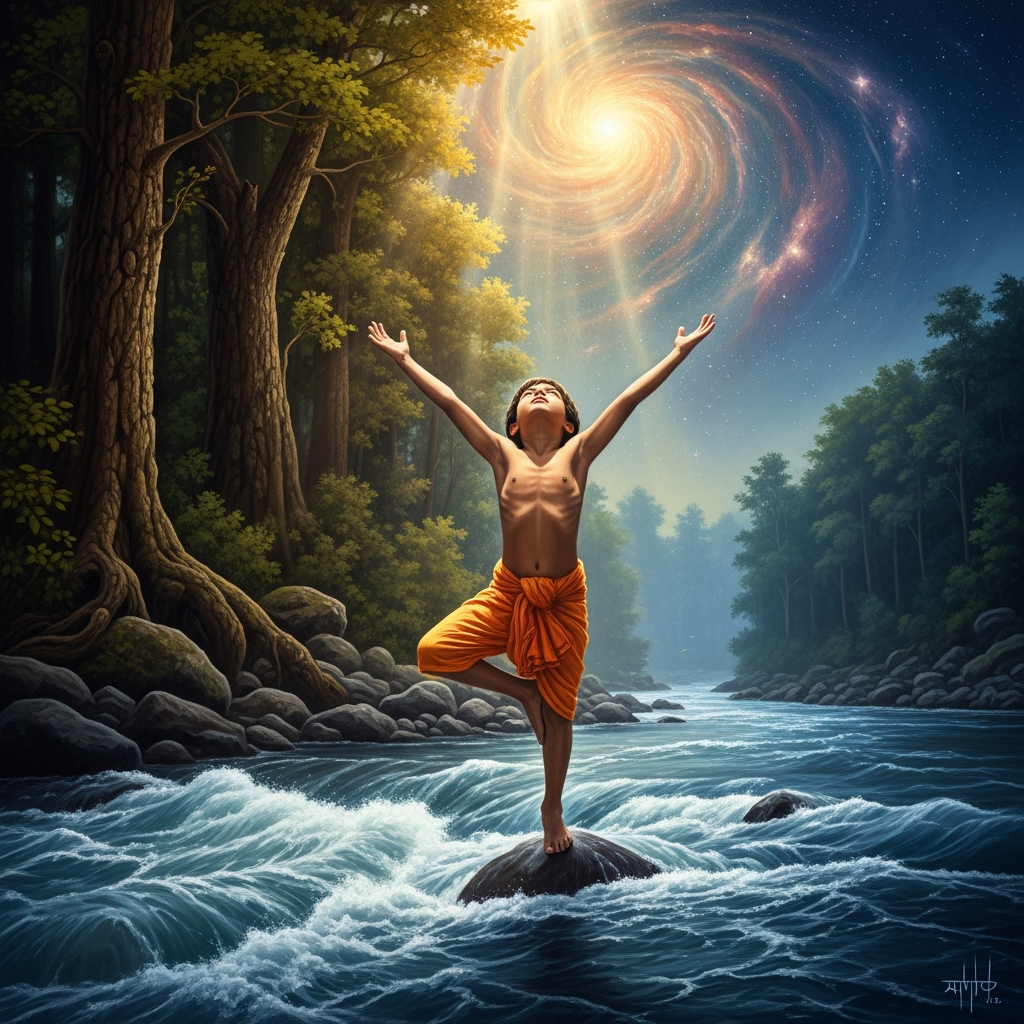
He arrives at the court of Brahma having already spent a thousand years in austerity. A thousand years of standing on one leg, arms raised, face turned to the sun. A thousand years of offering — rice, sesame, water poured from cupped hands into the earth. He is not a young king anymore. He has dissolved most of what kings are made of — pride, comfort, the easy assumption that the world arranges itself around the royal will. What remains is the asking.
He asks for Ganga.
The story is this: his ancestor King Sagara once sent sixty thousand sons — burned from his own flesh by divine boon — to find a stolen sacrificial horse. The sons found a sage named Kapila in meditation and, mistaking him for the thief, shouted an accusation. The sage opened his eyes. The sixty thousand were reduced to ash in an instant. Not punished by any god. Simply caught in the full presence of concentrated spiritual fire and annihilated, the way a moth is annihilated by getting what it sought.
Their ashes sit in the underworld. No water has touched them. No river has crossed that distance. Without purification they cannot move — cannot dissolve, cannot rise, cannot complete the circuit that Sanskrit calls moksha. They are sixty thousand souls stopped at the threshold.
Bhagiratha has spent a thousand years earning the right to ask a goddess to cross a threshold for them.
Brahma grants it. He tells Bhagiratha: Ganga will come. But her fall from heaven will crack the earth in half. Go ask Shiva to catch her.
Bhagiratha goes to Shiva.
Another thousand years of austerity. Another millennium of offering. Shiva is not easy to reach. He sits on Mount Kailash in a stillness that precedes language — eyes half-closed, ash on his skin, the third eye sealed, Parvati somewhere nearby and patient. He has destroyed and will destroy again. He has danced the cosmos to rubble and watched it reassemble. He is not, in any ordinary sense, approachable.
But Bhagiratha comes with a thousand years of sincerity, and sincerity is the one currency Shiva does not ignore.
He opens his eyes. He says: I will stand beneath her.
She falls.
The heaven-born river gathers herself and lets go of the sky. In the Ramayana the poets say the gods themselves come to watch — the devas and apsaras and heavenly musicians crowding the rim of the firmament to see what has never happened. Ganga has been a river of light for longer than memory. Now she is water, and the water is falling, and the fall is without limit, and if she strikes the earth she will drive a hole through to the underworld and drag the ocean in behind her and there will be no world left to purify.
Shiva stands at the foot of the sky.
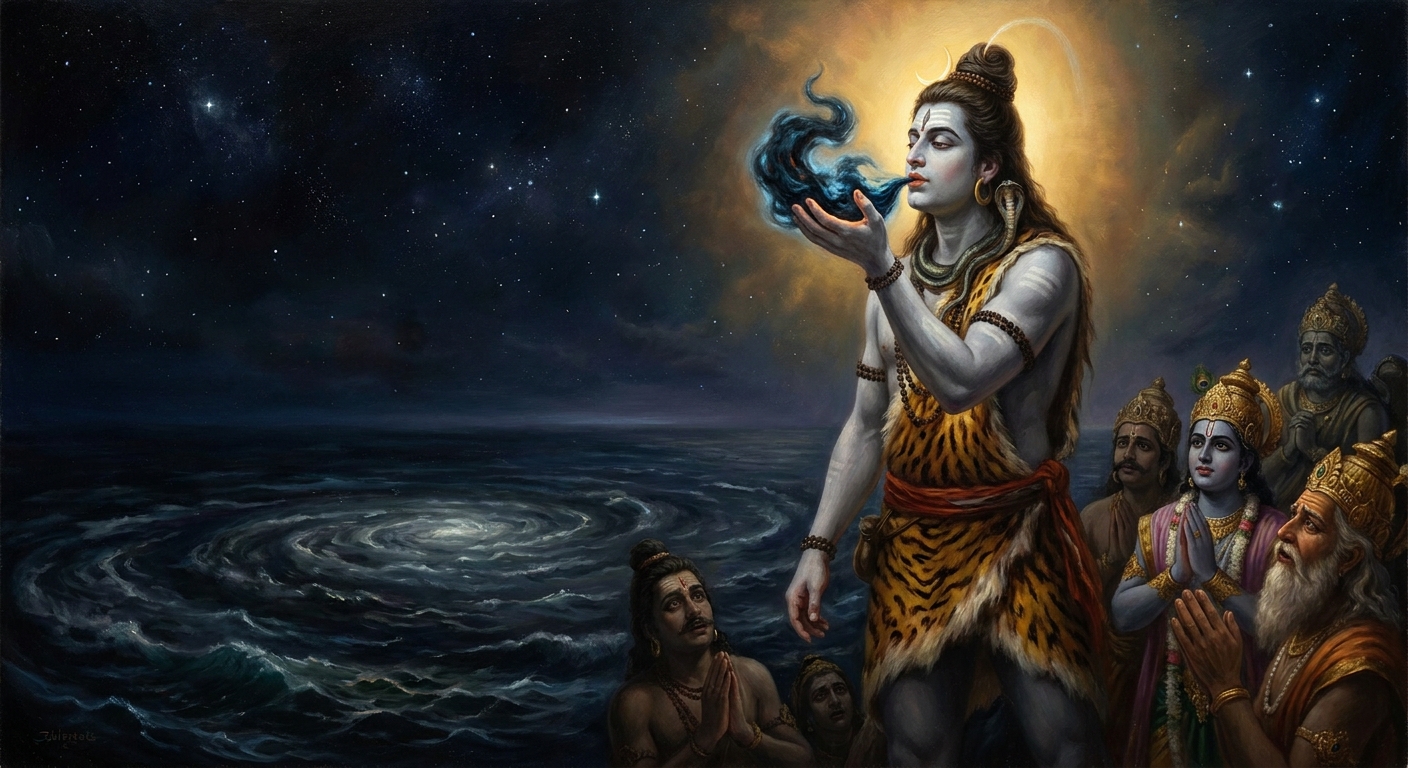
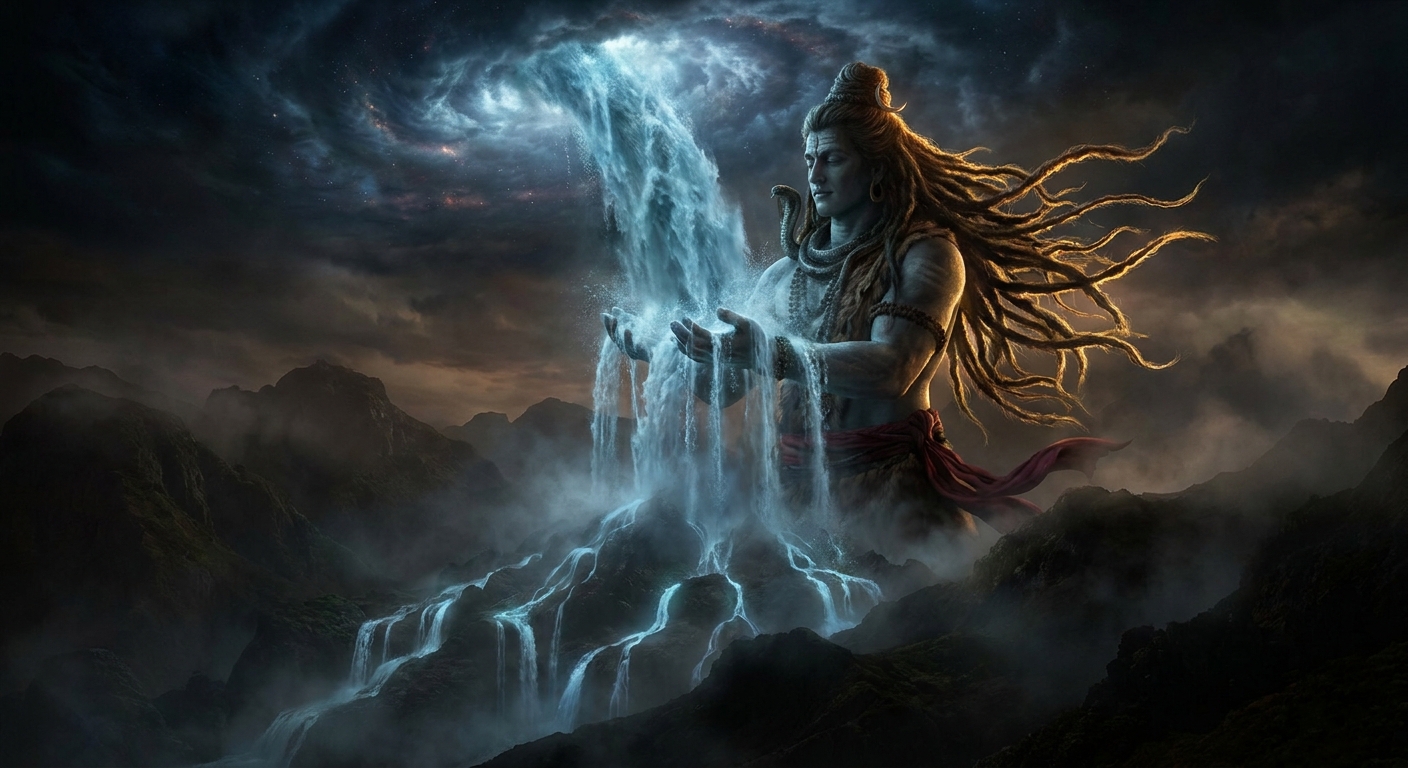
He is not large, in the painting. He is not muscular or armored. He stands on Kailash in the cold morning air with his matted locks unbound — the jata, that great tangle of ascetic hair that no razor has touched since before the current age of the world. He raises his head.
She strikes him.
The force would flatten a mountain range. It does flatten the ambition of the fall — the roar, the splitting of stones, the unmaking of what was beneath. Instead there is a sound like the cosmos taking a breath, and Ganga disappears into the coiled labyrinth of Shiva’s hair, and the earth does not crack.
She wanders in there for years.
This is the part of the myth that the rationalist tends to skip, and it is the part that holds the weight. She does not simply flow through and emerge. She is lost. The jata is a world — a dense, matted continent of hair in which a river can turn and double back and lose its direction entirely. The path that seemed obvious from above has no clear continuation below. She searches for an exit and does not find one. Time passes differently inside the god’s own body. Years pass the way years pass in a forest with no sky visible.
Bhagiratha waits below. The sixty thousand ashes wait. The ancestors wait. Waiting is the one posture this myth does not let anyone escape.
Then Shiva parts his locks.
A trickle. Not a torrent. He does not release the whole river at once; the earth could not receive it. He parts the hair at one point, and a single thread of sacred water runs down the side of his head and across his shoulder and finds the mountain’s slope and begins, slowly, to find its way.
More trickles follow. Seven, the texts say — seven streams separating from the matted locks, seven beginnings of a river that will eventually be one. Each stream finds its own channel through the Himalayas, cutting stone over centuries, carving the gorges that pilgrims now walk to reach the source. The water that fell from heaven and was held in a god is now learning, slowly, how to be a river.
It flows east.
Down the Himalayan foothills, across the alluvial plain, through the flat country where cities will eventually grow — Haridwar, Prayagraj, Varanasi. The river does not rush; it meanders, which is the shape of a river that has time. In the Mahabharata the sages list its tributaries the way the Bible lists the begettings — names accumulating, each name a place where something sacred joined something already moving.
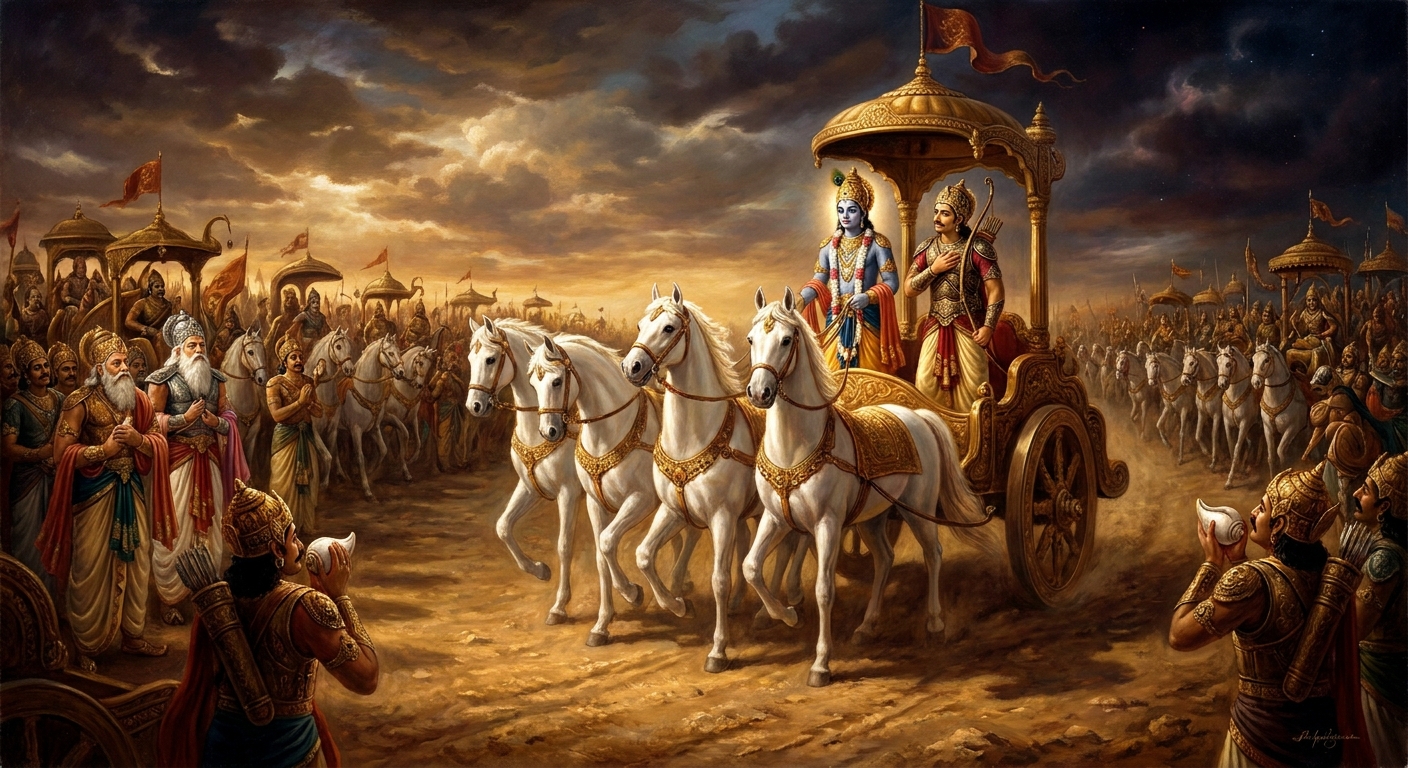
Bhagiratha rides ahead of the river on his chariot, guiding it toward the ocean. This is the image that survives most strongly in the poetry: the king leading the water, the river following the king, the long slow procession from the mountains to the sea. He is not carrying the water. He is walking before it, which is a different kind of service.
The river reaches the ocean.
It descends into the underworld where the sixty thousand ashes lie.
The water touches the ash.
They rise.
All sixty thousand, in the moment the sacred water reaches them, are released. The Ramayana does not labor over this part. It is simply stated: the ancestors of Sagara attained svarga, the celestial realm. They had been held by their own state — ash without purification, fixed in the darkness below the world — and the water dissolved what held them. They ascend the way steam ascends: by becoming the right thing in the right conditions.
Bhagiratha watches from the shore. He has spent two thousand years and two lifetimes of austerity for this moment, and the moment lasts no time at all. The ancestors are gone before he can think of anything to say. The river remains.
This is why the river matters.
Not as metaphor. As cosmological fact, in the tradition that tells the story: Ganga is a goddess who agreed to descend, who was caught by a god, who wandered in the divine before she could reach the human, and who carries that origin in every current. The water that flows through Varanasi today is, in the reckoning of the tradition, the same water that fell from heaven through Shiva’s hair. To die in Varanasi and have your ashes scattered there is to complete the same circuit that Bhagiratha’s ancestors completed — to be touched by water that remembers where it came from.
The anthropologist will note the sanitation practices. The hydrologist will note the self-purifying properties attributed to the river. The theologian will note that the Ganges basin has supported civilization continuously for longer than most religions have existed. These are all true, and none of them is the claim.
The claim is this: the river is a being. It fell. It was held. It was released. And the holding — those years inside the matted hair of the god of transformation — is the source of its power to purify. What passes through the divine is changed. What is changed can change what it touches.
The sixty thousand ascend.
That is the whole story. That is why a billion people call her Ganga Ma — Mother Ganges — and carry her water in brass pots to the homes of the dying, and stand at her banks in the early morning, waist-deep in cold water, pouring the river back to itself with cupped hands.
The river catches what falls. The river releases what has been held long enough.
That is what rivers are for.
Echoes Across Traditions
Entities
- Ganga
- Shiva
- Bhagiratha

Sources
- Valmiki, *Ramayana* Bala Kanda 38-44
- *Mahabharata* Vana Parva 108-109
- *Bhagavata Purana* 9.8-9
- Diana Eck, *India: A Sacred Geography* (2012)
- *India: Sacred Maps* (Ganges chapter)