Quetzalcoatl Walks Into the Sea
Mythic-historical time · Toltec and Aztec tradition · Florentine Codex, Sahagun c. 1577; Historia de los Mexicanos por sus Pinturas, c. 1535 · Tula (Tollan) and the Gulf Coast of Mexico
Contents
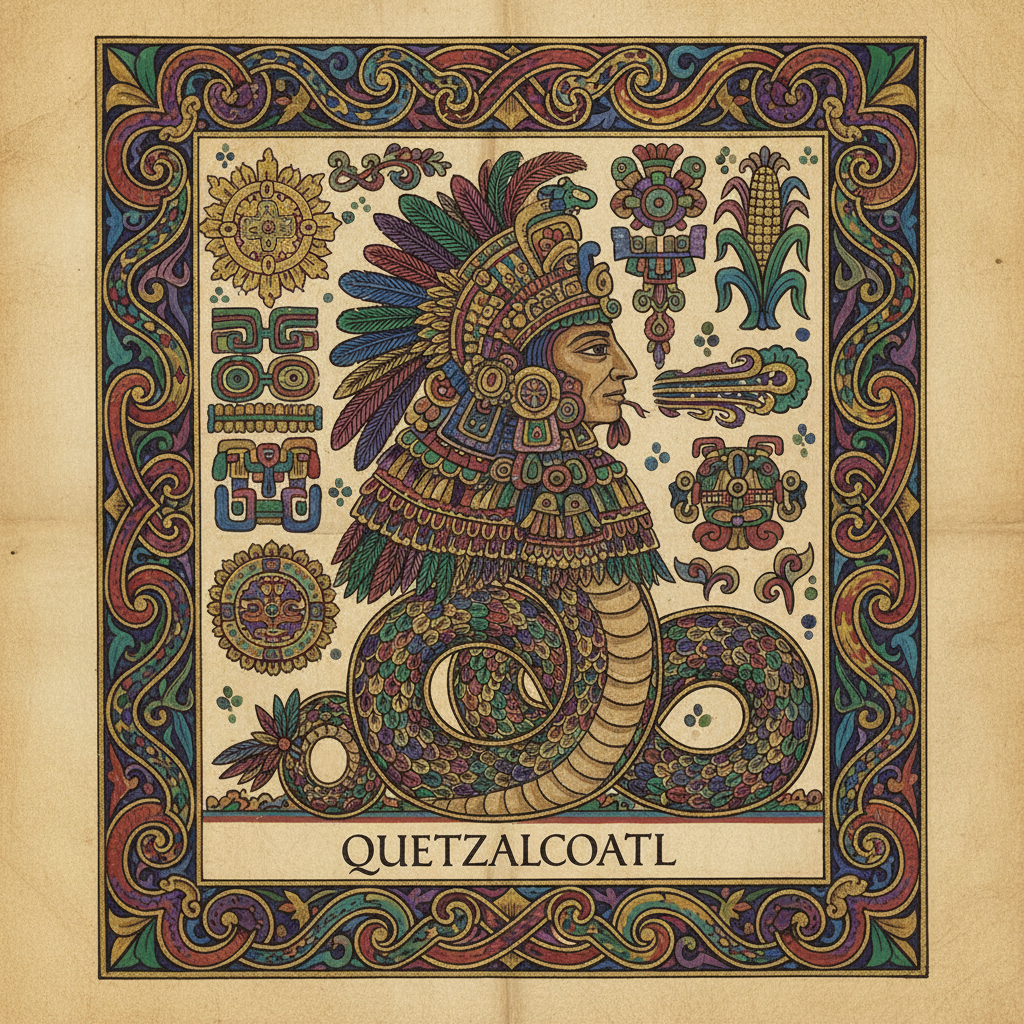
Quetzalcoatl, the Feathered Serpent and priest-king of Tula, is tricked by Tezcatlipoca into drunkenness and incest. Disgraced, he burns his houses of gold and jade, buries his treasures, and walks east with a procession of weeping servants. At the shore of the Gulf of Mexico, he builds a raft of serpents and sails into the dawn. He promises to return from the east in the year One Reed. Hernán Cortés arrived in 1519 — which was One Reed.
- When
- Mythic-historical time · Toltec and Aztec tradition · Florentine Codex, Sahagun c. 1577; Historia de los Mexicanos por sus Pinturas, c. 1535
- Where
- Tula (Tollan) and the Gulf Coast of Mexico
He should never have answered the door.
The night that Tezcatlipoca comes to Quetzalcoatl’s palace in Tula, it is late and cold and the city is quiet in the way that great cities are quiet in the deep hours: not silent but submerged, the ordinary sounds of the day replaced by the different sounds of night, guards at their stations, dogs in the alleys, the occasional distant drum from the temple district. Quetzalcoatl is in his palace of turquoise and jade and red shell, the palace with four chambers that the Florentine Codex describes with reverent precision — the golden room, the turquoise room, the white shell room, the quetzal-feather room — resting in the ceremonial penitential way that the priest-king of Tula observes: cold water over the body at midnight, fasting, the withdrawal from ordinary pleasure that is the cost of the extraordinary power he holds.
He is, by every account of the tradition, a man of extraordinary ritual purity. He does not sacrifice human beings. He sacrifices only birds and snakes, the things appropriate to a priest of the peaceful arts. He does not drink octli — the white, fermented maguey sap that the Aztec call pulque, that is the drink of the unguarded moment, the loosener of the ceremonial self. He observes his vows with the completeness of someone who understands that the vows are not constraints but the shape of the power.
This is what Tezcatlipoca knows. This is what he uses.
The trickster arrives as a physician.
The versions differ in the specific mechanism — the Florentine Codex, the Leyenda de los Soles, and the various other accounts each provide slightly different details of the deception — but the core is consistent: Tezcatlipoca, the Smoking Mirror, the god of night and sorcery and the obsidian surface that shows futures no one wants to see, comes to Quetzalcoatl in a form of apparent helpfulness. He has something that will ease the priest-king’s suffering, he says. He has medicine for the pain in Quetzalcoatl’s chest, the heaviness that the penitential discipline creates in a human body over years of cold and fasting.
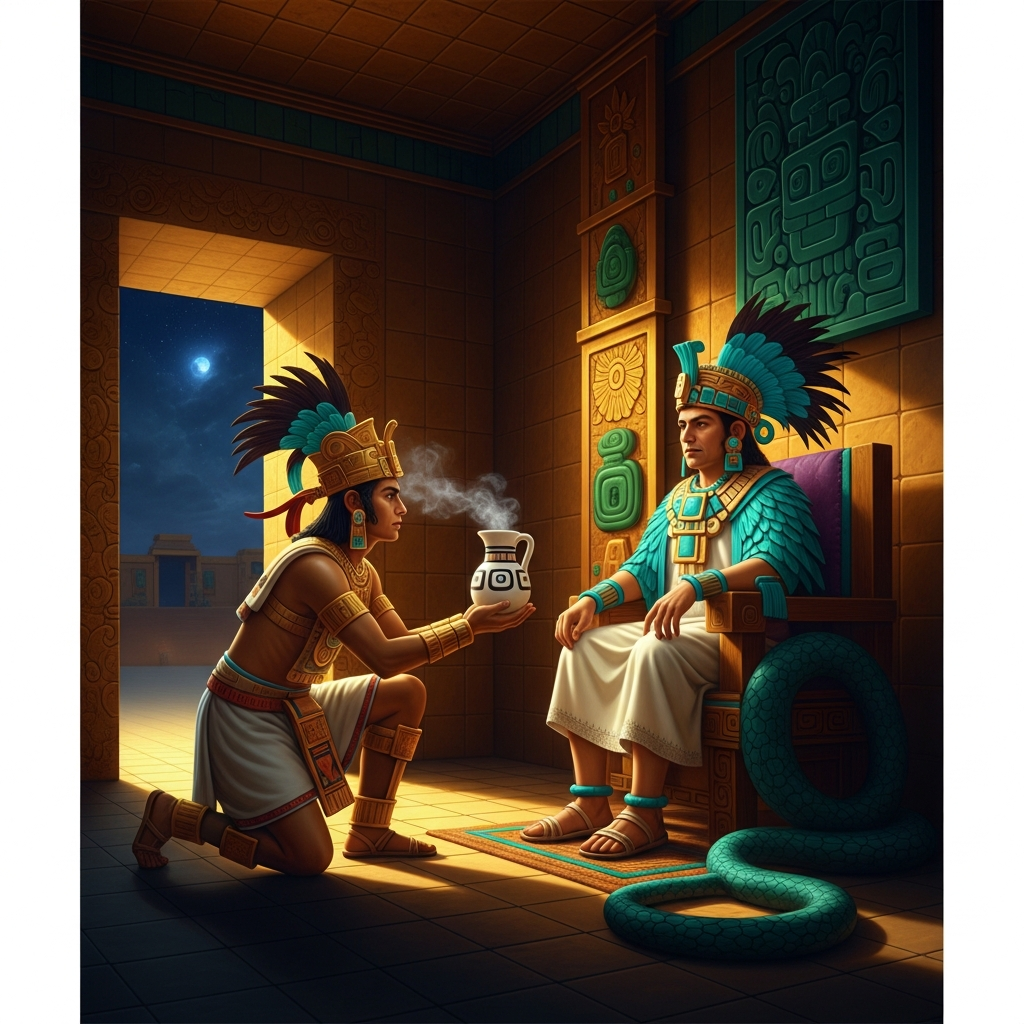
Octli. White and thick and slightly sour, made from the heart of the maguey cactus. The Smoking Mirror offers it as medicine. Quetzalcoatl refuses. The Smoking Mirror insists: just taste it from your finger, just a touch, to know whether the medicine is what I say it is.
He tastes it from his finger.
The Florentine Codex records what happens next with the remorseless specificity of someone who has thought about this moment for a long time: the taste is not unpleasant, the finger goes in again, and again, and then the cup is in his hand, and then it is empty, and then there are more cups, and then there is singing, and then he calls for his sister Quetzalpetlatl, who maintains her own vows of ceremonial purity, and she drinks too, and the night goes wrong in the ways that nights go wrong when the ceremonial self is dissolved.
When morning comes, he knows what he has done.
The shame is specific and architectural.
It is not the drunkenness that destroys Quetzalcoatl — the tradition is not a temperance fable. It is the violation of the celibacy that was the condition of his priestly authority, the specific form of the transgression: not ordinary sin but the undermining of the vows that made him who he was. A priest-king of Tula who observes the penitential discipline is Quetzalcoatl. A priest-king who does not is simply a man in an elaborate costume sitting in a turquoise room.
He weeps. The sources agree on this. Ce Acatl Topiltzin Quetzalcoatl — the full historical-mythological name, combining the calendar name One Reed with the title Our Prince and the name of the Feathered Serpent — sits in the ruins of his night and weeps, and the weeping is not the beginning of recovery. It is the beginning of departure.
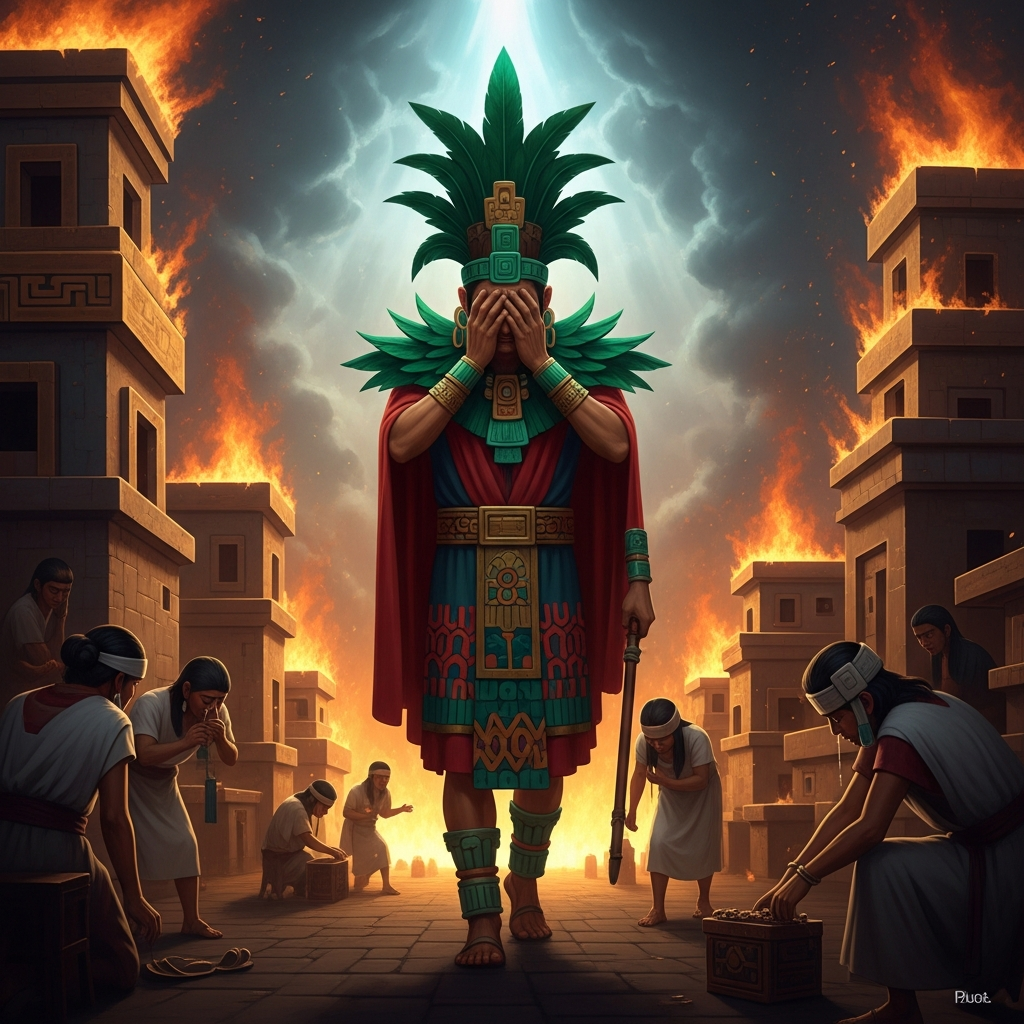
He orders his houses burned.
The specific properties listed in the accounts are the point: not everything, but the things he built with his priestly excellence, the houses that existed because he was who he was. The house of coral. The house of turquoise. The house of white shell. The house of jadestone. The house of turquoise and gold together. He orders them set alight and watches them burn, standing in the pre-dawn darkness while his servants weep around him and the city of Tula, which is the greatest city in the world and the evidence of what the Feathered Serpent made possible, begins to lose its organizing principle.
Then he buries his treasures. The gold and feathers and precious things that are not yet burned — he orders them interred in the earth, taken from the world of the living into the world of the underground, where they will wait. The trees, the accounts specify, he transforms: the cacao trees become drought-colored mesquite, their promise withdrawn. The quetzal birds who nested in Tula fly away. The rivers that ran clear near the city run muddy.
The world that Quetzalcoatl organized around himself is dissolving as he prepares to leave it.
He walks east with a procession of weeping servants.
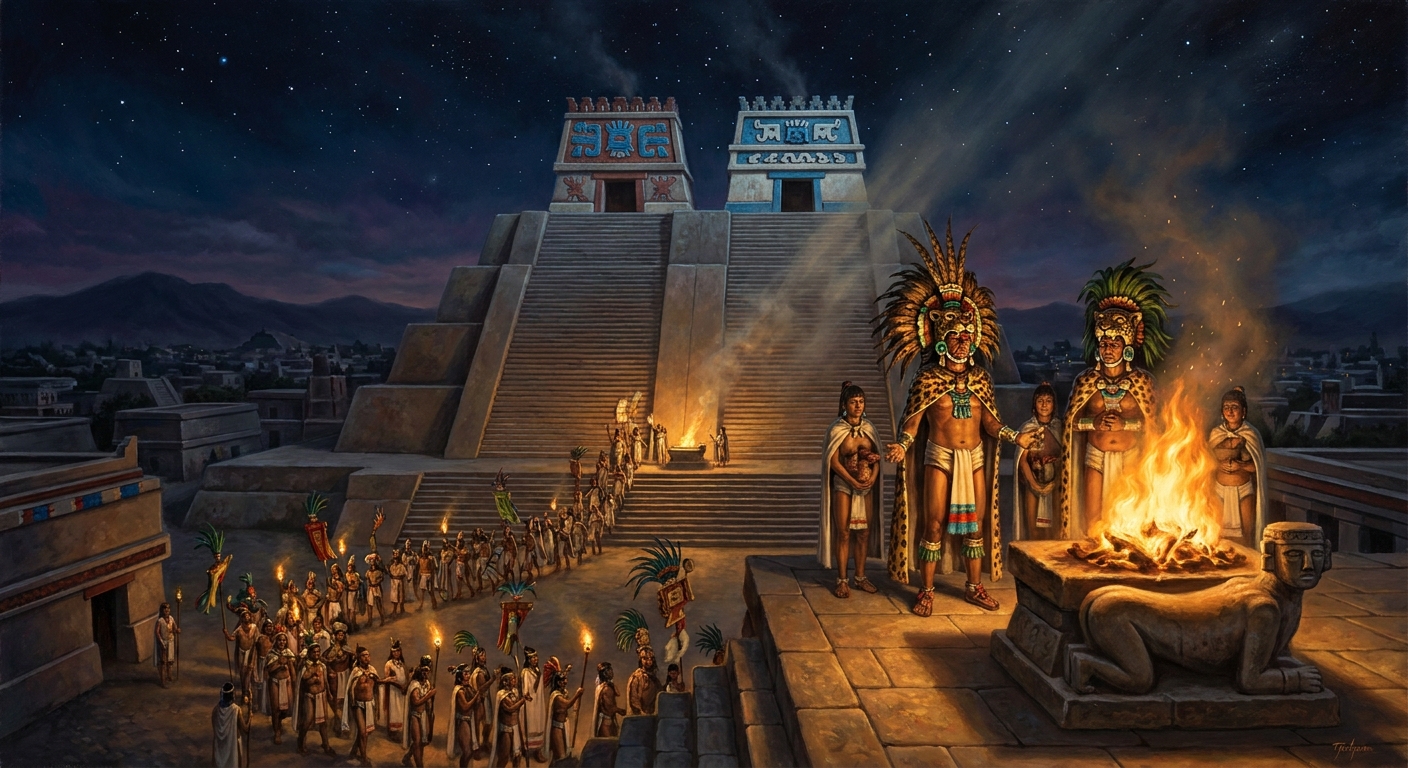
This is one of the most moving passages in any Mesoamerican source text: the great priest-king of Tula, in full ceremonial regalia, walking east toward the Gulf Coast, and behind him his servants and ritual companions, all weeping, all singing the songs of lament that the Nahuas reserved for the deaths of great things. They walk for days. The accounts mention specific places where Quetzalcoatl stops to sit, to rest, to make offerings, to leave marks in the landscape that will still be visible to later Toltec pilgrims — the shape of a person pressed into a stone, the tree where he wept, the river where he bathed and turned the sand to gold.
The journey east is the direction of the morning sun — toward the place where the sun rises, toward the sea beyond which the sun comes from each morning. If Quetzalcoatl’s nature is solar, as the tradition consistently maintains, then his direction of departure is not chosen arbitrarily. He is going home. He is returning to the origin of the light he embodied.
At the shore of the Gulf of Mexico — Davíd Carrasco identifies the location with the coast near modern Veracruz — he stops and looks at the water. His servants are behind him. The water is ahead. He builds a raft.
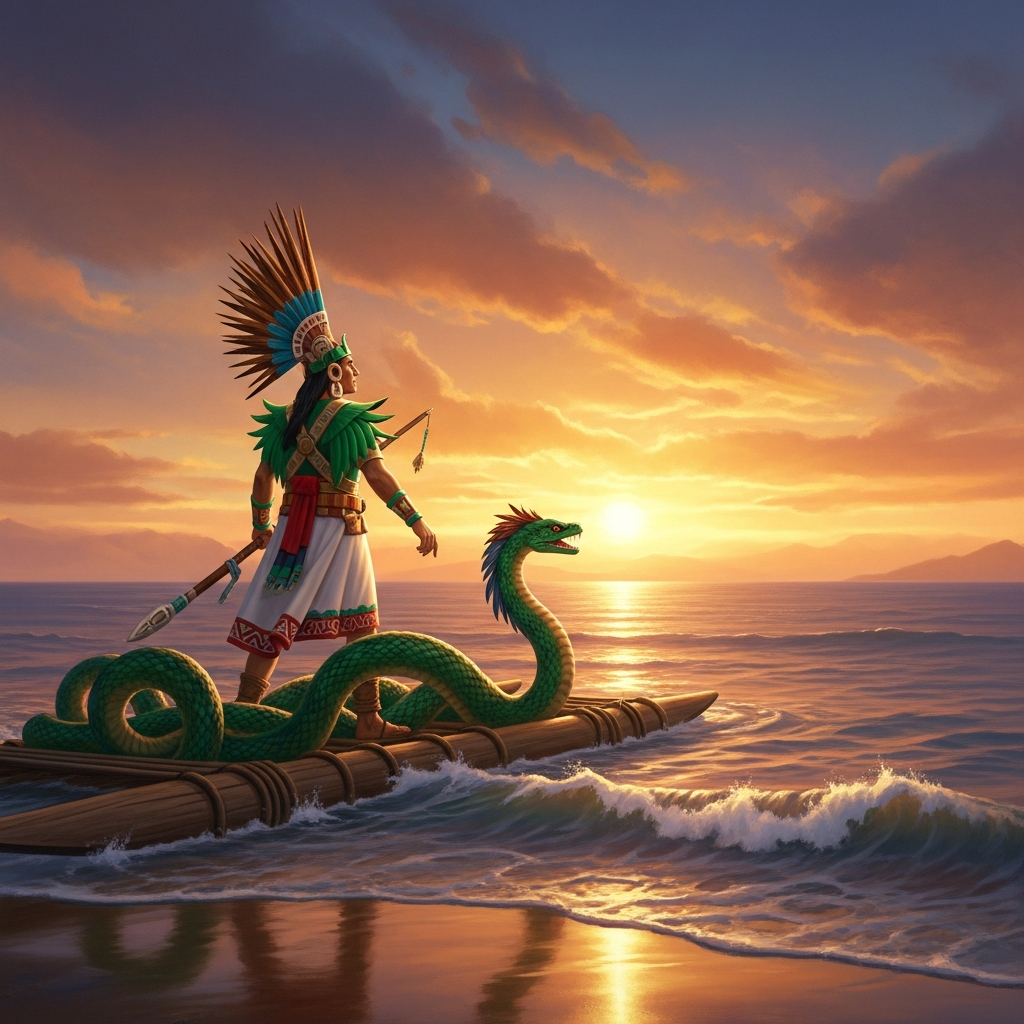
The raft is made of serpents.
Chalchiuh apantli — the jade-water channel, the stream of precious water that leads to Tlapallan, the red land, the legendary destination the Florentine Codex names as the goal of Quetzalcoatl’s eastward journey. He weaves the serpents together, their bodies forming the platform, their scales the floor of the vessel. He steps onto it. He looks back at his servants, who are still weeping.
He says: I will return from the east in the year One Reed.
The year One Reed in the Aztec calendar occurs once every 52 years, the completion of the Calendar Round — the interlocking of the 365-day solar calendar and the 260-day ritual calendar that produces a unique date only once in 18,980 days, just over 52 years. The year One Reed is the year Quetzalcoatl was born (according to the calendar-name Ce Acatl, One Reed), the year his myth took shape, the year of his departure.
The next occurrence of One Reed after the Spanish arrival was 1519.
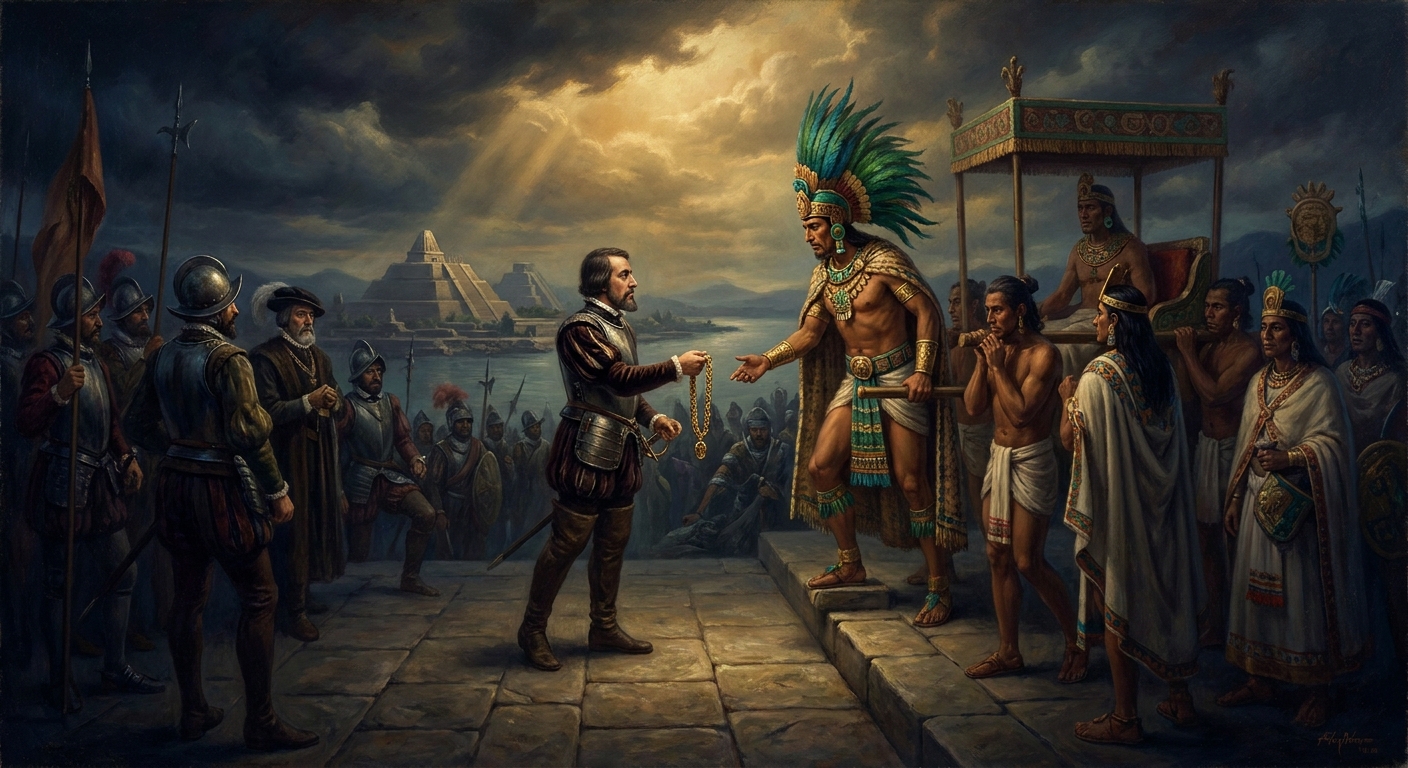
Hernán Cortés sailed from Cuba and arrived on the coast of Mexico in 1519.
The academic debate about whether Moctezuma II actually believed Cortés was Quetzalcoatl is extensive and mostly unresolvable — Matthew Restall, among others, has argued persuasively that the identification was a post-conquest invention, a narrative constructed after the fact by indigenous informants trying to make sense of the conquest within an available theological framework. The Spanish were happy to encourage the identification. It explained their success in terms that both parties could use.
But even if Moctezuma did not literally believe that Cortés was the Feathered Serpent returned, the myth provided the interpretive frame. A people with a strong theological expectation of a powerful figure arriving from the east in a specific year, carrying the authority of the solar hero who departed in shame but promised to return — such a people encounters a fleet of ships with armed men from the east in that exact year, and the myth is the first tool available for understanding what is happening.
The myth did not cause the conquest. But it may have shaped the response.
Tula fell. Tenochtitlan fell. The empire that the Aztec built on the Toltec foundation that Quetzalcoatl organized — the entire Mesoamerican world that the Feathered Serpent’s departure haunted for five centuries — collapsed in 1521, two years after the year One Reed. The city was dismantled and a Spanish colonial capital was built over its ruins, as the Spanish colonial capital in Cuzco was built over Inca ruins, as the church at Cholula was built over the great pyramid.
The raft of serpents is still moving east across the jade water. The Smoking Mirror tricked Quetzalcoatl, but the trick is only complete if the promised return never happens, and the promised return is always in the next occurrence of One Reed, 52 years ahead, perpetually deferred, perpetually expected.
The theology of the Feathered Serpent is a theology of the departing good: the idea that something essential and precious was lost, not destroyed, and that it is somewhere east of the horizon, across the jade water, moving through the red land that is the sunrise. This is not grief in the ordinary sense. It is orientation — the whole Mesoamerican world organized around the absence of the one thing that would complete it. Quetzalcoatl’s departure did not impoverish the world. It gave the world its longing. And longing, in the Aztec theological imagination, is not weakness. It is the form that the sacred takes when it cannot be approached directly. You reach toward the east. The sun comes up. It is not him, but it comes from where he went, and that is enough to sustain the vigil.
Scenes
Tezcatlipoca offering pulque to Quetzalcoatl in his palace at Tula — the Smoking Mirror god kneeling before the Feathered Serpent priest-king with a vessel of white octli pulque, Quetzalcoatl seated in his turquoise regalia, the palace walls shining with gold and jade, the night sky visible through the doorway
 Generating art…
 Quetzalcoatl at dawn after his disgrace — the great priest-king of Tula walking through his burning palace, the houses of coral and jade and gold all aflame, his face covered in shame, the servants of Tula weeping around him, the magnificent city of turquoise he built dissolving in the fire he ordered set
 Generating art…
 Quetzalcoatl at the shore of the Gulf of Mexico, stepping onto his raft woven from living feathered serpents — the dawn light turning the water gold and rose, the priest-king in full regalia looking back at the land one last time before the raft carries him east into the rising sun
 Generating art…
 Echoes Across Traditions
Entities
- Quetzalcoatl
- Tezcatlipoca
- Ce Acatl Topiltzin


Sources
- Fray Bernardino de Sahagun, *Historia General de las Cosas de Nueva España* (Florentine Codex, c. 1577; translated by Arthur J.O. Anderson and Charles Dibble, University of Utah Press, 1950-1982)
- Leyenda de los Soles (Codex Chimalpopoca, c. 1558; translated by John Bierhorst, University of Arizona Press, 1992)
- Davíd Carrasco, *Quetzalcoatl and the Irony of Empire* (University of Chicago Press, 1982)
- H.B. Nicholson, *Topiltzin Quetzalcoatl: The Once and Future Lord of the Toltecs* (University Press of Colorado, 2001)
- Inga Clendinnen, *Aztecs: An Interpretation* (Cambridge University Press, 1991)
- Matthew Restall, *Seven Myths of the Spanish Conquest* (Oxford University Press, 2003)