Rata and the Canoe That Would Not Stay Cut
Mythic time · Māori and pan-Polynesian oral tradition · The great forest of Tāne — the deep inland forest of Aotearoa, where the largest trees grow and the birds of Tāne keep the god's law
Contents
Rata wants a canoe to avenge his father's death. He chops down a great tree. He returns to find it standing again — rebuilt overnight by the children of Tāne. On the third night he hides, watches, confronts them, and learns that the world requires a relationship, not just a will.
- When
- Mythic time · Māori and pan-Polynesian oral tradition
- Where
- The great forest of Tāne — the deep inland forest of Aotearoa, where the largest trees grow and the birds of Tāne keep the god's law
Rata’s father is dead.
The exact manner of his father’s death varies across the tellings — in some, Pūhaorangi was killed by enemies from another island and his bones scattered; in others, he was taken by a sea-creature during a voyage. What does not vary is the bones: they have not been recovered, which means his father’s spirit cannot rest, which means Rata’s obligation as a son is not discharged until he goes to get them back.
To get them back, he needs a canoe.
Not a small canoe. The kind of journey he has in mind — across open water, against enemies who have already killed his father once — requires a vessel that will not break in a channel-crossing, a hull that will carry enough men and weapons to do what he intends. He needs the largest, straightest, most resilient timber available. He knows where to find it.
He takes his adze and walks into the forest.
The forest of Tāne is not like the cleared land around the village.
It is another world — the same island, but governed by a different set of agreements. Tāne is the god of living things that grow upward: trees, birds, the standing ancestors of the forest that were planted before any human walked on this land. His children are the birds that nest in the canopy and the insects that process the dead wood and the spirits that live in the great trunks. The forest has a law. The law requires that you enter with acknowledgment and take with permission and do not take more than you named at the start.
Rata does not acknowledge and does not ask permission. He is grieving and righteous and in a hurry, and the tree is just a tree.
He finds the one he wants — a great tōtara, straight-grained, old enough to have forgotten what sapwood felt like. He sets his adze to it. The sound it makes is the sound of a boundary being crossed without a visa.
He works through the day and drops it before dark. He goes home to sleep.
He returns at first light and the tree is standing.
Every chip he cut is back in its place. The bark is sealed as if it were never opened. The adze-marks are gone. The tree stands in the morning light with the composure of something that has never been touched, and Rata stands in front of it with the composure of someone who does not know what has happened.
He touches the bark. Solid. He looks at the ground. No chips. He looks at his hands — the calluses are real, the soreness is real, the memory of the day’s work is real. He sets his adze and cuts again. He works through the day. He drops the tree a second time.
He goes home. He sleeps. He comes back.
The tree is standing.
He is not a fool. He knows the first time could be explained. He knows the second time cannot. He sets his adze a third time and cuts — methodically, with controlled anger, because anger and grief are the same thing in this wood — and drops the tree at dusk. Then he does not go home.
He hides in the undergrowth near the stump and waits.
The night is not quiet. The forest at night is never quiet — there are too many things living in it that do not appear during the day, too many processes that use the dark as cover. But after the birds go to sleep and before the early risers begin, there is a period in which the forest sounds like it is holding its breath.
In that period, Rata hears them.
Small sounds first — the whirr of insects, but organized, purposeful, moving in a direction. Then the sound of wood being fitted together, not broken apart. Then the sound of a great many small things working in concert, which is one of the most alarming sounds in the world because it means there are many of them and they know what they are doing. He looks through the undergrowth.
The children of Tāne are rebuilding the tree.
Birds carry the large pieces. Insects carry the small ones. Each chip goes back to its exact place. The bark seals as they press it. They work in silence except for the sounds of the work itself — steady, efficient, without hurry, the way a community works when everyone knows their role. The tree rises.
Rata steps out of the undergrowth.
The work stops.
Every bird and insect is still at once — there is a moment of absolute suspension, the kind you get when you walk into a room where everyone was talking about you. Then the largest among them steps forward, and speaks for them all, and the question they ask is simple: Who gave you permission?
Rata has no answer.
The question is not rhetorical. They genuinely want to know. They are not angry — or not only angry. They are the kind of community that operates by protocol, and the protocol was skipped, and the protocol exists for reasons that have to do with the integrity of everything the forest is. The tōtara Rata cut was not just a tree. It was Tāne’s child, placed there before the first human walked on the island, living its own life in the dark with its roots in the water-table and its canopy sheltering the birds’ nests and its root-mat holding the slope above the river-crossing. Taking it without acknowledgment is not just bad manners. It is an act that tears a hole in the web of relationships that makes the forest the thing it is.
Rata stands at the stump and listens to this. The grief for his father has not left him. The need for the canoe is still real.
Tell me, he says, what is required.
They teach him the rites.
He learns the correct prayer to Tāne before a tree is cut — the prayer that names the tree’s parentage, that acknowledges what will be lost, that names the purpose clearly so the forest can assess whether the purpose is worth the tree. He learns the offering required at the base of the trunk before the first adze-blow. He learns the prayer to be said over the chips and shavings, returning their spiritual substance to the forest. He learns the names he must give the finished canoe, binding it back to the tree it came from.
He goes back to the stump.
He says the prayers. He makes the offering. He names the purpose — his father’s bones, his father’s spirit waiting, the obligation of a son that the forest, when it hears it, regards as sufficient. He lifts the adze.
The tree falls. It does not rise again.
The children of Tāne come back in the morning, but this time they bring their tools to help. The canoe takes shape with their assistance — the birds show him where the grain runs truest, the insects show him where to let the hull breathe, the forest cooperates with the making of a vessel from one of its own because the relationship has been established and the purpose declared and the protocol observed.
Rata sails. What happens next is another story.
The Rata myth exists in variants across virtually the entire Polynesian triangle — in Aotearoa (where it is called Rātā or Rata), in the Cook Islands, in the Society Islands, in Hawaiʻi (where the hero is Laka). In every version, the core sequence is identical: the tree is cut, the tree is rebuilt, the builder is caught, the protocol is taught, and the canoe is built with the forest’s help. The variation is in the destination — the enemies are different, the bones belong to different people, the journey crosses different water.
Elsdon Best, who spent decades documenting Māori forest practice in the late nineteenth and early twentieth centuries, found that the practices described in the Rata story were still observed by tohunga working in the forest. Before a canoe-tree was felled, a priest would address the tree directly, explain the need, name the person for whom the canoe was being built, and ask the spirit of the tree to cooperate with the work. The chips and shavings were gathered and burned rather than left to rot, and prayers accompanied the burning.
The myth is the instruction manual. The instruction manual says: the forest is not a resource. It is a community. You are entering it. Enter correctly.
Scenes
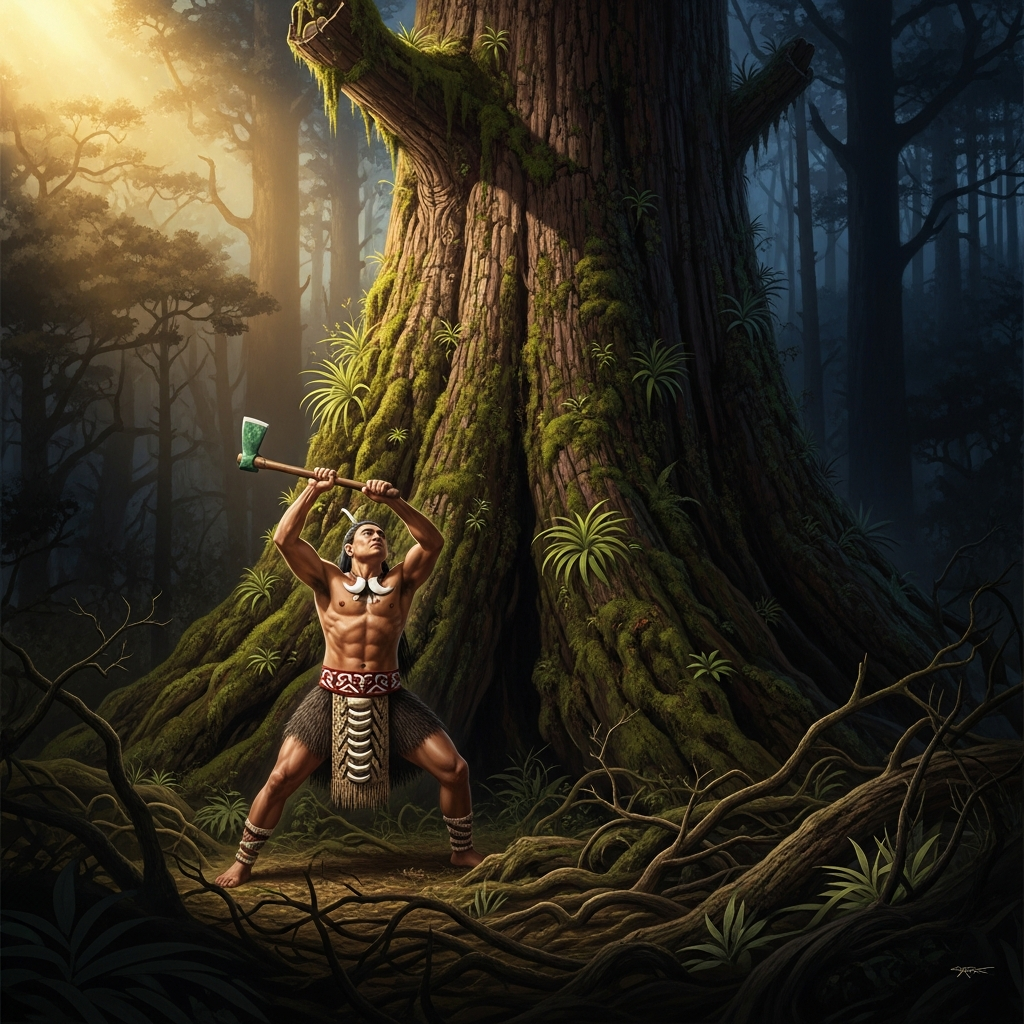
Rata at the base of the great tōtara — his adze raised, the forest dark around him, the tree standing with the permanence of something that has been here longer than memory
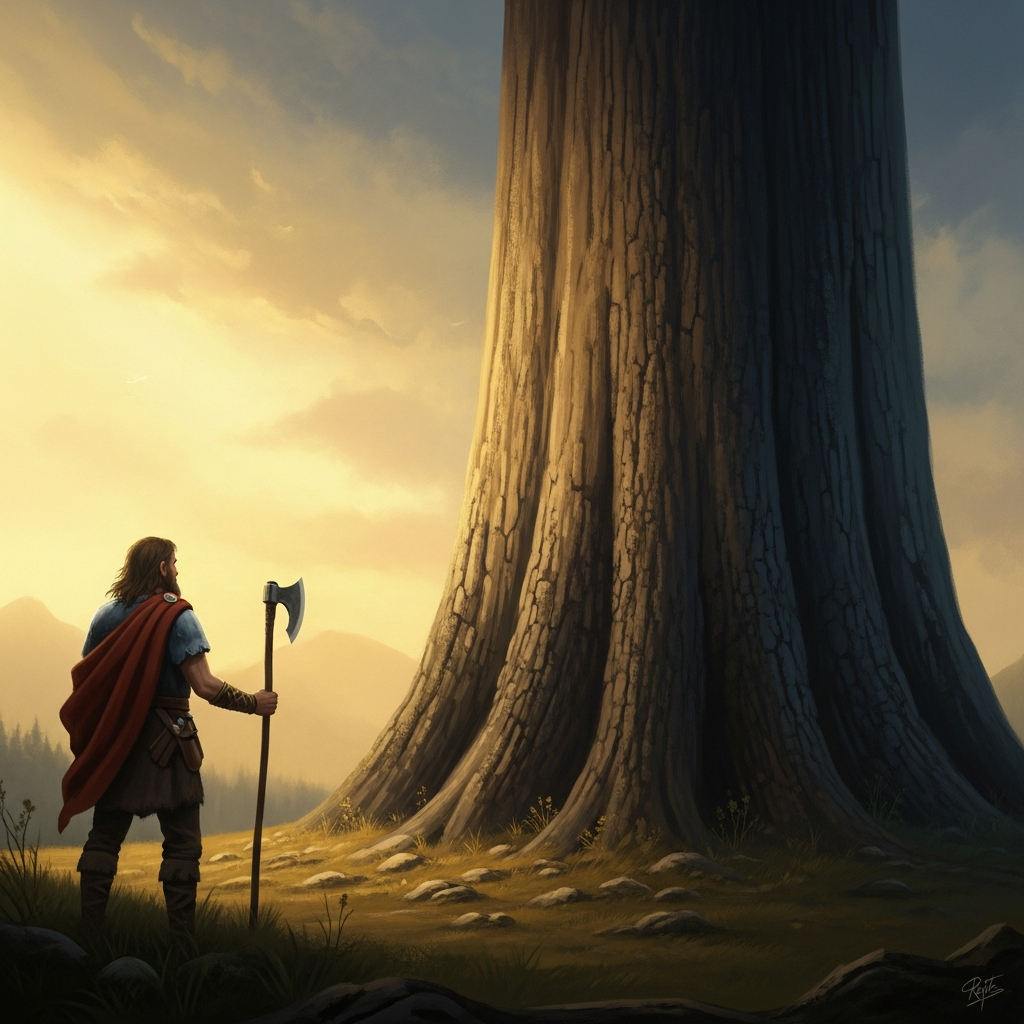
Generating art… Rata returning at dawn to find the tree standing again — the chips swept up, the bark sealed, the rings intact, as if the axe never touched it
 Generating art…
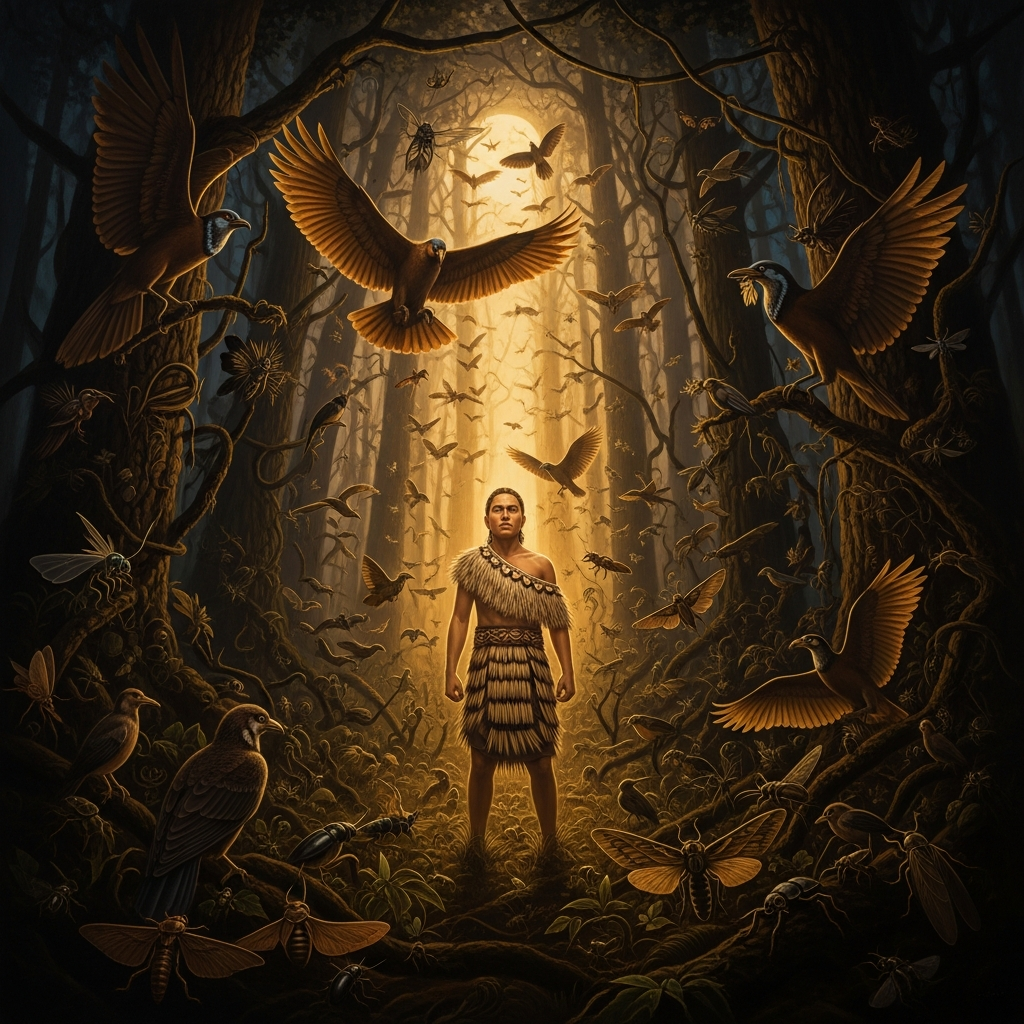
 The children of Tāne confronting Rata in the dark — birds and insects filling the forest around him, the air full of wings and the sound of small bodies working in the moonlight
 Generating art…
 Echoes Across Traditions
Entities
- Rata
- Tāne
- Hine-rau-wharangi
- Pūhaorangi
- Niwareka
Sources
- George Grey, *Polynesian Mythology* (1855) — Māori version with the birds and insects rebuilding the tree
- Antony Alpers, *Maori Myths and Tribal Legends* (1964)
- Te Rangikāheke (mid-19th c. Māori manuscripts)
- Elsdon Best, *Forest Lore of the Maori* (1942) — on Tāne worship and tree-cutting protocols
- Anne Salmond, *The Trial of the Canoe* (1991) — cultural context for waka building