Quetzalcoatl Looks in the Mirror and Leaves Tula
Mythic Time · pre-Columbian Toltec period, c. 900–1168 CE historical layer · Tula, the Toltec capital; the Gulf Coast of Mexico
Contents
The dark sorcerer Tezcatlipoca tricks the priest-king Quetzalcoatl with a smoking mirror — he sees himself as an old man, drinks pulque in his shame, breaks his sacred vows, and burns his jade palace. He walks to the sea, sets himself on fire, and becomes the planet Venus.
- When
- Mythic Time · pre-Columbian Toltec period, c. 900–1168 CE historical layer
- Where
- Tula, the Toltec capital; the Gulf Coast of Mexico
Tezcatlipoca does not come in his own shape.
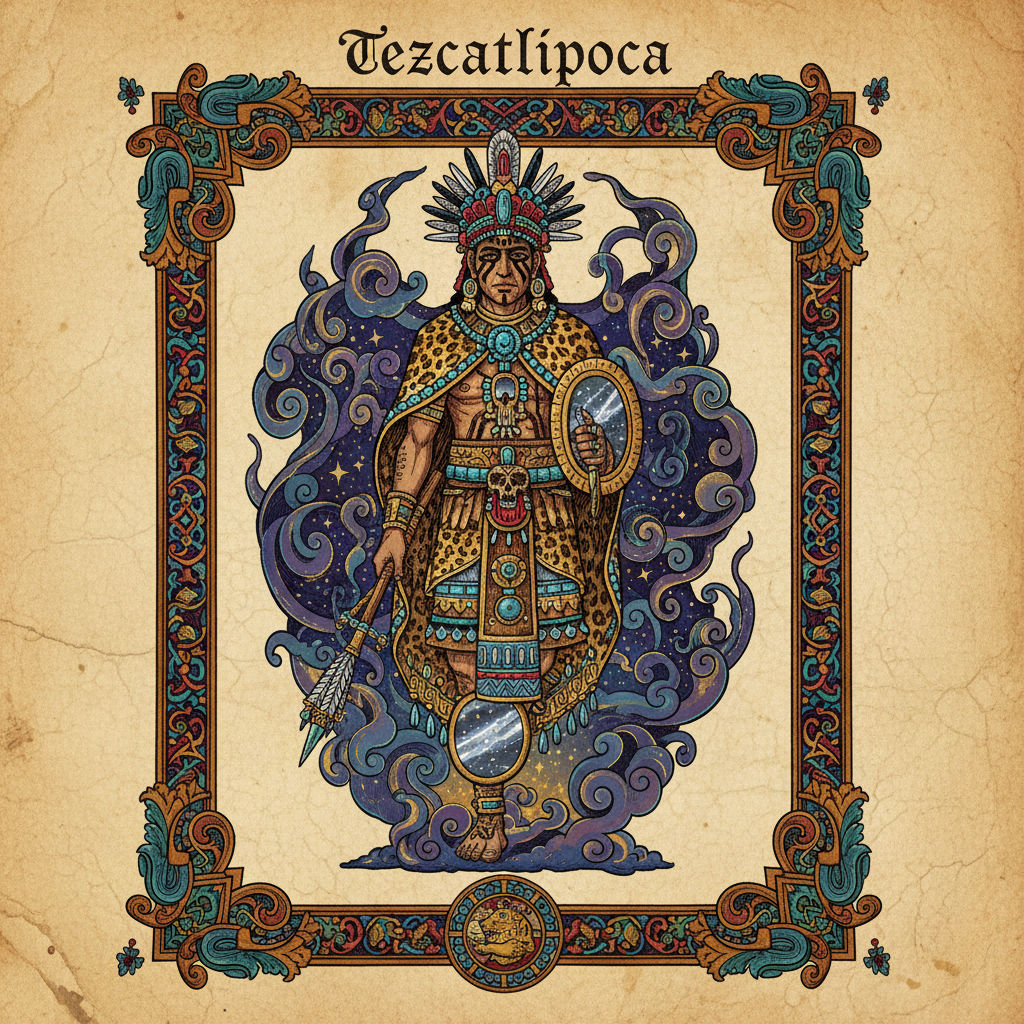
The Smoking Mirror, eternal adversary, the god whose obsidian glass reflects what you most need not to see, arrives in Tula as an old woman selling chili peppers by the road, a vendor with a pot of green pulque and a mirror made of black obsidian smoke. He finds the temple of Quetzalcoatl, the Feathered Serpent, priest-king of the Toltecs, celibate guardian of the golden age, the man who taught his people mathematics and astronomy and the working of jade and the tracking of the planet Venus. Quetzalcoatl has kept his vow for years. He does not drink. He does not look at his own face. He does not need to see what the flesh has become, because the flesh is not the point.
Tezcatlipoca holds the mirror up anyway.
In it Quetzalcoatl sees an old man.
This is the trick: not a lie but the wrong truth. Quetzalcoatl is old. The skin on his face has loosened. His eyes are sunk. The body that carries the divine mission is the body of a man who has been carrying it for a long time, and the mirror makes nothing up. It only shows. What it shows is what asceticism requires the priest-king to ignore: the mortal apparatus of the divine, the tired flesh behind the feathered headdress, the gap between what he is and what his people see when they look at him. You look like this, the mirror says. Your people see this. Quetzalcoatl cannot look away. He stares into the obsidian smoke until the image of the old man’s face is deeper in him than the image of anything else.
The Anales de Cuauhtitlan records it plainly: “Quetzalcoatl wept.”
Tezcatlipoca gives him the pulque.
Drink, the old woman says — Tezcatlipoca in the old woman’s shape — you are sick and you need medicine. The pulque is white and the cup is ceramic and the ritual is ancient, older than the vow it breaks. Quetzalcoatl drinks once and feels nothing except the warmth of it. He drinks again. The Florentine Codex says he drank five times. The number does not matter; the threshold does. What falls apart is not his dignity but the architecture of his restraint — the scaffolding he built around himself to keep the golden age upright. He calls for his celibate priestesses. The vows shatter one by one through the night while the Toltecs listen and do not speak.
In the morning the temples are full of silence.
He burns the palace first.
The house of jade, of turquoise, of white shell and red shell and quetzal feathers — everything he built to embody the Toltec ideal, the material proof that a civilization can be beautiful rather than only powerful — he sets it on fire himself. The Anales lists what burns: the house of gold, the house of coral, the house of quetzal feathers, the house of turquoise mosaic. He buries the rest in the mountain or throws it into the rivers, because what cannot be burned cannot be left. The cacao trees he planted become thorny shrubs. The colored cotton, which grew here in its colors before anywhere else in the world, withers. He calls the craftsmen and the skilled workers and the artists and he tells them: You cannot follow me. What we built is over. Some weep. Some do not understand yet.
He walks east.
The road to the coast is long and the Anales lingers on it.
At each stopping place Quetzalcoatl leaves a trace — a handprint in stone, a ball court, a place where he rested and the earth remembered. His followers walk with him through the Valley of Mexico, past the volcanoes, down toward the Gulf where the sky opens and the world ends at the water. There is a place on the coast called Tlillan Tlapallan, the land of the red and the black, the land of opposites meeting, the edge where the sea and sky exchange themselves. This is the destination. The Florentine Codex gives him words for the arrival: “I go now to Tlapalan.” Not exile. Not retreat. A journey toward the place where shame and divinity cannot both survive and one must consume the other.
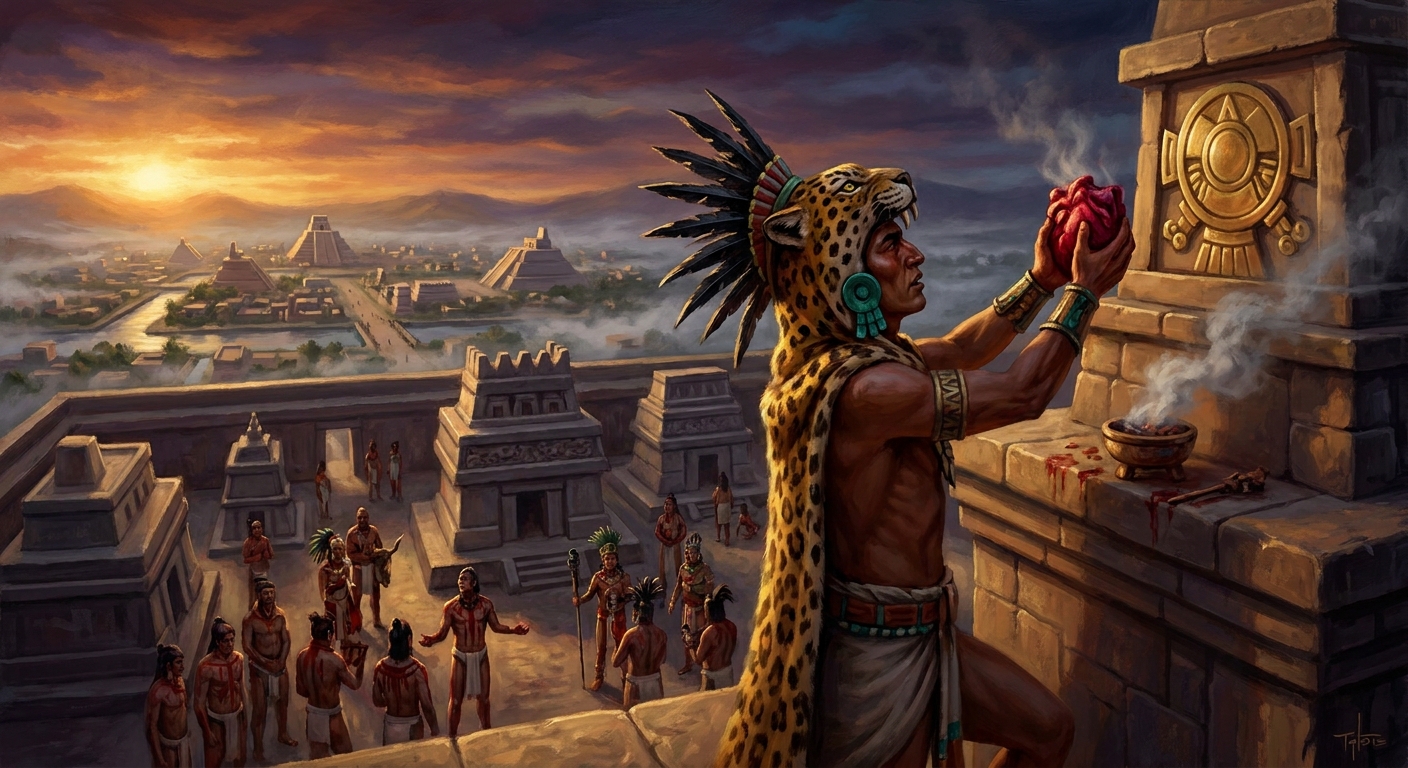
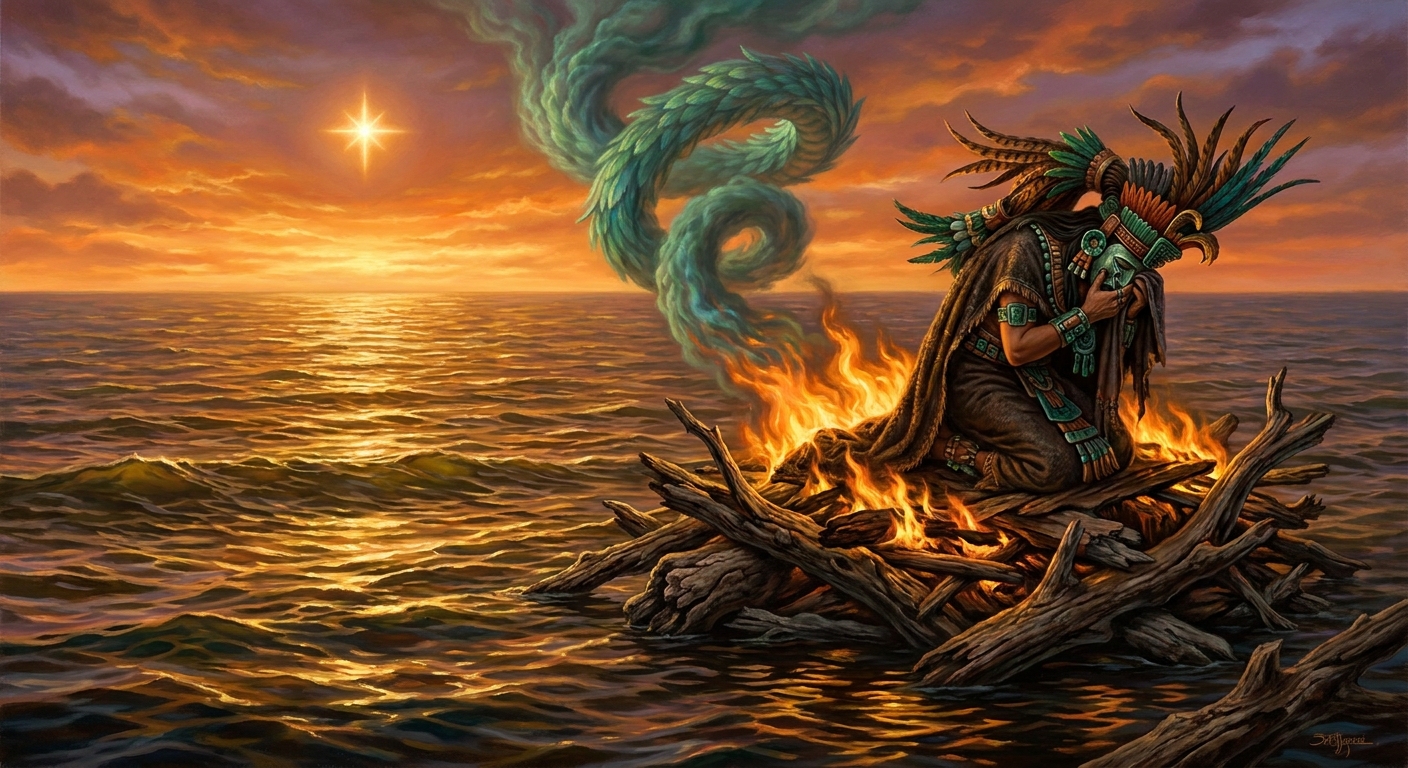
He builds the pyre himself. No priest helps. No choir sings. He is alone with the sound of the water and the smell of copal incense and the wood stacked precisely, the way a priest stacks things, with the care of someone who has spent a lifetime attending to the architecture of sacred acts. He steps in.
Gods do not simply burn away.
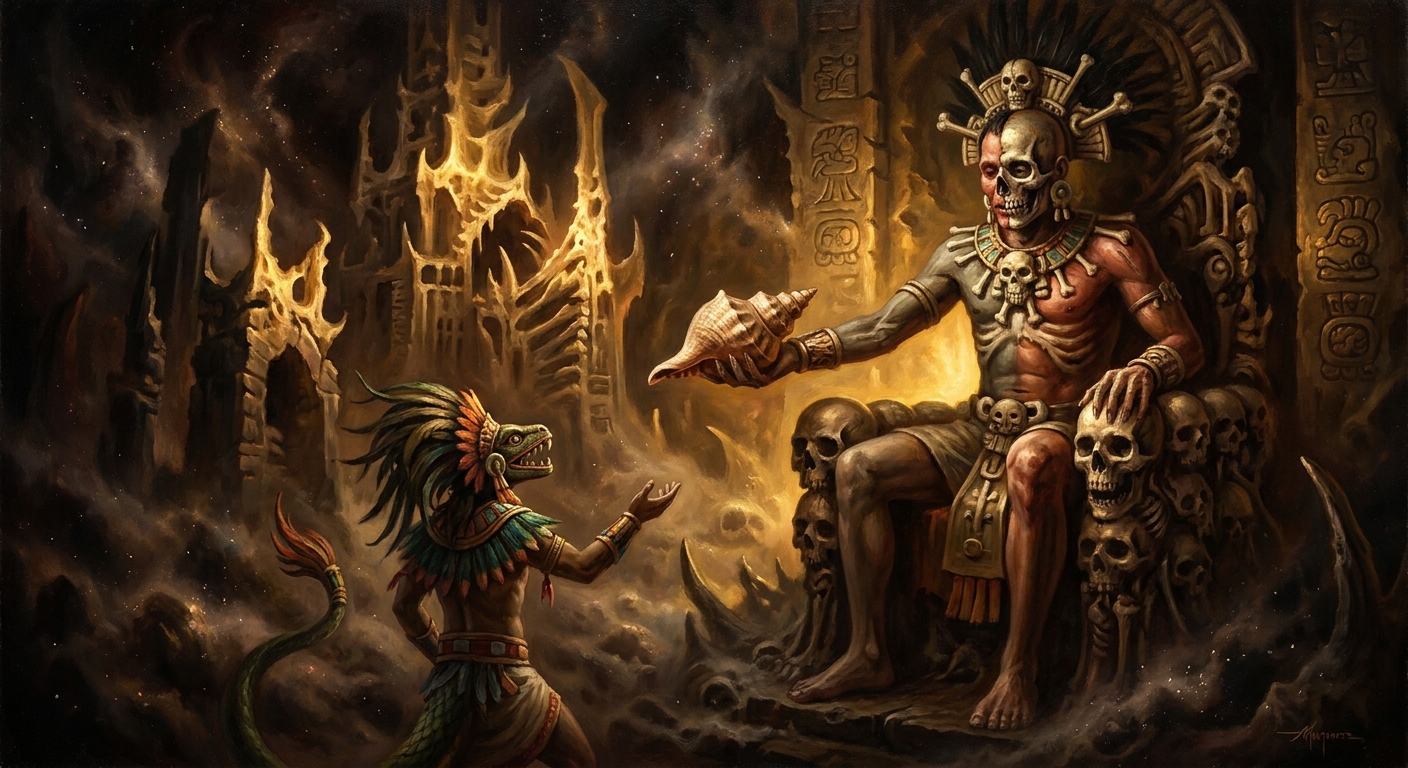
What the Nahua astronomers knew — what the calendar made precise — is that the planet Venus disappears from the western sky for approximately eight days and then reappears in the east as the Morning Star, the brightest object in the pre-dawn sky, the herald that arrives before the sun to announce what is coming. Quetzalcoatl enters the fire and his body becomes ash, but his heart rises through the smoke. It ascends. It spends four days in the underworld — Mictlan, the nine-layered dark — and then it rises, east-facing, brilliant, before the sun it now serves. Tlahuizcalpantecuhtli. The Lord of the Dawn. The house of light that stands before the light. He makes a promise as he rises: I will return. I will return from the east on my day, One Reed, Ce Acatl, the day of my birth.
Not a threat. Not a prophecy of conquest. A god’s exile vow, the kind of promise that keeps the world from closing: the ending is not final.
Five hundred years later a man in armor arrives on the Gulf Coast on a ship, on the date Ce Acatl, from the east, and does not know that everything he is about to do has already been named.
The Morning Star still rises before the sun every morning, and carries without understanding the weight of a promise made by a god who was ashamed, and transformed the shame into light, and set it in the sky as the only kind of redemption available to a being too proud to ask for forgiveness and too divine to disappear entirely.
Scenes
Tezcatlipoca holds the smoking mirror before the priest-king of Tula
 Generating art…
 The morning after his fall: Quetzalcoatl weeps in the temples he built, surrounded by the evidence of everything he taught the Toltecs — the calendar, the geometry of stars, the mathematics of jade
 Generating art…
 At the eastern coast, Quetzalcoatl enters the pyre he built alone
Generating art… Echoes Across Traditions
Entities
- Quetzalcoatl
- Tezcatlipoca
- the Toltecs
- Ce Acatl Topiltzin


Sources
- *Anales de Cuauhtitlan* (Codex Chimalpopoca, c. 1558)
- *Florentine Codex*, Books 3 and 10 — Bernardino de Sahagún (~1580)
- *Leyenda de los Soles* (Codex Chimalpopoca)
- David Carrasco, *Quetzalcoatl and the Irony of Empire* (1992)
- Miguel León-Portilla, *Aztec Thought and Culture* (1963)
- Inga Clendinnen, *Aztecs: An Interpretation* (1991)