The Sword and the Living Child
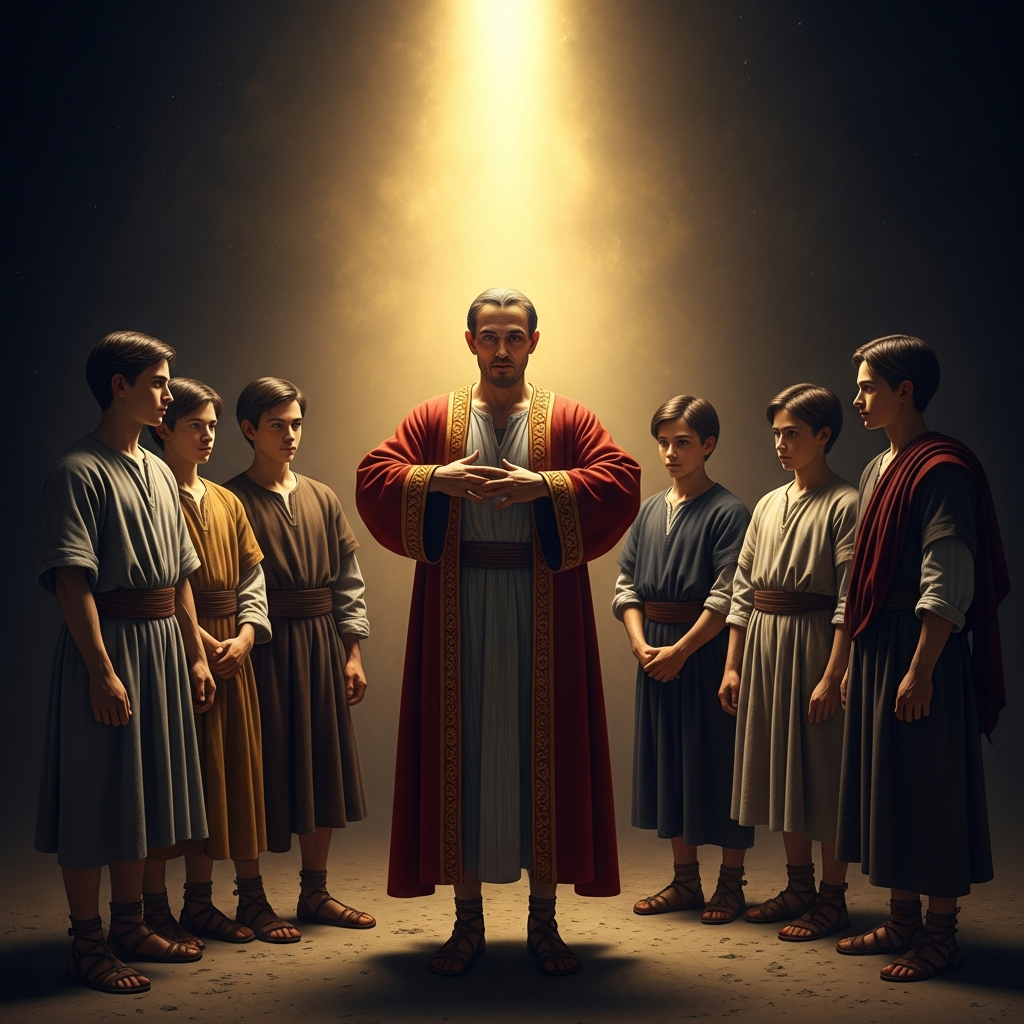
United Monarchy of Israel · ~970-931 BCE · Jerusalem, the throne hall of King Solomon, son of David
Contents
Two prostitutes claim the same infant. The young king of Israel calls for a sword and orders the child cut in half. The mother who flinches is the mother who keeps him.
- When
- United Monarchy of Israel · ~970-931 BCE
- Where
- Jerusalem, the throne hall of King Solomon, son of David
He has been king for less than a year.
His father David is freshly buried. The throne is still warm. Solomon, the youngest son, has come to power through a palace maneuver involving Bathsheba, Nathan the prophet, and the poisoning of his older brother’s claim. He is twenty, perhaps twenty-five. The kingdom is watching to see if the boy can govern.
He has just dreamed in Gibeon. God came to him in a vision and offered anything — long life, riches, the death of his enemies — and the boy asked for an understanding heart, that I may discern between good and bad. God was pleased. God promised wisdom no king before or after would equal.
That morning, two prostitutes stand at his door, and a dead infant lies in one of their arms.
They live in the same house.
That is the first detail, and the storyteller wants it remembered. Two women, both unmarried, both mothers, no men in the building — the lowest social position in Iron Age Jerusalem, and the only kind of household where two newborns and no husbands could plausibly arrive within three days of each other.
The first woman speaks. “O my lord, this woman and I dwell in one house. I gave birth, and three days later she gave birth. There was no other in the house, just the two of us.”
She tells the king the rest in a flat voice, the way people tell terrible things they have already lived through. The other woman rolled onto her own son in the night. He smothered. She woke at midnight to find him dead beside her, and so she rose, and laid the dead child against the breast of the sleeping woman, and took the living child to her own bed.
“And when I rose in the morning to give my child suck, behold, he was dead. But when I considered him in the morning, behold, it was not my son, which I did bear.”
The second woman cuts in.
“No — the living is my son, and the dead is your son.”
“No — the dead is your son, and the living is my son.”
They argue in front of the throne. There are no witnesses. The midwife, if there was a midwife, is not present. The infants are nearly the same age. There is no birthmark, no token, no proof. Solomon listens. The court listens. The kingdom listens.
The boy-king has been on the throne nine months and is being asked to decide whose breast a baby drinks from based on nothing but the words of two women whose word the law of the land does not formally accept. Any verdict he gives will be wrong. Any refusal to give a verdict will be worse.
He sits silent for a long moment.
Then he speaks the sentence the world has remembered for three thousand years.
“Bring me a sword.”
A guard brings the sword.
The throne room goes quiet in a way it has not been quiet before. Even the scribes stop writing. The king looks at the two women without affect. He looks at the living child held between them. He gives the order in the same flat administrative voice he might use to allocate grain.
“Divide the living child in two, and give half to the one and half to the other.”
For one heartbeat, two heartbeats, neither woman moves.
The first woman — the one who spoke first, the one whose son the dead infant is — opens her mouth and the sound that comes out is the sound a body makes when its insides are being pulled toward the door. “O my lord, give her the living child, and in no wise slay it.”
The second woman, in the same instant, says: “Let it be neither mine nor thine. Divide it.”
Solomon sets down his hand.
He has his answer before the sword has moved.
“Give her the living child,” he says, pointing to the woman who flinched, “and in no wise slay it. She is the mother.”
The court exhales. The scribes pick up their styluses. The guard sheathes the sword. The bereaved woman is led away — what becomes of her the text does not say; the storyteller is not interested in her, only in the move. The mother takes her son. She bows to the floor and walks out of the throne room with him, and the chronicle records that she does not look back.
The verdict travels. By sundown the marketplace knows. By the end of the week the tribes know. By the end of the year the surrounding kingdoms know — Sheba is already listening, and will come herself within a decade to test him with her own riddles.
“And all Israel heard of the judgment which the king had judged, and they feared the king: for they saw that the wisdom of God was in him, to do judgment.”
The trick is not the sword. The sword is the bait. The trick is that Solomon understands, at twenty years old, that maternal love is the only force in the room that will give itself away under threat. A liar will let the child be cut. A mother, even at the cost of losing him forever to her enemy, will not.
The verdict is the test. The test is the verdict. Three thousand years of judges have been studying the move — Vidura in the Mahabharata stages a version of it, the Bodhisatta in the Jataka does it almost line for line, the Bao-Zheng tradition in China deploys it in dozens of cases, the Egyptian principle of Ma’at is its philosophical scaffolding. The Hebrew Bible’s claim is that this is what God’s gift looks like in a human skull.
Solomon will go on to build the Temple, marry seven hundred wives, write the Song of Songs, and end his reign in idolatry and strain. But the kingdom will tell this story first, always — the boy-king, the threat, the flinch, the verdict that arrived before the sword could fall.
Echoes Across Traditions
Entities
- Solomon
- the two mothers
- the living child
Sources
- *1 Kings* 3:16-28 (Hebrew Bible / Tanakh)
- Robert Alter (trans.), *The Hebrew Bible* (2018)
- Mordechai Cogan, *I Kings* (Anchor Bible, 2001)
- Marc Brettler, *How to Read the Bible* (2005)