The Queen of Sheba and the Seed of Solomon
c. 10th century BCE (mythic claim) · *Kebra Nagast* compiled c. 14th century CE · Jerusalem and Aksum (Ethiopia) — the two poles of the story, joined across the Red Sea by a year-long caravan
Contents
Makeda comes from Aksum to test Solomon's wisdom and stays a year. On her last night he serves spiced meat and salt and asks for a single promise. She makes it. She wakes thirsty in the dark, reaches for water — and Solomon is waiting.
- When
- c. 10th century BCE (mythic claim) · *Kebra Nagast* compiled c. 14th century CE
- Where
- Jerusalem and Aksum (Ethiopia) — the two poles of the story, joined across the Red Sea by a year-long caravan
She is the queen of a country the Hebrews have only heard rumours about.
The Hebrew text in 1 Kings calls her malkat sheva, the Queen of Sheba, and gives her thirteen verses and no name. The Ethiopian text — the Kebra Nagast, compiled in Ge’ez in the fourteenth century but resting on traditions older than its compilation by a thousand years — calls her Makeda. Queen of Azab. Queen of the South. She is twenty-eight years old. She has ruled Aksum since her father’s death and she rules it well. She is unmarried. She is, by the testimony of the men who write about her later, both extraordinarily beautiful and extraordinarily clever, and the Ethiopian narrative is at pains to insist that her cleverness comes first and her beauty second.
A merchant arrives at her court. His name is Tamrin. He has been to Jerusalem. He has traded with the Israelites for cedar and for craftsmen, because Solomon is building something — a temple, the Ethiopians have heard — and he is buying everything that anyone in the world is selling. Tamrin tells Makeda about the king. He says the king is the wisest man on earth. He says the king answers every riddle that has ever been put to him. He says the temple Solomon is building is unlike anything the world has ever seen, and that the king himself is unlike anything Tamrin has ever seen.
Makeda decides to go.
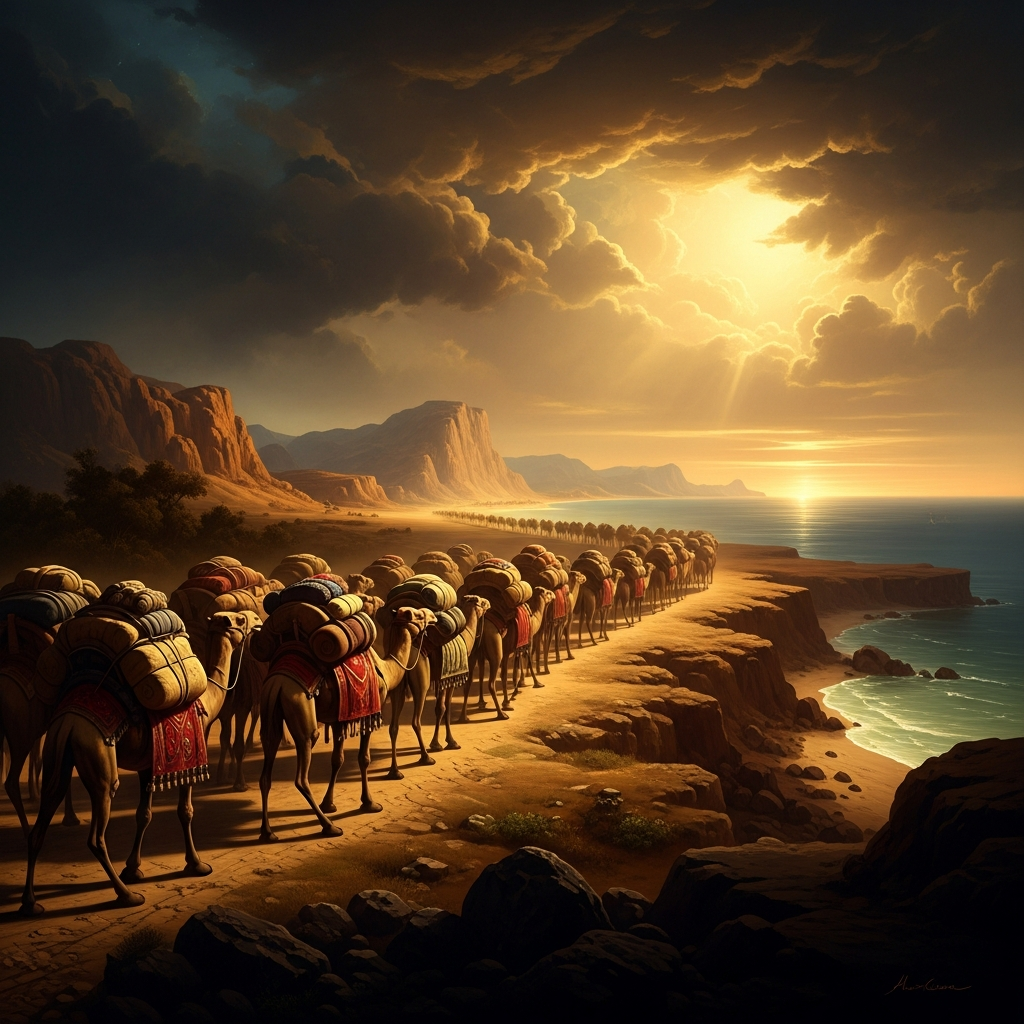
She does not consult her court. She gathers a caravan — eight hundred camels by some accounts, more by others — and she loads it with the wealth of Aksum: gold, ivory, ebony, frankincense from the southern mountains, the rare spices of the Arabian and East African coasts. She brings jewels the Hebrews have never seen. She brings questions. She has prepared the questions for months. She wants to test this king. She wants to test him because she, too, is a ruler, and she suspects that what travelers describe as wisdom in another country is often simply the difference between their court and one’s own. She wants to find out for herself.
The caravan crosses the Red Sea. The caravan crosses the desert. The caravan climbs the Judean hills. Makeda enters Jerusalem with her camels and her court behind her, and the city stops to stare.
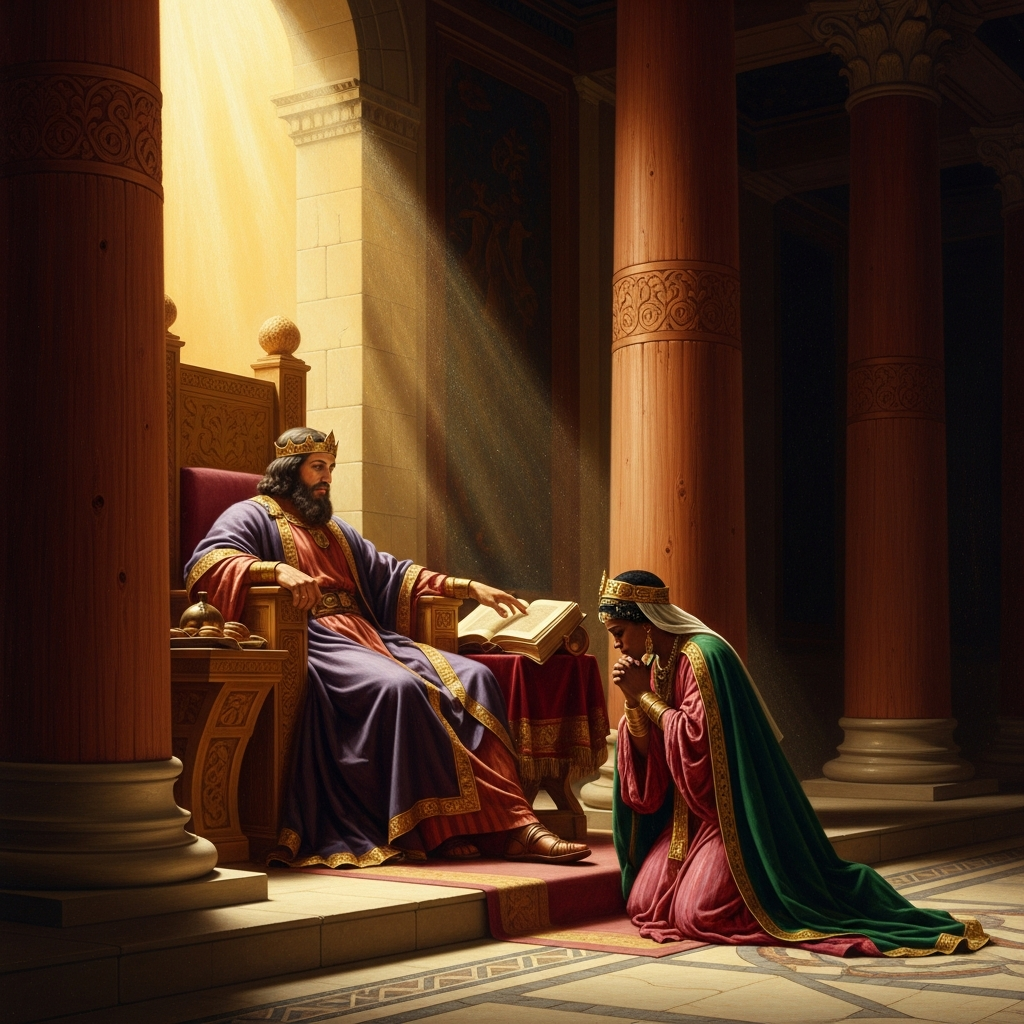
Solomon receives her in the great hall.
She comes prepared. She asks him riddle after riddle — riddles the Ethiopians later record at length, riddles about water and stones and trees and birds, riddles about the difference between a living thing and a dead thing, riddles about kingship. He answers every one. He answers them not the way a man answers who has memorized a great many things, but the way a man answers who is seeing through to the structure beneath the questions. He sees what she is asking before she finishes asking it. By the third day she is asking the questions slowly, almost reluctantly, because each answer is teaching her something she did not know she did not know.
She stays for a year.
The Kebra Nagast is candid about what is happening. She has come to test a king. She has stayed because the king is teaching her how to be a queen. She walks with him through the half-finished temple, where the cedar is being raised on the great stone foundations and the smell of new wood and old quarry-dust mixes with incense. He shows her the courts and explains the orders of priests. He shows her the place where the Ark will go — the inner room, the qodesh ha-qodashim, the holy of holies, the windowless chamber that will be opened only once a year and only by one man. He explains the Law of his people. He talks about Yahweh. He says things about the nature of the divine that fit nowhere in the cosmology Makeda brought with her from Aksum, and yet which she finds herself unable to dismiss, because they explain things her cosmology had left dark.
She is, slowly, converting.
Solomon is, slowly, watching her.
The Kebra Nagast does not pretend Solomon is innocent. He is not. He is a man with seven hundred wives and three hundred concubines, says the biblical text, and the Kebra Nagast takes that number seriously. He is in love with Makeda. He has been in love with her since the first afternoon. He is also a king who has decided, the way kings decide, that he wants something. He wants her body. He wants a child by her. He wants — and the Kebra Nagast says this directly — to plant the seed of Israel in the south, to sow Solomonic blood into a country he will never visit, because some part of him knows that empires die and what survives an empire is its grandchildren.
She decides to go home.
She announces her departure. She has stayed long enough. She has learned what she came to learn and far more besides. She has converted; she will return to Aksum and she will lead her people in a new direction, toward the God of Israel and away from the older gods of the Sabaean south. She tells Solomon. He nods. He says he understands. He invites her to a final feast on the night before her caravan turns south.
The feast is in his private chambers.
There are not many people there. The cooks are his own. The wine is his finest. The food is — and the Ethiopian text is very specific about this — heavily spiced and heavily salted. Makeda eats. She eats more than she should. The food is the kind of food that asks you to keep eating. The pepper of the southern mountains is in it; the salt of the Dead Sea is in it; the meats are roasted with herbs whose names Makeda does not yet know. The wine is poured. The wine is poured again.
Toward the end of the meal, Solomon makes a small joke about hospitality. He says: I want to ask one promise of you tonight, my sister, before you leave my house.
She is in good humour. She is full of food and wine. She says: Ask, and I will give it.
He says: Promise me that you will take nothing of mine that has not been freely given to you.
She laughs. Of course, she says. I am a queen. I am not a thief. Why would I take anything that was not given?
Promise me.
She promises.
The feast ends. He has prepared two beds in the chamber, one for her and one for himself, separated by a low embroidered screen. He says it is so that she will not have to walk far to her caravan in the morning. She accepts. The lamps are dimmed. The servants withdraw. He lies on his side of the screen. She lies on hers.
The salt is already working in her body.
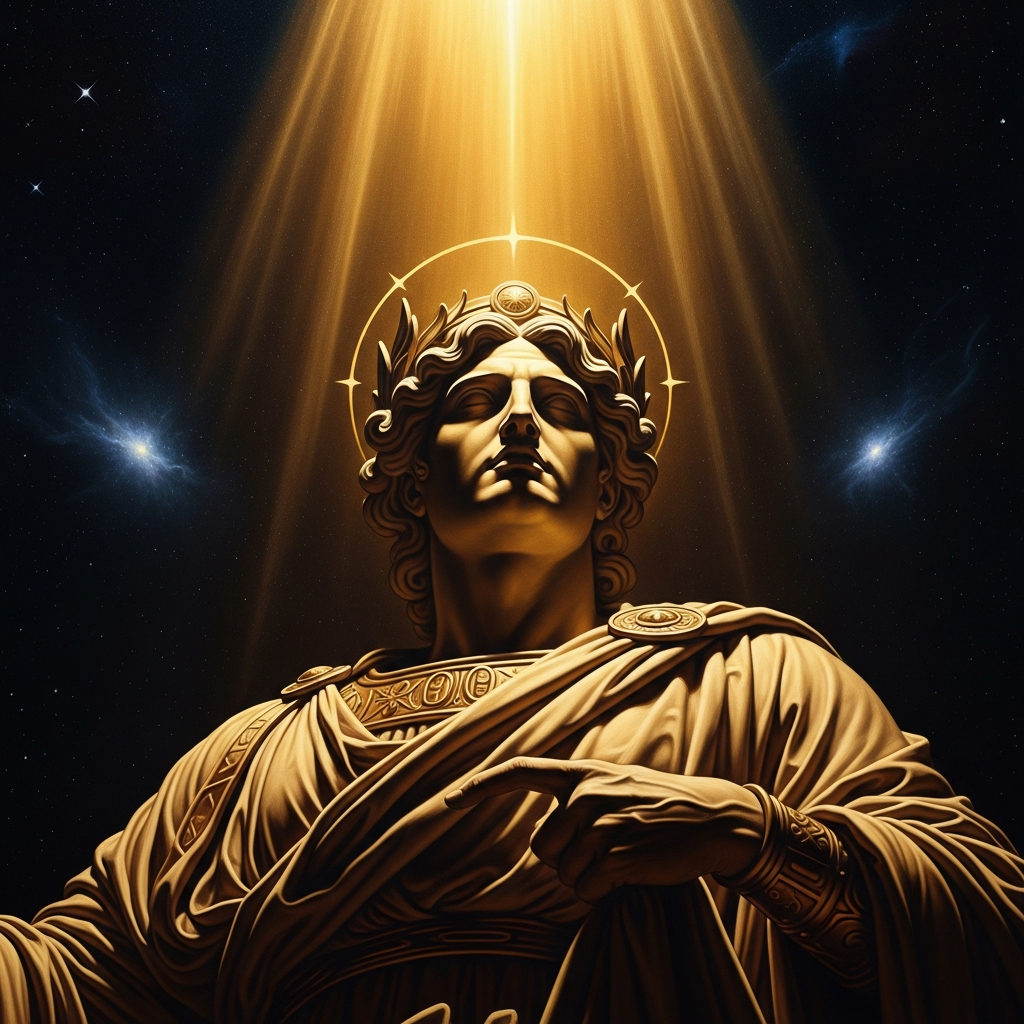
She wakes in the deep of the night. Her mouth is dry. Her tongue feels as though it has been wrapped in wool. She has never been so thirsty in her life. The lamp on her side is almost out, but she can see, on the small table beside the screen, on the king’s side, a clay pitcher of cool water with the mouth still beaded from the well. She listens. The king is breathing slowly. He is asleep. She sits up. She stretches her hand across the screen. She picks up the pitcher.
She has just put it to her lips when his hand closes over hers.
He is awake. He has been awake. He has been waiting, possibly for hours. He is smiling. The Ethiopian text says he smiles the way a king smiles when a long campaign has finally come to its predictable end.
My sister, he says, what did you promise me?
She freezes.
She freezes because she understands what has happened. The salt. The spice. The deliberate thirst. The pitcher placed precisely on his side of the screen. The promise extracted at exactly the moment her judgment was at its weakest. She has been hunted across an entire dinner. She has been outmaneuvered by a man who has had sixty years to learn how to extract consent from people who arrived at his court intending to refuse him.
She tries to speak. He waits. The water is in her hand. The thirst is in her throat.
She has two choices. She can put the pitcher back. She can refuse to drink. She can hold to her promise. She can leave the room dry-mouthed, head high, dignity intact, the moral victor.
Or she can drink.
The Kebra Nagast says she drinks.
She lifts the pitcher and she drinks the cold water, and the moment the water touches her lips she is, by the terms of the promise she made hours earlier, taking something of his without it having been freely given. She has broken the promise. The water has bound her. She is, in the law of the night, his.
He claims his price.
The text is brief about what follows. They lie together. The lamp goes out. In the morning he gives her a ring from his own finger and tells her that if she bears a son, she should give the ring to him when he comes of age, and if the boy ever wants to know who his father is, the ring will be the proof.
She returns to Aksum carrying his child.
She bears Menelik. The name means, in the Ethiopian etymology, son of the wise man. He grows up in Aksum the heir to the throne his mother holds. When he is old enough — twenty-two, says the Kebra Nagast, though some traditions say younger — he asks his mother who his father was, and she shows him the ring, and she sends him to Jerusalem with the merchant Tamrin, the same merchant who brought her the news a generation earlier.
Menelik arrives in Jerusalem. He is recognized immediately because, the text says, he has Solomon’s face. Solomon weeps. Solomon offers him the throne of Israel. Menelik refuses. He says his throne is in Aksum. Solomon then does the strangest thing in the entire epic: he commands that the eldest son of every priestly family in Israel be given to Menelik to accompany him back to Aksum, so that Israel’s priesthood may be doubled in the south.
The young men do not want to go.
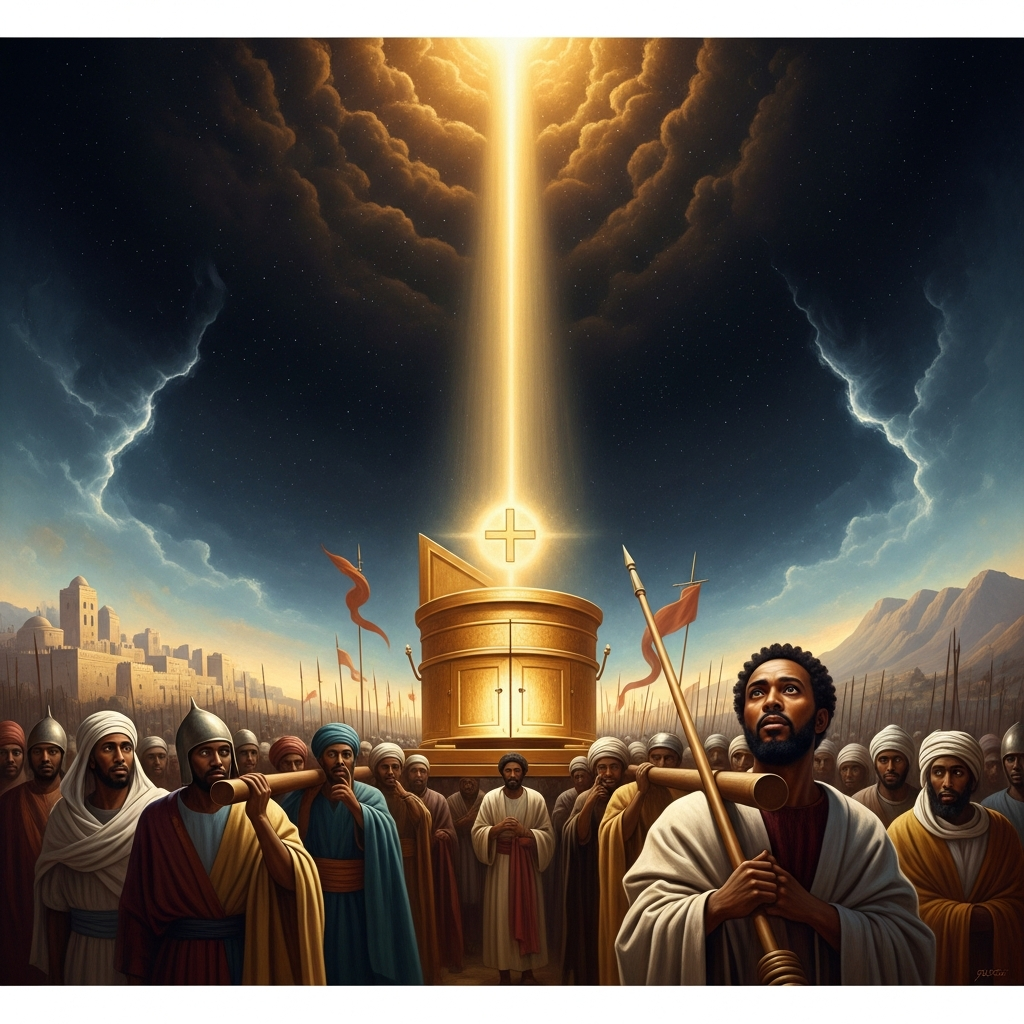
They do not want to leave Jerusalem and they do not want to leave the Ark. So they conspire, by the *Kebra Nagast’*s account, to take the Ark with them. One of them — Azariah, son of the high priest Zadok — receives a vision. The vision tells him to take the Ark out of the Holy of Holies and replace it with a replica, and to carry the original south to Aksum, because Israel has been unworthy of it and the Ark is choosing a new home.
They do it. They lift the Ark. They wrap it in seven layers of linen. They put it on a cart at the back of Menelik’s caravan. They leave Jerusalem in the dead of night, and they do not realize until they have crossed several days of desert that the Ark is, in fact, with them — that it has consented to come, that it has, in some sense, lifted itself.
Solomon discovers the theft. He pursues. He cannot catch them. The Ark has wrapped the caravan in a cloud of unnatural speed. By the time Solomon understands he has lost it, the Ark is already over the Red Sea.
Menelik arrives in Aksum with the Ark of the Covenant.
The Kebra Nagast says he places it in the church that will become, after Christianization, the Church of Our Lady Mary of Zion. It says the Ark has been there ever since. It says it is guarded by a single monk who is chosen by his predecessor and who, once chosen, never leaves the compound. The monk speaks to no one outside. He chooses his successor before he dies. The line is unbroken. The chamber is opened by no one but him.
Two and a half thousand years later, in 1930, a man named Tafari Makonnen will be crowned emperor of Ethiopia. He will take the regnal name Haile Selassie I, Power of the Trinity. His full title will include the words Conquering Lion of the Tribe of Judah, King of Kings of Ethiopia, Elect of God, and his claimed lineage will run, generation by generation, back through the Solomonic dynasty to Menelik son of Makeda son of Solomon son of David. The Constitution of Ethiopia will codify this descent. The Kebra Nagast will be its proof-text.
In Jamaica, Marcus Garvey’s followers will hear of Haile Selassie’s coronation and read the Kebra Nagast and conclude that the African emperor is the returned messiah promised in the Book of Revelation. They will call themselves Rastafari, after Selassie’s pre-coronation name Ras Tafari. They will read the Kebra Nagast alongside the Bible. They will identify Ethiopia as Zion and Babylon as the systems of empire that scattered Africa across the New World, and they will spend the next century building a religious culture out of an Ethiopian text written in the fourteenth century about a queen who took a caravan to Jerusalem in the tenth century BCE.
In Aksum, the monk who currently guards the Ark walks every morning around the perimeter of the Church of Our Lady Mary of Zion. He has not seen another human being’s full face in years. The pilgrims gather at the fence, far away, and they look at the church and they whisper. The monk nods. He goes back inside.
The thing inside the chamber, wrapped in its layers of linen, is — depending on whom you believe — the Ark of the Covenant, or a copy of the Ark made in the fifth century, or a stone of no particular significance, or the actual stone tablets of Sinai inside their original wooden box plated with gold. No one will ever measure it. No one will ever photograph it. No one outside the line of monks will ever see it.
Makeda’s caravan is very long out of Jerusalem.
The salt in her mouth is very long swallowed.
The water she drank that night, in the lamplight, on the night she broke her promise to a king who had laid a careful trap for her — that water has been working in the world for three thousand years.
Scenes
The caravan crosses the Red Sea coast — eight hundred camels, jewels, spices, ebony, gold from the mines of Ophir — bound from Aksum to Jerusalem to test the wisdom of a king
 Generating art…
 Makeda kneels before Solomon in the cedar-pillared hall
Generating art… Midnight in the king's chamber
 Generating art…
 Twenty years later, Menelik I leads a caravan north out of Jerusalem in the dead of night
 Generating art…
 Echoes Across Traditions
Entities
- Makeda (Queen of Sheba / Queen of Azab)
- Solomon (King of Israel)
- Menelik I (their son, first Solomonic emperor of Ethiopia)
- The Tabot (the Ark of the Covenant in Aksum)
- Haile Selassie (twentieth-century claimant of Solomonic descent)
Sources
- *Kebra Nagast: The Glory of Kings*, trans. E.A. Wallis Budge (1922) and trans. Miguel F. Brooks (1995)
- 1 Kings 10:1–13 and 2 Chronicles 9:1–12 — the biblical version
- Edward Ullendorff, *Ethiopia and the Bible* (Schweich Lectures, 1968)
- Ephraim Isaac, 'Is the Ark of the Covenant in Ethiopia?' *Biblical Archaeology Review* 19.4 (1993)
- Stuart Munro-Hay, *The Quest for the Ark of the Covenant: The True History of the Tablets of Moses* (2005)