Kupe Voyages to Aotearoa
c. 900 CE — the age of the great Polynesian voyages · Hawaiki (origin homeland) to Aotearoa (New Zealand) — across the southern Pacific
Contents
Kupe, the great navigator of Hawaiki, follows a colossal octopus called Te Wheke-a-Muturangi across the open Pacific — the octopus has been stealing bait from his fishing grounds. He pursues it for weeks across featureless ocean, using stars and swells and the flight of birds, until he finds it in a channel between two great islands. He kills it, names the land, and turns back. He never returns. His people wait nine hundred years.
- When
- c. 900 CE — the age of the great Polynesian voyages
- Where
- Hawaiki (origin homeland) to Aotearoa (New Zealand) — across the southern Pacific
The octopus takes the bait first.
It is not a small theft. Te Wheke-a-Muturangi is not a small creature — it is the giant octopus of the deep, the one that belongs to the chief Muturangi, and it has been reaching its arms into the fishing grounds of Hawaiki and pulling bait from lines before the hooks can settle. The fishermen return with empty lines. They bait and return and their lines come back empty again. The theft is systematic. The creature is not wild; it is trained, or willing, or something else the fishermen don’t have a word for yet.
Kupe goes to Muturangi. He says: control your octopus or I will find it and kill it.
Muturangi says nothing. The octopus keeps taking the bait.
Kupe goes back to the ocean.
He is one of the great navigators of Hawaiki. This means he is one of the great navigators of the world, in the period when the Pacific voyaging tradition is at its height — when Polynesian canoes are crewing the largest ocean on the planet, crossing distances that make the Mediterranean look like a river, navigating without instruments by the stars and the swells and the color of the water and the flight of specific birds that venture specific distances from specific shores.
He knows the ocean the way a person knows the room they grew up in — by feel, by the pattern of the swells against the hull, by the quality of the wind at certain latitudes, by the stars that rise in certain places and tell him where he is in relation to everything he knows.
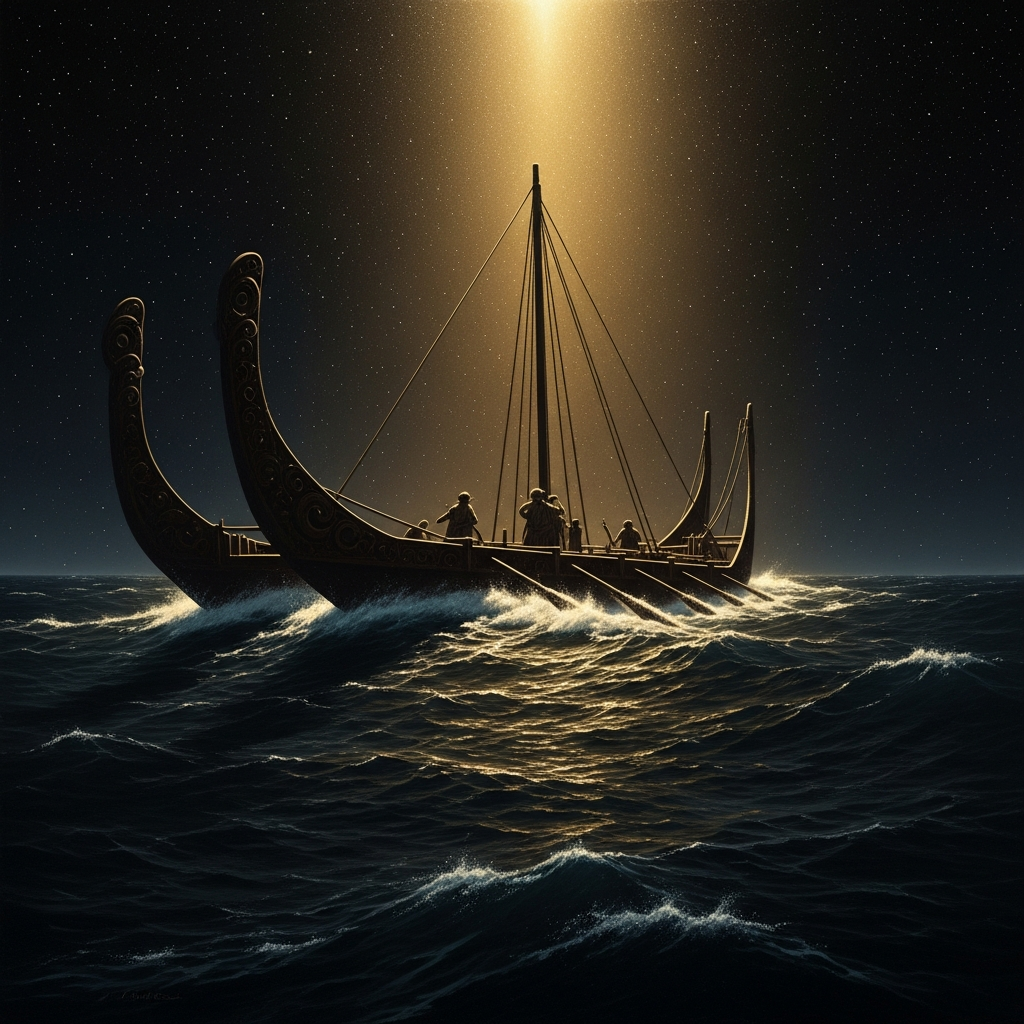
He prepares his waka hourua — his double-hulled voyaging canoe, the vessel designed for open ocean, built to ride swells rather than cut them — and he loads it with provisions and takes crew and takes his wife Hinerangi, and he sets out after the octopus.
It is already ahead of him. Already in the open ocean. Already moving south and east into the part of the Pacific where there is nothing, where the charts of every known island stop and the water continues indefinitely in every direction.
Kupe follows.
The octopus is vast enough to track — it leaves disturbances in the water, a trail of evidence readable to a man who has spent his life reading the ocean. He follows the signs. He follows for days. The wind is favorable and then unfavorable and then favorable again. The stars overhead tell him how far south he has come — further south than any navigator from Hawaiki has gone, into colder water, under unfamiliar sky.
He loses the trail. He searches. He finds it again.
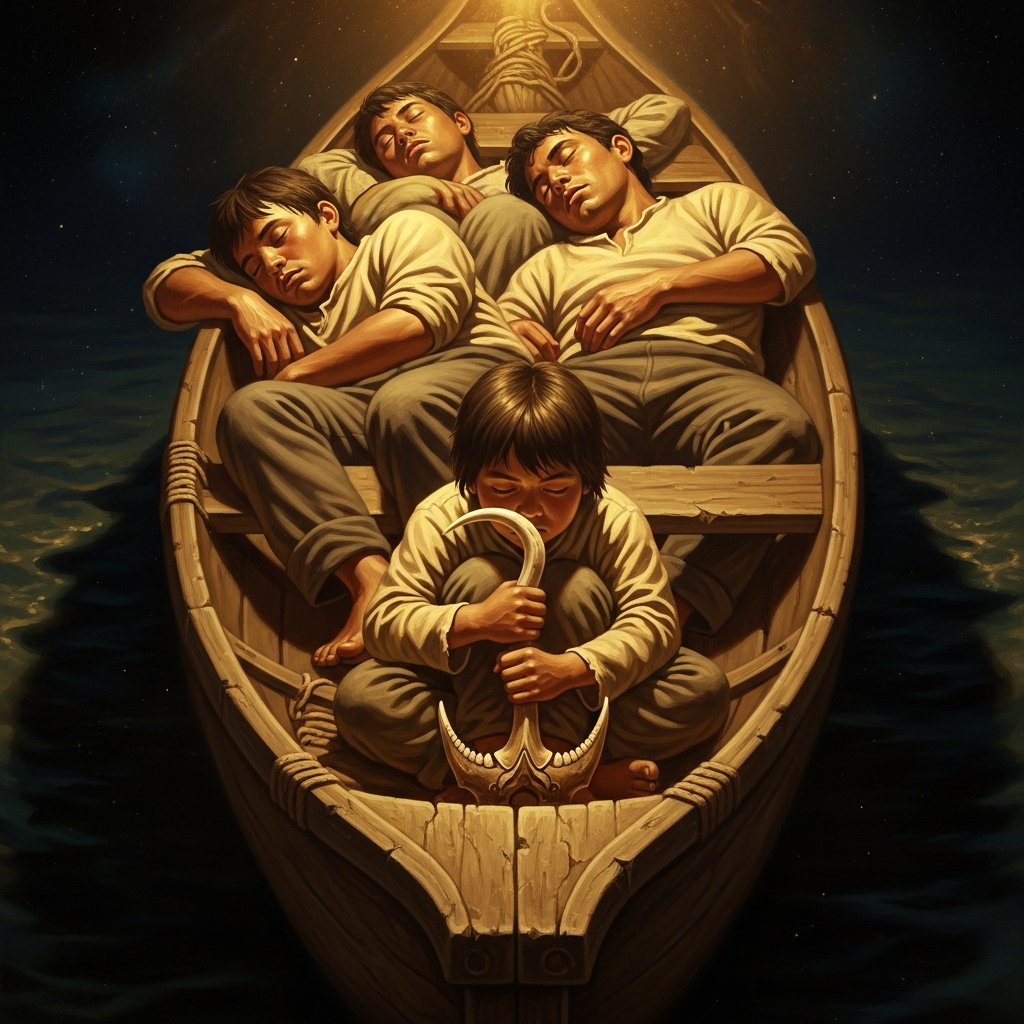
His wife Hinerangi watches the swells and calls corrections when the canoe drifts. His crew works in shifts, sleeping on the platform between the hulls, waking to paddle or bail or adjust the sail as the wind demands. They eat sparingly. They do not know how much further there is to go because there is no map for this. They are making the map by going.
On a certain morning, a gannet appears.
Then another. Then several — gannets flying in a consistent direction, not foraging in circles the way seabirds forage, but moving with purpose, with destination, the flight-path of birds going to land. Kupe watches the direction. He adjusts his course to match it.
He follows the birds the way the birds follow what they know.
Then his wife sees it first.
A shape on the horizon that does not belong to the ocean. A darkness above the waterline that does not move the way cloud moves — does not shift or thin at the edges or drift with the wind. It sits. It is fixed. It is land.
He ao, he ao, he aotearoa — a cloud, a cloud, a long white cloud. This is the account: Hinerangi’s words at the first sighting, the words that give the land its name. Aotearoa. The Long White Cloud.
Below the cloud: mountains. Below the mountains: forest running to the water. Below the forest: two islands, enormous, separated by a channel.
And in the channel: Te Wheke-a-Muturangi.
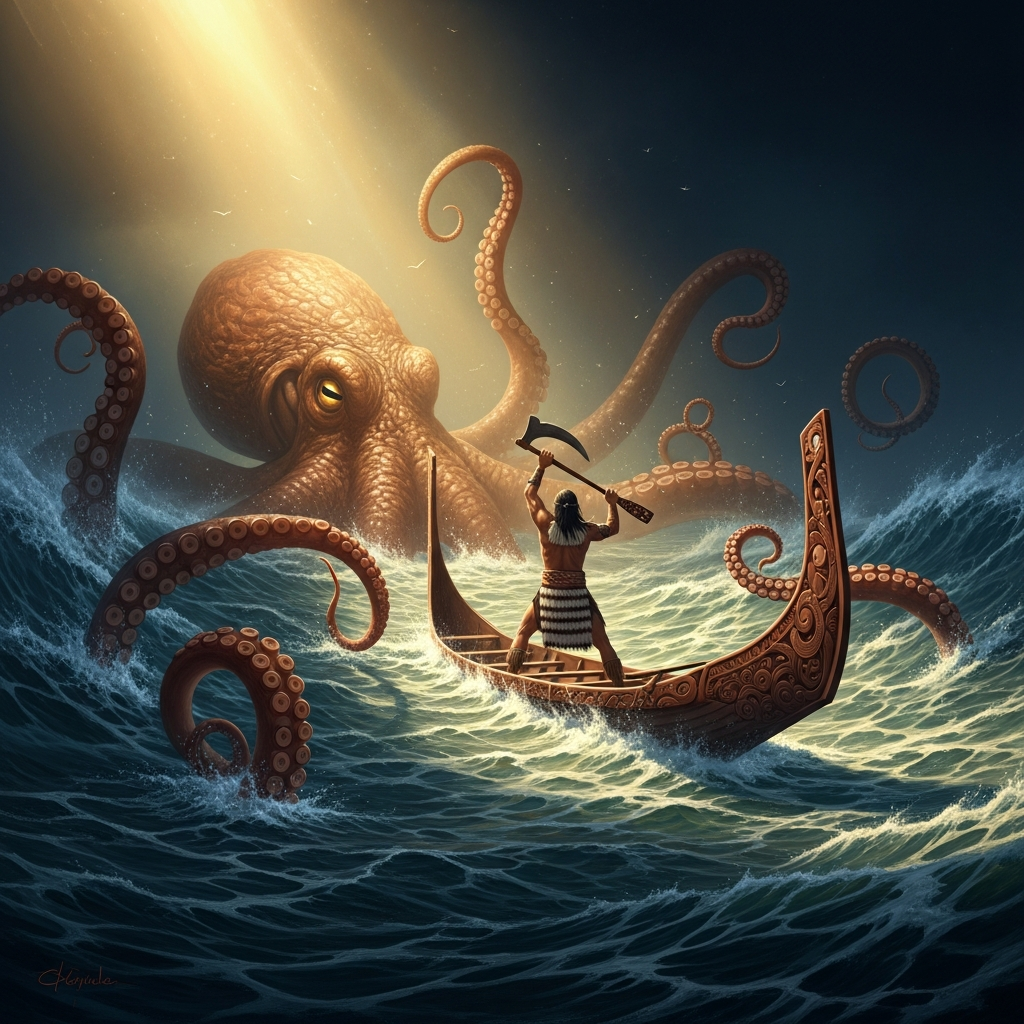
The octopus fills the strait between the islands. Its arms extend across the surface, wider than the canoe’s length, wider than ten canoes’ length, the great suckers each the size of a man’s head turning and searching in the water. It has led him here. It has been ahead of him the entire journey, moving south and east across the empty Pacific toward this channel, toward these islands, toward the place where the water narrows between two land masses and the current is strong and an octopus can find the depth it needs.
Kupe attacks.
The account does not linger on the mechanics of killing something that large — the point is that he does it, that the navigator who has followed a creature across an unknown ocean finally catches it in a channel it chose for its own reasons and defeats it there, in the water between the two islands, and the water after is still.
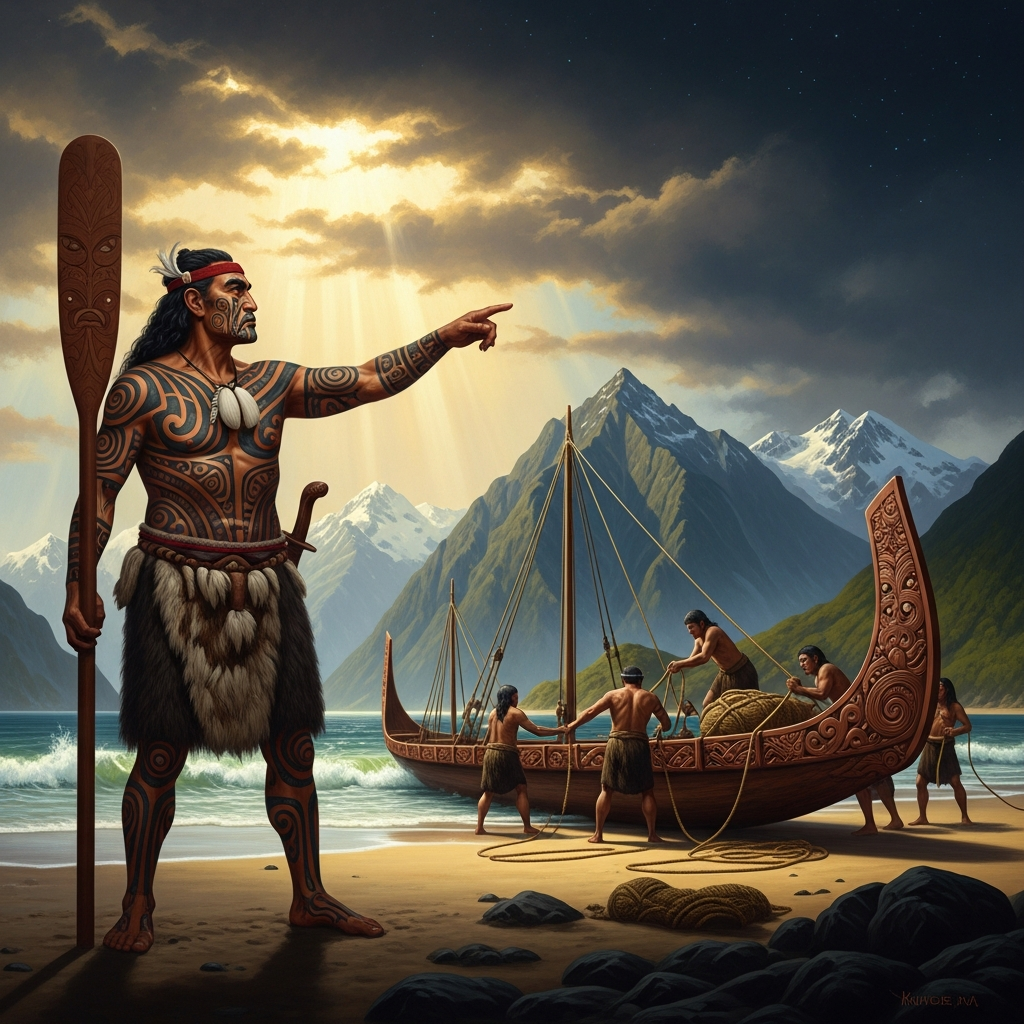
He names the channel: Raukawa. He names the islands. He walks on the shore of the larger one and names landmarks as he goes — headlands and harbors and hills — and in the naming he gives the land a shape that can be communicated, that can be told to others, that can bring other people here after him.
Then he turns around.
He sails back to Hawaiki.
He describes what he found: two large islands, heavily forested, ringed with harbors, with birds that have never seen a human and do not know to flee. He describes the currents and the stars and the direction and the distance. He describes the channel where he killed the octopus. He gives precise navigational instructions — the swells to follow, the stars to steer by, the birds that appear when you are close.
He says: I will go back.
He does not go back.
The reasons are lost. Perhaps he died. Perhaps the opportunity did not come. Perhaps the subsequent decades of life in Hawaiki gave him other urgencies and the return receded until it was a plan rather than an intention, and then a memory rather than a plan, and then a story his children told.
Several generations later, the great migration canoes depart Hawaiki — the Tainui, the Aotea, the Arawa, the Mataatua, the Tokomaru, the Horouta, the Kurahaupō, the Māhūhū — following the navigational account Kupe left behind, following the stars he named and the swells he described. They arrive. They settle. They become the Māori.
They wait for Kupe.
In 1642, Abel Tasman sails from Batavia and encounters the coast of the South Island. He anchors in a bay. A fleet of Māori war canoes comes out to meet him. There is a confrontation — a skirmish — and four of his crew are killed. He sails away without landing. He names the coast Staten Landt.
The Māori who came out in the war canoes were not attacking a stranger.
They were responding to an unannounced arrival in their waters by people who were not Kupe.
They had been waiting, for seven centuries, for the navigator who found the land to keep his word and come back. Every canoe that appeared on the horizon was potentially his. Every stranger needed to be assessed. Nine hundred years of waiting for a return that never happened, and then a Dutch ship appears with none of the signs they were expecting and four men die in the confusion.
Kupe found the land and left it and the finding and the leaving are both part of the same story. The Long White Cloud. The empty sea between. The navigator who named everything and then turned for home and never came back, and the people who built a civilization out of the things he told them about a place he had only visited once.
The waka hourua — the Polynesian double-hulled voyaging canoe — was rediscovered in the 1970s by a revival movement that built the Hokule’a and sailed it from Hawaiʻi to Tahiti by traditional navigation alone. The navigator was Mau Piailug, a Carolinian master navigator, the last carrier of an unbroken Pacific navigational tradition. He read the swells with his body, lying on the deck and feeling the wave directions through the hull.
The ocean has not changed. The stars have not changed. The technique Kupe used is still usable. What changed was the memory of it — and the memory was recovered, the way Aotearoa was recovered, by people who followed the account of someone who had gone first and come back and told them exactly what they would find.
Scenes
Kupe's waka hourua in the open Pacific — the double-hulled canoe a dark shape on a dark ocean, the stars the only fixed points in every direction
 Generating art…
 The confrontation in the strait — Te Wheke-a-Muturangi surfacing, its tentacles spreading across the water, Kupe raising his weapon above the hull
 Generating art…
 Kupe on the shore of Aotearoa for the only time, naming the mountains and the channels, a navigator who found the land and immediately began preparing to leave it
 Generating art…
 Echoes Across Traditions
Entities
- Kupe
- Te Wheke-a-Muturangi (the great octopus)
- Hinerangi (Kupe's wife)
- Aotearoa
Sources
- George Grey, *Polynesian Mythology* (1855)
- Te Rangikāheke (mid-19th c. Māori manuscripts)
- Anne Salmond, *Two Worlds: First Meetings between Maori and Europeans, 1642-1772* (1991)
- Patrick V. Kirch, *On the Road of the Winds* (2017)
- David Lewis, *We, the Navigators* (1972)